
Adding energy-based devices to a dermatology practice involves four practical steps: choosing devices for appropriate concerns, integrating them with other treatments, reviewing the evidence, and setting clear expectations and follow-up plans. Match each device’s intended use to patient needs, treatment goals, and recovery considerations.
New technology can broaden clinical options, but a device’s presence alone does not make it suitable for every patient or concern. This article reviews how energy-based devices are used in dermatology, where evidence may be limited, and how to discuss realistic outcomes. It also covers device categories, combination-treatment considerations, and structured follow-up.
Key Takeaways
- Plan combination treatments around the concern being addressed and the sequence of procedures; some modalities should not be performed on the same day.
- Match the device category to its intended use, such as resurfacing, pigment or vascular concerns, skin laxity, or hair reduction.
- Assess the strength and scope of the available evidence, including study design and patient characteristics, when setting treatment and follow-up plans.
- Explain expected changes, treatment course, and recovery clearly so patients can make informed decisions and track outcomes over time.
1. Combination therapies using energy-based devices
Combination therapy pairs two or more modalities, such as lasers, radiofrequency, injectables, or topical medication. The rationale is to address complementary goals: one procedure may prepare tissue while another targets a separate concern. For example, laser-assisted drug delivery uses laser pretreatment followed by topical application to support the effect of local skin treatments. Choose the sequence based on the condition, treatment area, and recovery needs.
Some plans coordinate injectables and energy-based treatments in one or more sessions. Fillers, neuromodulators, and light-based procedures may be combined in selected plans. However, deeply placed dermal fillers should not be performed on the same day as resurfacing procedures, including microneedling or laser resurfacing. Another example is injecting botulinum toxin into muscle around a wound alongside laser treatment to support healing. These cases illustrate why the procedures and their sequence matter.
In Canada, assess a device’s intended purpose and regulatory status, and ensure its use fits the clinician’s authorized scope of practice. Provincial and territorial rules shape professional practice, so plan implementation according to the applicable jurisdiction and device instructions.
Clinicians should hold qualifications appropriate to their regulated profession and complete device-specific education before treating patients. Training should cover treatment selection, operation, contraindications, protective measures, and adverse-event management.
Use written informed consent to explain the planned combination, alternatives, material risks, expected recovery, and follow-up. Document the assessment, device settings, treatment sequence, consent, and outcomes. Ensure advertising accurately reflects the device’s authorized purpose.
Ongoing costs depend on maintenance schedules, consumables, repair needs, and service-contract terms. Before purchasing, map these costs to expected use and the manufacturer’s maintenance requirements rather than relying on a single upfront figure.
2. Energy-based device types used in dermatology
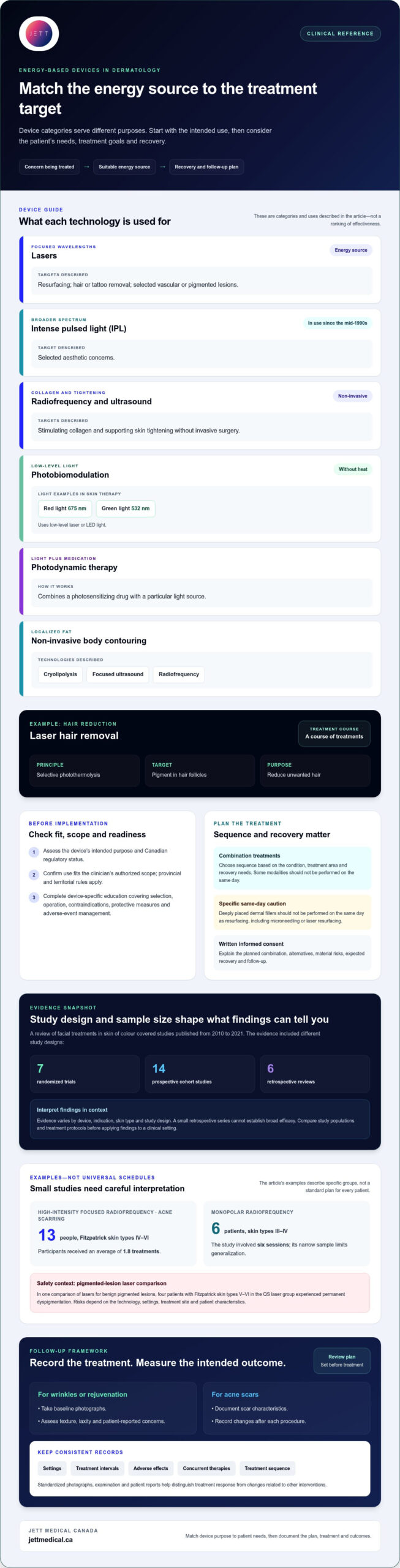
The process of adding energy-based devices to a dermatology practice begins with matching the energy source to its intended treatment target. Lasers use focused wavelengths for resurfacing, hair or tattoo removal, and selected vascular or pigmented lesions. Intense pulsed light (IPL), used since the mid-1990s, delivers a broader spectrum for selected aesthetic concerns. Radiofrequency and ultrasound can stimulate collagen and support skin tightening without invasive surgery.
Other technologies serve distinct clinical purposes. Photobiomodulation uses low-level laser or LED light without heat; skin therapy examples include red light at 675 nm and green light at 532 nm. Photodynamic therapy combines a photosensitizing drug with a particular light source. Non-invasive body contouring may use cryolipolysis, focused ultrasound, or radiofrequency to address localized fat.
Canadian practices can purchase devices through manufacturers and distributors. Warranty and support terms vary, so compare coverage, exclusions, training, maintenance, repair procedures, and service arrangements in writing. Provincial and territorial rules affect professional scope and service delivery; device authorization is a separate consideration for the Canadian market.
Purchase and financing costs depend on the device, configuration, included components, and financing terms. The value of adding energy-based devices to a dermatology practice depends on patient demand, treatment pricing, expected use, and ongoing expenses such as consumables and maintenance. Assess these factors together when modelling potential return on investment.
Risks depend on the technology, settings, treatment site, and patient characteristics. In one comparison of benign pigmented-lesion lasers, four patients with Fitzpatrick skin types V-VI in the QS laser group experienced permanent dyspigmentation. Assess contraindications and adverse-event management as part of treatment planning. For plasma technology, explore plasma device options relevant to your practice.
Energy-based devices are used for aesthetic and medical concerns. Laser hair removal uses selective photothermolysis to target pigment in hair follicles and reduce unwanted hair over a course of treatments.
3. Evidence limitations and follow-up needs
Evidence for energy-based treatments varies by device, indication, skin type, and study design. A review of facial treatments in skin of colour covered studies published from 2010 to 2021. It included seven randomized trials, fourteen prospective cohort studies, and six retrospective reviews. This mix helps map the evidence, but results from a small retrospective series cannot establish broad efficacy. Compare study populations and treatment protocols before applying findings to your own clinical setting.
For example, a retrospective review examined high-intensity focused radiofrequency for acne scarring in thirteen people with Fitzpatrick skin types IV-VI. Participants received an average of 1.8 treatments. That finding describes one small group, not a standard schedule for every patient. A separate monopolar radiofrequency study involved six patients with skin types III-IV who received six sessions. Its narrow sample limits how widely clinicians can generalize its results.
Match follow-up to the treatment’s purpose and the outcome being measured. For wrinkles or rejuvenation, take baseline photographs and assess changes in texture, laxity, and patient-reported concerns. For acne scars, document scar characteristics and changes after each procedure. Track settings, treatment intervals, adverse effects, and concurrent therapies, including needling or combination approaches. Consistent records help distinguish treatment response from changes related to other interventions.
Collagen remodelling and visible surface changes may develop on different timelines, so establish a review plan before treatment. At follow-up, compare standardized photographs, examine the treated area, and record the patient’s experience. If the response differs from the intended endpoint, reassess the diagnosis, device settings, and treatment sequence before proceeding. This makes evidence useful at the individual level and keeps claims aligned with the studied indication. It also helps determine whether to continue, modify, or stop the plan.
4. Patient education and realistic outcomes
Set expectations by explaining the treatment target, likely course, and outcome measure before the first session. For pigment concerns, describe clearance as a gradual change, not an instant result. A comparison of QS and picosecond lasers reported approximately 50% pigment clearance after a mean of 4-5 treatments. Patients can use standardized photographs to compare changes across visits and discuss whether the observed effect matches their goals.
Explain that response varies with the condition and treatment protocol. A monopolar radiofrequency study reported 70 to 75-percent improvement in skin tightening at three-month follow-up. That result came from a specific study, not a universal forecast. For laxity, clarify which area is targeted and how clinicians will assess change. Radiofrequency and ultrasound can stimulate collagen and tighten skin without invasive surgery, but they use different energy sources and treatment approaches.
For acne, surgical, burn, or trauma scars, lasers can improve appearance, texture, and range of motion over time. Specify which scar feature you are assessing, such as colour, surface texture, or mobility. For photorejuvenation, explain that repeated IPL or BBL treatments each year can significantly reverse skin aging in many patients. Distinguish this maintenance approach from a short course targeting a specific lesion or pigment concern.
Give patients a written plan covering the treatment schedule, expected recovery, and follow-up measures. At each review, compare photographs and document pigment, texture, laxity, and patient-reported changes. Consistent measures make progress easier to interpret and help identify when the plan needs adjustment. Do not present a study result as a guaranteed individual outcome.
For practices assessing plasma-based treatment options, explore plasma device information as part of patient education and treatment planning.
When discussing radiofrequency for acne scarring, distinguish a study result from an individual forecast. A high-intensity focused radiofrequency study of acne scarring reported a mean improvement score of 3.1, corresponding to 50-75% clearing. Explain what the score represents in relation to the patient’s scar goals, and review change through consistent photographs and assessment of colour, texture, or mobility. Invite patients to discuss whether improvement is meaningful to them, while making clear that the study finding does not guarantee the same response for each person.
Jett Medical Canada: Jett Plasma Pen Medical
Jett Medical Canada offers Jett Plasma Pen Medical for practices considering plasma technology in dermatology and aesthetic care. Its patented direct-current plasma technology is designed for applications involving wrinkles, pigmentation, and scars, among other conditions. The device is Health Canada licensed, and the company’s products also hold CE and MDSAP certifications.
Consider this option when your clinical plan includes plasma technology and you are assessing how its intended applications fit your practice. Review its role alongside your treatment protocols, staff training, patient selection, and follow-up approach. This keeps device selection focused on clinical needs rather than novelty.
Contact Jett Medical Canada to discuss Jett Plasma Pen Medical and its relevance to your practice.
Make your next device decision with purpose
When adding energy-based devices to a dermatology practice, start with a defined clinical need rather than a technology trend. Identify the patient concern you want to address, the treatment capability required, and how your team will assess whether the device supports that goal. A focused framework helps align clinical priorities, staff readiness, and future investment.
For plasma technology, Jett Medical Canada offers Jett Plasma Pen Medical, Jett Plasma Lift Medical, and Jett Plasma Medical II. Consider how each option fits your intended applications and practice plans, then make device selection part of a broader clinical strategy.
Contact Jett Medical Canada to discuss device options and take the next step towards an informed, patient-centred approach.
Frequently Asked Questions
What energy-based devices are commonly used in dermatology practices in Canada?
Common options include lasers, intense pulsed light (IPL), radiofrequency, ultrasound, and photobiomodulation systems. Dermatology practices use these technologies for hair reduction, tattoo removal, resurfacing, vascular or pigmented lesions, and skin tightening. Some protocols combine light with a photosensitizing drug, as in photodynamic therapy. Select a device based on its intended application and the concern being treated.
How do laser, IPL, radiofrequency, and ultrasound devices compare for dermatology treatments?
Lasers deliver focused light for targets such as hair follicles, tattoos, and selected skin lesions. IPL uses a broader spectrum of light, while radiofrequency delivers energy that can stimulate collagen. Ultrasound can also support non-surgical skin tightening through focused energy. These technologies differ in how they deliver energy and what they target, so compare intended applications, patient characteristics, and recovery needs before selecting a platform.
What steps are involved in adding an energy-based device to a dermatology practice?
Start by identifying a clinical need and defining the applications your practice intends to support. Then assess the device’s intended use, Canadian market authorization, training requirements, and fit with your professional scope. Establish protocols for patient selection, consent, documentation, and follow-up before introducing treatments. Plan staff education and evaluate outcomes using consistent measures, such as standardized photographs and recorded patient-reported changes.
What Canadian regulations and licensing requirements apply to buying and using medical aesthetic devices?
Assess each device’s intended purpose and Canadian regulatory status, and ensure its use fits the clinician’s authorized scope of practice. Clinicians should hold qualifications appropriate to their regulated profession and complete device-specific training. Provincial and territorial rules and device instructions also apply.