
A plasma device that appears technically similar to another may not be suitable for the same clinical purpose. Evaluating advanced plasma technology for clinics starts with fit: the device’s operating principles, authorized use, and intended application must align with your services and patient population.
Clinic teams are right to look beyond marketing claims. In Canada, device authorization and intended use are specific to each device. Compare the documentation for the system you are considering with the clinical application you have in mind, rather than assuming devices in the same category are interchangeable.
This guide explains how to assess plasma technology by clinical application, operating principles, and regulatory status, then connect those factors to professional scope, staff training, and patient selection. You’ll also find practical steps for evaluating implementation responsibly. Jett Medical Canada supplies professional plasma devices for distinct clinical applications and provides training and support for doctors and nurses adopting plasma-based therapies.
Key Takeaways
- Assess plasma systems by energy generation, delivery design, and device-specific indications rather than treating them as interchangeable.
- Compare options across dermatology, ophthalmology, aesthetics, and gynaecology using specialty, intended use, documentation, workflow, and training needs.
- Evaluate advanced plasma technology for clinics against a defined clinical need, then plan staff preparation, patient selection, consent, and documentation.
- Review device documentation alongside your clinic’s professional scope to guide responsible implementation and evaluation.
- Explore how professional devices such as Jett Plasma Pen Medical, Jett Plasma Lift Medical, and Edge EOM-P EVO fit into a device-specific evaluation.
What advanced plasma technology means for a modern clinic
For a clinic, plasma technology is a way to generate and deliver energy, not a treatment name or a promise of a particular patient outcome. Plasma technology describes the method used to generate and deliver plasma; a device’s authorized clinical use is defined separately by its device-specific documentation and regulatory status.
In physics, plasma is commonly described as the fourth state of matter, distinct from solids, liquids, and gases. The overview of Plasma (physics) helps explain the term, but it doesn’t establish how a medical device works or what it is intended to do. Those details depend on the system’s design and documentation.
How plasma technology enters clinical practice
A professional device translates an energy source into a delivery method and controls designed for a defined clinical application. Systems may differ in how plasma is generated, how energy reaches the treatment area, and what the manufacturer documents for use. A technical description alone cannot tell a clinic whether a device fits a particular procedure or patient group. Check the device instructions and intended use against the application you plan to offer.
Skin rejuvenation illustrates the distinction. Patient-facing material may describe a treatment goal, while clinician-facing documentation explains the technology, intended use, operating instructions, and limitations. The term “skin rejuvenation” doesn’t mean every plasma system addresses the same concerns, uses the same method, or has the same authorized indications. Connect any proposed application to the specific device documentation and relevant clinical evidence.
Why clinics need to define the technology precisely
Labels such as “plasma,” “cold plasma,” or “plasma pen” can describe different technologies or device categories. They aren’t, on their own, evidence of clinical equivalence. Before comparing claims, identify the modality, intended use, delivery design, and supporting documentation. In Canada, include the device’s Health Canada licensing status and authorized indications in that review. Authorization is device-specific, not a blanket endorsement of a technology category.
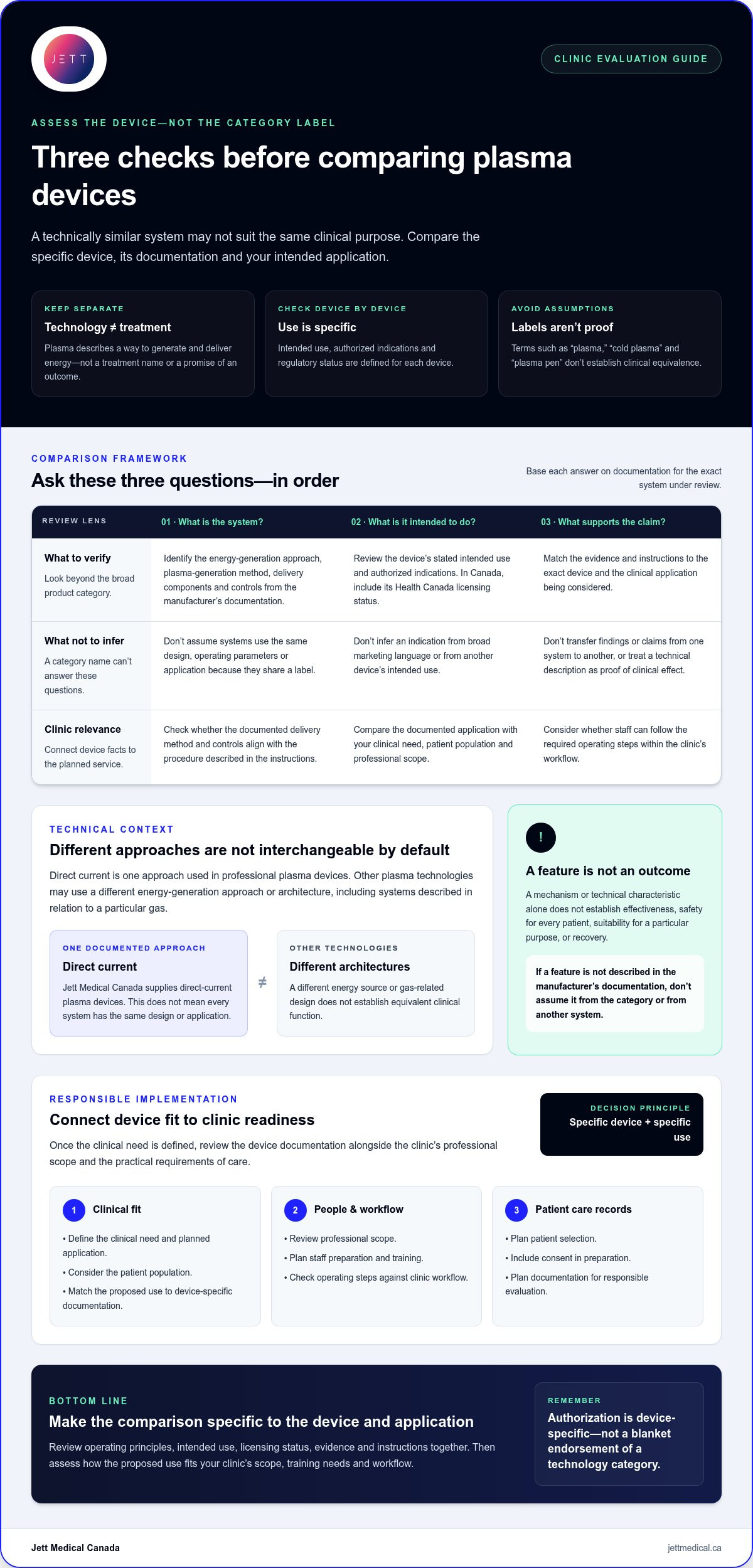
A disciplined comparison keeps three questions separate:
- What is the system? Identify its energy-generation and delivery approach from manufacturer documentation.
- What is it intended to do? Review its stated intended use and authorized indications rather than inferring them from a broad marketing label.
- What supports the claim? Match evidence and instructions to the exact device and proposed application.
This precision prevents findings or claims associated with one system from being generalized to another. It also helps teams distinguish a device capability from a patient-facing description of a procedure. For more device-specific context, the professional plasma pen guide discusses licensed technology in Canada.
For clinics assessing advanced plasma technology for clinics, start with the clinical question, then compare the specific device with its documentation. This makes comparisons across specialties more meaningful and keeps adoption decisions tied to intended use rather than terminology alone.
How plasma devices work: connect technical design with clinical use
A plasma device’s operating mechanism begins with how it generates energy and continues through how that energy is delivered and controlled. Device documentation describes these particulars. A category label or product description isn’t enough to establish the system’s operating parameters, clinical role, or suitability for a clinic’s intended application.
Plasma-device mechanisms, intended uses, and supporting claims are specific to each device and can’t be inferred from the word “plasma” alone. An explanation of how a device produces an energy source is not, by itself, evidence that a treatment is effective, safe for every patient, or appropriate for a particular clinical purpose.
Direct-current and other plasma approaches
Direct current is one approach used in professional plasma devices. Jett Medical Canada supplies direct-current plasma devices, but that description doesn’t establish that every system uses the same design or application. Other plasma technologies may use a different energy-generation approach or architecture, including systems described in relation to a particular gas. These terms shouldn’t be treated as interchangeable or as proof that devices have equivalent clinical functions.
For any system under consideration, review the manufacturer’s documentation for the energy source, plasma-generation method, delivery components, and controls. If a feature isn’t described there, don’t assume it based on the device category or information about another system.
From technical feature to clinical relevance
A technical characteristic matters to a clinic when its documented role connects to the intended application and workflow. Assess each feature in context rather than translating it directly into a claim about results, safety, or recovery. Check whether the specified delivery method and controls align with the procedure described in the instructions, and whether staff can follow the required operating steps within the clinic’s workflow.
Dermatology and ophthalmology illustrate why context matters. A system intended for a dermatological application shouldn’t be presumed appropriate for ophthalmic use just because both involve plasma technology. The anatomical site, clinical objective, operator requirements, and device-specific authorized use all shape the assessment. Compare documentation with the proposed application instead of relying on broad claims about what plasma can do.
During a technical review, organize questions around the evidence available for the exact device:
- Generation: What energy source and plasma-generation method does the documentation specify?
- Delivery and control: How is energy delivered, and what operating parameters or controls are described?
- Clinical relevance: How do those documented characteristics relate to the intended use, procedure steps, and staff workflow?
Keep mechanism, evidence, and patient suitability as separate parts of the evaluation. A plausible explanation of energy delivery doesn’t replace clinical evidence or professional judgement in patient selection. Clinics exploring professional plasma devices and clinical training can use these questions to frame a focused, documentation-led discussion with Jett Medical Canada.
How clinics can assess plasma technology across specialties
A useful comparison begins with the clinic’s clinical need, not a broad technology label. Dermatology, ophthalmology, aesthetics, and gynaecological care involve distinct patient pathways and professional requirements. A device’s relevance in one specialty doesn’t establish its suitability in another. For each proposed application, assess the exact device documentation, intended use, clinic workflow, training needs, and whether the use falls within the clinician’s professional scope and applicable requirements.
Match intended use to the clinic’s patient population
Define the clinical question and patient pathway before comparing systems. Consider who would assess the patient, how eligibility would be determined, and what follow-up or documentation the clinic’s process requires. Then compare that pathway with the device’s documented intended use. A broad claim about a related condition isn’t a substitute for an indication specific to the device. Patient selection remains a clinical responsibility guided by professional judgement and relevant requirements.
Keep specialty-specific considerations visible during the review. For example, an ophthalmic application calls for a separate assessment of its documented purpose, operator training, and workflow from an aesthetic application. The ophthalmic plasma buying guide offers context for evaluating that specialty as its own clinical area.
Compare clinical fit, not just technical labels
Use a structured comparison to record what is known for each proposed application. The entries below are review prompts, not claims that a particular device is authorized for every specialty.
| Specialty | Intended use to assess | Device documentation | Workflow considerations | Training needs |
|---|---|---|---|---|
| Dermatology | Match the proposed application to the device’s specific intended use. | Review indications, instructions, and stated limitations. | Map assessment, procedure steps, and follow-up to clinic processes. | Identify required device-specific instruction and competency needs. |
| Ophthalmology | Define the ophthalmic clinical need and confirm device-specific relevance. | Review documentation for the exact ophthalmic application. | Consider how the application fits the specialty’s patient pathway. | Align training with the documented use and clinical responsibilities. |
| Aesthetics | Distinguish the proposed clinical application from broad treatment claims. | Check intended use, instructions, and authorized indications. | Assess suitability for the clinic’s consultation and care processes. | Plan training for the device and the clinic’s intended application. |
| Gynaecology | Define the specialty-specific need before considering a technology. | Review documentation for the proposed gynaecological use. | Assess fit with the relevant patient pathway and clinic procedures. | Determine training in relation to scope and documented use. |
For advanced plasma technology for clinics, a feature matters only in relation to a documented use and the clinic’s practical needs. Compare operating approach, training, and workflow against the same proposed application, rather than ranking devices by technical terminology. This keeps the assessment focused on clinical fit and prevents assumptions from crossing specialties.
What clinics should prepare before adopting plasma technology
Responsible adoption is a clinic-level process, not simply a device purchase. A clear sequence connects the clinical need to device documentation, professional responsibilities, staff readiness, and a plan for evaluating implementation. Keep patient selection, informed consent, and clinical record-keeping within the clinic’s established governance processes and applicable professional requirements.
Review licensing, intended use, and clinical evidence
Assess licensing and authorized indications for each device. Don’t infer them from a technology category or another system’s status. In Canada, review current Health Canada licence information and the device’s authorized indications, then check the manufacturer’s documentation for the proposed application. Licensing status and evidence supporting a particular clinical claim are related considerations, but they are not interchangeable. A licence alone does not establish that every claim made about a device is supported by clinical evidence.
The Canadian plasma device licensing reference can provide additional context as your team reviews device-specific information. Record what documentation supports the proposed use and note any limitations that affect your clinic’s evaluation.
Plan staff training and workflow integration
Training and workflow planning should reflect the specific device and application. Identify which clinicians may use the technology, what instruction they need, and how the process fits consultation, patient communication, procedure documentation, and follow-up responsibilities. Jett Medical Canada provides training and support for doctors and nurses adopting plasma-based therapies. This supports clinic implementation alongside professional judgement, device instructions, and applicable requirements.
Use this sequence to structure the clinic’s preparation:
- Define the clinical need. Describe the intended application and the patient pathway it would serve. Confirm that the proposed use aligns with professional scope and applicable requirements.
- Review device documentation. Examine current Health Canada licensing information, authorized indications, manufacturer instructions, and evidence relevant to the specific clinical claim.
- Assess the workflow. Map how consultation, patient selection, consent, device use, records, and follow-up would fit the clinic’s processes. Identify responsibilities before implementation.
- Prepare staff. Determine who needs device-specific training and how the team will apply instructions and clinic protocols consistently.
- Plan the evaluation. Decide how the clinic will review implementation against its defined clinical and operational aims, using appropriate documentation and professional oversight.
For clinics considering advanced plasma technology for clinics, this sequence turns a broad interest into a documented evaluation. It keeps device claims, patient suitability, and clinic readiness distinct, so decisions remain grounded in the specific intended use.
Learn about professional plasma technology and adoption support from Jett Medical Canada.
How Jett Medical Canada supports professional plasma adoption
Professional adoption calls for more than selecting a device. Clinics need to understand the distinctions between plasma technologies, clinical settings, and the documentation that guides responsible use. Jett Medical Canada supplies professional plasma devices to clinics across Canada, with applications spanning dermatology, ophthalmology, aesthetics, and gynaecology. The company supplies technology and supports professional implementation; it does not provide direct patient treatments.
A portfolio for distinct clinical applications
The portfolio includes Jett Plasma Pen Medical, Jett Plasma Lift Medical, Edge EOM-P EVO, Jett Plasma Medical II, Jett Plasma For Her II, and Edge O Tech. These professional devices serve a varied field; they are not a single universal solution for every clinic or specialty. Their inclusion in the portfolio doesn’t mean each device is intended for every application.
For a clinic, relate the device under consideration to its clinical need, then assess its device-specific documentation, intended use, and workflow fit. Dermatological, ophthalmic, aesthetic, and gynaecological applications require separate consideration. Don’t infer an indication from a product name or assume that a device used in one specialty is appropriate for another. This application-led approach keeps the evaluation focused on professional context rather than broad category claims.
Professional training, support, and next steps
Jett Medical Canada provides training and support for doctors and nurses adopting plasma-based therapies. Training can help clinical teams understand device instructions and incorporate the technology into their professional practice. It works alongside, rather than replacing, the clinic’s responsibility to consider professional scope, patient selection, informed consent, documentation, and applicable requirements.
As part of an adoption review, clinics can discuss how a device’s documented use relates to the planned application and what training supports implementation. Keep the review grounded in current device documentation and the clinic’s own protocols. For wider Canadian context, the Canadian medical device distribution guide can complement a device-specific assessment.
Choosing advanced plasma technology for clinics is ultimately a decision about clinical fit, documentation, and readiness to integrate a specific system responsibly. Jett Medical Canada brings professional devices together with clinician training and support to help clinics evaluate adoption across distinct applications.
Explore Jett Medical Canada’s professional plasma devices and consider how the portfolio aligns with your clinic’s clinical focus.
Make your next evaluation clinically specific
Turn your clinic’s priorities into a focused review: identify the application you’re considering, write down the questions your team needs answered, and assess each device against its intended use and your professional practice. This keeps the decision grounded in clinical fit rather than novelty.
Jett Medical Canada’s products are Health Canada licensed and hold CE and MDSAP certifications. Treat these as starting points for review, not substitutes for checking current, device-specific licence details and authorized indications. The company also provides training and support for doctors and nurses adopting plasma-based therapies, helping teams consider implementation alongside their own clinical responsibilities.
With a clear evaluation framework, advanced plasma technology for clinics can be considered thoughtfully and in context. Explore professional plasma technology for your clinic and take the next step with a well-defined clinical objective.
Frequently Asked Questions
Is advanced plasma technology the same across all medical devices?
No. Plasma devices can differ in energy generation, delivery design, controls, and intended use. A nitrogen plasma system and a direct-current plasma device shouldn’t be assumed to operate identically. For a useful comparison, consider the exact device and proposed clinical application, not just the terminology in a brochure. Review the device documentation, authorized indications, and relevant evidence before applying any treatment claim or reported outcome to another system.
Can one plasma device be used across different clinical specialties?
Not automatically. A device’s documented applications depend on its design, licence, and intended use. For example, a system described for an aesthetic application shouldn’t be presumed suitable for an ophthalmic or gynaecological one. Before considering use in another specialty, assess the specific application against the device’s authorized indications and the practitioner’s professional scope. Sharing a technology category doesn’t mean devices serve the same purpose or patient pathway.
How should a clinic assess evidence for a plasma device?
Start with evidence relevant to the exact device and proposed indication. Separate descriptions of how the technology works from clinical findings about its use. Check whether the studied population, treatment context, and reported endpoints resemble the clinic’s intended application. Licensing status also shouldn’t be treated as proof of every claimed outcome. If evidence doesn’t address the proposed use, avoid extrapolating from another system and seek appropriate clinical and regulatory review.
Does Health Canada licensing mean a plasma device can be used for any treatment?
No. A licence relates to a specific device and doesn’t establish authorization for every possible treatment or marketing claim. Review current Health Canada licence information and authorized indications for the individual device, then consider the practitioner’s scope and applicable practice requirements. A clinic evaluating a new application shouldn’t rely on a general statement about plasma technology instead of checking whether that use is covered by the device’s documentation.
What training should clinic staff receive before adopting plasma technology?
Training should match the specific device, its documented intended use, and each clinician’s role. Clinic planning can address device operation, patient selection, consent discussions, protocols, record-keeping, and follow-up responsibilities. Doctors and nurses adopting plasma-based therapies need support relevant to their clinical work. Training complements, but doesn’t replace, professional judgement, manufacturer documentation, or applicable regulatory and practice requirements. The clinic should also define how staff will handle questions outside the documented use.
Can plasma technology replace surgery or other established treatments?
Plasma technology shouldn’t be considered a universal substitute for surgery or other established care. Whether it is appropriate depends on the individual patient, the clinical concern, the device’s specific indications, available evidence, and the clinician’s assessment. A “non-surgical” description alone doesn’t demonstrate equivalent results or suitability for every case. Clinical discussions should address relevant alternatives and expectations within the practitioner’s scope and applicable professional framework.
What is the first step in evaluating plasma technology for a clinic?
Define the clinical need and the patient group your clinic intends to serve. Then identify devices whose documentation addresses that proposed purpose. For example, if the need concerns a particular specialty, record the intended patient pathway and compare it with the device’s indications, evidence, training needs, and workflow implications. This gives your team a practical basis for evaluating advanced plasma technology for clinics without relying on broad claims or category labels.