
The most important item on an aesthetic clinic equipment checklist for Canada is a clear match between each device, the treatments you plan to offer and the patients you expect to see. Before ordering, assess treatment needs, patient volume, safety supplies, infection controls and equipment suitability. If you offer injectables, include emergency preparedness, such as an emergency cart and AED, in your planning.
Choosing equipment involves more than selecting a device. You also need supplies and protocols that support safe, consistent care without tying up resources in items your practice won’t use.
This checklist will help you assess treatment priorities and patient volume, plan consumables and safety supplies, organize infection prevention, and evaluate aesthetic technology before purchase. It also explains how to consider device fit, including whether a laser is suitable across Fitzpatrick skin types I to VI, so your ordering decisions reflect your clinic’s services and standards.
Key Takeaways
- Match each purchase to the treatments you plan to provide and the patient volume your clinic can support.
- Build emergency readiness into injectable services, including the supplies and protocols needed to respond to complications.
- Choose infection-control equipment and consumables that support safe workflows and appropriate handling of reusable tools.
- Assess treatment devices for clinical fit, intended applications and suitability for the patients you serve before ordering.
Defining clinic treatment needs and patient volume
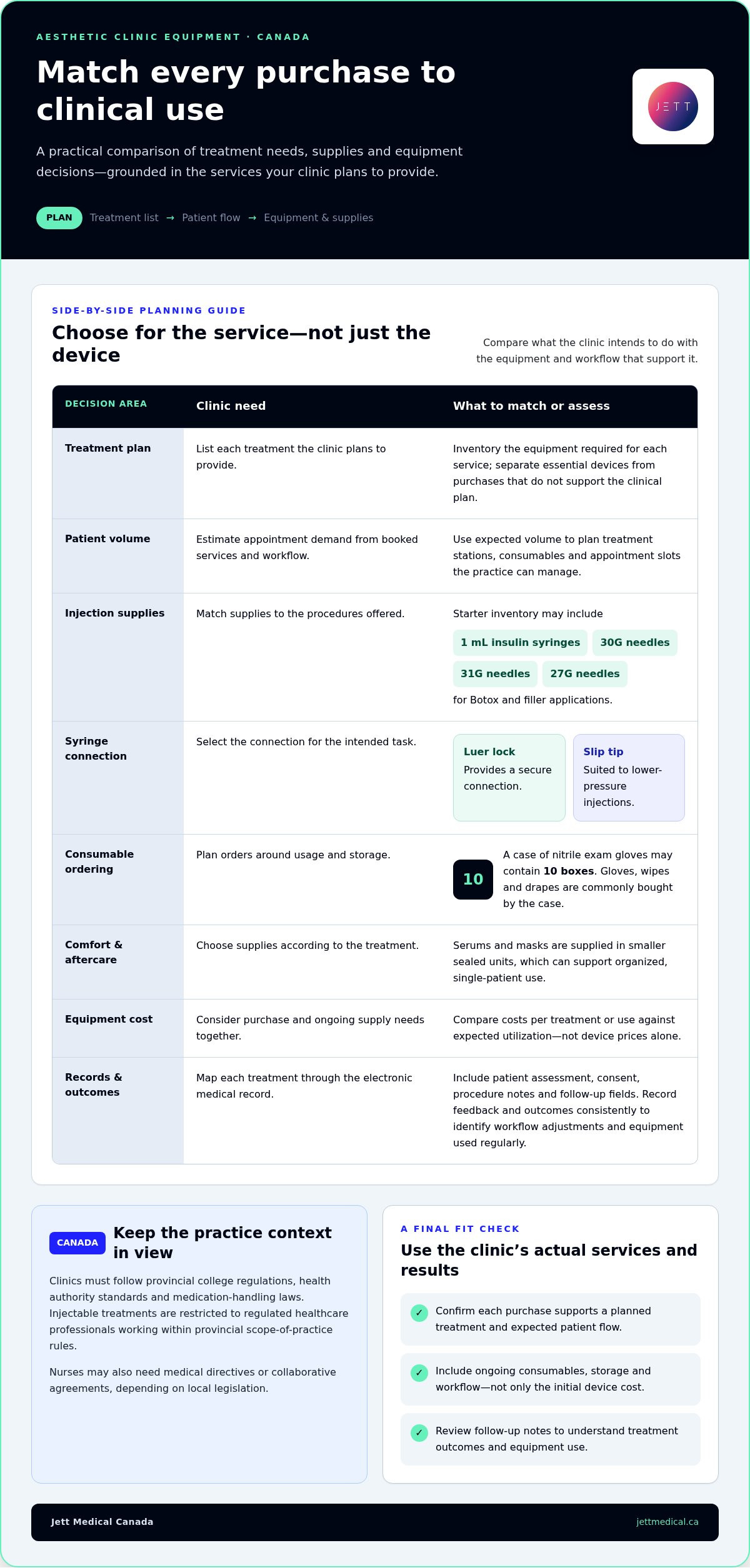
Canada has no separate aesthetic licence or mandatory national certification for physicians entering aesthetic medicine. Clinics must follow provincial college regulations, health authority standards and medication-handling laws. Injectable treatments are restricted to regulated healthcare professionals working within provincial scope-of-practice rules. Nurses may also need medical directives or collaborative agreements, depending on local legislation.
- List each planned treatment and its required equipment. A treatment-by-treatment inventory helps distinguish essential devices from purchases that don’t support your clinical plan.
- Estimate appointment demand using your booked services and workflow. Expected patient volume affects how many treatment stations, consumables and appointment slots your practice can manage.
- Map each treatment through your electronic medical record. Include the patient assessment, consent, procedure notes and follow-up fields needed for a complete record.
- Match injection supplies to the procedures offered. A starter inventory may include 1 mL insulin syringes and 30G, 31G or 27G needles for Botox and filler applications.
- Select syringe connections for the intended task. Luer lock syringes provide a secure connection, while slip tip syringes are suited to lower-pressure injections.
- Plan consumable orders around usage and storage. Gloves, wipes and drapes are commonly bought by the case; a case of nitrile exam gloves may contain 10 boxes.
- Choose patient comfort and aftercare supplies by treatment. Serums and masks are supplied in smaller sealed units, which can support organized, single-patient use.
- Record patient feedback and treatment outcomes consistently. Compare follow-up notes across treatments to identify workflow adjustments and equipment that sees regular clinical use.
- Compare equipment costs per treatment or use. Assess purchase and ongoing consumable needs against expected utilization, rather than comparing device prices alone.
Use this sequence to make the aesthetic clinic equipment checklist Canada-specific to your services, patient flow and documented treatment results.
Emergency supplies and complication protocols
For injectable services, include an emergency cart and an automated external defibrillator (AED) in the clinic plan. These supplies support response readiness, but equipment alone is not a complication protocol. Document who takes each action, where emergency supplies are stored and how staff summon emergency assistance. Align the protocol with staff training and the treatments performed.
- Set out the response sequence. Record how staff recognize a complication, pause the procedure, alert the appropriate responder and document the event.
- Make the emergency cart accessible. Assign responsibility for its organization and readiness so staff can locate supplies during a time-sensitive response.
- Include the AED in emergency planning. Identify its location and incorporate access into the clinic’s response process.
- Use treatment-specific protocols. A facial injectable procedure and another aesthetic treatment may require different escalation steps, so write instructions for each service.
- Record follow-up actions. Document the event, communications and subsequent care in the patient record to support continuity.
Digital records add another review point. Treat PIPEDA, GDPR and HIPAA as distinct privacy frameworks, not interchangeable proof of suitability for a Canadian practice. For each system, document what patient information it stores, who can access it and how the clinic manages records. Align staff access and record handling with the clinic’s privacy procedures.
Keep marketing accurate and distinguish clinical information from promotional claims. Canadian regulations restrict public advertisements for prescription drugs to the brand name, proper name, common name, and the drug’s price and quantity. Avoid unsupported outcome promises or wording that could blur the distinction between a treatment description and a drug advertisement.
For clinics assessing plasma technology as part of their treatment plan, plasma technology for aesthetic practice is a relevant equipment category to evaluate alongside emergency readiness and documented protocols.
Infection prevention and control
Build infection prevention into every cosmetic treatment workflow, from room preparation through device reprocessing. Separate clean supplies from used instruments, and document who completes each step. In Ontario, the CPSO requires physicians to follow infection prevention and control practices aligned with the PIDAC clinical office practice document, including documented policies and procedures.
- Write a procedure-specific cleaning sequence. List the treatment-room surfaces, reusable tools and patient-contact areas staff must address after each service.
- Select disinfectants for their intended surfaces. Follow the product label and device manufacturer’s instructions so cleaning methods suit the materials and equipment.
- Plan reusable-tool processing. An autoclave supports sterilization; an ultrasonic cleaner can support instrument cleaning before the appropriate processing step.
- Keep clean and used instruments apart. Use clearly designated storage and work areas to reduce the chance of contaminating ready-to-use tools.
- Trace supplies by delivery and lot. Match each consumable’s grade to its clinical use, and retain lot numbers for batch tracing.
- Use approved products in nursing practice. The College of Nurses of Ontario expects nurses to use Health Canada-approved substances and products.
- Maintain a written record of completed tasks. Cleaning logs help staff show which procedure was followed and identify missed steps.
Public Health Ontario’s personal service settings resources provide a provincial reference for infection prevention. Use the guidance checked on 12 October 2026 alongside the requirements relevant to your practice setting.
Make the protocol practical for a busy clinic day. Store disinfectants and processing supplies where staff can reach them, assign responsibility for each task, and record completion before the next patient enters. For example, a treatment-room checklist can distinguish surface disinfection from reusable-instrument processing. Review written procedures when services, devices or room layouts change, so each step remains relevant to the clinic’s workflow.
Aesthetic equipment and technology
Assess each device against the procedures, patient group and treatment room it must support. Medical-grade treatment beds and lighting are common aesthetic clinic startup expenses because positioning and visibility affect procedure setup. Plan storage, power access and cleaning space before selecting equipment.
- Match device capability to the planned procedure. A laser’s suitability across Fitzpatrick skin types I to VI helps assess whether it fits the clinic’s intended patient population.
- Compare workflow requirements before ordering. Check setup, treatment-room space, consumables and cleaning needs for each device.
- Review instructions for use and storage conditions. Staff need accessible operating guidance, while appropriate storage protects equipment between procedures.
- Assess the treatment environment as a system. A treatment bed, lighting and device should support safe positioning and clear access for the clinician.
Health Canada rules depend on the device and its intended use. Assess the device’s Health Canada licensing status and intended purpose before adding it to a medical aesthetics practice.
For maintenance, calibration and staff training, follow the manufacturer’s instructions and document the clinic’s procedures. Keep service records with the device documentation, and train each operator on the device’s controls, intended use and cleaning requirements.
Canadian clinics can purchase aesthetic equipment through medical-device suppliers; whether to purchase or lease depends on cash flow, expected use and service terms. Compare the full agreement, including maintenance responsibilities, training, consumables and end-of-term conditions, rather than considering the payment alone.
A plasma-based device may suit clinics assessing technology for specific aesthetic procedures. Explore plasma technology for aesthetic practice as part of your equipment review.
Jett Medical Canada: Jett Plasma Pen Medical
Jett Medical Canada supplies plasma devices for clinics evaluating non-surgical treatment technology in dermatology, ophthalmology and aesthetics. Its Jett Plasma Pen Medical uses patented direct-current plasma technology designed for precision and minimal downtime, with applications that include wrinkles, pigmentation and scars.
Clinics can also consider the Jett Plasma Lift Medical and Jett Plasma Medical II in relation to their treatment plans and workflow. Clinics should verify each device’s regulatory status and certifications as part of their purchasing assessment. Include each device’s intended applications, staff training needs, room setup and infection-control workflow in your purchasing assessment.
If your planned services align with plasma technology, explore how these devices could fit your equipment needs. Contact Jett Medical Canada to discuss plasma equipment for your clinical practice.
Plan your next equipment decision with confidence
Use an aesthetic clinic equipment checklist in Canada as a working document, not a one-time purchasing list. Revisit it as your treatment plan evolves, recording why each device is needed and how it fits your clinical workflow. This gives you a clear basis for future investment decisions, rather than making novelty the reason to buy.
For clinics considering plasma technology, Jett Medical Canada offers the Jett Plasma Pen Medical, Jett Plasma Lift Medical and Jett Plasma Medical II. Compare each option with your intended applications, staff capabilities and operating procedures. A deliberate review can help you determine whether this technology belongs in your practice’s equipment plan.
Contact Jett Medical Canada to explore its plasma equipment for your practice. With a clear plan and carefully matched technology, you can continue developing a focused, patient-centred clinic.
Frequently Asked Questions
What should an aesthetic clinic check before ordering?
Start with the treatments you intend to provide, then map each purchase to its clinical use. An aesthetic clinic equipment checklist for Canada should cover device suitability, room layout, storage, consumables, staff workflow and infection-control processes. For example, confirm that a proposed device fits the treatment space and that its operating and cleaning instructions can be incorporated into staff procedures before ordering.
What equipment is essential for opening an aesthetic clinic in Canada?
Essential equipment depends on the procedures offered and the clinic’s patient workflow. A practice may need medical-grade treatment beds, task lighting, procedure-specific devices, an electronic record system and suitable consumables. Plan for emergency readiness and infection prevention alongside treatment equipment. For example, a clinic offering injectables needs an emergency cart and AED in its preparedness plan, while other services require equipment matched to their procedures.
What medical-grade devices are used in Canadian aesthetic clinics?
Clinics may use lasers and other devices selected for their intended procedures, patient population and clinical setting. Medical-grade treatment beds and lighting support positioning and visibility, while a treatment device serves its intended purpose. Compare the device’s stated use with your service plan, and consider whether its capabilities suit the skin types you intend to treat. Choose equipment to meet a clinical need, not because it is new.
How much does aesthetic clinic equipment cost in Canada?
There is no meaningful total for every clinic because equipment requirements depend on treatment scope, patient volume and room setup. Build a budget by separating major devices, furnishings, consumables, maintenance and staff training. Compare each item’s expected use with its purchase or leasing terms. For a plasma device, request pricing directly from its supplier rather than relying on a general equipment estimate.
What infection-control and sterilization equipment does an aesthetic clinic need?
Choose reprocessing equipment based on whether your services use reusable tools and on the required processing workflow. An autoclave sterilizes reusable instruments; an ultrasonic cleaner supports cleaning before the appropriate sterilization step. Use disinfectants suited to the surfaces and devices in your clinic, and maintain separate areas for clean and used tools. Written procedures and task records help staff follow the same sequence.
What personal protective equipment and emergency equipment should an aesthetic clinic have?
Stock procedure-appropriate protective supplies, including exam gloves, and keep them accessible where treatments take place. Clinics offering injectables should plan for an emergency cart and AED. Assign responsibility for organizing emergency supplies and document how staff access them during a response. Tailor inventory to your procedures so staff can identify required supplies and their locations without delaying a response.