
A device can generate strong treatment revenue and still deliver weak returns if ownership costs and utilization are overlooked. Calculating ROI on aesthetic capital equipment means dividing net profit by the investment cost, then multiplying by 100. Aesthetic practices commonly target 25% to 100% ROI over three to five years, depending on equipment type and patient demand.
The purchase price is only one part of the decision. Installation, training, maintenance, consumables, and the time needed to build treatment volume all affect payback. Assess the full cost before committing capital.
This article explains how to calculate ROI, compare conservative and peak-volume projections, and use clinic investment benchmarks to assess break-even timing. It also shows how utilization and total cost of ownership shape the decision, helping you weigh the investment against realistic clinic operations.
Key Takeaways
- Build a complete ownership-cost picture by including installation, training, maintenance, consumables, and integration alongside the purchase cost.
- Compare cautious and higher-volume treatment projections to see how changes in demand affect revenue and payback.
- Use equipment utilization and total cost of ownership to assess whether an investment fits your clinic’s operating model.
- Review Jett Medical Canada’s plasma pen offerings when considering equipment for non-surgical aesthetic treatments.
Upfront equipment, installation, integration, and training costs
Purchase price alone understates the investment needed to put equipment into operation. Installation, integration, staff training, and recurring expenses all affect the decision.
Equipment and integration expenses
Equipment and integration costs include the purchase, installation, and work needed to fit a device into clinic operations. Integration may also require workflow, scheduling, and recordkeeping changes. Include these tasks in the initial budget: excluded costs can extend payback even when treatment revenue meets projections.
Program and training costs
Program costs may include software or sensors, installation, and staff preparation. If monitoring tools are part of the equipment plan, include setup and any ongoing subscription costs in the ownership estimate. Account for both initial and recurring expenses when estimating how long it will take treatments to generate income.
Recurring expenses continue after installation.
Downtime costs more than the repair invoice. An unavailable device can disrupt bookings, delay revenue, and require rescheduling. Include emergency repairs and lost appointment revenue in the model, rather than treating the repair as the only failure cost. This makes operating scenarios more useful to compare.
Reactive maintenance costs can accumulate over time. For an aesthetic clinic, base the decision on its service schedule, repair history, and revenue affected by equipment outages.
What Is Return on Investment?
Return on investment (ROI) expresses a project’s net profit as a percentage of its investment cost. For a useful comparison, track cumulative returns over a defined period and distinguish revenue from savings.
Cumulative financial returns
Cumulative financial returns measure gains and expenses across an operating period, rather than in one month. This view shows whether early costs are offset as treatment capacity and revenue build. The standard formula is ROI = (net profit ÷ investment cost) × 100. For example, increasing a package price by C$500 across eight monthly package sales adds C$4,000 in monthly revenue, or C$48,000 over the first year. That amount is revenue, not profit. Subtract operating expenses before applying the formula, and use the same period for costs and returns.
Cost avoidance in ROI calculations
Cost avoidance is the value of expenses a project prevents compared with the current operating approach. It may include reduced downtime, emergency repairs, replacement needs, or other costs. Estimate each category against a clear baseline, and include only savings reasonably attributable to the project. Keep avoided costs separate from treatment revenue to make assumptions visible and prevent double-counting.
Applying ROI formulas to equipment and projects
Dividing C$900 by C$2,100, then multiplying by 100, gives a projected ROI of 42.9%. This illustrates why assumptions about price and sales volume matter.
A project breaks even when total revenue matches total expenses. Anticipated ROI uses estimated costs and returns before work begins; actual ROI uses final figures afterward. Compare both over the same period and record each cost and saving separately. This makes it easier to judge whether the equipment generated enough profit to justify the investment.
Comparing conservative and peak-volume projections
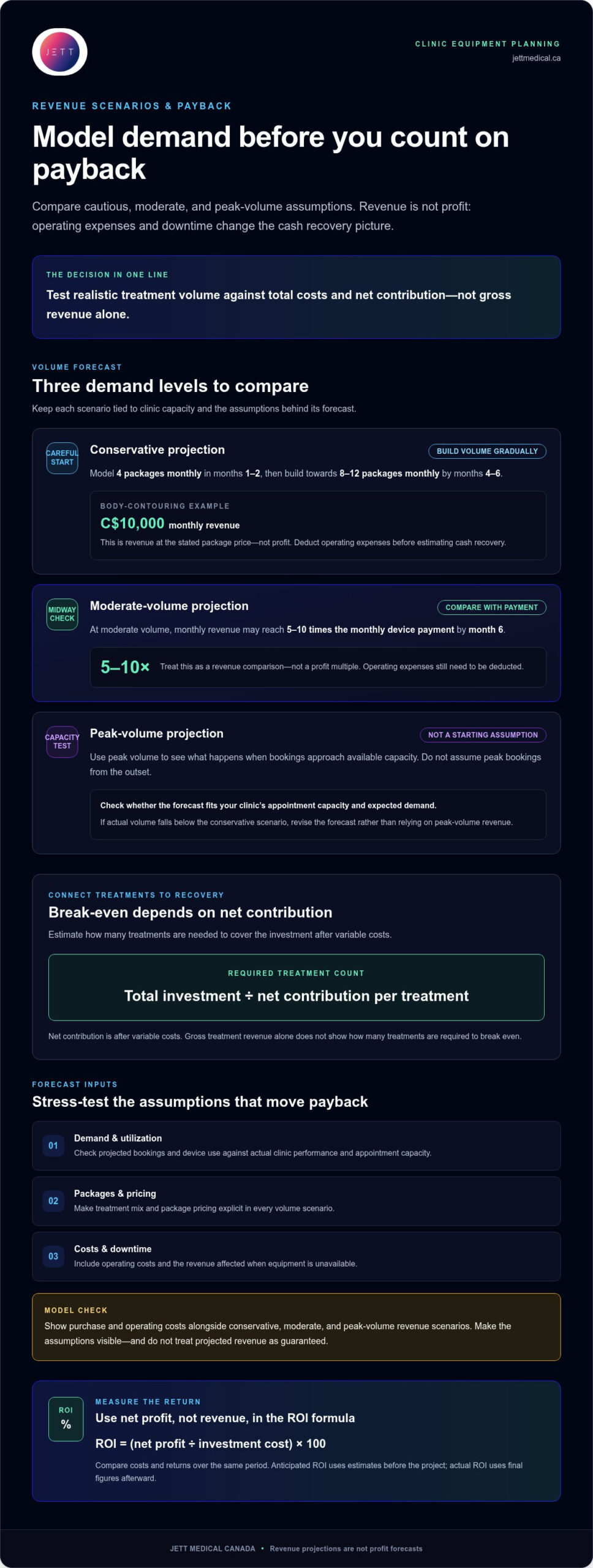
Volume assumptions show whether projected returns reflect clinic capacity or an optimistic target. Calculating ROI on aesthetic capital equipment means comparing cautious and higher-volume scenarios before assessing the investment.
How many treatments are needed to break even? Divide the total investment by the net contribution per treatment, after variable costs, to find the required treatment count. The result depends on contribution margin, not gross treatment revenue alone.
The main risks are overstating demand, utilization, package sales, or pricing while understating costs and downtime. These assumptions directly affect projected payback. To calculate ROI on aesthetic capital equipment accurately, compare assumptions with actual clinic performance.
A conservative model can begin with four packages monthly in months one and two, then build toward eight to twelve packages monthly by months four to six. A body-contouring example estimates C$10,000 in conservative monthly revenue at its stated package price. Treat that as revenue, not profit: deduct operating expenses before estimating cash recovery.
Peak-volume projections show what happens when bookings approach available capacity. At moderate volume, monthly revenue may reach five to ten times the monthly device payment by month six. Use this comparison to assess whether expected demand supports the project, without assuming peak bookings from the outset.
For a project proposal, present purchase and operating costs alongside conservative, moderate, and peak-volume revenue scenarios. Show the assumptions behind each forecast, including treatment mix, package pricing, and appointment capacity. This creates a clearer business case and identifies the conditions needed for positive cash flow.
Anticipated ROI uses estimated costs and revenues before a project starts. Actual ROI is calculated afterward using final figures. Track bookings, completed treatments, variable costs, and downtime against projections, then compare results at consistent intervals. If actual volume falls below the conservative scenario, revise the forecast rather than treating peak-volume revenue as guaranteed.
Cash recovery occurs when cumulative net returns cover the investment and related expenses. Calculating break-even from net contribution per treatment connects service volume to that point. Review projected recovery alongside actual cash flow to assess whether the equipment supports the clinic’s operating plan.
Aesthetic clinic equipment investment benchmarks
Device type alone doesn’t determine payback; utilization, patient demand, treatment margins, and ownership costs shape the result. Aesthetic practices commonly target 25% to 100% ROI over three to five years, while estimated break-even commonly falls within 12 to 30 months.
How do ROI and payback periods compare by device type? Compare devices using net contribution per treatment, expected utilization, and total ownership costs. A device with higher treatment revenue may still take longer to pay for itself if demand or margins are lower.
What is the typical purchase price of aesthetic lasers and other capital equipment in Canada? Prices depend on the modality, treatment capabilities, included components, and clinic configuration. These factors determine the investment used in the payback formula, so compare total ownership cost rather than purchase price alone.
Benchmarks provide context, not a substitute for a clinic-specific scenario. Established practices are described as having realistic baseline equipment utilization of 60% to 75%, while aesthetic practices allocate 15% to 25% of annual revenue to capital equipment and technology. Annual maintenance is estimated at 5% to 15% of purchase price.
For a numerical example, a C$120,000 investment generating C$6,500 in monthly net profit reaches break-even in 18.5 months. Most aesthetic clinics aim to break even within 18 to 36 months and reach positive cash flow by year two or three. A period exceeding 36 months signals a need to reassess the assumptions and strategic rationale.
Evaluate the investment across three-year, five-year, and seven-year periods to see how results change over time. Practices commonly keep equipment for five to seven years. Compare total cost of ownership, utilization, and net returns across available options before deciding. Explore plasma equipment options as part of your clinic investment assessment.
Jett Medical Canada: Jett Plasma Pen Medical
Jett Medical Canada supplies plasma pen devices to clinics evaluating equipment investments for non-surgical aesthetic care. The JETT Plasma Pen uses patented direct-current plasma technology for precise treatment applications in dermatology, ophthalmology, and aesthetics.
For an ROI assessment, consider whether the device’s intended applications align with your clinic’s patient demand, treatment capacity, and operating model. Jett Plasma Lift Medical, Jett Plasma Medical II, and Jett Plasma For Her II are also among the available offerings. Clinics should verify the regulatory and certification details relevant to their own purchasing and use decisions.
These details can inform a clinical and operational evaluation, but they don’t replace your own revenue, utilization, and ownership-cost projections. Contact Jett Medical Canada or visit jettmedical.ca to learn more about the Jett Plasma Pen Medical.
Turn your ROI analysis into a confident next step
A disciplined approach to calculating ROI on aesthetic capital equipment turns an investment decision into an operating plan. Use your analysis to define how the equipment fits your clinical priorities, appointment workflows, and future service mix. Assign responsibility for reviewing performance so the original assumptions stay connected to day-to-day decisions.
Before proceeding, bring the financial case and clinical objectives together. Consider whether the technology supports the treatments your practice intends to provide and aligns with its longer-term direction. A clear rationale helps your team assess the opportunity consistently, from initial planning through routine evaluation.
For clinics considering plasma technology, Jett Medical Canada can help you explore its offerings in relation to your practice’s needs. Contact Jett Medical Canada to discuss the next step. With a considered plan, your equipment decision can support a focused and sustainable path forward.
Frequently Asked Questions
What does the first year actually look like?
The first year may involve a gradual transition from setup to routine bookings, so assess progress month by month. Record completed treatments, cancellations, treatment mix, and net contribution after variable expenses. Compare results with the original forecast, then adjust expected capacity as demand develops. This helps distinguish normal ramp-up from a change in the business case.
What costs should be included when buying aesthetic equipment?
Include every cost required to acquire, prepare, and operate the equipment, not just the supplier’s base quote. Check whether delivery, room modifications, software, accessories, or financing charges appear separately on invoices. A device that needs electrical or workflow changes, for example, may create costs outside its purchase order. Separate one-time items from ongoing expenses to keep your ownership estimate useful throughout the equipment’s service life.
How do you estimate revenue per treatment and equipment utilization?
Estimate revenue per treatment from the amount patients pay for the planned service, then subtract variable expenses to find its contribution. To calculate utilization, compare device time used for completed treatments with clinic time available for those appointments. Distinguish completed appointments from bookings: cancellations and gaps reduce actual usage. Model treatments with different prices or durations separately.
How do financing, leasing, and cash purchases affect equipment ROI?
Financing and leasing spread payments over time, while a cash purchase commits capital at acquisition. Compare the full payment schedule, fees, ownership terms, and end-of-term obligations, using the same evaluation period for each option. The preferred structure depends on cash reserves, payment capacity, and how long the clinic expects to use the device.
How should maintenance, consumables, training, and downtime factor into ROI?
Track expenses by device and period, then connect them to completed treatments and interruptions. Record consumables used per procedure, planned maintenance dates, staff training time, and appointments affected by outages. This reveals whether operating expenses are stable or rising and whether downtime displaces billable work. Separate routine servicing from unexpected repairs to make cost patterns easier to assess.
What Canadian regulations, taxes, and financing considerations affect aesthetic equipment ROI?
In Canada, assess equipment licensing and intended use alongside the clinic’s financing and tax treatment. JETT Medical Canada’s products are Health Canada licensed, an important product-specific consideration when evaluating its equipment. Tax effects depend on the purchase or lease structure, business use, and applicable tax treatment. Keep tax estimates separate from operating ROI, and include financing obligations in cash-flow projections rather than treating them as clinical revenue.