
What if the most important safeguard against a plasma pen complication is a decision made before the device is switched on? For clinicians, avoiding plasma pen complications in a clinical setting starts with more than careful technique. Patient suitability, procedure-specific risks, and consistent use of the device instructions all shape safer decisions.
A clear, repeatable process helps teams turn device guidance into practical clinic workflows and respond appropriately to concerns. No checklist can eliminate risk, but a disciplined approach can help identify when to proceed, when to pause, and when further assessment or escalation is needed.
This 2026 checklist covers pre-procedure and post-procedure safeguards, including patient assessment, informed consent, education about expected healing, and clear documentation. It also explains how device-specific instructions and training can support consistent protocols, and what to record and escalate if an adverse event or unexpected change arises. The aim is practical, evidence-informed decision-making that keeps patient safety central at every stage.
Key Takeaways
- Build a pre-procedure checklist around the patient’s history, treatment area, healing considerations, expectations, and intended indication.
- Avoiding plasma pen complications in a clinical setting depends on consistent safeguards, not on a device or checklist alone eliminating risk.
- Use the applicable device instructions and indication-specific training to guide each workflow step. Don’t rely on generic settings or treatment patterns.
- Give tailored aftercare guidance, document the procedure, and arrange follow-up so concerns can be assessed and escalated appropriately.
- Turn individual checks into a clinic-owned protocol, with staff training and periodic review to support consistent practice.
What does avoiding plasma pen complications in a clinical setting involve?
A complication is an unintended or adverse outcome that needs clinical assessment, documentation, or follow-up. This can include a response that differs from the expected healing course, as well as a more serious event. Avoiding plasma pen complications in a clinical setting means reducing foreseeable risks through consistent decisions before, during, and after treatment. It does not mean eliminating risk: no device or checklist can guarantee a complication-free result.
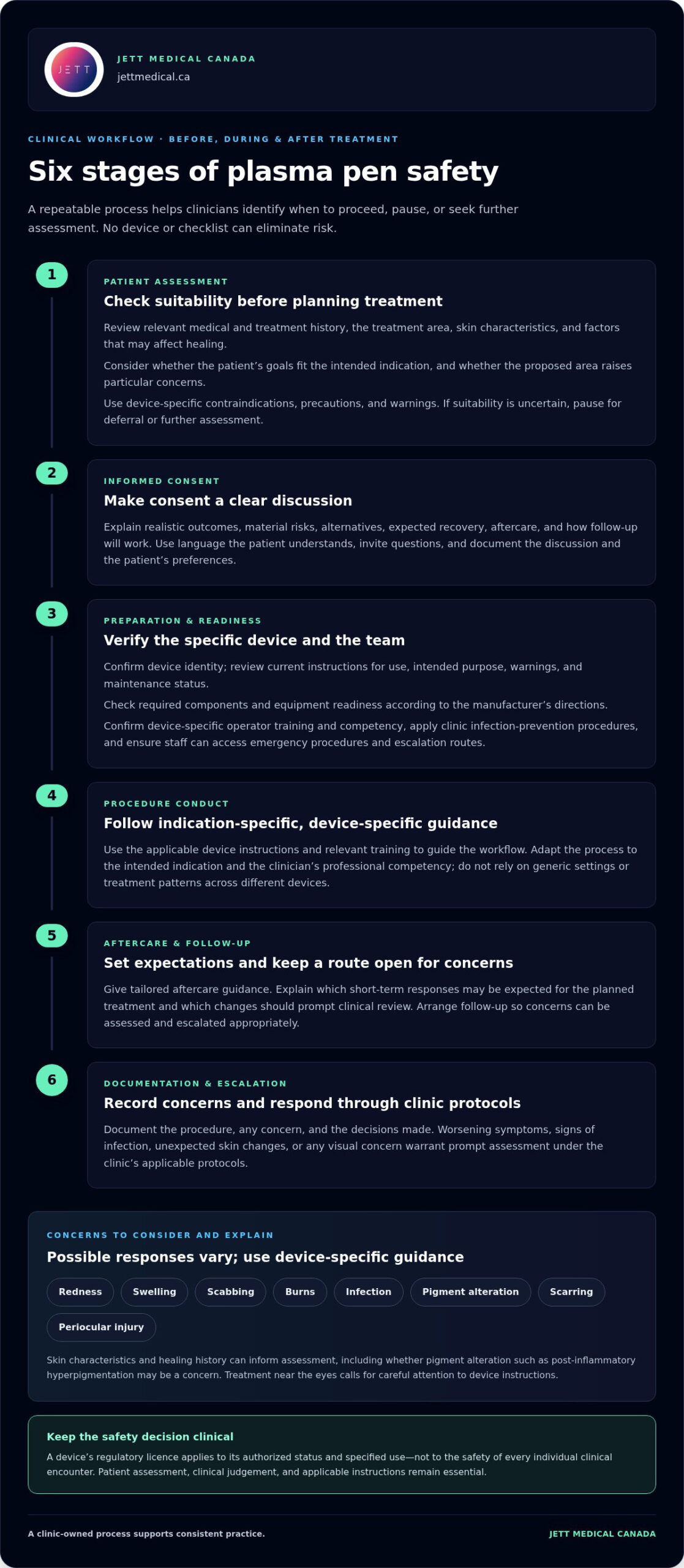
A practical safety checklist should connect six stages: patient suitability, informed consent, preparation, procedure conduct, aftercare, and escalation. Adapt each step to the intended indication, the clinician’s professional competency, and the current device instructions for use. Plasma technology involves an electrical discharge and ionized gas, often described as the fourth state of matter. The terminology alone does not establish how a specific device should be used.
A device’s regulatory licence applies to its authorized status and specified use, not to the safety of every individual clinical encounter. Clinical judgement, patient assessment, and adherence to applicable instructions remain essential.
Which concerns should a clinic consider before plasma pen treatment?
Potential concerns include redness, swelling, scabbing, burns, infection, pigment alteration such as post-inflammatory hyperpigmentation, and scarring. Skin characteristics and healing history can inform the assessment, including whether pigment alteration may be a concern. Treatment near the eyes also calls for careful attention to the device instructions and the potential for periocular injury. The type and duration of expected responses vary, so use device-specific guidance rather than treating one recovery pattern as universal.
Explain which short-term responses may be expected for the planned treatment and which changes should prompt clinical review. Worsening symptoms, signs of infection, unexpected skin changes, or any visual concern warrant prompt assessment under the clinic’s applicable protocols. Document the concern and the decisions made.
Why is complication prevention a whole-clinic responsibility?
Safety depends on coordinated work. A competent clinician assesses suitability, clear communication supports informed consent, equipment checks confirm readiness, and planned follow-up gives patients a route to report concerns. Staff should know their roles, where to find current device instructions, and how to record and escalate an unexpected event.
Regulatory status does not replace these safeguards or clinical judgement. For Canadian context, see this guide to Health Canada licensed plasma devices. Before adding a device to a clinical protocol, confirm its current licence status, permitted indications, warnings, and instructions.
Pre-procedure plasma pen safety checklist: assess the patient, indication, and device
A reliable pre-treatment review connects the patient, intended indication, operator, and specific device. Use the current instructions for use and relevant professional guidance to shape the checklist. Don’t assume a protocol or setting applies across different devices. Patient selection and device-specific instructions must be considered together: neither can establish suitability on its own.
How should clinicians assess patient suitability and expectations?
Review relevant medical and treatment history, the area to be treated, skin characteristics, and factors that may affect healing. Consider whether the patient’s goals match the intended use and whether the proposed treatment area raises particular concerns. Health Canada’s advisory describes circumstances in which plasma pens may pose health risks, including burns, pigment changes, and scarring. Apply this information alongside the exact device warnings and current clinical evidence. It does not replace an individual assessment.
Record findings that support proceeding, and identify circumstances that call for deferral, further assessment, or a different care plan. The device instructions may specify contraindications, precautions, and limits relevant to the intended indication. If suitability is uncertain, pause rather than filling gaps with assumptions.
Consent should be an informed discussion, not only a signed form. Explain realistic outcomes, material risks, alternatives, expected recovery, aftercare, and how follow-up will work. Use language the patient understands, invite questions, and document the discussion and the patient’s preferences.
What should the clinic verify about the device and team?
Before treatment, confirm the exact device identity and review its current instructions for use, intended purpose, warnings, and maintenance status. Check that required components are available and that the equipment is ready according to the manufacturer’s directions. Apply the clinic’s infection-prevention procedures, and make sure the team can access relevant emergency procedures and escalation routes.
- Patient and plan: Confirm identity, treatment area, indication, assessment findings, consent, and agreed expectations.
- Operator and equipment: Confirm the operator’s device-specific training and competency, device readiness, and compliance with applicable professional and jurisdictional requirements.
- Clinic readiness: Confirm infection-prevention measures, documentation processes, and access to emergency procedures.
Set a clear stop point: if the device, instructions, operator competency, or patient assessment doesn’t align with the planned use, defer and resolve the uncertainty before proceeding. A device’s regulatory status does not replace clinical judgement or adherence to its instructions. For broader context, review this professional plasma pen technology guide. Jett Medical Canada’s professional plasma technology resources provide information for clinics evaluating device-specific workflows.
During treatment: control the workflow without relying on generic settings
A controlled workflow helps the team verify that the planned treatment still matches the patient, indication, treatment area, and device instructions. Keep the current instructions for use accessible, and include a documented pause before activation. Procedural parameters must come from the applicable device instructions and qualified, device-specific training, not from generic settings or habits carried over from another system.
Which treatment-room controls support consistent practice?
Use this sequence as a workflow framework, adapting each step to the specific device, indication, and clinic protocol:
- Confirm identity and plan. Verify the patient’s identity, intended indication, treatment area, and documented consent. Invite the patient to raise any new concern before proceeding.
- Prepare the site and room. Follow the manufacturer’s preparation instructions and applicable infection-prevention guidance. Use protective equipment and room controls appropriate to the procedure and treatment area.
- Check the device. Confirm the device and required components are ready, and complete any relevant maintenance or readiness checks as directed by the manufacturer.
- Reconfirm before treatment. Ensure the operator is working within their training and the current instructions. Maintain clear communication with the patient and team throughout.
- Review immediately afterward. Assess the treatment area and the patient’s immediate response, then document relevant observations and next steps.
These checks support repeatability without replacing device-specific preparation or treatment directions with a generic sequence. A change in the patient’s condition, the treatment site, or equipment readiness should prompt a fresh assessment before continuing.
When should a clinician pause or stop the procedure?
Pause if the patient reports an unexpected symptom, the treatment area changes in a concerning way, or the equipment behaves unexpectedly. A break in the planned workflow, uncertainty about the device instructions, or a concern about protective measures is also a reason to stop and reassess. Don’t improvise technical adjustments to keep a procedure moving.
Follow the applicable device instructions and clinic escalation protocol. Assess the patient, determine whether further care or escalation is needed, and communicate the decision clearly. If the procedure is stopped, record when and why, the patient’s reported symptoms or observed findings, the assessment, and the next steps. Clear documentation supports continuity if follow-up or additional clinical review is required.
In practice, avoiding plasma pen complications in a clinical setting means treating workflow changes as safety signals. A deliberate pause protects the patient and gives the team time to make a reasoned decision.
After treatment: document, follow up, and respond to possible complications
Post-treatment safeguards turn patient instructions and clinical observations into a clear continuity-of-care plan. Tailor aftercare to the treated area, indication, device instructions, and clinician’s assessment. Explain expected healing responses, how to follow the recommended care plan, and which changes should prompt clinical review. Give the patient a clear route for reporting concerns and explain how the clinic will arrange follow-up. Don’t present one set of instructions as suitable for every device or treatment.
What belongs in the clinical record and follow-up plan?
Make the record specific enough to support later assessment and continuity of care. Include:
- Indication, treatment area, relevant assessment findings, and consent discussion.
- Device identification, operator, and relevant settings as documented for that device and procedure.
- Patient response, any unexpected observations, and the aftercare instructions provided.
- Planned follow-up, the route for raising concerns, and any clinical review arranged.
If a concern arises later, record the reported symptoms, timing, assessment, advice or care provided, and planned next steps. Keep documentation factual and contemporaneous, distinguishing the patient’s report from clinical observations.
How should a clinic respond when an adverse event is suspected?
Assess the patient promptly. If the concern may require urgent or emergency care, follow the clinic’s established emergency and escalation pathways. For other concerns, use qualified clinical judgement, current evidence, and the applicable device instructions to determine appropriate review and follow-up. Don’t rely on generic online treatment advice or assume that a response is routine without assessing the patient.
Document the event and actions taken, including any decision to stop treatment, arrange further assessment, or escalate care. The clinic should also determine whether the event requires reporting under applicable requirements and follow its reporting process. Canadian reporting obligations can depend on the circumstances and applicable requirements, so don’t assume one process applies to every event.
Device-specific information can help clinics review the equipment and instructions relevant to an event. This clinical comparison of professional plasma pen brands can support device evaluation, but it is not a substitute for patient assessment or event-management guidance. Clinics building device-specific adoption and training into their safety systems can also explore professional plasma technology and training support.
In practice, avoiding plasma pen complications in a clinical setting includes having a clear response plan after the procedure. Timely assessment, precise documentation, and appropriate follow-up help the team recognize concerns and make reasoned clinical decisions.
Build a repeatable plasma pen safety system with training and device-specific support
A checklist becomes more reliable when it’s part of a clinic-owned system rather than an individual clinician’s memory. Assign responsibility for maintaining the protocol, keep current device instructions accessible, and define how staff record competency, raise concerns, and learn from unexpected events. This makes avoiding plasma pen complications in a clinical setting an ongoing quality process, not a one-time pre-treatment check.
How can clinics keep plasma pen protocols current?
Designate a lead to review device instructions, relevant clinical evidence, and applicable professional requirements when information changes and as part of a scheduled protocol review. Keep a record of staff training and competency, and use case discussions and incident reviews to identify workflow gaps. Update the protocol when learning points affect patient assessment, equipment checks, documentation, aftercare, or escalation.
Requirements may vary by province or territory. Before describing or incorporating scope-of-practice, regulatory, or reporting requirements, verify the current rules that apply to the clinic and its practitioners. Clear version control also matters: staff should be able to identify the current protocol and find its supporting device instructions.
What should professional device training and support contribute?
Device-specific training should help the clinical team understand the device’s intended use, controls, warnings, limitations, and applicable instructions. Match training to the planned clinical application and the operator’s professional competency. Generic instruction alone may not prepare a clinician to apply the directions for a particular device or recognize when the planned use falls outside their training.
Jett Medical Canada provides training and support to doctors and nurses adopting plasma-based therapies. This support can contribute to implementation alongside clinic protocols, professional judgement, patient assessment, and ongoing review. Training and device licensing don’t guarantee a complication-free outcome; each clinic remains responsible for applying current instructions and appropriate safeguards.
As part of planning device-specific training and implementation, review Jett Medical Canada’s professional plasma technology and clinical support. A repeatable safety system helps teams make consistent decisions while keeping patient needs and clinical accountability central.
Make safer plasma pen practice part of every procedure
A consistent safety system links patient suitability and informed consent with device-specific instructions, a controlled treatment workflow, and clear follow-up. The goal of avoiding plasma pen complications in a clinical setting is to reduce preventable risks and support timely assessment when a concern arises, not to promise that complications can be eliminated.
Keep protocols current, record staff competency, and use case review to strengthen clinic processes. Device selection and training should align with the intended clinical application, the operator’s professional competency, and the applicable instructions. Confirm current product-specific Health Canada licence details and licensed indications before referring to a named device.
Jett Medical Canada supplies professional plasma devices to clinics across Canada and provides training and support for doctors and nurses adopting plasma-based therapies. This support can contribute to implementation alongside clinic-owned protocols and clinical judgement. Explore Jett Medical Canada’s professional plasma technology and support as you plan your clinical approach. With thoughtful preparation and ongoing review, your team can build a more consistent, patient-centred foundation for care.
Frequently Asked Questions
Can a Health Canada-licensed plasma pen still cause complications?
Yes. A Health Canada licence doesn’t guarantee an uncomplicated outcome for every patient or procedure. Risk can depend on patient factors, the treatment indication and area, operator competency, adherence to current instructions for use, and follow-up. Clinicians should verify the specific device’s licence and intended use, obtain appropriate consent, and follow clinic protocols. Licensing is one consideration in clinical decision-making, not a substitute for professional judgement or patient-specific assessment.
What are possible complications of plasma pen treatment?
Possible concerns can include skin injury, infection, pigment changes, scarring, delayed healing, or injury near sensitive areas. The risks and their relevance vary with the patient, procedure, and device, so this isn’t an exhaustive list or a prediction of what will occur. Clinicians should review current evidence and the device’s specific warnings, explain material risks during consent, and give patients a clear route to report concerns and receive follow-up.
How can clinicians reduce the risk of plasma pen complications?
A structured process can support avoiding plasma pen complications in a clinical setting. Assess the patient and indication, discuss risks and expectations, confirm operator competency and device readiness, and follow infection-prevention measures and the current device instructions. Plan aftercare and follow-up before treatment begins. A checklist improves consistency, but it can’t replace clinical judgement, appropriate training, or an assessment tailored to the patient and proposed procedure.
What should a clinic do if a patient reports a possible complication?
Arrange prompt clinical assessment and follow the clinic’s escalation protocol, considering the patient’s symptoms and treated area. Document the report, findings, advice provided, and next steps. Use current professional guidance and emergency pathways when indicated. Don’t rely on generic online treatment instructions. The clinic should also determine whether device-vigilance or other reporting requirements apply, then follow the relevant process. Keep follow-up arrangements clear so the patient knows how to communicate further concerns.
Does informed consent prevent plasma pen complications?
No. Informed consent supports decision-making, but it doesn’t prevent an adverse outcome or replace safe clinical practice. Discuss the proposed treatment, material risks, expected recovery, alternatives, aftercare, and when to seek assessment. Tailor the conversation to the patient, indication, and device’s current instructions, and invite questions. Document the discussion and confirm the patient’s understanding. Consent is one part of a broader safety process that includes patient assessment, competent practice, and follow-up.
Are the same plasma pen settings appropriate for every patient?
No. Don’t assume that parameters are interchangeable across devices, indications, treatment areas, or patients. Clinicians should use the applicable device instructions and training, applying professional judgement to the individual case. Universal settings or treatment parameters aren’t appropriate guidance for clinical use. Before relying on technical details, verify them against current, device-specific documentation and training. If the planned approach isn’t supported by those sources, pause and resolve the uncertainty before proceeding.
What should a plasma pen safety checklist include?
A practical checklist covers patient suitability and indication, consent, device identity and readiness, operator competency, infection prevention, protective measures, and the treatment record. It should also address tailored aftercare, follow-up, and escalation if concerns arise. Adapt the checklist to the specific device instructions, procedure, and applicable professional requirements. Review it periodically and after relevant incidents or guidance changes, so staff can use a current, workable process rather than relying on memory alone.