
When considering combining plasma therapy with biostimulators, first clarify what “plasma” means. Platelet-rich plasma (PRP) is prepared from a patient’s blood, while direct-current plasma devices deliver energy to tissue. These are different modalities, with distinct mechanisms, evidence and clinical considerations.
It is understandable that clinicians may consider pairing treatments to address different aspects of tissue quality or repair. But a plausible rationale does not establish that a combination is safe, effective or more beneficial than either treatment alone. Evidence for each modality separately cannot validate a combined protocol.
This guide explains how PRP differs from energy-based plasma and how biostimulators are used, then outlines how to assess evidence for a combination. It also covers practical questions about treatment goals, sequencing, patient factors and product-specific indications, including the relevance of a device’s Health Canada licence and intended use. For clinicians evaluating complementary approaches, decisions should be based on the specific modalities and available evidence, not on the appeal of treatment stacking.
Key Takeaways
- Assess evidence for combining plasma therapy with biostimulators separately from evidence on each treatment alone.
- Compare modalities by delivery route, intended target and evidence type before considering them in the same care plan.
- Use a structured clinical review: define the indication, examine product-specific information, document the rationale and plan monitoring.
- Distinguish professional direct-current plasma devices from injectable biostimulators. A shared treatment goal does not establish a combined benefit.
- Consider how clinician training and product-specific regulatory details inform responsible implementation, without treating them as proof of combination outcomes.
What does combining plasma therapy with biostimulators mean?
Combination therapy means considering two distinct modalities within one care plan, either as separate treatments or in a planned sequence. The phrase combining plasma therapy with biostimulators is not precise on its own. “Plasma” may refer to a blood-derived preparation or an energy-based device, and the two approaches should not be treated as equivalent.
Biostimulators are injectable materials intended to prompt a tissue response. Whether an injectable is appropriate alongside another modality depends on the treatment goal and the evidence for the specific products, indication and sequence. A proposed rationale is not proof of safety or added benefit. The clinical question is not simply whether both treatments relate to tissue remodelling, but whether evidence supports their use together in the relevant context.
Energy-based plasma and platelet-rich plasma are not interchangeable
Direct-current plasma is an energy-based device modality; platelet-rich plasma (PRP) is a preparation derived from a patient’s blood sample. A direct-current plasma device uses energy to act on tissue, whereas PRP is prepared from blood for clinical use. The word “plasma” refers to different things in these contexts. For an overview of the blood-derived approach, see Platelet-Rich Plasma (PRP).
This distinction matters when interpreting evidence. Research on PRP used with an injectable cannot automatically support a combination involving a direct-current plasma device. Before applying a study’s findings, check whether its modality, products, indication and treatment sequence match the proposed clinical use.
What clinicians mean by biostimulators
Biostimulator is a broad category, not one product or standardized treatment. Poly-L-lactic acid and calcium hydroxylapatite are examples of injectable materials discussed in this context, but they are not interchangeable. Their properties, intended uses, supporting evidence and product-specific indications may differ.
Clinicians should assess the specific injectable rather than infer suitability from the category name. Review the product information and applicable Canadian authorization or licensing details for the intended use. A shared goal, such as influencing tissue quality, does not establish that an injectable and a plasma modality work through the same mechanism or produce a better result together.
In practice, “combination” should describe a defined clinical plan, not simply two treatments mentioned in the same discussion. Before considering one, clinicians need evidence relevant to the actual modalities and products, the indication being addressed and the proposed timing. Evidence for either treatment alone, or a plausible biological explanation, is not enough to establish a combined benefit.
How plasma devices and injectable biostimulators differ in clinical action
These modalities may be considered within the same care plan, but they have different delivery routes and must be assessed using their own evidence. A shared interest in tissue remodelling does not mean they have equivalent mechanisms, address the same outcomes or provide added benefit when used together.
| Modality | Delivery route | Intended target | Evidence to assess | Key uncertainties |
|---|---|---|---|---|
| Direct-current plasma device | Energy delivered from a device to tissue | The tissue and clinical use specified for the device | Device- and indication-specific clinical outcomes | Intended use, patient population, treatment parameters and evidence for use alongside an injectable |
| Injectable biostimulator | Material administered by injection | A tissue response described for the specific product and indication | Product-specific outcomes, including clinical and patient-reported measures where studied | Product properties, indication, follow-up and evidence for the proposed combination |
| Platelet-rich plasma (PRP) | Prepared from a patient blood sample and administered clinically | The outcomes evaluated for the particular PRP preparation and use | Studies matching the preparation method, indication and comparator | Preparation differences and whether findings apply to a different modality or treatment plan |
Compare treatment roles without assuming synergy
Start by identifying what each treatment is intended to address and which outcomes have actually been measured. A device study might assess a specified tissue or aesthetic outcome, while an injectable study may evaluate a different endpoint. Patient-reported results, clinician assessments and mechanistic observations are different forms of evidence. One cannot stand in for another.
Mechanisms alone do not prove that a combination is clinically effective. A proposed biological interaction may support a research hypothesis, but it does not demonstrate an additional benefit for patients. Claims about synergy require direct evidence from the actual modalities and products used together.
Why study design matters when interpreting combination claims
Give greatest weight to controlled clinical studies that evaluate the proposed combination against a relevant comparator. Check whether the study identifies the device and injectable, matches the intended indication, and reports sample size, follow-up, outcome measures and adverse events. These details help clinicians judge how relevant a result is and what it can say about outcomes and safety.
Distinguish peer-reviewed clinical findings from marketing statements and preliminary mechanistic hypotheses. For example, the U.S. FDA’s FDA Safety Communication on Renuvion/J-Plasma Device addresses that specific device. It does not establish combination outcomes for other plasma devices or injectables, or Canadian product status. In Canada, product-specific licensing and intended use are relevant to device selection. For clinicians considering professional direct-current plasma technology, Jett plasma devices and clinician training provide product and implementation context, not evidence that a combination is validated.
What evidence supports combining plasma therapy with biostimulators?
To determine whether evidence supports combining plasma therapy with biostimulators, look for studies that evaluate the exact modalities and products together for a defined indication. Evidence about individual treatments or a proposed biological explanation cannot answer that question by itself. If a relevant combination study is not identified, the appropriate conclusion is that the evidence reviewed does not establish the combined outcomes, not that the combination is necessarily ineffective.
Three evidence categories to distinguish
- Direct combination studies: These evaluate the specific plasma modality and injectable biostimulator used together for a defined indication. Check whether the study reports the treatment details and outcomes needed to assess that combination.
- Studies of each treatment separately: Research on a plasma device, PRP or a particular injectable may inform its individual use. It cannot establish the benefit or risk of pairing it with a different modality.
- Mechanistic hypotheses: A proposed interaction may offer a rationale for research, but it remains a hypothesis unless clinical outcomes demonstrate a meaningful effect.
Evidence does not transfer automatically across plasma technologies or injectable products. A study involving PRP cannot substantiate a combination using an energy-based device. Similarly, findings for one biostimulator do not necessarily apply to another, because product properties, intended uses and supporting evidence can differ. Keep conclusions within the boundaries of the modality, product and patient population actually studied.
How to appraise a study of combined treatments
First, confirm that participants received the exact modalities and products under consideration, for the same or a comparable indication. Then examine the comparator. A combination compared only with no treatment cannot show whether it adds value over either treatment alone. Follow-up duration, sample size, clinically meaningful outcomes, patient-reported measures and adverse-event reporting all affect how confidently results can guide practice. Consider study limitations and conflicts of interest alongside the findings.
Separate direct evidence from plausible rationale
For combining plasma therapy with biostimulators, assess which indication is being treated, which modality and injectable are involved, and what sequence or interval is being evaluated. Patient selection, relevant clinical and patient-reported outcomes, follow-up and adverse events also need clear reporting. These details determine whether research applies to a proposed care plan.
Describe mechanistic explanations as hypotheses, not demonstrated synergy, unless product- and indication-specific clinical evidence supports a stronger conclusion. Any clinical conclusion should reflect the limits of the evidence. In Canada, device-specific licensing and intended use also belong in the assessment, but regulatory status alone does not establish that a combination is effective.
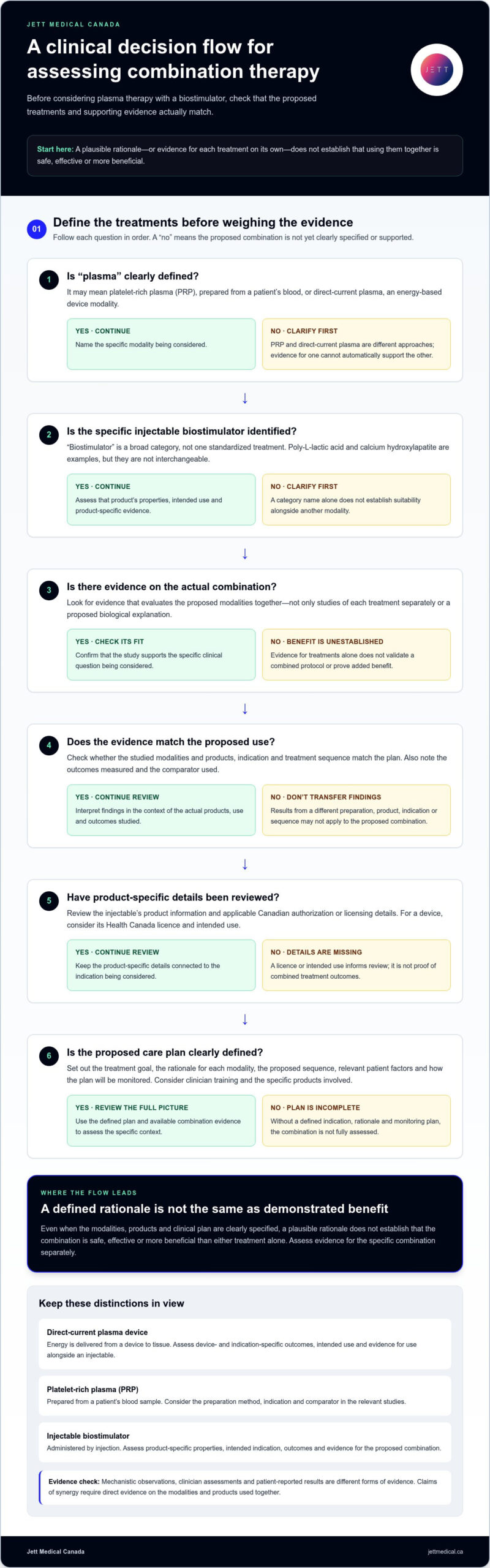
How clinicians can assess a potential combination responsibly
Considering a combined approach calls for a documented clinical rationale, not a default protocol. Qualified clinical judgement should guide each decision, with the patient’s goals, health history and evidence for the specific products at the centre of the assessment. A structured review helps identify what the evidence supports, where uncertainty remains and whether a combination is appropriate to consider.
Start with indication, patient factors and product information
Define the clinical objective first. Assess whether each modality has a relevant role for that indication and whether evidence supports using the specific device and injectable together. Evidence for individual treatments should not be treated as evidence for a combined plan.
Review patient history and individual risks alongside current product information. Consider contraindications, potential adverse effects, intended use and, for a device in Canada, its product-specific Health Canada licence details. Discuss alternatives, evidence limitations and uncertainty with the patient. Document the rationale and informed discussion in the clinical record, including why the proposed approach is appropriate for that individual.
Plan assessment and follow-up around evidence
Set expectations for how the clinical objective will be assessed. Where appropriate, record relevant baseline findings and select outcomes that correspond to the indication rather than relying on a general impression of improvement. Follow-up and monitoring should reflect professional standards and current information for the products involved.
Document the patient’s response and any adverse events. This record supports ongoing clinical assessment and helps distinguish expected observations from issues that may require further evaluation. Avoid assuming a universal treatment order, interval or eligibility rule. Those decisions require product- and patient-specific judgement supported by relevant evidence.
For device-specific context, see Direct Current vs AC Plasma: Clinical Precision and Health Canada Licensed Plasma Devices: The 2026 Clinician’s Reference Guide. These topics can inform modality and product review, but neither should be taken as evidence that a particular combination is validated. A careful assessment of combining plasma therapy with biostimulators keeps the indication, patient factors, product information, consent and monitoring connected throughout the decision process.
For professional plasma technology and clinician training context, explore Jett plasma devices and training support.
Where professional direct-current plasma technology fits in combination discussions
Jett professional plasma devices use patented direct-current technology. This is an energy-based modality, not an injectable biostimulator or a blood-derived PRP preparation. Device-specific use should be assessed on its own evidence and documentation. Any proposed combination requires evidence that directly supports the specific device, injectable, indication and treatment plan.
Jett devices should not be treated as validated combination products on the basis of their technology or intended role alone. A device’s documentation and licence relate to its specific model and authorized intended use. They do not, by themselves, establish that using it alongside a biostimulator is indicated, licensed or effective.
Assess plasma technology on its own evidence and intended use
For any model under consideration, review its current product documentation and applicable Health Canada licence details. Confirm its intended use and assess evidence for that device separately from evidence about injectable biostimulators. Keep any device-specific indication distinct from claims about a combined protocol.
For broader context on professional device considerations, consult Medical Grade Plasma Pen Canada: The Professional’s Guide to Licensed Technology. Product-specific information can guide device assessment, but it cannot substitute for clinical evidence evaluating the proposed combination.
Build implementation around clinician training and documentation
Responsible implementation involves qualified clinicians, appropriate patient selection and a clear record of clinical reasoning. Jett Medical Canada provides training and support for doctors and nurses adopting plasma-based therapies. These resources support implementation, but they are not evidence that combining a device with an injectable produces a particular outcome.
Before making model-specific claims, review current licensing, intended use and applicable certifications against the relevant product documentation. Document how the device’s role relates to the clinical objective, the patient’s individual factors and the available evidence. If the evidence does not address the proposed combination, preserve that uncertainty in clinical decision-making and patient communication.
For clinicians reviewing combining plasma therapy with biostimulators, separating device information from combination evidence supports a more precise assessment. Explore Jett professional plasma technology for information about the device platform and clinician training.
Keep combination decisions evidence-led
Responsible decisions about combining plasma therapy with biostimulators begin by distinguishing the modality: direct-current plasma devices and platelet-rich plasma are not interchangeable. A shared tissue-remodelling goal does not establish that treatments work better together. Assess evidence for the exact device, injectable, indication and sequence, recognizing that evidence for individual treatments cannot validate a combination on its own.
Clinical consideration should also reflect the patient’s goals and individual factors. Review product-specific information, discuss evidence limitations and uncertainty, document the rationale, and plan appropriate monitoring. For devices, assess current licensing, intended use and certifications against the specific model rather than relying on general claims.
Jett Medical Canada supplies professional plasma devices to clinics across Canada and provides training and support for clinicians adopting plasma technology. These resources support implementation, but are not evidence of combined-treatment outcomes. Explore Jett professional plasma technology to learn more about the device platform and training support. With careful assessment and clear documentation, clinicians can approach evolving treatment options with precision.
Frequently Asked Questions
Can plasma therapy be combined with biostimulators?
It may be considered within a clinician-led care plan, but that does not establish that the combination is safe, effective or appropriate for a particular patient. Before combining plasma therapy with biostimulators, assess the exact plasma modality, injectable product, indication and proposed sequence. Evidence for either treatment alone is not enough to demonstrate a combined benefit. The decision requires qualified clinical judgement and product-specific evidence.
Is plasma therapy the same as platelet-rich plasma?
No. “Plasma therapy” can refer to different approaches. Platelet-rich plasma (PRP) is prepared from a patient’s blood sample, while direct-current plasma devices are energy-based technologies that act on tissue. They have different delivery methods and evidence bases. Findings about PRP should not automatically be applied to device-based plasma, or vice versa.
What does a biostimulator do in aesthetic treatment?
A biostimulator is an injectable material intended to prompt a tissue response. Some are used with the aim of stimulating collagen production over time, but effects and evidence depend on the specific product and indication. Poly-L-lactic acid and calcium hydroxylapatite are examples, not interchangeable treatments. Clinicians should review each product’s properties, intended use, contraindications and supporting evidence rather than relying on the category name alone.
Is there clinical evidence for combining plasma devices with injectable biostimulators?
The evidence reviewed for a proposed combination needs to establish whether it supports or does not support the approach. If the available evidence does not evaluate the specific products together, a conclusion cannot be drawn about combined outcomes. That is not proof that a combination is ineffective. A relevant study would assess the actual device and injectable together for a defined indication, with appropriate comparators, follow-up, outcome measures and adverse-event reporting.
Can direct-current plasma and a biostimulator be used in the same treatment plan?
They can be assessed as distinct modalities within a care plan, but their inclusion together should not be assumed to be validated or appropriate. Review the specific device’s current intended use and product documentation, then assess the injectable’s indication and evidence separately. A shared tissue-remodelling goal does not prove added benefit. Any proposed combination requires evidence relevant to both products, the indication and the patient.
How should clinicians assess the sequence of plasma treatment and biostimulators?
There is no universal sequence or interval that applies to every device, injectable and patient. Clinicians should look for evidence evaluating the specific products and timing, and consider the indication, patient factors, product information and potential risks. Document the clinical rationale and discuss uncertainty with the patient. Avoid extrapolating a schedule from studies of different modalities or products.
What safety considerations matter when evaluating combined aesthetic treatments?
Review the patient’s history, individual risks, product-specific contraindications and current device documentation. Confirm the device’s intended use and applicable Canadian licensing details for its model. Discuss evidence limitations, alternatives, potential adverse effects and aftercare, and obtain informed consent in line with professional standards. Appropriate clinician training, documented reasoning and follow-up to monitor response and adverse events are also important.