
The more intensive-sounding option isn’t automatically the better one. For DC plasma versus RF microneedling for skin texture, the right fit depends on the concern being treated. DC plasma applies direct-current plasma precisely to targeted areas, while RF microneedling uses needles and heat to stimulate collagen across skin layers. Neither approach suits every texture concern, and combining treatments requires careful attention to timing and skin recovery.
It’s reasonable to want clearer pores, smoother acne scars or firmer-looking skin without choosing a treatment based on hype. This comparison explains how the two approaches differ, what each may address, how skin type and recovery factor into the decision, and why treatment timing matters. You’ll also find a practical decision guide to help match the technology to your main concern and understand what to discuss as part of a treatment plan.
Key Takeaways
- Match the treatment to the concern: RF microneedling is aimed at texture, pores and acne scars, while direct-current plasma offers a different approach to targeted skin concerns.
- Plan around a series rather than a single appointment: microneedling courses commonly involve several sessions spaced four to six weeks apart.
- Build recovery into your schedule. Plasma pen treatment can involve visible healing, while microneedling recovery is generally shorter.
- Skin tone matters when weighing plasma treatment, as darker Fitzpatrick skin types carry a higher risk of post-inflammatory hyperpigmentation.
- Use the decision guide to clarify your priorities, from scar and pore refinement to tightening, skin-type considerations and treatment timing.
Choosing a treatment based on skin concerns
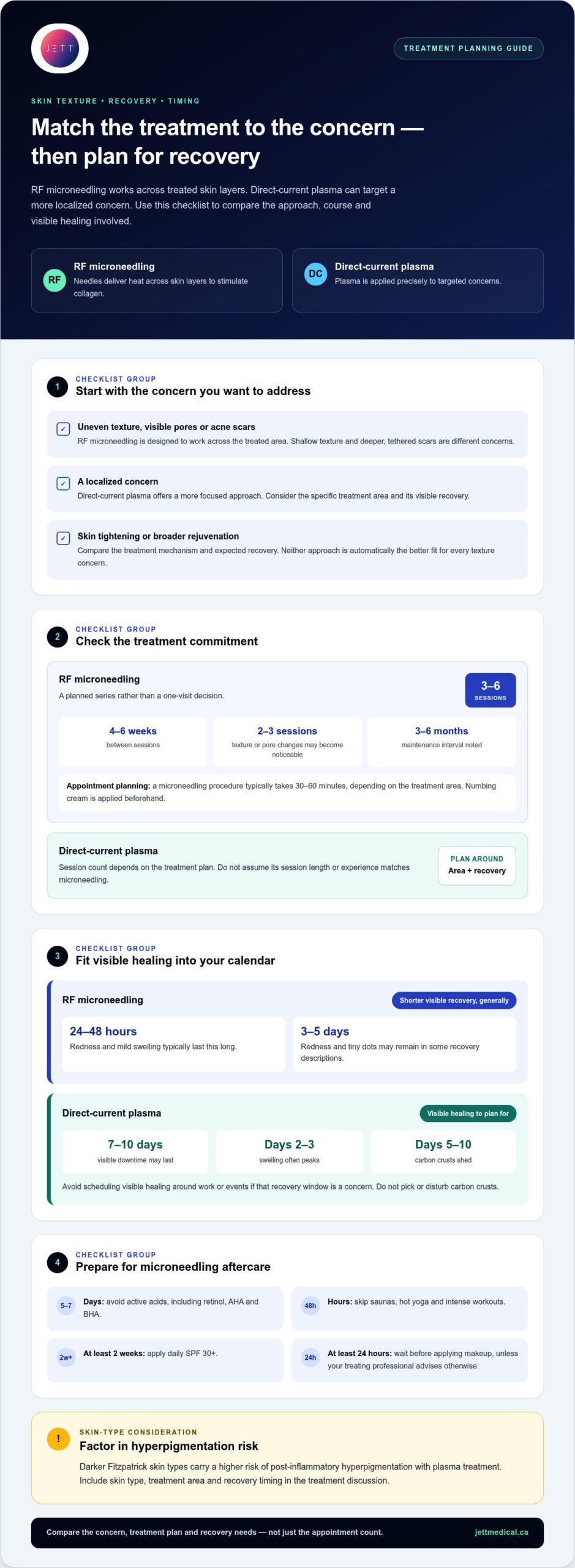
The question of DC plasma vs RF microneedling for skin texture comes down to the concern, treatment area and approach you prefer. RF microneedling combines needles with heat to stimulate collagen across skin layers. Direct-current plasma can be applied precisely to targeted concerns. Neither treatment is automatically more effective for every texture issue; the intended result guides the comparison.
Start by identifying the change you want to address. For uneven texture, visible pores or acne scars, RF microneedling is designed to work across the treated area. For a localized concern, direct-current plasma offers a more focused approach. Skin tightening is another consideration, but the treatment mechanisms and expected recovery differ. Setting a clear priority, such as scar refinement rather than general rejuvenation, helps narrow the options.
| Option | Approach | Typical course | Planning factor |
|---|---|---|---|
| RF microneedling | Needles deliver heat across skin layers | 3 to 6 sessions, 4 to 6 weeks apart | Allow time for a series and maintenance |
| Direct-current plasma | Precisely applied plasma for targeted concerns | Session count depends on the treatment plan | Consider the specific area and visible recovery |
For RF microneedling, a typical course is 3 to 6 sessions spaced 4 to 6 weeks apart. Texture and pore refinement may become noticeable after 2 to 3 sessions. Maintenance sessions every 3 to 6 months can help sustain improvement. These intervals make the treatment a planned course, not a one-visit decision.
Session experience also affects scheduling. A microneedling procedure typically takes 30 to 60 minutes, depending on the treatment area. Numbing cream is applied before microneedling. Direct-current plasma uses a different treatment method, so its session length and experience shouldn’t be assumed from microneedling appointments.
Compare treatment intensity by considering the area and process, not just the appointment count. RF microneedling uses needles and heat across skin layers; plasma treatment applies direct-current energy with precision. The number and spacing of RF sessions, along with any maintenance, also affect the overall commitment. Compare treatment plans by their sessions, timing and recovery needs rather than assuming one option costs less.
Choose RF microneedling when broader texture, pore or acne-scar concerns are the priority; consider direct-current plasma when precision for a targeted concern matters most.
Downtime and recovery
Recovery differs because direct-current plasma and RF microneedling affect the skin differently. DC plasma treatment can leave visible downtime lasting 7 to 10 days. Carbon crusts shed between 5 and 10 days after treatment, while swelling often peaks on days 2 to 3. These temporary effects are important to consider when planning around work or events.
For RF microneedling, redness and mild swelling typically last 24 to 48 hours. Some descriptions of RF recovery include redness and tiny dots for 3 to 5 days. The treated area and the procedure’s intensity influence how noticeable those marks are. Microneedling punctures close and heal within a few hours to a few days.
What are the risks, side effects, and recovery time for DC plasma treatment? The expected visible effects include carbon crusts and swelling, with downtime lasting 7 to 10 days and swelling peaking on days 2 to 3. Plan for the crusts to shed between 5 and 10 days after treatment, rather than picking or disturbing them.
Pain is separate from visible downtime. RF microneedling uses needles and heat, and numbing cream is applied before the procedure. That preparation addresses the treatment experience, but it doesn’t make recovery immediate. With DC plasma, carbon crusts form on the treated surface, so recovery involves visible healing rather than only short-lived redness.
After microneedling, use a structured recovery plan. Avoid active acids, including retinol, AHA and BHA, for 5 to 7 days. Skip saunas, hot yoga and intense workouts for 48 hours. Apply daily SPF 30+ for at least 2 weeks, and wait at least 24 hours before applying makeup, unless the treating professional advises otherwise.
- First 24 to 48 hours: Expect possible redness or mild swelling after RF microneedling.
- Days 2 to 3: DC plasma swelling can peak, especially around the eyes.
- Days 5 to 10: DC plasma carbon crusts shed during visible recovery.
- First 2 weeks: Maintain daily SPF 30+ after microneedling.
Choose timing around the recovery pattern, not just the appointment itself. An event during the following week may conflict with DC plasma’s 7 to 10 days of visible downtime. RF microneedling may suit a shorter recovery window, but redness, swelling or tiny dots can remain for several days. Schedule treatments when aftercare steps can be followed consistently.
Recovery also varies by treatment area. Swelling after DC plasma can be more pronounced around the eyes, while RF microneedling marks appear across the treated surface. For either procedure, follow the aftercare instructions provided and avoid disrupting healing skin.
RF microneedling for texture, pores and acne scars
RF microneedling combines tiny needles with heat to stimulate collagen across multiple skin layers. This makes it relevant to uneven texture, enlarged-looking pores and some acne scars. Potential benefits depend on the concern: shallow textural irregularities differ from deeper, tethered scars, and the two should not be treated as the same target.
What is DC plasma skin treatment, and how does it improve skin texture? It applies direct-current plasma precisely to targeted areas and is designed to address concerns such as scars. Its approach differs from RF microneedling, which delivers heat through needles to stimulate collagen across skin layers.
For RF microneedling, a course commonly involves 3 to 6 sessions spaced 4 to 6 weeks apart. Texture and pore refinement may become noticeable after 2 to 3 sessions, while results can continue settling for up to three months. Those milestones help set expectations: early changes aren’t the same as the full response.
Acne scars vary in depth and shape. A broad area of shallow irregularity may call for a different plan than distinct depressions. RF microneedling’s needle-and-heat mechanism targets multiple skin layers, but pigmentation and scar texture are separate concerns. A change in surface texture doesn’t necessarily mean a dark mark will change at the same pace.
Fine lines and mild laxity may also factor into a texture plan, since collagen stimulation can support skin tightening. Still, RF microneedling isn’t interchangeable with every tightening treatment. The treated area, scar pattern and main goal help determine the approach and how progress is assessed.
Who is qualified to perform DC plasma and RF microneedling in Canada, and what regulations apply? Qualifications and oversight depend on provincial or territorial frameworks, the practitioner’s authorized scope and the procedure. Device-specific training and competence are important considerations for both treatments.
- For pores: Track whether visible pore refinement follows the planned RF series.
- For acne scars: Identify whether scars are shallow, depressed or accompanied by pigmentation.
- For fine lines or laxity: Clarify whether texture or tightening is the primary goal.
Use these distinctions to set a practical baseline before treatment. Note whether your main concern is cheek scarring, uneven texture or fine lines. Review progress over time, allowing for the full healing period before judging results. RF microneedling outcomes can continue settling for up to three months, so timing matters when comparing photographs or planning another procedure.
In the DC plasma versus RF microneedling comparison, the better fit depends on the target: broader textural change, pores and acne scars point toward RF microneedling, while precisely targeted concerns may suit direct-current plasma. Skin tightening, pigmentation and healing needs should also inform the decision.
Skin tightening and collagen stimulation
Collagen provides structural support, while the body produces less collagen from a person’s mid-20s onwards. RF microneedling combines needles and radiofrequency heat to trigger collagen production across multiple skin layers. This makes it relevant to concerns such as mild laxity, fine lines and uneven texture, although tightening develops as the skin’s healing response progresses.
Microneedling creates tiny, controlled micro-injuries that activate the skin’s repair response and collagen and elastin production. Radiofrequency adds heat to that process. The response is gradual: microneedling results are typically visible within 4 to 6 weeks as collagen develops, while RF skin-tightening results can take up to 12 weeks as collagen rebuilds.
Needle-free RF skin tightening is a different treatment from RF microneedling. A typical plan for RF skin tightening involves 6 to 12 sessions, spaced weekly or fortnightly. Top-up treatments are required every 4 to 8 weeks after the starter course. These schedules describe RF skin tightening, not the 4-to-6-week spacing used for RF microneedling courses.
Direct-current plasma offers a different mechanism. Its energy is applied precisely to targeted concerns, rather than delivered through microneedling needles and radiofrequency heat. To guide a treatment decision, distinguish a small, specific area from broader laxity or texture concerns. This helps clarify whether targeted plasma or a collagen-stimulating RF approach better matches the intended treatment area.
Skin tone and pigment response also matter when considering energy-based treatments. Redness and swelling can occur after RF microneedling, and redness may be part of the skin’s short-term response. These visible effects do not measure collagen remodelling; they describe the surface response. Assessing skin tightening requires time for healing and collagen changes to develop.
Use these criteria to compare treatment goals:
- Broader laxity or fine lines: RF microneedling combines needles and heat to stimulate collagen across skin layers.
- Gradual tightening: Allow for collagen remodelling over weeks, rather than judging results immediately.
- Targeted concern: Direct-current plasma applies energy precisely to selected areas.
- Needle-free RF: Distinguish its weekly or fortnightly starter schedule from RF microneedling.
For example, someone focused on mild laxity across the cheeks may compare collagen-stimulating RF with a targeted approach for a localized concern. The treatment area, desired change and tolerance for needles guide that comparison. Skin tightening isn’t an immediate surface effect: RF skin-tightening results may take up to 12 weeks as collagen rebuilds.
Plan around the full treatment timeline. RF microneedling stimulates a healing response, while needle-free RF has its own starter and top-up schedule. Comparing the mechanisms, treatment area and time needed for collagen remodelling offers a more useful basis for choosing than redness or swelling alone.
Skin type and hyperpigmentation considerations
Skin tone can affect the risk profile of direct-current plasma treatment. Plasma pen treatment is best suited to Fitzpatrick skin types I through III. Types IV through VI carry an elevated risk of post-inflammatory hyperpigmentation, or darkening after inflammation. This distinction matters when the concern includes existing pigment changes, not only texture or wrinkles.
Traditional microneedling and RF microneedling are considered appropriate for all skin types and tones. This gives them a different suitability profile from plasma pen treatment, but it doesn’t make every treatment plan identical. The assessment should account for the treatment area, current skin condition and primary goal, such as acne-scar texture or fine lines.
Melasma and post-inflammatory hyperpigmentation are pigment concerns, so distinguish them from textural irregularities before selecting a procedure. For example, someone may have both acne scarring and uneven pigmentation. The treatment goal should identify which concern takes priority, since a texture-focused plan and a pigment-focused plan are not interchangeable. Skin tone, past pigment response and treatment area all inform that discussion.
Collagen and elastin stimulation is a separate objective from pigment correction. Microneedling works through controlled micro-injuries that activate the skin’s healing response and collagen production. RF microneedling adds heat through the needles. These mechanisms can address texture concerns across skin layers, while pigment-related risks still require consideration based on skin type.
- Fitzpatrick I through III: Plasma pen treatment is described as best suited to these skin types.
- Fitzpatrick IV through VI: Plasma pen treatment carries elevated post-inflammatory hyperpigmentation risk.
- All skin types and tones: Traditional and RF microneedling are considered appropriate options.
- Mixed concerns: Separate pigment goals from scars, wrinkles and texture before planning treatment.
Timing also matters. RF microneedling courses are typically spaced 4 to 6 weeks apart, allowing the skin to heal between sessions. A treatment plan should consider skin tone and pigment history throughout the series, not only at the first appointment. A clinic can use those details to set the treatment area and sequence around the main concern.
For someone with darker skin and acne scars, the elevated pigment risk associated with plasma is a key factor in comparing options. For someone whose main concern is uneven texture, RF microneedling offers a distinct needle-and-heat mechanism and is considered appropriate across skin tones. The comparison should keep pigment, laxity and texture as separate outcomes.
Review direct-current plasma technology as part of understanding how precisely applied plasma differs from microneedling. Use skin type, pigment history and the intended treatment target to guide that comparison, especially when melasma or prior post-inflammatory darkening is part of the concern.
Jett Medical Canada: Jett Plasma Pen Medical
Jett Medical Canada offers Jett Plasma Pen Medical, a device using patented direct-current plasma technology for precision-focused applications. Its intended treatment areas include scars, pigmentation and wrinkles, making it relevant when targeted plasma is part of the comparison with RF microneedling. The company’s products are Health Canada licensed. Understanding the device’s role can help clarify how direct-current plasma fits alongside other approaches to skin concerns, without treating the technologies as interchangeable.
For information about Jett Plasma Pen Medical and its intended applications, visit Jett Medical Canada.
Set a clear direction for your next step
Before selecting a technology, decide which change matters most to you and how you’ll recognize progress. A focused goal keeps the discussion practical: distinguish the appearance you want to address from the treatment method you’re considering. That makes the comparison between DC plasma and RF microneedling for skin texture more purposeful, grounded in your priorities rather than a general preference for one device type.
Jett Medical Canada offers Jett Plasma Pen Medical, Jett Plasma Lift Medical and Jett Plasma Medical II. If you’re considering direct-current plasma technology, explore how these devices relate to your goals and treatment context. A clear discussion of your intended application can help you take the next step with greater direction.
Contact Jett Medical Canada to discuss options, and move forward with an informed plan for your skin concerns.
Frequently Asked Questions
Does it work on every skin tone?
RF microneedling is considered appropriate for all skin types and tones; plasma pen treatment is best suited to Fitzpatrick skin types I through III. Types IV through VI have an elevated risk of post-inflammatory hyperpigmentation with plasma pen treatment. If you have melasma or a history of dark marks after inflammation, distinguish pigment concerns from textural ones before comparing treatments. Skin tone affects suitability, not just the treatment area.
How Many Sessions Are Needed?
A typical microneedling course involves 3 to 6 sessions, spaced 4 to 6 weeks apart. Texture and pore refinement may become noticeable after 2 to 3 sessions, so early changes don’t necessarily reflect the full course. Maintenance sessions every 3 to 6 months can help sustain improvement. The number of appointments depends on the concern being treated and how the skin responds during the series.
How long do results last?
Results from both microneedling treatment types are described as lasting 1 to 2 years. That timeframe is a guide, not a scheduling guarantee. Maintenance, the original concern and the treatment plan can affect how long changes remain visible. For example, someone tracking pore refinement can compare consistent photographs over time, then discuss maintenance when the improvement begins to diminish.
How long does the skin stay red?
Redness and mild swelling after RF microneedling typically last 24 to 48 hours. Redness and tiny pinpoint marks can remain for 3 to 5 days, so plan around the possibility of visible signs beyond the first couple of days. For an event, allow recovery time before deciding whether the skin looks settled enough. Avoid judging the final texture change by early redness.
Radiofrequency With or Without Needles: Which One for Your Skin?
Choose RF microneedling when the treatment goal involves texture, pores or acne scars and a needle-based approach fits your plan. Needle-free radiofrequency is used for skin tightening without needles. These modalities have different treatment schedules and aren’t performed on the same day. They can both occur within the same year, but timing should account for each treatment’s course and recovery needs.
How does RF microneedling improve skin texture, acne scars, and pores?
RF microneedling uses tiny needles to deliver radiofrequency heat into skin layers, stimulating collagen production. This mechanism can target uneven texture, visible pores and some acne scars. For example, someone with shallow cheek scarring and enlarged-looking pores could track each concern separately in progress photographs. Results can continue settling for up to three months, so assess changes over time rather than immediately after treatment.
What skin concerns and skin types are suitable for DC plasma or RF microneedling?
RF microneedling is considered appropriate for all skin tones and can address texture, pores and acne scars. Plasma pen treatment is best suited to Fitzpatrick types I through III, with elevated post-inflammatory hyperpigmentation risk for types IV through VI. Direct-current plasma is designed for targeted concerns such as scars, pigmentation and wrinkles. Separate pigment, laxity and texture goals when comparing the options.
What are the risks, side effects, and recovery time for RF microneedling?
Common short-term effects include redness and mild swelling, typically lasting 24 to 48 hours; tiny marks can remain for 3 to 5 days. In October 2025, the FDA reported serious complications with certain RF microneedling uses, including burns, scarring, fat loss, disfigurement and nerve damage. These reports make treatment technique and intended use important considerations. Follow the procedure’s aftercare instructions during recovery.