
The most advanced device isn’t automatically the right choice for a patient with dry eye. Effective dry eye disease management technology should be selected according to the clinical presentation and likely underlying mechanisms, not novelty alone. Meibomian gland dysfunction, tear-film deficiency, inflammation and eyelid abnormalities can call for different management strategies, so technologies with distinct purposes aren’t interchangeable.
Persistent symptoms rarely tell the whole clinical story. The challenge is to connect assessment findings to a suitable care plan while weighing evidence, safety, workflow and device-specific scope. This guide explains how phenotype-led care can inform technology selection, describes the roles of major in-office approaches and considers ophthalmic plasma as one option, not a universal solution. It also outlines practical adoption considerations for Canadian clinical practice, including the importance of understanding a device’s authorized indication, relevant evidence and training needs. The aim is to provide a clear framework for evaluating clinical fit and integrating technology responsibly into individualized dry-eye management.
Key Takeaways
- Use dry eye disease management technology to address a defined clinical target, not as a substitute for diagnosis or individualized care.
- Distinguish approaches such as light-based treatments and direct-current plasma by their intended targets; they aren’t interchangeable.
- Compare technologies by evidence, indication, workflow and limitations to assess their fit for your clinic and patients.
- Use a practical pathway that moves from assessment and target selection to documentation and reassessment, within professional scope and device instructions.
- Assess how Edge O Tech fits within ophthalmic plasma options, using device-specific evidence, indications and training needs to inform adoption.
Dry eye disease management technology starts with understanding the condition
Dry eye disease is a multifactorial disorder of the ocular surface. Tear-film instability and related changes can cause symptoms, clinical signs, or both. Assessment considers the patient’s experience alongside examination findings and contributing factors, rather than treating discomfort as a diagnosis on its own. The Understanding Dry Eye Disease overview provides background on causes, symptoms, diagnosis and management.
Phenotype-led care connects a patient’s symptoms, ocular signs and likely disease mechanisms to an appropriate care plan. Technology is considered only when it addresses a defined clinical target. This keeps a device in its proper role: a possible assessment or treatment tool, not a stand-alone diagnosis or universal solution.
Why dry eye does not have one treatment pathway
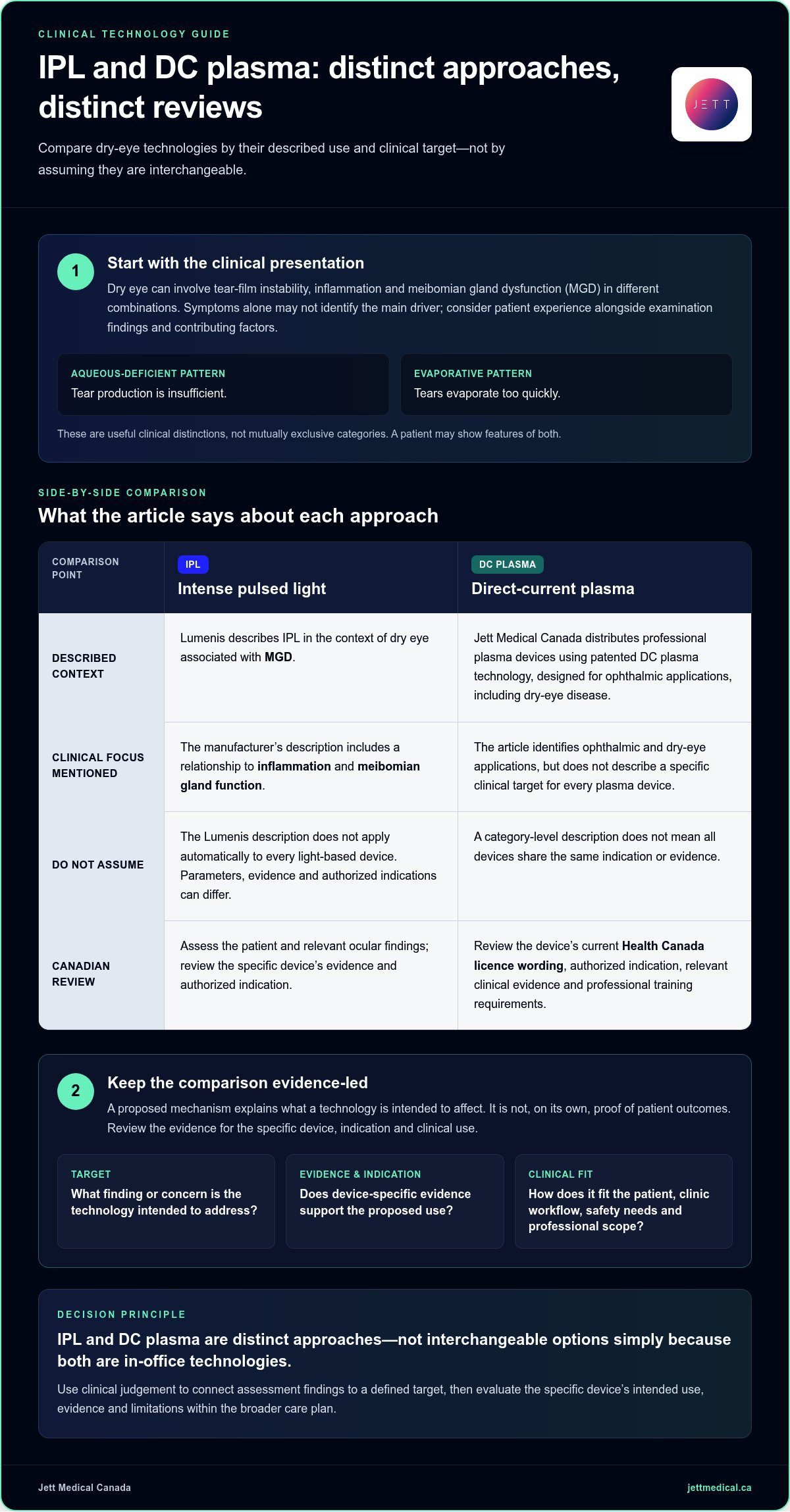
Tear-film instability, inflammation and meibomian gland dysfunction can contribute to dry eye in different combinations. Clinicians often distinguish aqueous-deficient patterns, where tear production is insufficient, from evaporative patterns, where tears evaporate too quickly. These are useful clinical distinctions, not mutually exclusive categories. A patient may show features of both, and the relative importance of each pattern can vary across the ocular surface.
Symptoms alone may not reveal the main driver. Burning, fluctuating vision, grittiness and irritation can occur across different presentations, while signs and contributing factors require clinical assessment. The American Academy of Ophthalmology’s overview describes dry eye as challenging to manage because it can have multiple causes and manifestations. For technology selection, this complexity has practical consequences: a tool designed for one target may not address another, even when patients report similar discomfort.
What clinicians mean by dry-eye management technology
Here, technology broadly refers to tools or devices used in assessment or therapeutic care. Diagnostic instruments may help clinicians characterize ocular-surface findings, while in-office devices may be intended to address a specific therapeutic target. Keep these roles distinct. A measurement tool can inform clinical judgement, but it does not independently establish a diagnosis or determine the treatment plan.
Technology-based interventions are one part of management. Medications, foundational care and monitoring remain separate components of a plan and may be used alongside, before or instead of a device-based intervention, according to the patient’s needs. For example, identifying an evaporative pattern does not automatically make a light-based approach appropriate. The clinician must determine whether the relevant target and device indication align with the individual presentation.
Device selection depends on clinical judgement, intended indication and evidence relevant to the proposed use. Ask what the technology is designed to do, which findings make that target clinically relevant, and how it fits within the broader care plan. This is the foundation for comparing dry eye disease management technology by clinical purpose rather than novelty or promotional language.
How dry-eye technologies address different clinical targets
Technology categories are most useful when compared by their intended clinical target, not by brand language or broad claims of benefit. A device may be designed for a particular ocular-surface concern, but that does not mean it suits every patient with dry eye. Clinicians need to connect observed findings to the device’s specific intended use, then assess whether the available evidence supports that application.
A proposed mechanism describes what a technology is intended to affect. Evidence for the specific device, indication and clinical use is needed to assess patient outcomes. This distinction helps teams interpret manufacturer descriptions without treating a plausible target as proof of effectiveness or assuming that different technologies are equivalent.
IPL and meibomian gland dysfunction
Lumenis describes intense pulsed light (IPL) in the context of dry eye associated with meibomian gland dysfunction (MGD), including its relationship to inflammation and meibomian gland function. This is the manufacturer’s description of its approach, not a description to apply automatically to every light-based device. Device parameters, evidence and authorized indications can differ. A qualified clinician must assess the patient and relevant ocular findings when considering IPL and a treatment plan.
Direct-current plasma in ophthalmic care
Jett Medical Canada distributes professional plasma devices that use patented direct-current (DC) plasma technology and are designed for ophthalmic applications, including dry-eye disease. That category-level description does not mean all devices share the same indication or evidence. For Canadian clinical use, review the specific device’s current Health Canada licence wording and authorized indication, along with relevant clinical evidence and professional training requirements.
IPL and DC plasma are distinct approaches, not interchangeable options simply because both involve in-office technology. Review their descriptions, proposed targets and supporting evidence separately. A manufacturer’s account of IPL in relation to MGD, for example, cannot establish the mechanism, indication or outcomes of a plasma device. Nor can a category-level description replace device-specific documentation.
Start a practical comparison with precise questions: What clinical target is named? What indication applies to this specific device? What type of evidence supports its use, and in which patient group? What limitations or uncertainties should inform clinical decisions? In Canada, review the device-specific licence wording. A general statement about a technology category is not a substitute for an individual device’s authorized indication.
For clinicians assessing plasma as one possible component of individualized care, the ophthalmic plasma technology buying guide provides device-focused context. Jett Medical Canada also offers professional plasma technology for clinics, with training and support for clinical adoption.
Compare dry-eye management technologies by evidence, indication, and fit
A useful comparison starts with the clinical question, then examines what each approach is intended to address and what evidence supports its use. The table distinguishes technology categories from foundational care and monitoring, which remain part of clinical management rather than competing devices. Manufacturer descriptions are identified as such and should not be read as independent evidence of patient outcomes.
| Approach | Potential target or role | Evidence and indication to review | Workflow and limitations |
|---|---|---|---|
| Assessment and monitoring tools | Characterize or track relevant ocular-surface findings. | Review evidence for the specific measure and its clinical interpretation. | Supports, but does not replace, practitioner assessment or establish a diagnosis alone. |
| IPL | Manufacturer-described use includes dry eye associated with meibomian gland dysfunction (MGD). | Lumenis describes IPL in relation to MGD and discusses inflammation and gland function. Evaluate independent evidence and the particular device’s indication separately. | Requires qualified clinical assessment. Manufacturer protocols are specific to that device and should not be generalized. |
| Thermal or gland-directed devices | May be intended to address a gland-related clinical target. | Check the device-specific evidence, patient group, outcomes measured and authorized indication. | Workflow and limitations vary by device; the category label alone does not establish suitability. |
| Direct-current plasma | Jett Medical Canada describes its plasma technology for ophthalmic applications, including dry-eye disease. | Assess the specific device’s clinical evidence and current Health Canada licence wording and authorized indication. | Professional adoption requires device-specific review and training; category-level claims do not establish outcomes. |
| Foundational care and monitoring | Provide ongoing management context and a basis for reassessment. | Consider clinical guidance and the individual care plan, rather than comparing these elements as devices. | May continue alongside or independently of a device-based intervention, according to clinical judgement. |
How to interpret evidence for a device and indication
Separate mechanistic rationale from clinical studies, regulatory status and real-world experience. A proposed mechanism explains why an approach might be relevant; it does not establish patient benefit. Check whether studies concern the same device, indication, patient group and outcome under consideration. Licensing or certification provides regulatory or quality context, but does not prove comparative superiority.
When a technology may not fit the clinical question
If the patient’s presentation does not align with the device’s intended target, the rationale for using it is weaker. Assess patient selection, contraindications and operational requirements using device-specific documentation and practitioner judgement. A new device does not replace individualized, multimodal care. It may have a role only when its indication and evidence fit the clinical question.
For clinics evaluating this category, Jett Medical Canada’s professional plasma technology is supported by training and adoption support for doctors and nurses.
Build a practical clinic pathway for technology-supported dry-eye care
A consistent pathway helps clinic teams connect clinical findings to a justified technology decision and follow-up plan. Technology selection follows assessment and indication, not novelty. The steps below support organized decision-making while keeping diagnosis and treatment within the practitioner’s scope and the device’s instructions for use.
- Assess. Record the patient’s reported symptoms, relevant examination findings, history and prior management. Consider whether additional assessment or monitoring is needed before selecting an intervention.
- Identify the clinical target. State the specific finding or management need the proposed technology is intended to address. Avoid choosing a device based only on a broad dry-eye label.
- Review evidence and indication. Examine evidence relevant to the specific device, intended use, patient group and outcomes. For Canadian practice, review the current device-specific Health Canada licence wording and applicable instructions.
- Select. Decide whether the target, indication and evidence fit the patient’s presentation and the clinic’s capacity to use the technology appropriately. If they don’t align, consider other elements of care.
- Document. Record the rationale, relevant discussion with the patient, selected approach and planned review. Follow applicable device documentation requirements.
- Reassess. Review the patient’s response and relevant findings at an appropriate follow-up, then decide whether to continue, adjust or reconsider the plan.
From assessment to a documented technology decision
A clear record makes clinical reasoning traceable. Include relevant symptoms, findings and prior management, then connect the identified target to the specific device indication and supporting evidence. Document material uncertainties and discuss them with the patient in clear, balanced language. Set expectations without promising a result. Explain how the proposed technology fits the care plan and what will be reviewed at follow-up.
Training, workflow, and ongoing evaluation
Before adoption, plan staff training, role clarity, patient communication and the steps needed to use the device according to its instructions. Establish how the team will record device use and assess response over time, including who is responsible for follow-up. Jett Medical Canada provides training and support to doctors and nurses adopting plasma-based therapies. Its Health Canada licensed device reference provides regulatory context; review current, device-specific wording when assessing a clinical application.
Technology should remain one component of individualized care, not a replacement for ongoing assessment or other appropriate management. A defined review process helps the clinic assess whether an intervention remains aligned with the patient’s clinical needs. For clinics considering professional plasma technology, explore Jett Medical Canada’s clinical adoption support.
Assess Jett Medical Canada’s ophthalmic plasma technology in context
Jett Medical Canada is a national distributor of professional plasma technology for clinics. Its offerings include Edge O Tech, and the company provides training and support to doctors and nurses adopting plasma-based therapies. For Canadian clinical teams, the key question isn’t whether plasma is new. It’s whether a specific device, indication and evidence base fit a defined clinical need and the clinic’s capacity to implement it responsibly.
Where a plasma device belongs in a considered care plan
Ophthalmic plasma is one potential technology option within individualized dry-eye management. It doesn’t replace assessment, other appropriate care or follow-up. Any clinical application should be grounded in evidence relevant to the specific device and the exact indication in its documentation. A broad description of a technology category alone cannot establish suitability for an individual patient.
For broader context on professional devices, the medical-grade plasma pen guide discusses licensed technology for professional use. It complements, but does not replace, device-specific review of clinical evidence and authorized use.
Next steps for Canadian clinical teams
Before adoption, organize the evaluation around intended use, relevant evidence, licensing, training and workflow. In regulatory discussions, use the exact Health Canada licence wording and device documentation rather than paraphrasing an indication or extending a general category claim to a specific device. Confirm that clinic roles, patient communication and recordkeeping support use within professional scope and applicable instructions.
A structured review can help teams identify what they know and what still requires assessment:
- Intended use: Identify the clinical target and compare it with the specific device’s documented indication.
- Evidence: Review the study design, patient group and outcomes, distinguishing independent clinical evidence from manufacturer-provided claims.
- Licence and instructions: Consult the current device-specific Health Canada licence wording and instructions for use.
- Training: Define who will use the technology and what preparation the clinical team needs.
- Workflow: Consider how patient discussions, documentation and follow-up fit into existing practice processes.
These considerations keep technology selection tied to clinical fit rather than novelty. Edge O Tech can be considered within this professional plasma category without assuming specifications, outcomes or an indication beyond its device documentation. Jett Medical Canada’s training and support can help clinics approach clinical adoption with a clear implementation plan.
For a considered next step, explore Jett Medical Canada’s professional plasma technology and assess how device-specific evidence, indication and clinic readiness inform a responsible evaluation.
Make your next technology decision with confidence
Turn clinical priorities into a focused adoption review: define the need, examine device-specific evidence and indication, and consider how the technology would fit your clinic’s workflow. This keeps dry eye disease management technology centred on patient needs and clinical judgement, rather than the appeal of a new device.
Jett Medical Canada states that its products are Health Canada licensed and hold CE and MDSAP certifications. These credentials provide important context, while clinical decisions still depend on the specific device’s licence wording, intended use and supporting evidence. The company also provides training and support to doctors and nurses adopting plasma-based therapies.
If professional plasma technology is relevant to your clinic’s evaluation, take a considered next step and review the available information. Explore Jett Medical Canada’s professional plasma technology and assess its potential fit within individualized care. An evidence-informed approach can help your team evaluate the option with clarity.
Frequently Asked Questions
What is dry eye disease management technology?
Dry eye disease management technology refers to tools or devices used to assess ocular-surface findings or support care. Examples include instruments that help examine tear-film features and devices intended for an in-office intervention. The choice depends on the clinical presentation and the question being addressed. A device isn’t a complete plan: care may also involve non-device measures, medication where appropriate and planned clinical review.
Can technology cure dry eye disease?
No technology should be presented as a guaranteed cure for dry eye disease. Its causes and contributing factors vary, and symptoms may need ongoing, individualized management. A device may have a role when its intended use fits the clinical situation, but it doesn’t replace assessment or other appropriate care. If symptoms persist or change, consult a qualified eye-care professional to review the diagnosis and management options.
Is IPL used for every type of dry eye?
No. The manufacturer description cited in this guide positions intense pulsed light (IPL) around dry eye associated with meibomian gland dysfunction (MGD), not every dry-eye presentation. A patient’s symptoms alone can’t establish whether MGD is the relevant target. A qualified clinician assesses the ocular findings, patient factors and the specific device’s indication before deciding whether IPL is appropriate.
What happens if dry-eye symptoms continue despite treatment?
Arrange reassessment with an eye-care professional rather than assuming the same approach remains suitable. Persistent symptoms may prompt a review of the diagnosis, examination findings, contributing factors and current care plan. For example, the clinician may ask whether symptoms vary with screen use or environmental exposure and review how the current plan is being followed. Report ongoing or worsening symptoms so the next steps can be considered.
Can dry eye affect vision?
Dry eye can affect visual comfort or clarity for some people, including causing vision to fluctuate during activities such as reading. That symptom alone doesn’t confirm dry eye or identify its cause. Persistent blurring, discomfort or other changes merit assessment by an eye-care professional, particularly if they interfere with daily activities. Sudden or severe vision changes should be assessed promptly by an appropriate health professional.
Does a medical device licence prove that a technology is the best treatment?
No. A medical device licence relates to the device’s regulatory status and authorized use; it doesn’t establish that it is superior to other options. Clinicians should consider the exact device-specific indication, relevant clinical evidence, the patient’s presentation and professional judgement. For Canadian practice, review the current Health Canada licence wording and device documentation. A licence should inform the decision, not make it on its own.
How should a clinic evaluate new dry-eye technology?
Assess several factors together, rather than treating any one as a pass-or-fail test. Review the quality and relevance of evidence, the device-specific indication and whether the intended target fits the patient group. Separately consider staff training, workflow, patient communication, documentation and follow-up. For example, a clinic may have relevant equipment but still need to define who records its use and how patient response will be reviewed.