
A “high precision” label doesn’t establish clinical suitability. Assess a high precision plasma pen by how its technology and controls support the intended use, not by product-page language alone. That distinction matters when professional medical devices and consumer beauty tools can look similar in search results.
Precision doesn’t guarantee a particular outcome or make every device appropriate for every practice. This guide covers what to examine: the technology behind the claim, the device’s Health Canada licence and authorized indications, and the practitioner training required for its intended use.
Use the questions here to prepare for supplier discussions, confirm device-specific documentation, and assess clinical fit and implementation needs. The goal is a considered selection process: verify the claims, match the technology to your specialty and intended use, and identify the training and support needed before introducing a device into practice.
Key Takeaways
- Assess a high precision plasma pen by its technology, intended use, and controls, not by the precision label alone.
- Compare professional and consumer devices by intended user, documentation, regulatory status, training, and technical support.
- Check the specific device’s Health Canada licence and authorized indications in the Medical Devices Active Licence Listing before making a selection.
- Match device choice to your specialty, practitioner qualifications, clinic protocols, and workflow requirements.
- Prepare focused supplier questions about device-specific documentation, training, and implementation support.
What Does High Precision Plasma Pen Technology Mean in Clinical Practice?
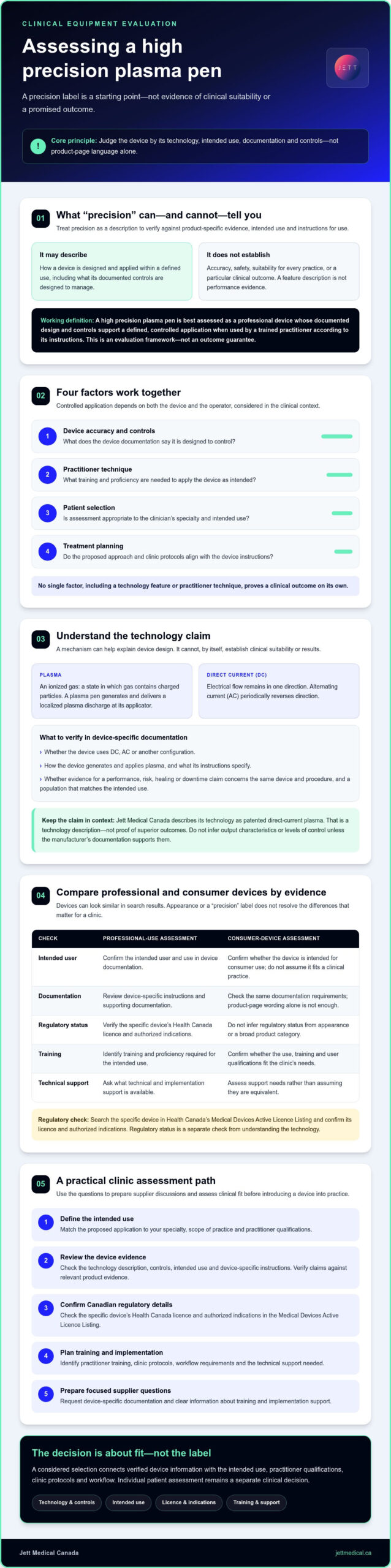
For a clinician assessing equipment, precision should describe how a device is designed and applied within a defined use, not promise a particular result. A product label alone can’t establish accuracy, safety, or suitability for a practice. Check whether the technology, documentation, and practitioner’s technique align with the intended clinical application.
Plasma is an ionized gas, a state in which gas contains charged particles. The field of Plasma medicine explores medical applications of low-temperature plasma. A plasma pen generates and delivers a localized plasma discharge at its applicator for use according to the device’s instructions. The term “plasma pen” doesn’t describe one uniform technology: device design, intended use, and instructions can differ.
A high precision plasma pen is best understood as a professional device whose documented design and controls support a defined, controlled application when used by a trained practitioner according to its instructions for use. This is an evaluation framework, not a guarantee of clinical outcomes.
What does precision mean when evaluating a plasma pen?
Controlled application depends on both the device and the operator. Device features may support consistent use, while practitioner technique determines how the device is applied in context. Neither, on its own, proves a clinical outcome. Treat claims about precision as questions to verify against product-specific evidence, intended use, and instructions for use. A feature description is not a substitute for evidence of performance in the relevant application.
Keep four considerations distinct:
- Device accuracy and controls: What does the documentation say the device is designed to control?
- Practitioner technique: What training and proficiency are needed to apply it as intended?
- Patient selection: Is assessment appropriate to the clinician’s specialty and intended use?
- Treatment planning: Do the proposed approach and clinic protocols align with the device instructions?
Who should assess professional plasma technology?
Evaluation belongs with qualified clinicians and clinic decision-makers considering equipment for professional practice, not at-home consumers. Specialty, scope of practice, and practitioner qualifications help determine whether a device’s intended use fits the clinic. Individual patient assessment is a separate clinical decision. This guide helps readers evaluate equipment and implementation requirements; it doesn’t determine whether a particular treatment is appropriate for an individual.
How Direct-Current Plasma Works, and What It Cannot Tell You
Direct current describes the direction of electrical flow: it remains in one direction, while alternating current (AC) periodically reverses direction. This distinction identifies an electrical approach, not a clinical result. The label alone doesn’t establish how a specific device generates or applies plasma, or whether it is appropriate for a particular procedure.
How does direct-current plasma differ from a general plasma claim?
A general “plasma” claim may not specify a device’s electrical characteristics. Product-specific documentation should clarify whether a device uses direct current, AC, or another configuration, and explain its intended use. Jett Medical Canada describes its technology as patented direct-current plasma. Treat that as a technology description, not proof of superior outcomes. Review the relevant model’s instructions and the direct-current versus AC plasma clinical comparison when evaluating the distinction.
The device generates and delivers plasma through its applicator, while the trained practitioner positions and operates it according to the device’s instructions. The interaction between the device, operator, and intended application matters. Don’t infer specific output characteristics or levels of control unless the manufacturer’s documentation supports them.
Which claims need evidence beyond the technology description?
A mechanism explains how a device is designed to work. It doesn’t, by itself, establish safety or efficacy for a specific indication, patient group, or clinical setting. Assess evidence in context: does it concern the same device and procedure, and does the population studied match the intended use? Device instructions and product-specific documentation should support claims about performance, risks, healing, or downtime. Avoid guarantees.
For Canadian clinics, regulatory status is a separate verification step from understanding the technology. Health Canada’s safety advisory on plasma pens addresses the risks of unauthorized devices and notes that certain devices are authorized for professional use. Check the specific device’s current licence and authorized indications rather than treating a technology description or general claim as confirmation.
A feature statement should stay within what the documentation supports: “Jett Medical Canada describes its technology as patented direct-current plasma; confirm the electrical characteristics and intended use for the specific device in its product documentation.” This connects a stated feature to the need for product-specific review without implying an unverified clinical benefit.
Clinics comparing professional options can review Jett Medical Canada’s device information alongside product-specific instructions and evidence.
Professional Plasma Pen or Consumer Beauty Device? Compare the Evidence
A pen-shaped design doesn’t establish that a device is intended for clinical use. Nor does a “precision” label confirm regulatory status, practitioner suitability, or evidence for a particular application. Compare documentation and support, not appearance or marketing language.
Use these categories to frame a device review. They are evaluation prompts, not assumptions about every product in either category.
| Evaluation area | Professional medical device | Consumer beauty device |
|---|---|---|
| Intended user | Confirm the device’s documented user and whether it aligns with the practitioner’s qualifications. | Check whether it is intended for consumer use; don’t treat consumer availability as clinical suitability. |
| Documented intended use | Compare the manufacturer’s intended use with the clinic’s proposed application. | Marketing descriptions may not establish an authorized medical indication. |
| Canadian regulatory status | Verify the specific device and its indications in current Health Canada records. | Online listings or ratings aren’t evidence of Canadian medical-device licensing. |
| Training | Ask what device-specific training is available and what competencies are expected. | Consumer instructions aren’t a substitute for clinical training or judgement. |
| Technical support | Confirm what supplier support, maintenance guidance, and device documentation are provided. | Check what support is actually offered; don’t assume it addresses professional practice needs. |
What should clinicians verify before comparing devices?
Start with the proposed application, then check that the model’s intended use and instructions support it. Confirm the device’s current Canadian licence and authorized indications using Health Canada’s official records. The Health Canada advisory on plasma pens explains that certain devices are authorized for professional use; it does not mean every device is authorized. Before assessing workflow fit, review training, maintenance expectations, instructions for use, and the supplier’s technical support.
Why isn’t a consumer plasma pen an equivalent clinical option?
A consumer device may resemble professional equipment, but appearance and product claims don’t establish intended use, clinical authorization, safety, or efficacy. Online ratings can describe a buyer’s experience; they don’t verify a device’s evidence for a clinical application. A consumer product isn’t a substitute for professional equipment, clinical judgement, or appropriate training.
For brand-level criteria, see this professional plasma pen brands comparison. Clinics considering a high precision plasma pen can also review Jett Medical Canada’s professional device information and verify documentation for each specific model.
How to Assess a High Precision Plasma Pen for Your Clinic
A structured evaluation connects the device’s documented use to your specialty, practitioner qualifications, and clinic protocols. Use this sequence before procurement to identify gaps that a product demonstration alone may not reveal.
- Define the intended use. Specify the application your clinic is considering and who would operate the device. Confirm that this fits your specialty, practitioner qualifications, and proposed scope of practice.
- Verify product-specific documentation. Request current licensing details, authorized indications, and instructions for use for the exact model. Check Canadian licensing through Health Canada’s Medical Devices Active Licence Listing, and confirm that the documented intended use aligns with the proposed application.
- Review training requirements. Ask which practitioners can train on the device, what prerequisites apply, how training is delivered, and what ongoing support is available. Clarify how the supplier handles technical questions and where concerns should be escalated.
- Assess workflow fit. Confirm that the device and any required accessories fit the clinic’s proposed setup. Discuss maintenance expectations, documentation, and how device use would integrate with existing protocols.
Which questions belong in a device evaluation checklist?
Ask the supplier for the current instructions for use and product-specific licensing and indication information. Clarify training format, practitioner prerequisites, maintenance guidance, technical support arrangements, and escalation channels. Confirm which accessories are included or required, and whether they suit the workflow you plan to use. Record responses so clinical and operational decision-makers can review the same information.
How should a clinic assess implementation readiness?
Identify the practitioners responsible for device use and resolve training needs before procurement. Review patient selection, consent, documentation, and follow-up protocols internally, using device instructions and applicable professional requirements to guide the discussion. Decide who will maintain records, manage device-related questions, and respond if an issue arises.
Readiness also means setting realistic expectations. Don’t base a purchase on assumed patient demand, revenue, or promised outcomes without supporting evidence. A high precision plasma pen is a potential fit only when its verified intended use, practitioner preparation, and clinic processes align.
For a product-specific discussion about professional plasma technology and clinic implementation, discuss your requirements with Jett Medical Canada.
Explore Jett Medical Canada’s Professional Plasma Pen Options
Jett Medical Canada distributes professional plasma devices to medical and aesthetic clinics across Canada and supports doctors and nurses adopting plasma therapies. The company describes its technology as patented direct-current plasma and provides clinic training and support. These details can help frame a supplier discussion, but they don’t replace model-specific verification of intended use, licensing, or practitioner requirements.
The portfolio includes Jett Plasma Pen Medical, Jett Plasma Lift Medical, Jett Plasma Medical II, Edge EOM-P EVO, Jett Plasma For Her II, and Edge O Tech. A product name or broad application category isn’t enough to determine whether a device fits a particular specialty or procedure. Confirm the current documentation for the exact model under consideration.
Which Jett plasma pen devices may merit a clinic discussion?
A clinic evaluating a high precision plasma pen can start by defining its intended application and practitioner group, then ask which portfolio models have documentation relevant to that context. The company’s portfolio includes devices associated with dermatological, ophthalmic, and gynaecological applications, but that doesn’t establish that every model is suitable for each specialty or indication.
Before comparing options, request the model’s current instructions for use, intended use, and Canadian licence details. Verify the licence and authorized indications against current Health Canada records. Jett Medical Canada’s Canadian guide to Health Canada licensed plasma devices offers a starting point for regulatory questions; confirm current product-specific details before making a selection.
What is a practical next step for Canadian clinicians?
Prepare questions that connect product documentation to clinic readiness. Ask what training is available for the practitioners who would use the device, what prerequisites apply, and what ongoing clinic support is provided. Clarify maintenance expectations, technical assistance, and how to escalate device-related questions. Then consider how the documented intended use fits your specialty, qualifications, and existing clinic protocols.
A supplier discussion can help identify which information to review next; it shouldn’t replace independent verification or internal clinical decision-making. Bring your proposed application and workflow questions so you can assess fit before planning adoption.
Contact Jett Medical Canada about professional plasma technology to discuss device documentation, training, and support for your clinic’s evaluation.
Make Your Device Evaluation Clinically Grounded
Choosing a high precision plasma pen takes more than a precision claim. Assess the technology in relation to its documented intended use, product-specific evidence, practitioner training, and clinic protocols. A device feature describes how equipment is designed; it doesn’t guarantee an outcome or establish suitability for every indication.
For Canadian clinics, verify the specific model’s current Health Canada licence and authorized indications, then assess whether they align with your specialty and proposed application. Jett Medical Canada states its products are Health Canada licensed, but confirm details for each device. Its portfolio includes devices for dermatological, ophthalmic, and gynaecological applications, and the company provides training and support for doctors and nurses.
A focused supplier discussion can clarify documentation, onboarding, and implementation questions before you select equipment. Discuss professional plasma technology with Jett Medical Canada as you evaluate options for your practice. Verify the details and prepare a clear clinical plan before moving forward.
Frequently Asked Questions
What is a high precision plasma pen?
A high precision plasma pen is a professional device designed to deliver plasma for a defined application under controlled conditions. “Precision” describes a technology and its use context, not a guaranteed clinical result. To assess a device, review its documented intended use, controls, product-specific evidence, and instructions for use. Suitability also depends on practitioner technique, qualifications, patient assessment, and treatment planning.
How does a professional plasma pen work?
A professional plasma pen generates a plasma discharge through its applicator for use according to the device’s instructions. Some manufacturers describe direct-current technology, in which electrical flow travels in one direction, but devices may differ. Confirm the electrical characteristics for the specific model rather than relying on a general claim. The practitioner’s training and technique also affect how the device is applied in the intended clinical context.
Is a high precision plasma pen the same as a consumer plasma pen?
No. Similar appearance or “precision” wording doesn’t establish that a device has a professional intended use, appropriate Canadian licensing, or evidence for a clinical application. Consumer products aren’t substitutes for professional equipment, clinical judgement, or relevant practitioner training. Clinics should compare product-specific documentation, Health Canada licensing, training, and technical support. Online ratings and retail descriptions don’t confirm clinical authorization, safety, or efficacy.
Can any clinician use a professional plasma pen?
No. A clinician should assess whether the device’s intended use aligns with their qualifications, specialty, and scope of practice, and whether they can complete the required training. Device authorization doesn’t establish that every practitioner or clinic is suitable for every application. Clinics should review the model’s instructions and their own protocols before adoption. Individual patient eligibility requires a separate assessment by an appropriately qualified healthcare professional.
What should a Canadian clinic verify before choosing a plasma pen?
Verify the exact device’s current Canadian licence and authorized indications in Health Canada’s Medical Devices Active Licence Listing. Compare its documented intended use with your proposed application, then review its instructions for use, evidence, and maintenance expectations. Ask about practitioner prerequisites, training, technical support, and escalation channels. Finally, assess whether the device and any required accessories fit your specialty, qualifications, clinic protocols, and workflow.
Does a precision label prove that a plasma pen is clinically effective?
No. A precision label is not, by itself, proof of accuracy, safety, or efficacy. It may describe a device feature or a marketing claim, but its clinical significance needs product-specific evidence. Check whether the evidence applies to the same device, procedure, and patient population you’re considering. Review the manufacturer’s instructions and intended use, and don’t treat a technology description as a guarantee of results or recovery.
What training and support should a clinic ask about before adopting plasma technology?
Ask what training is available, who can participate, what prerequisites apply, and how practitioners’ competency is assessed. Clarify what ongoing technical support is provided, how maintenance is addressed, and where device-related questions or concerns should be escalated. Confirm access to current instructions for use and product documentation. Jett Medical Canada states that it provides training and support for doctors and nurses; ask how these arrangements apply to the specific device under consideration.