
What if your clinic’s next revenue gain comes from making better use of existing capacity rather than adding another service? Understanding how to increase aesthetic clinic revenue in 2026 starts with identifying which services, appointment slots and follow-up activities contribute to sustainable performance while keeping patient needs central.
It can be difficult to know where to focus. New patient acquisition takes time and resources, while inconsistent rebooking or underused treatment rooms can limit the value of your current schedule. Equipment decisions also involve more than comparing features: technology needs to suit your patients, clinical scope, staff training and operational capacity.
This practical framework explains how to use clinic-level measures to find revenue opportunities, improve patient-centred follow-up and make better use of existing capacity without relying on blanket discounts. You’ll also learn how to assess a new service or technology against demand, implementation requirements and realistic utilization, so growth decisions support both clinic performance and responsible care.
Key Takeaways
- Learn how to increase aesthetic clinic revenue in 2026 by tracking patient volume, service mix and productive clinical capacity.
- Map the patient journey to identify opportunities for appropriate follow-up and stronger retention.
- Use appointment patterns, cancellations and provider availability to spot scheduling improvements before adding clinical hours.
- Make marketing more measurable by defining your audience, clarifying service messages and tracking enquiries.
- Assess new technology against patient fit, practitioner scope, training needs and planned utilization before investing.
How to increase aesthetic clinic revenue in 2026 starts with a clear baseline
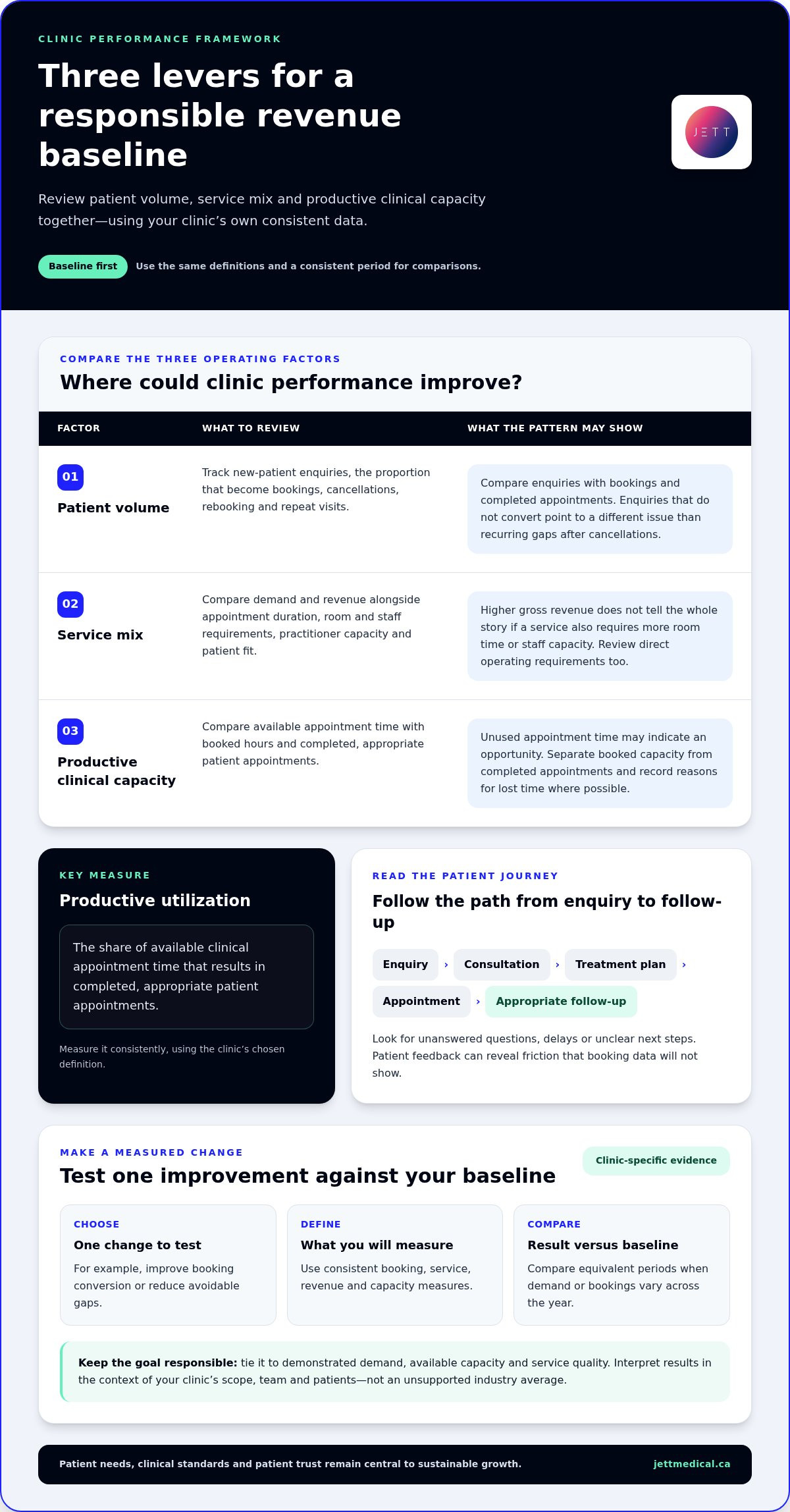
Sustainable growth means improving clinic performance without compromising appropriate care, clinical standards or patient trust. Start by examining how revenue relates to three operating factors: patient volume, service mix and productive clinical capacity. A clinic may have strong demand but lose potential revenue through unused appointment time. A fully booked schedule may still depend too heavily on a narrow range of services.
Interpret these factors in the context of your clinic’s scope, team and patients. The broad field of aesthetic medicine includes a range of procedures and approaches, but market-wide figures can’t determine which services are appropriate or commercially viable for an individual Canadian clinic. Treat external 2026 statistics as context only, and use them only when their source is current, credible and relevant to Canada.
Which clinic metrics show where revenue opportunities may exist?
Start with a consistent period of booking, service, revenue and capacity data. Use the same definitions throughout, then compare results by service, provider and available appointment hour. This can show whether a service is contributing meaningfully, whether results vary by provider, or whether booked hours aren’t turning into completed appointments.
Review the patient journey alongside the schedule. Track new-patient enquiries, the proportion that become bookings, cancellations, rebooking and repeat visits. Separate booked capacity from completed appointments, and record reasons for lost time where possible. For example, recurring gaps after cancellations point to a different operational issue than enquiries that don’t convert into consultations.
Keep revenue distinct from other performance measures. A service with higher gross revenue may also require more room time or staff capacity. Review appointment duration and direct operating requirements alongside revenue to understand the contribution without assuming that more bookings always mean better performance.
How can owners set a responsible 2026 revenue goal?
Set a measurable goal tied to demonstrated demand, available capacity and service quality. Compare it with the clinic’s own historical baseline over a consistent period. If demand or bookings vary across the year, compare equivalent periods instead of drawing conclusions from a short, atypical stretch. Don’t treat an unsupported industry average as a target for your clinic.
Choose one change to test, such as improving booking conversion or reducing avoidable gaps, and define which measures will show whether it helped. Compare the result with the baseline before making another change. This controlled approach helps distinguish an operational improvement from normal variation, while keeping patient experience and appropriate care central to growth.
Productive utilization is the share of available clinical appointment time that results in completed, appropriate patient appointments, measured consistently using the clinic’s chosen definition.
Improve aesthetic clinic revenue per patient through service mix and retention
Revenue per patient should reflect a relevant, well-managed care journey, not a reason to add procedures to every visit. Map each stage from first enquiry to consultation, treatment planning, appointment and appropriate follow-up. Look for unanswered questions, delays or unclear next steps that could interrupt continuity. Clear education helps patients make informed decisions and gives the team a consistent way to explain options, expectations and follow-up.
A practical approach to how to increase aesthetic clinic revenue in 2026 is to strengthen the fit between patient needs and the services your clinic can responsibly deliver. Review services against practitioner expertise, documented protocols, patient demand and available capacity. A service that attracts enquiries may still be a poor fit if the clinic lacks the relevant expertise or workflow to deliver it consistently.
How can a clinic strengthen retention without relying on discounts?
Make post-appointment communication timely, clear and relevant to the patient’s care plan. Explain appropriate follow-up, provide the information the patient needs, and make booking straightforward when another appointment is clinically indicated. Measure rebooking and return patterns by service, but interpret them in context. Not every service or patient requires the same cadence, and a longer interval isn’t automatically a retention problem.
Patient feedback can reveal friction that booking data won’t show. Ask where the process felt confusing or inconvenient, then look for patterns across enquiry, consultation and follow-up. Address practical barriers, such as unclear appointment instructions or inconsistent communication, before considering price reductions.
How should a clinic review its service mix?
Compare services using more than demand or revenue. Consider appointment duration, room and staff requirements, practitioner capacity, and how each service fits the clinic’s expertise and target patient population. This helps distinguish a service with genuine clinical and operational fit from one that only looks attractive on a revenue report. Recommendations should follow assessment and established protocols, not a target to increase each patient’s spend.
- Retain: Services that fit patient needs and can be delivered consistently within current capacity.
- Refine: Services with demand but recurring scheduling, communication or workflow barriers.
- Reassess: Services that require resources or expertise the clinic can’t currently support.
Packages or memberships may suit some care pathways, but only when their terms are transparent, administration is manageable and included services remain appropriate for each patient. Avoid structures that pressure patients to use unnecessary appointments or influence clinical decisions to meet a sales commitment.
When specialized plasma technology fits the clinic’s patients, practitioner scope and operating plan, include training and support in the implementation plan. Professional plasma technology and training can be part of that evaluation, alongside service planning and realistic utilization expectations.
Use scheduling and equipment utilization to improve clinic revenue
Before adding clinical hours or purchasing equipment, identify whether current capacity is being used effectively. Review recurring schedule gaps, cancellations, appointment lengths and provider availability together. An open room may reflect low demand, or it may be unavailable for a particular service because the appointment template, provider schedule or preparation time doesn’t fit. The cause determines the response.
This is a practical step in how to increase aesthetic clinic revenue in 2026: make better use of existing resources before assuming the clinic needs more capacity. Compare scheduling changes, such as waitlists, reminders or revised appointment templates, with actual workflow. A reminder may reduce missed appointments, but it won’t resolve recurring gaps caused by appointment lengths that don’t match the service.
How can clinics identify unproductive time in the schedule?
Use booking-system data to look for repeated gaps by day, appointment type and provider. Separate preventable friction, such as late cancellations or mismatched templates, from periods when patient demand is genuinely low. Test one change at a time, then compare completed appointments and usable clinical hours with the same baseline period. This shows which adjustments help and which add administrative work without improving capacity.
Keep booked time distinct from completed appointments. Track cancellations, rescheduling and the time required to prepare a room between appointments. A waitlist may help fill a cancellation if patients can attend at short notice. It may be less useful if the service requires advance preparation or a specific provider. Choose an approach that staff can manage consistently.
How should a clinic assess equipment utilization before investing?
New equipment doesn’t create revenue simply by being installed. Adoption depends on suitable patient demand, practitioner readiness, training, room availability and an operational plan for integrating the service. Estimate demand from the clinic’s own records and defined care plans, not optimistic assumptions about who might book. Then compare expected appointment capacity with the time and resources actually available.
Use a simple readiness scorecard before deciding:
- Current utilization: Identify available room and provider time that could realistically support the service.
- Appropriate demand: Estimate potential appointments from documented patient needs and planned services.
- Implementation effort: Account for training, workflow changes, scheduling and ongoing responsibilities.
- Capacity fit: Compare planned use with realistic appointment availability, including existing clinical commitments.
If a key requirement is missing, address it before adoption or revise the utilization estimate. For example, strong patient interest may not translate into practical capacity if trained provider time is already fully committed. When specialized plasma technology fits the clinic’s patients, scope and operational readiness, include training and implementation support in the plan. Evaluate an investment using clinic-specific inputs, including the resources needed to put it into sustained use, rather than relying on generic device prices or revenue guarantees.
Attract appropriate aesthetic clinic patients with measurable marketing
Marketing is more useful when it attracts patients whose needs align with the clinic’s services and expertise. Define your audience and explain what the clinic provides, who may be an appropriate candidate, and what a consultation involves. Use educational content to answer common questions and set realistic expectations. Avoid guarantees, unsupported clinical claims and language that pressures people to book.
Build a repeatable process:
- Define the audience: Identify the patient group and needs the clinic is equipped to serve.
- Clarify the message: Describe relevant services, practitioner expertise and appropriate expectations in specific, evidence-aligned terms.
- Select channels: Choose channels that suit the audience and the clinic’s capacity to respond to enquiries.
- Track the journey: Record where enquiries originate, whether they become consultations, and whether appointments are completed.
- Review performance: Compare results over a suitable period before changing campaign effort.
How can a clinic measure marketing that contributes to revenue?
Use one consistent method to record enquiry sources. For example, ask each prospective patient how they heard about the clinic and log the answer using the same categories. Compare channels by enquiry quality, consultation bookings and completed appointments, not impressions alone. A channel that attracts attention but few suitable bookings may need a clearer message, a better response process or a different audience. Review results over a period that reflects the clinic’s booking cycle.
Connect marketing records with booking outcomes while limiting access to patient information appropriately. For consent-based enquiry and follow-up, make the purpose of communication clear and respect the preferences patients provide. Before publishing campaigns or patient-facing content, review applicable provincial professional standards and Canadian privacy obligations. This keeps promotion aligned with responsible practice and clinic objectives.
How does specialist positioning support patient acquisition?
Specialist positioning works when it explains the clinic’s relevant expertise and services without overstating what patients can expect. Publish useful material that answers real questions about consultations, treatment planning, practitioner qualifications and factors that influence suitability. Keep claims evidence-aligned, and review content for accuracy as services and protocols change. Clear education helps prospective patients decide whether to enquire without substituting marketing copy for an individual assessment.
Measure the path from first enquiry to completed appointment. If enquiries are strong but consultations aren’t being booked, examine response times, clarity of information and booking friction. If consultations happen but appointments don’t follow, review whether the service message accurately reflects the consultation and patient expectations. This helps distinguish a marketing issue from a scheduling or communication issue.
For clinics considering specialized plasma technology as part of their service planning, Jett Medical Canada provides information on plasma technology for professional clinics, including training and support for medical professionals.
Evaluate aesthetic technology as a responsible revenue opportunity
New technology can support clinic growth, but only if it fits the patients the clinic serves, practitioners’ scope and the capacity to implement it responsibly. Treat equipment as a strategic option, not a revenue shortcut. Use clinic records to assess appropriate patient demand and available appointment time, then account for training, workflow changes and the work required to introduce the service. If the clinic can’t support those requirements, projected utilization may not be realistic.
This evaluation is central to how to increase aesthetic clinic revenue in 2026 without allowing a purchase decision to drive clinical recommendations. A device’s potential contribution depends on services the clinic can appropriately provide and patients for whom those services are suitable. Plan around authorized indications and practitioner qualifications, not the assumption that every use or patient is appropriate.
What should a clinic evaluate before adding plasma technology?
Define the proposed application and intended patient population first. Match them with practitioner qualifications, clinic protocols and the device’s authorized indications. In Canada, verify licensing for the specific device and review its authorized indications in current authoritative documentation. A licence shouldn’t be interpreted as permission for every possible application. Review certification claims against current device-specific records as well.
Then plan implementation. Identify who needs training, how patient education will explain the service and appropriate expectations, and how the new workflow will fit existing appointments, room use and staff responsibilities. A service plan is more practical when the clinic knows how it will be delivered, communicated and scheduled.
For a focused regulatory starting point, consult this Health Canada licensed plasma device guide, then assess device-specific documentation for the intended application. Canadian distribution context is also outlined in the medical aesthetic device distribution guide.
How can Jett Medical Canada support informed technology adoption?
Jett Medical Canada supplies specialized plasma technology to professional clinics across Canada and provides training and support for doctors and nurses adopting plasma-based therapies. Its professional plasma devices use patented direct-current plasma technology. The clinic-level decision still depends on patient fit, practitioner scope, current device documentation and the ability to implement the service responsibly.
Before deciding, bring the evaluation together in a concise adoption plan: define the intended service, document relevant patient demand, identify training and workflow requirements, and set a realistic utilization measure to review after implementation. This gives owners a practical basis for comparing a technology opportunity with other clinic priorities, without relying on generic returns or promised outcomes.
Clinics assessing whether specialized plasma technology fits their practice can explore Jett Medical Canada’s professional plasma technology and use the information to evaluate implementation, training and service planning.
Make your next growth decision with confidence
Choose one opportunity to examine first, then define what a useful result would look like for your clinic. A focused review can distinguish a promising idea from one that needs more preparation, whether the next step is improving a process or considering new technology. Keep patient suitability and service quality central as you assess the change, and use what you learn to guide the next decision.
That measured approach is a practical way to think about how to increase aesthetic clinic revenue in 2026: build growth from evidence gathered in your own practice rather than adopting a tactic simply because it appears popular. If specialized plasma technology is relevant to your clinic’s plans, explore the equipment and professional support available through Jett Medical Canada’s professional plasma technology.
Steady progress comes from matching each opportunity to your patients, team and capacity. With a clear next step and a willingness to learn from the results, your clinic can pursue growth while maintaining the trust that sustains patient relationships.
Frequently Asked Questions
How can an aesthetic clinic measure revenue growth effectively?
Compare revenue across consistent periods, then interpret the change alongside completed appointment volume and service mix. For example, if total revenue rises while completed visits fall, a shift in services may explain the result. Review operating expenses as well if you want to understand whether growth is improving the clinic’s financial position, not just top-line revenue. To assess how to increase aesthetic clinic revenue in 2026, choose measures that reflect your clinic’s actual goals.
What is the most important metric for increasing aesthetic clinic revenue?
There isn’t one best metric for every clinic. The most useful measure depends on the constraint you’re trying to address. If appointment capacity is the concern, examine completed appointments relative to available clinical hours. If enquiries aren’t becoming bookings, focus on conversion from enquiry to consultation. Choose one primary measure for the current objective and pair it with a quality check, such as cancellations or patient feedback, so the target doesn’t encourage rushed or unsuitable care.
Should aesthetic clinics use discounts to attract more patients?
Discounts can be used selectively, but they shouldn’t replace clear service information or a strong patient experience. Before offering one, define its purpose, audience and end date, then assess whether it attracts appropriate enquiries and completed appointments. Avoid discount structures that encourage unnecessary treatment or create expectations that regular fees are negotiable. If the underlying issue is limited awareness or booking friction, improving educational content or the enquiry process may address it more directly.
How can an aesthetic clinic increase repeat bookings without pressuring patients?
Make the next step an informed option, not an assumption. At the end of an appointment, explain whether follow-up is appropriate, why it may be recommended and what timing the care plan suggests. Give the patient space to decide, and record their preferred communication method for follow-up. For example, a reminder can invite the patient to arrange a review without implying that everyone needs another appointment.
How can a clinic tell whether marketing is generating revenue?
Trace each enquiry from its reported source through consultation booking to completed appointment, using consistent categories such as referral, search or social media. Compare channels by the number and suitability of completed appointments, not only by clicks or enquiries. Also note when patients encounter more than one channel before booking, since simple source tracking may not capture the full decision path. Review a consistent reporting period before shifting effort, so a short-term fluctuation doesn’t drive an unnecessary change.
Does buying new aesthetic equipment automatically increase clinic revenue?
No. Equipment can contribute to revenue only if the clinic can implement it, use it appropriately and support the service operationally. Before purchasing, consider the intended application, practitioner qualifications, relevant Canadian device licensing and authorized indications, training requirements, room availability and realistic patient demand. A device that remains underused may add complexity without supporting clinic performance. Treat utilization planning and clinical fit as part of the investment decision instead of assuming ownership will generate bookings.
How can a small aesthetic clinic grow revenue without adding more working hours?
Look for changes that improve the use of existing time rather than extending the schedule. For example, prepare consultation information in advance to reduce avoidable administrative interruptions, or adjust appointment templates when booking records show a recurring mismatch between visit length and service type. Focus on one workflow change at a time, and monitor completed visits and patient experience. Growth should come from more effective operations, not from compressing care or recommending services patients don’t need.