
What if the most important part of a non-surgical procedure happens before treatment begins? Patients may hope for immediate, uniform or lasting results, yet outcomes and recovery can vary. Managing patient expectations for non-surgical procedures means addressing those hopes with clear, individualized information, not promotional promises. A thoughtful conversation helps patients understand what a procedure may achieve, where its limitations lie and what remains uncertain before they consent.
For clinicians, setting expectations is an ongoing part of care, not a single discussion at consultation. This guide offers a structured, patient-centred approach to explaining outcomes, potential risks, recovery and follow-up in plain language. It also covers how to connect treatment goals with relevant evidence, identify expectations that may not be realistic and invite questions before proceeding. If results differ from what a patient anticipated, a clear follow-up conversation can help address concerns and determine appropriate next steps.
Key Takeaways
- Approach managing patient expectations for non-surgical procedures as an ongoing, two-way conversation, not a one-time consent discussion.
- Use a repeatable consultation framework to connect each patient’s goals with clinical assessment, plausible outcomes, uncertainty and follow-up.
- Distinguish evidence-supported information from clinical judgement, and explain what cannot be predicted for a particular patient.
- Adapt the discussion to the procedure’s goals, recovery considerations and follow-up needs instead of assuming every treatment requires the same conversation.
- Agree on how progress and concerns will be reviewed so patients know what to do if recovery or outcomes differ from expectations.
Why managing patient expectations matters before a non-surgical procedure
Expectation-setting is not a reassurance script or a single conversation before consent. It is an ongoing, two-way clinical process that helps a patient understand the proposed care and helps the clinician learn more about the patient’s goals, concerns and assumptions. It means aligning what a patient hopes to achieve with what clinical assessment and available evidence can reasonably support.
Expectations shape how patients interpret potential benefits, limitations, recovery and results. If someone anticipates an immediate or permanent change, for example, a gradual or temporary outcome may feel like a failure even when the procedure proceeded as expected. A clear discussion can support understanding, informed consent and useful follow-up, without guaranteeing satisfaction or a particular result.
What patients need to understand before deciding
Begin by clarifying the concern the patient wants addressed and the change they hope to see. Ask what success would look like to them, then explore assumptions about timing, degree of change and durability. A patient’s goal is central to the discussion, but it does not determine clinical suitability. The clinician must assess whether the procedure is appropriate and explain realistic possibilities for that individual.
“Non-surgical” describes a category of care, not an assurance that a procedure is risk-free, permanent or suitable for everyone. Relevant risks, recovery considerations and limitations depend on the procedure and the patient’s circumstances. To check understanding, invite the patient to describe the proposed plan, expected recovery and uncertainties in their own words. This can reveal misunderstandings that a simple “Do you understand?” may not.
How expectations support informed decision-making
Present the decision as a balanced comparison, not a pitch. Explain potential benefits alongside limitations, uncertainties, alternatives and the option of no treatment. Separate what is supported by relevant evidence from what reflects clinical judgement, and be direct about what cannot be predicted for one person. Neutral wording helps patients weigh the information against their priorities without feeling steered toward a procedure.
This collaborative approach reflects shared decision-making in medicine: the clinician contributes professional assessment, while the patient contributes their values and preferences. Both are needed for a considered decision. For device-based care, include the specific device’s applicable Health Canada licensing and intended use in the discussion. A clinician-facing resource such as “Health Canada Licensed Plasma Devices: The 2026 Clinician’s Reference Guide” can help frame that review, but it does not replace assessment of the individual patient or review of the device’s documentation.
How to explain likely outcomes, limitations, and uncertainty clearly
Organize the explanation around four questions: What does the patient hope to change? What outcomes are plausible based on relevant evidence? What are the procedure’s limitations? What remains uncertain for this individual? This structure keeps the discussion specific without turning findings from a group or clinical experience into a personal prediction.
Outcomes can vary because patients’ starting points, clinical circumstances and responses to a procedure differ. Which factors matter depends on the treatment. Discuss only those supported by appropriate procedure-specific evidence, and avoid implying that any single factor determines the result. If reliable information supports a range or timeline, explain what it describes and how closely it applies to the patient. If it does not, say so rather than supplying a universal estimate.
Describe variability without creating confusion
Use plain language to distinguish established information from clinical judgement and unknowns. For example: “Evidence can describe results in a studied group, but it can’t tell us exactly how you will respond.” Then explain how that uncertainty affects the decision. A patient may consider an uncertain or modest change acceptable, or decide that the available information isn’t enough to proceed. Either response deserves consideration.
Before-and-after images and individual examples should not be presented as typical outcomes unless reliable evidence supports that conclusion. They may illustrate a possibility, but they don’t establish what another patient should expect. For managing patient expectations for non-surgical procedures, precision means describing what is known without overstating what is likely for one person.
Discuss risks, recovery, and alternatives proportionately
Explain material risks and recovery expectations using current information specific to the procedure, rather than relying on general claims about non-surgical care. Clarify which effects may be expected, which require clinical attention and what follow-up is appropriate. If details are not established for the patient’s situation, identify that uncertainty and explain how it will be addressed.
Compare the proposed procedure with other clinically appropriate options, including no treatment. Describe differences in goals, limitations, risks and recovery without suggesting that non-surgical care is always safer, easier or preferable. For device-based procedures, make sure the discussion matches the specific device and its applicable Health Canada licensing and intended use. The AMA Code of Medical Ethics offers a reference for the principle of providing information patients need to make an informed decision. Canadian clinicians should also follow the requirements that apply to their own practice.
Clinicians integrating plasma technology into practice can explore clinician education and device support as part of responsible technology adoption.
A consultation framework for managing patient expectations
A repeatable consultation gives clinicians a practical structure while leaving room for individual needs and professional judgement. Move from the patient’s goals to clinical assessment, a balanced discussion of options, confirmation of understanding and an agreed follow-up plan. This sequence supports managing patient expectations for non-surgical procedures without turning the conversation into a rigid script.
Move from patient goals to a shared treatment plan
Start with open questions: “What change matters most to you?” and “What are you hoping the procedure will achieve?” Explore the patient’s preferred timing, priorities, previous experiences and concerns without assuming why they are considering treatment. Then explain whether their desired outcome appears compatible with your assessment. If it does not, clarify why and discuss appropriate alternatives, including no treatment.
Use a simple comparison to connect the patient’s goal with the clinical discussion and follow-up plan:
| Patient goal | Clinical assessment | Possible outcome | Uncertainty | Follow-up |
|---|---|---|---|---|
| “I want to address this concern.” | Assess the concern and suitability for the proposed procedure. | Describe plausible outcomes supported by relevant information. | Explain what cannot be predicted for this patient. | Agree when and how progress or concerns will be reviewed. |
Confirm comprehension and document the discussion
Before concluding, invite the patient to explain the proposed procedure, its limitations and the next steps in their own words. Try: “To make sure I explained this clearly, how would you describe what we discussed?” If their summary reveals a misunderstanding, clarify the point and check again. A signed form records consent, but it does not by itself show that the patient understood the discussion.
Document the patient’s goals, your assessment, the options discussed, material questions, areas of uncertainty and the agreed follow-up. Check the professional standards and jurisdictional requirements that apply to your practice rather than relying on a generic template. The UK-based NHS guidance on consent can provide general context, but it does not establish requirements for Canadian practice.
For clinicians considering plasma technology, device education can support responsible integration within the applicable licensed intended use. Professional device education and support can be one resource in that process.
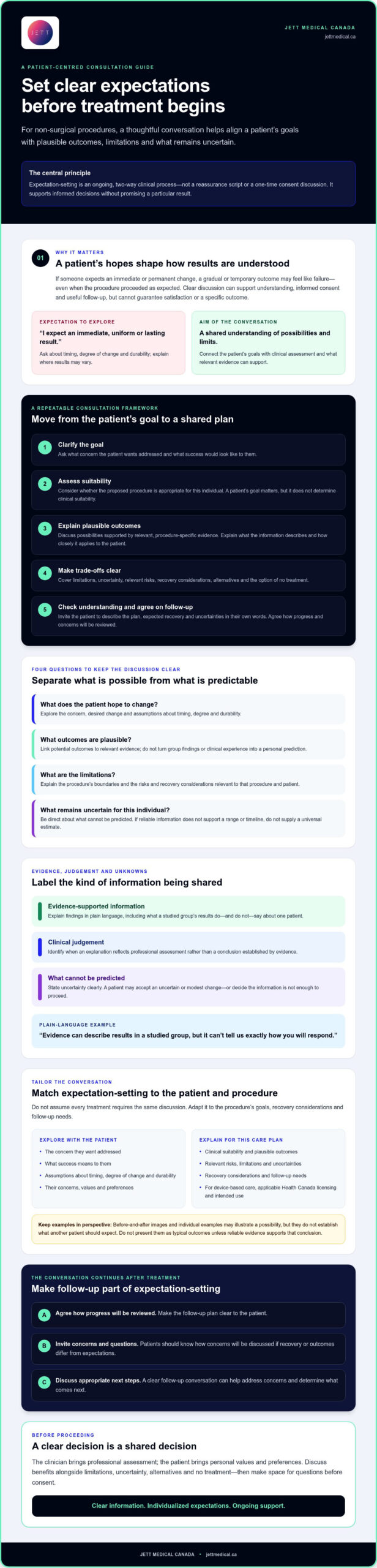
Adapting Expectation-Setting for Patients & Procedures
Expectation-setting should reflect both the procedure under consideration and the person considering it. The communication goal stays consistent, but discussion of intended outcomes, evidence, recovery and follow-up must be specific. Avoid treating different procedures as interchangeable or assuming similar-sounding goals mean similar results.
Match the discussion to the procedure and evidence
Start with the intended outcome, then explain what available evidence can and cannot establish for that procedure. For example, a patient considering a device-based treatment may need a clear explanation of the device’s applicable intended use, the evidence relevant to that use and the recovery information supported by current clinical sources. Someone considering another category of non-surgical care may need different details about its purpose, limitations and review plan. These are communication examples, not claims that one approach is more effective than another.
Be explicit if evidence is limited, does not closely match the patient’s circumstances or cannot support a reliable estimate of timing. Do not transfer a recovery description or result from one procedure, device or patient group to another. If a detail has not been established for the planned treatment, say so and explain how that uncertainty affects the decision and follow-up.
A patient-language example can acknowledge concern without minimizing it: “I understand that recovery time matters to you. What we can say depends on this specific procedure and your circumstances, so I’ll explain what current information supports and what we can’t predict with confidence.”
Recognize individual needs without making assumptions
Patients differ in what they already know, which details matter most and how they prefer to receive information. Ask what questions remain, what concerns them about recovery and whether practical factors could affect their ability to attend follow-up. Do not assume that a patient’s age, confidence or familiarity with medical terminology tells you how much explanation they need.
Adjust the pace and language to the patient. Explain technical terms, pause for questions and offer written information they can revisit. Interpreters or accessible materials may be appropriate when needed and available in the clinical setting. Check comprehension by asking the patient to summarize the key points, then clarify any gaps without placing blame.
In practice, managing patient expectations for non-surgical procedures means tailoring the conversation while keeping its foundation consistent: patient goals, procedure-specific evidence, uncertainty, recovery considerations and a clear review plan. For clinics evaluating plasma technology, clinician training and device support can help inform responsible integration into professional care.
How follow-up and clinical support sustain realistic expectations
Expectation-setting continues after a procedure. A follow-up plan agreed in advance gives the patient a clear route for questions and helps the clinical team assess recovery and progress against the goals discussed. It also avoids leaving patients to guess whether an experience is expected or needs review. The timing and method should be specific to the procedure and the responsible clinical team’s guidance, not based on a universal schedule.
Agree on follow-up before the procedure
Before proceeding, explain how follow-up will work and what information the patient will receive. Clarify the appropriate contact route for questions, who to contact if a concern develops and what to do if recovery or symptoms differ from the instructions provided. Use procedure-specific aftercare and escalation guidance approved by the responsible clinical team. Do not offer a recovery timeline unless it is supported for that procedure, and do not dismiss new or worsening concerns as routine healing.
Written instructions can help patients revisit the plan while managing recovery at home. Check that they understand the key points by asking what they would do if they had a question or noticed a change that concerned them. This practical step supports managing patient expectations for non-surgical procedures beyond the consultation.
Review outcomes and improve communication
At follow-up, ask what the patient understood about the expected course and whether their experience matches the goals and information discussed beforehand. Listen without becoming defensive. If their recovery or perceived outcome differs from what they anticipated, acknowledge the concern, reassess clinically and explain appropriate next steps. Do not assume the cause or promise a particular resolution before evaluating the situation.
For device-based care, professional selection and use require attention to the particular device and its applicable Health Canada licensing and intended use. The resource Medical Grade Plasma Pen Canada: The Professional’s Guide to Licensed Technology can be referenced when discussing device selection, but device documentation and current evidence should guide clinical decisions. Jett Medical Canada distributes plasma devices for professional clinical use and provides training and support for doctors and nurses. This is professional education and device support, not direct patient treatment.
Clinicians seeking education on professional technology can explore Jett Medical Canada’s professional technology and clinical support as part of responsible integration into care.
Build Clearer Conversations Into Every Stage of Care
Effective managing patient expectations for non-surgical procedures starts with listening to the patient’s goals and explaining what evidence can support, what remains uncertain and how recovery and follow-up will be handled. A structured, two-way consultation helps patients make informed decisions without implying a guaranteed result. Tailoring the discussion to the procedure and the individual also makes it easier to address concerns if the experience differs from what was anticipated.
Technology education is part of responsible clinical integration. Jett Medical Canada supplies specialized plasma devices for professional clinics and provides training and support for doctors and nurses across Canada. Before discussing a specific device, verify its applicable Health Canada licensing, intended use and certifications against current documentation.
Explore Jett Medical Canada’s professional technology and clinician support to learn about resources for clinical teams. Clear communication and informed technology choices can help clinicians support thoughtful, patient-centred care at every step.
Frequently Asked Questions
How do you manage patient expectations before a non-surgical procedure?
Manage expectations by clarifying the patient’s concern, desired change and definition of success. Explain the proposed procedure’s plausible outcomes, limitations, material risks, recovery considerations, alternatives and uncertainties using procedure-specific information. Ask what the patient expects and invite them to summarize the plan in their own words. This two-way approach supports an informed choice and gives follow-up a clear reference point.
What should patients know before choosing a non-surgical treatment?
Patients should understand the proposed treatment’s purpose, potential benefits and limitations, relevant risks, recovery considerations and what remains uncertain. They should also discuss whether their goals appear compatible with the clinician’s assessment and consider appropriate alternatives, including no treatment. For a device-based procedure in Canada, the clinician should verify the specific device’s applicable Health Canada licensing and intended use before presenting it as an option.
Can clinicians guarantee results from non-surgical procedures?
No. Clinicians should not promise a particular result, because an individual outcome cannot be guaranteed. Evidence may describe findings in a studied group, but it cannot establish exactly how a specific patient will respond. Explain what outcomes are plausible based on relevant information, where that information has limits and what remains uncertain. Avoid presenting promotional claims, selected examples or another patient’s experience as a reliable prediction for the person considering treatment.
How should clinicians discuss risks and recovery with patients?
Discuss risks and recovery using current information specific to the procedure and the patient’s circumstances. Explain material risks, recovery considerations, instructions from the responsible clinical team and how the patient can raise concerns or seek review. Avoid universal recovery timelines or minimizing uncertainty. Ask about practical concerns, then check that the patient understands what to expect and what steps to take if their experience differs from the guidance provided.
What happens if a patient’s results differ from their expectations?
Listen to the patient’s concern, acknowledge the difference between their experience and what they anticipated, and reassess the situation clinically. Review the goals and information discussed before treatment, then explain appropriate next steps without assuming the cause or promising a resolution. Follow the agreed review plan and respond to new or worsening concerns according to procedure-specific guidance from the responsible clinical team. Clear, respectful communication can help determine whether further assessment is appropriate.
How can clinicians check that a patient understands the treatment plan?
Ask the patient to explain the proposed treatment, its limitations, relevant recovery information and follow-up steps in their own words. A prompt such as “How would you describe the plan we discussed?” can reveal points that need clarification. Explain those points again in plain language and check understanding once more. A signed consent form can document a discussion, but it does not by itself show that the patient understood the information.
Does non-surgical mean risk-free or no downtime?
No. “Non-surgical” does not mean risk-free, permanent or free of recovery considerations. Risks and recovery differ by procedure, device and individual circumstances, so patients should ask the clinician what applies to the specific treatment being considered. Before deciding, clarify relevant risks, aftercare instructions, possible effects on daily activities and the appropriate route for questions or concerns. Do not assume one procedure’s recovery experience applies to another.