
Could a device described as an MDSAP certified plasma device still leave important questions unanswered for a Canadian clinic? Yes. MDSAP audits a manufacturer’s quality management system. It is not a Health Canada Medical Device Licence, and it does not confirm that a specific model is licensed for the intended use.
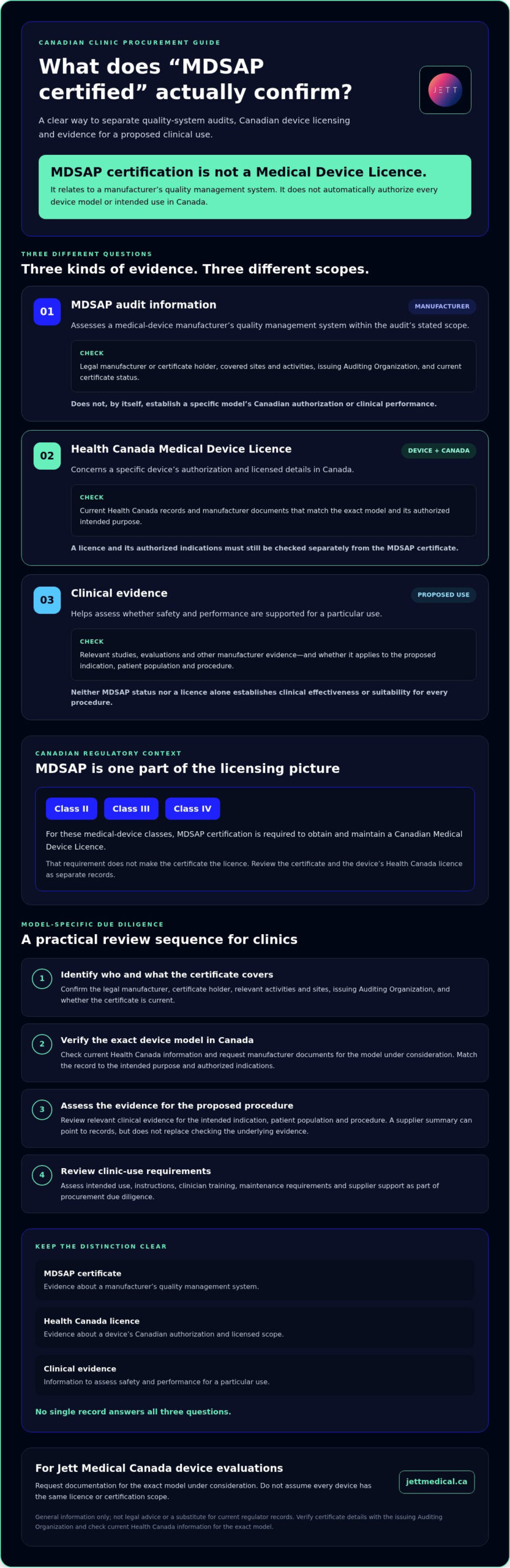
Certification terms can sound interchangeable, especially when suppliers make broad product claims. For Class II, III and IV devices, MDSAP certification is required to obtain and maintain a Canadian Medical Device Licence. However, the licence and its authorized indications must still be checked separately. Neither document, on its own, establishes clinical effectiveness or suitability for every procedure.
This article explains what MDSAP does and does not confirm, and how to review the evidence behind a supplier’s claims. You’ll learn which certificate details to check, what model-specific Health Canada and manufacturer documents to request, and how to assess clinical evidence, intended use, training and support. A consistent checklist can help your clinic evaluate a supplier and device model more confidently.
Key Takeaways
- An MDSAP certified plasma device claim relates to a manufacturer’s quality management system. It does not automatically authorize every model or use in Canada.
- Distinguish MDSAP audit records, a Health Canada Medical Device Licence and clinical evidence when reviewing supplier documents.
- Use a model-specific checklist to confirm the legal manufacturer, certificate holder, audit scope and current certificate status.
- Assess intended use, clinician training, instructions, maintenance and supplier support as part of procurement due diligence.
- For Jett Medical Canada offerings, request documentation for the exact model under consideration. Do not assume every device has the same licence or certification scope.
What does an MDSAP certified plasma device claim mean for a Canadian clinic?
MDSAP status indicates that a manufacturer’s quality management system has been audited under the Medical Device Single Audit Program. It does not show, by itself, that a particular device model is licensed in Canada or appropriate for every proposed use.
The wording matters. An “MDSAP certified plasma device” claim should prompt questions about the certificate holder, the activities and sites within the certificate’s scope, the issuing Auditing Organization and whether the certificate is current. A certificate covering a manufacturer’s quality system is not blanket evidence for every model sold under its name.
What is the Medical Device Single Audit Program?
MDSAP is a shared audit framework that allows participating regulatory authorities to rely on audits of medical-device manufacturers’ quality management systems. An audit assesses whether the system meets applicable quality-management requirements. It is not an evaluation of every device’s clinical performance. The Medical Device Single Audit Program (MDSAP) overview offers background on the programme’s history and participating authorities. Check current programme information for the latest authority roster.
For Canadian clinics, the distinction has practical significance. For Class II, III and IV medical devices, MDSAP certification is required to obtain and maintain a Health Canada Medical Device Licence (MDL). It is one part of the regulatory picture, not the licence itself. The audit relates to the manufacturer’s quality system, while the licence concerns a specific device and its authorized scope in Canada.
What does MDSAP status not establish by itself?
An MDSAP certificate does not independently authorize a specific plasma device for sale or use in Canada. Nor does it prove clinical effectiveness, patient outcomes or suitability for every indication. Those questions require other evidence, including current Health Canada records, the device’s authorized intended purpose and relevant clinical evidence. A supplier’s summary can help identify documents to request, but it does not replace checking the underlying records.
MDSAP is evidence about a manufacturer’s quality system. A Health Canada licence is evidence about a device’s Canadian authorization.
This section provides general context, not legal advice or a substitute for regulator records. Before procurement, verify the certificate with its issuing Auditing Organization and check current Health Canada information for the exact model. Those records help clarify whether the claim applies to the manufacturer, the device and the intended Canadian use.
How does MDSAP differ from Health Canada licensing and clinical evidence?
These records answer different procurement questions. An MDSAP audit concerns the manufacturer’s quality management system. A Health Canada licence concerns a specific medical device’s authorization and scope in Canada. Clinical evidence helps clinicians assess whether the device’s performance and safety are supported for a proposed indication and patient population. One type of evidence cannot stand in for the others.
| Evidence | Purpose and scope | Source to review | Buyer question |
|---|---|---|---|
| MDSAP certificate and audit information | Assesses the manufacturer’s quality management system within the stated scope. | Current certificate and confirmation from the issuing Auditing Organization. | Does the certificate cover the legal manufacturer and relevant activities, and is it valid? |
| Health Canada device licence | Identifies a device authorized for the Canadian market and its licensed details. | Health Canada records and the corresponding manufacturer documentation. | Does the record match this exact model and intended purpose? |
| Clinical evidence | Supports assessment of safety and performance for a particular use. | Relevant studies, evaluations and other evidence supplied by the manufacturer. | Does the evidence apply to the intended indication, population and procedure? |
MDSAP certificate versus Health Canada device licence
Review the two records independently. A certificate may identify a legal manufacturer or certificate holder, sites and activities within scope, and a validity period. Check a licence record against the exact device model and authorized intended purpose, not just a product family name or marketing description. For additional programme context, see the FDA explanation of MDSAP. Confirm current requirements and interpretations against Health Canada and programme records before relying on them.
If a supplier describes an MDSAP certified plasma device, ask which certificate and licence support the claim for the model being considered. A mismatch in manufacturer name, model identifier or scope is a reason to request clarification before procurement. Clinics can also consult this guide to Health Canada licensed plasma devices while organizing their document review.
Where clinical evidence fits into device evaluation
Market authorization and audit status do not establish that a device is effective for every procedure. Check whether the evidence addresses the proposed use, patient population, treatment parameters and relevant safety considerations. If the available material does not match the clinic’s intended application, ask the manufacturer or distributor for applicable documentation rather than extrapolating results.
For model-specific records, clinics can request documentation from Jett Medical Canada’s plasma device team and assess each model’s licence, certificate coverage and supporting evidence separately.
How can clinics verify an MDSAP plasma-device claim before procurement?
Review each model separately rather than relying on a general statement that a supplier’s products are MDSAP certified. Connect the claim to the legal manufacturer, a current certificate and scope, and the Canadian licence record for the exact device. Keep copies of the documents reviewed and note any gaps before making a purchasing decision.
Which documents should a clinic request?
Ask the supplier or manufacturer for the current MDSAP certificate, relevant scope information and the identity of the certificate holder. Request the exact device model name and identifier, applicable Health Canada licence details, and manufacturer documents such as the instructions for use and stated intended purpose. Also ask about clinician training and ongoing support so the clinic can assess implementation requirements.
How should buyers check scope, validity and model identity?
Compare names and identifiers across the certificate, licence record, labelling and device documentation. Similar product names do not establish that models share the same licence or certification coverage. Check the certificate’s issue and validity information, stated scope and certificate holder. Check Health Canada records for the exact model and its authorized intended purpose. If details do not align, request written clarification rather than assuming the documents apply.
Work through this procurement checklist:
- Identify the exact device model and legal manufacturer. Record the model name and identifier as they appear in the manufacturer’s documentation, not only in a sales description.
- Request the current MDSAP certificate and scope. Confirm the certificate holder and ask which sites or activities fall within the stated scope.
- Verify the certificate with its issuing Auditing Organization. Guidance released by the MDSAP Regulatory Authority Council on September 2, 2026, describes how to validate certificates directly with issuing organizations. Record the confirmation and date checked.
- Check the Health Canada licence details. Match the device and manufacturer information to current regulator records, and review the authorized intended purpose.
- Review the clinical and operational documents. Confirm that the instructions for use, training information and support arrangements address the clinic’s planned use.
- Resolve discrepancies in writing. Keep unanswered questions, supplier responses and source records with the procurement file. Pause the decision if key model, scope or licence details remain unclear.
This process makes an “MDSAP certified plasma device” claim verifiable instead of relying on broad marketing language. A distributor can provide documentation and clarify product information, but the clinic should still confirm that each record applies to the specific model under consideration.
What should clinicians assess beyond MDSAP status?
MDSAP status is one part of procurement due diligence, not a standalone reason to select a device. The clinic’s decision should also account for the model’s documented intended purpose, evidence relevant to the proposed application and whether the device can be integrated into clinical practice. These checks connect regulatory records with the people, procedures and workflows involved in use.
Does the device fit the clinic’s intended use and workflow?
Compare the manufacturer’s stated intended purpose with the service the clinic plans to provide and the patient population it serves. Do not assume a device is suitable for a planned application because the technology or product category sounds relevant. Review the instructions for use and applicable clinical evidence, and identify any limits or conditions that affect the proposed procedure.
Consider implementation before purchase. Clarify which clinicians are qualified to operate the device and what training is available from the supplier or manufacturer. Assess how staff will learn the instructions, maintain the device and respond to operational issues. A workflow review can reveal training or maintenance needs that a certificate does not address.
Patient communication is also part of readiness. Clinicians should have evidence relevant to the intended indication and be prepared to explain the procedure, its limitations and known risks using appropriate documentation. Do not rely on generalized marketing claims or assume evidence for one use applies to another.
What should supplier support include?
Ask what the distributor provides and what must come from the manufacturer. Discuss access to current product documentation, clinician training, technical assistance, maintenance guidance and escalation procedures. Clarify how questions about device operation or documentation are directed to the appropriate party. Confirm these arrangements in writing. Do not assume local coverage or response times unless the supplier has verified them.
A useful assessment records the clinic’s intended application, required training, workflow considerations, maintenance responsibilities and outstanding evidence questions. This helps the team compare devices consistently and identify where more clarification is needed.
Jett Medical Canada distributes specialized plasma technology to professional clinics and provides clinician training and product support. Explore Jett Medical Canada’s plasma devices and request model-specific documentation to support your clinic’s review.
How can Canadian clinics evaluate Jett Medical Canada’s plasma devices?
Clinics can apply the same model-specific review to products distributed by Jett Medical Canada, a national distributor of professional plasma technology. Its listed offerings include Jett Plasma Pen Medical and Jett Plasma Lift Medical. The company reports Health Canada licensing and MDSAP status for its products, but clinics should confirm current documentation and scope for the exact model they are considering.
What information should clinics confirm for a specific Jett device?
Request the current MDSAP certificate and scope details, including the certificate holder, and verify that the documents apply to the legal manufacturer and relevant activities. Ask for Health Canada licence information for the specific model, then check the device identity and authorized intended purpose against current records. Do not assume similarly named models share the same certificate coverage or licence details.
Review the instructions for use alongside the regulatory records. Confirm that the intended purpose aligns with the clinic’s proposed application, and ask what clinician training and professional support are available for that model. A product overview can introduce device categories, but it cannot replace the model-specific documents needed for a procurement decision. Clinics researching this category may also consult a guide to medical-grade plasma pens for additional context.
What is a practical next step for a clinic?
Before contacting the distributor, prepare a concise list of the clinic’s intended application, the clinicians who would operate the device and the documentation questions that remain. This keeps the discussion specific and helps distinguish general product information from records that apply to the model being assessed.
- Request current MDSAP and Health Canada documentation for the exact model.
- Confirm the manufacturer, certificate holder, scope, model identity and intended purpose.
- Review the instructions for use, clinician training and available professional support.
- Compare the supplied records with current authoritative sources and document any unresolved differences.
Jett Medical Canada provides product support and clinician training. Clinics can request model-specific documentation and discuss their requirements without treating a broad certification statement as a substitute for independent verification. This review helps determine whether an MDSAP certified plasma device has documentation and support that align with the clinic’s intended use.
Make your next device review model-specific
A reliable procurement decision depends on matching evidence to the exact device and its intended use. MDSAP certification relates to a manufacturer’s quality system. It does not replace a Health Canada licence or clinical evidence relevant to the proposed application. Before selecting an MDSAP certified plasma device, confirm the certificate holder and scope, check current licence details for the model, and review its instructions, intended purpose and supporting evidence.
Jett Medical Canada states that its products hold Health Canada licences, MDSAP certification and other international certifications. Verify these claims against current, model-specific records rather than assuming they apply identically across the product range. The company also provides training and support for professional clinics across Canada, which clinics can assess alongside documentation and implementation needs.
Prepare your questions about the device model, clinic requirements, training and records you need to review. Request information about Jett Medical Canada plasma devices and discuss the documentation for the model you’re considering.
Frequently Asked Questions
What does MDSAP certification mean for a medical device?
MDSAP certification indicates that a medical-device manufacturer’s quality management system has been audited under the Medical Device Single Audit Program. The audit focuses on the system and activities within the certificate’s scope, not on independently proving every product claim. Review the certificate holder, scope, issuing Auditing Organization and validity to understand what the audit evidence covers.
Is an MDSAP-certified plasma device automatically licensed in Canada?
No. MDSAP certification is not a Health Canada Medical Device Licence, and it does not automatically authorize a specific plasma device in Canada. For the exact model under consideration, check current Health Canada records and confirm the manufacturer, device identity and authorized intended purpose. MDSAP is required for Canadian licensing of Class II, III and IV devices, but it does not replace the device-specific licence.
Does MDSAP certification prove that a plasma device is clinically effective?
No. MDSAP concerns a manufacturer’s quality management system. It does not establish that a plasma device is clinically effective for every indication or suitable for every patient. Review clinical evidence relevant to the intended procedure and patient population, along with the device’s authorized intended purpose and instructions for use. Do not infer clinical outcomes from certification status or rely on unsupported performance claims.
What documents should a clinic request when evaluating a plasma device?
Request the current MDSAP certificate and scope details, including the certificate holder’s identity, and the Health Canada licence information for the exact model. Ask for the manufacturer’s device identification, intended purpose and instructions for use. To assess implementation, request available clinician training information, maintenance guidance and details about professional support. Compare names and model identifiers across the records rather than relying on a general product brochure.
How can I check whether an MDSAP certificate is current and relevant?
Check the certificate holder, scope, issuing Auditing Organization and validity information, then confirm its status with the issuing organization. Compare the manufacturer and relevant activities on the certificate with the device documents and supplier’s claim. The MDSAP Regulatory Authority Council published certificate-validation guidance in September 2026. If model coverage or certificate status remains unclear, request written clarification before making a purchasing decision.
Are all Jett Medical Canada plasma devices covered by the same certifications?
Do not assume so. Jett Medical Canada states that its products hold Health Canada licences, MDSAP and other international certifications, but the applicable records and scope should be confirmed for each model. For a device such as Jett Plasma Pen Medical or Jett Plasma Lift Medical, request current model-specific licence and certificate information. Verify the certificate holder and intended purpose against authoritative records.
Who should review MDSAP and device documents before a clinic buys equipment?
The clinic’s clinical lead should review intended use, instructions, evidence and training needs with the staff who would operate the device. The person responsible for procurement or regulatory documentation can organize certificate and licence checks against current source records. If a record’s scope or interpretation is uncertain, seek clarification from the manufacturer, distributor or an appropriately qualified regulatory professional. Keep the review and unresolved questions documented.