
Financing can spread the cost of acquiring aesthetic equipment and help a clinic preserve working capital. For clinics considering medical aesthetic device financing in Canada, typical terms range from 24 to 84 months, while the available structure, payment and approval depend on the applicant and lender. The decision also reflects the clinic’s financial profile and the equipment being financed.
It’s understandable to focus on the device itself, but a financing application also depends on how clearly the clinic can demonstrate its financial strength and planned use for the equipment. This article explains how equipment financing and leasing can support an acquisition, what lenders may assess, and which documents can help prepare an application. It also explains how financing decisions fit into a clinic’s broader plans for staffing, operations and patient care.
Key Takeaways
- Compare equipment financing and leasing structures against your clinic’s cash-flow needs and plans for the device.
- In Ontario, aesthetic equipment financing terms typically range from 24 to 84 months; the lender and applicant determine the available structure and payment.
- Prepare financial statements, tax returns, business bank statements and equipment details to support a financing application.
- Strengthen your application by presenting a clear business plan, financial position and rationale for the equipment purchase.
- Review the equipment’s make, model and serial number in a written vendor quote as part of your purchase planning.
Application guidance and credit decisions
For an aesthetic equipment application, lenders assess the applicant, business history, financial strength, equipment and proposed transaction structure. Prepare a clear purchase plan and supporting records before comparing financing options.
Financing Application Sequence
Start by defining the equipment purchase and explaining how it supports the clinic’s services. Then assemble business and financial information, including the applicant’s credit profile, before submitting an application. Identify the preferred financing structure and consider how its payments would fit the clinic’s cash flow. After reviewing the application, a lender can outline an available option. Review the terms before proceeding with the purchase.
Lender Matching Process
Lender matching means finding a financing source and structure that fit the applicant and equipment transaction. Lenders weigh credit history, business experience, financial strength, equipment details, documentation and their own requirements. A clinic with an established operating record presents a different application profile from a new practice. New aesthetic clinics can also be assessed based on experience, medical oversight and a business plan. The lender’s assessment shapes the structure, payments and term available.
Application and Approval Timelines
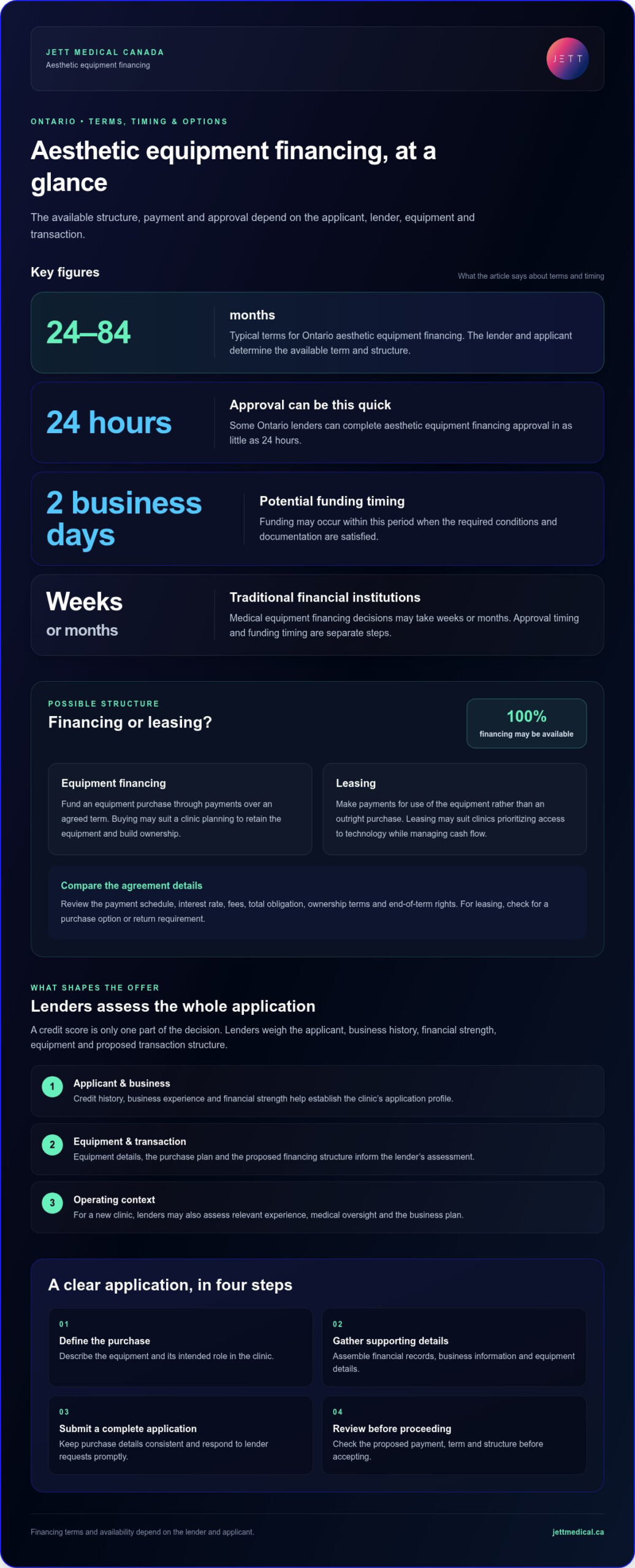
Application timing depends on the lender, the completeness of the documents and the transaction’s complexity. Traditional financial institutions may take weeks or months to decide on medical equipment financing applications. Some Ontario lenders can complete aesthetic equipment financing approval in as little as 24 hours. Funding may occur within 2 business days when the required conditions and documentation are satisfied. Approval timing and funding timing are separate steps, so account for both when planning an equipment opening.
Credit decisions involve more than a credit score. Lenders also consider business history, financial strength and whether the equipment and transaction structure support the application. Present a coherent plan: explain how the device fits the clinic’s services, why the purchase is timely and how the business expects to manage payments. For a new clinic, include the owners’ relevant experience, medical oversight arrangements and business plan. These details help lenders assess the operating context alongside credit information.
Before applying, define the purchase and compare the proposed financing structure with the clinic’s operating needs. A practical sequence is:
- Describe the equipment purchase and its intended role in the clinic.
- Gather financial records, business information and equipment details.
- Submit a complete application and respond to lender requests promptly.
- Review the proposed payment, term and structure before accepting.
A complete, consistent application helps lenders evaluate a transaction efficiently. Keep the purchase details aligned across the application and supporting documents, especially when the clinic is preparing to open.
01 What is equipment financing, and how can it help me acquire Aesthetic equipment in Ontario?
Equipment financing lets an Ontario clinic fund an equipment purchase through payments over an agreed term. Leasing offers another structure, with payments for use of the equipment rather than an outright purchase.
Before signing, review the interest rate, payment schedule, fees, total obligation and end-of-term terms. Understand what happens after missed payments and whether the agreement includes a purchase option or a return requirement.
Provincial operating requirements and lender conditions are separate considerations, and financing structures depend on the lender and transaction. Across Canada, clinics should confirm that a medical device is authorized for sale in Canada before buying it.
Financing and Leasing Options
Ontario clinics can explore equipment financing, equipment leasing, capital leases, equipment finance agreements and term financing. Some transactions may also use business financing, refinance or sale-leaseback structures. Compare each option’s payment schedule and ownership terms with projected clinic revenue. Typical Ontario aesthetic equipment financing terms range from 24 to 84 months, and 100% financing may be available.
Leasing Compared with Buying
Buying may suit a clinic that plans to retain equipment and build ownership through payments or an outright purchase. Leasing may suit clinics that prioritize access to technology while managing cash flow. For equipment that changes quickly, leasing can align the payment period with the clinic’s expected use. Compare the total payment obligation, end-of-term rights and equipment condition, especially for used devices.
Tax Considerations for Leasing
In Canada, medical equipment lease payments may, in many cases, be treated as a business expense. Tax treatment depends on the agreement and the business’s circumstances, so clinics should discuss the lease with an accountant and review Canada Revenue Agency guidance. Keep the signed agreement, invoices and payment records together. This helps the accountant assess the arrangement against the clinic’s bookkeeping and tax reporting.
Canadian Lender Options
Canadian clinics can explore banks, credit unions, equipment finance companies, private lenders and asset-based lenders. Each applies its own requirements to the applicant, equipment and transaction structure. Compare written offers based on the same purchase details, then assess payment, term, rate and fees together. For used equipment, include condition records in the application, since reduced resale value may lead to higher rates or shorter terms.
For clinics assessing a plasma-based device alongside financing choices, the Jett Plasma Pen Medical is one equipment option to consider in the purchase plan.
Financing aesthetic lasers and medical aesthetic devices
Clinics can use equipment financing to acquire aesthetic lasers, skin treatment systems, body-contouring devices and facial systems. Medical aesthetic device financing in Canada should align the device’s clinical role with the clinic’s operating plan, expected use and capacity to manage payments.
Financing can preserve working capital for other needs while a clinic adds equipment. For example, a clinic may reserve operating funds for staffing, rent, marketing, renovations, consumables or treatment-room expansion. A business plan should show how the device supports the clinic’s services and where financing payments fit within projected cash flow.
Medical spas, cosmetic clinics, dermatology practices, laser clinics, plastic surgery practices and skin-care clinics may seek financing for commercial equipment. Dental and cosmetic dental practices, physiotherapy businesses and other healthcare practices may also finance devices used in their operations. The applicant’s business model helps explain the equipment’s intended role to a financing source.
Before applying, define the type of device and whether it’s new, used or refurbished. Financing sources may consider used or refurbished equipment when its condition is documented. Include available condition records so the application describes the specific asset being financed, not just its category.
Clinics can explore equipment financing, leasing and, in some cases, refinancing equipment they already own. Some financing sources may consider leasehold improvements alongside equipment financing. A clinic expanding a treatment area, for example, can assess whether equipment and eligible improvements belong in one financing request or separate transactions.
For medical aesthetic device financing in Canada, prepare a written vendor quote before applying for an aesthetic laser. It should identify the make, model and serial number, giving the financing source specific asset details to assess. Compare the quote with the application to keep the equipment description consistent across purchase and financing documents.
Once the financing documents and conditions are complete, payment is coordinated with the vendor before installation. This connects funding to the equipment transaction and helps the clinic plan installation around its opening or treatment schedule. Build financing steps into the project plan rather than treating the machine’s delivery as the only milestone.
Lease structures can include end-of-term conditions that affect the clinic’s decision. For example, a sample lease may include a 10% buyout at the end of the lease term. Review whether the agreement ends with a purchase option, a return or another arrangement, and consider the device’s expected usefulness when that term concludes.
With financing, borrowers who have made all payments own the aesthetic equipment outright at the end of the financing term. Clinics should compare that outcome with a lease’s end-of-term conditions, then align their choice with equipment plans and cash-flow priorities.
Lender documentation and credit assessment
Canadian lenders assess an aesthetic equipment application using both the business’s financial picture and details about the proposed purchase. Ontario applications typically require financial statements, tax returns, business bank statements and information about the equipment. A complete, consistent package helps a lender assess the applicant, business history, financial strength and proposed transaction structure.
Organize the application around the lender’s requested records. Keep financial statements and tax returns for the same business entity, and ensure the bank statements relate to that entity. Equipment information should identify the asset being financed. If the application describes a different purchase from the supporting equipment details, the lender may need clarification before assessing the file.
- Financial statements: Present the clinic’s financial position and operating performance.
- Tax returns: Include the business returns requested for the application.
- Business bank statements: Provide the account records associated with the business.
- Equipment details: Describe the device and proposed transaction consistently.
Credit is one part of the assessment, not the only one. Lenders also weigh business history, financial strength, equipment, documentation, transaction structure and their own requirements. For an established clinic, the operating record and financial statements help explain its ability to manage payments. For a new practice, the business plan, applicant experience and medical oversight provide context for the lender’s review.
Build cash-flow planning into the application. Show how proposed payments fit alongside the clinic’s operating needs, including working capital and other business commitments. This gives the lender a clearer view of the financing request within the business plan. Avoid presenting equipment financing as an isolated purchase when the clinic is also planning staffing, renovations or an opening.
A complete document pack can affect how quickly an application moves through review. The stated comparison for Canadian med-spa applications is a reduction from two months to two weeks when applicants arrive with a complete pack. Preparation is therefore practical: gather the four core document categories before submission, then respond to lender requests with records that match the original application.
Professional credentials can also inform financing decisions for new practices. In Canada, a new dental practice may qualify based on credentials, experience and a business plan, though its terms may differ from those of an established practice. In Ontario, financing sources may ask dentists for proof of licensing through registration with the RCDSO. These details help frame the applicant’s experience and planned clinic operations alongside credit and financial information.
Before submitting, compare every document against the application: business identity, financial records, equipment description and planned use. The vendor quote and equipment details should describe the same transaction. This final review helps keep the credit assessment focused on the clinic’s financial capacity and the specific asset under consideration.
Which Canadian lenders and equipment finance companies finance aesthetic medical devices?
Canadian clinics can explore several financing-source categories for aesthetic medical devices, including banks, credit unions, equipment finance companies, private lenders and asset-based lenders. Each assesses the applicant, equipment, documentation and transaction structure according to its own requirements. A source that fits an established clinic may assess a new practice differently.
Banks and credit unions offer business financing and may consider equipment purchases as part of a clinic’s broader borrowing needs. Med-spa applicants can compare options through discussions with two banks, using the same equipment quote and financial information for each. This makes differences in structure, payment, rate and term easier to identify.
Equipment finance companies focus on transactions involving business equipment. Their assessment can consider the device alongside the applicant’s financial profile and business history. Private lenders and asset-based lenders are other categories in the Canadian financing marketplace. The type of lender alone doesn’t determine approval or terms; the applicant and transaction remain central to the assessment.
Clinics can also learn how the Canada Small Business Financing Program works. Under the program, a financial institution lends to the business, while the federal government shares the lender’s risk. This describes the lending arrangement, not an automatic approval. A clinic considering the program should assess whether this financing route fits its equipment purchase and application circumstances.
Organize lender comparisons around the same decision points:
- Structure: Compare equipment financing, leasing or another proposed arrangement.
- Payment and term: Assess how each offer fits clinic cash flow and equipment plans.
- Application requirements: Compare the financial records and equipment details each source reviews.
- Asset assessment: Include the device’s make, model, serial number and condition where relevant.
For example, a clinic assessing a used device should include records describing its condition. Financing sources may consider used or refurbished equipment when condition is documented. A written vendor quote identifying the make, model and serial number gives lenders a clear description of the asset under review.
Compare complete written proposals rather than headline payments alone. Review the full structure, total payment obligation, fees, end-of-term conditions and timing of payment to the vendor. Once documents and conditions are complete, payment for the healthcare equipment is coordinated with the vendor before installation. This sequence links the financing decision with the clinic’s equipment and opening plans.
Clinics planning a plasma-based device purchase can explore plasma device options alongside their financing assessment.
Jett Medical Canada: Jett Plasma Pen Medical
Jett Medical Canada supplies plasma devices for clinics evaluating equipment for dermatology, ophthalmology and aesthetic applications. Its offerings include Jett Plasma Pen Medical, Jett Plasma Lift Medical and Jett Plasma Medical II. These devices use patented direct-current plasma technology for precise treatment applications with minimal downtime.
Clinics should confirm that any device they consider is authorized for sale in Canada and check its certification details before purchase. Clinics comparing financing options can consider whether a plasma device aligns with their planned services, clinical requirements and equipment budget. Jett Plasma Pen Medical is one option for clinics assessing plasma technology.
Contact Jett Medical Canada or visit jettmedical.ca to learn more about its devices.
Plan your next equipment investment
For clinics considering medical aesthetic device financing in Canada, the next step is to align the proposed equipment purchase with clinical priorities and growth plans. A financing structure is useful when it supports a device choice that fits the practice’s intended applications and operational capacity.
Jett Medical Canada offers Jett Plasma Pen Medical, Jett Plasma Lift Medical and Jett Plasma Medical II. Clinics assessing plasma technology can consider these devices as part of their equipment planning and financing discussions.
As you develop your purchase plan, identify the device you want to evaluate and the role it could play in your clinic. Bring those priorities into your financing discussions so the proposed equipment and transaction make sense together.
Contact Jett Medical Canada about a device purchase as you plan financing, and move forward with a clearer view of your equipment options.
Frequently Asked Questions
Can I upgrade an aesthetic device before the lease ends?
Possibly, depending on the lease agreement’s upgrade, early-exit and transfer clauses. Before planning an upgrade, review whether the contract allows a device trade-in, requires payment of the remaining balance or sets other conditions. Also check who owns the equipment during the lease and what happens at the end of its term. These details determine whether replacing a device early fits the existing agreement.
Can a new salon or med spa get financing?
Yes, a new salon or med spa can apply, and financing sources can assess a new clinic using its owners’ experience, medical oversight and business plan. Clearly explain the planned services and the equipment’s role. Include projections showing how the business expects to manage operating expenses alongside financing payments. The lender evaluates these details alongside the application and its own requirements.
How do you finance a med spa in Canada?
Canadian med spas commonly combine three or four funding sources, such as owner capital, a bank term loan, equipment leasing and landlord contributions. Build a funding plan that assigns each source to a specific need rather than relying on equipment financing for every opening expense. Prepare month-by-month financial projections for the first two years so the plan reflects cash flow as the clinic develops.
Is medical equipment leasing in Canada tax deductible?
Medical equipment lease payments may, in many cases, be treated as a business expense in Canada. Tax treatment depends on the arrangement and the clinic’s circumstances. Keep the lease agreement and payment records with the business’s accounting documents, then discuss their treatment with an accountant using Canada Revenue Agency guidance. Don’t assume every lease payment is automatically deductible without considering the specific agreement.
What if my credit is less than perfect?
Less-than-perfect credit can result in higher interest rates or stricter financing terms. Lenders also consider business history, financial strength, equipment and transaction structure, so present a complete picture of the clinic’s ability to manage payments. For example, include current financial records and explain how the device supports the business plan. Compare the full terms, not only the payment amount.
What financing options are available for medical aesthetic devices in Canada?
Canadian businesses can explore equipment financing, equipment leasing, capital leases, equipment finance agreements, term financing and business financing. Refinancing or sale-leaseback arrangements can also be relevant in certain situations, including when a clinic already owns equipment. Compare how each structure handles payment, ownership and the clinic’s plans for the device. Match the option to the transaction and business needs.
What down payment, interest rates, and loan terms are typical for aesthetic equipment financing in Canada?
Ontario aesthetic equipment financing terms typically range from 24 to 84 months, and 100% financing may be available. Down-payment requirements and interest rates depend on the applicant, equipment, transaction structure and lender requirements. Credit profile and business financial strength also shape the offer. Compare the complete terms, including payment schedule and total obligation, rather than judging an option by its down payment alone.
Can Canadian clinics lease medical aesthetic devices, and how do lease options compare with equipment loans?
Yes, clinics can explore leasing for medical aesthetic devices. Medical equipment lease agreements commonly run between 24 and 60 months, while leasing can suit technology that changes quickly. With equipment financing, borrowers who make all payments own the equipment outright at the end of the term. Compare a lease’s end-of-term conditions with the ownership outcome of financing before choosing a structure.