
The largest equipment catalogue may be the least useful place to start. For Canadian clinics, choosing medical aesthetics equipment Canada-wide is less about the number of options and more about whether a device fits the practice’s clinical scope, patient needs, workflow, and staff capabilities.
Product catalogues can be difficult to compare because they often group devices, consumables, and treatment categories together, while technical and regulatory claims use different terms. A practical assessment goes beyond headline features. Health Canada licenses certain classes of medical devices for their intended purposes, while provincial professional rules also shape who may perform procedures and within what scope.
This guide offers a practical framework for assessing clinical fit, interpreting licensing and technical information, and planning training and implementation. It also explains how specialized plasma technology may fit within a clinic’s services, without assuming one device suits every practitioner or application. The aim is to help you make a measured equipment decision grounded in clinical relevance, regulatory context, and the realities of day-to-day practice.
Key Takeaways
- Distinguish capital devices from consumables, treatment supplies, and clinic infrastructure to compare equipment on a like-for-like basis.
- Choose medical aesthetics equipment Canada clinics can integrate by matching its intended use to clinical scope, patient needs, and staff capabilities.
- Assess device mechanisms individually. Direct-current plasma is a distinct technology, not a substitute for every aesthetic modality.
- Separate Health Canada licensing from international certifications, and consider what each credential says about the device.
- Plan adoption around workflow, space, documentation, equipment-use procedures, and staff training, not just the purchase decision.
Medical aesthetics equipment in Canada: what clinics need to assess
Professional medical aesthetics equipment is a device or related tool used by qualified clinic staff to support a defined clinical service, according to its intended use and the practice’s scope. That distinguishes clinical equipment from consumer beauty tools marketed for personal use. A device’s appearance or marketing category alone doesn’t establish its suitability for professional care. The general concept of a medical device includes products designed for medical purposes, but the intended use and applicable documentation of each device matter.
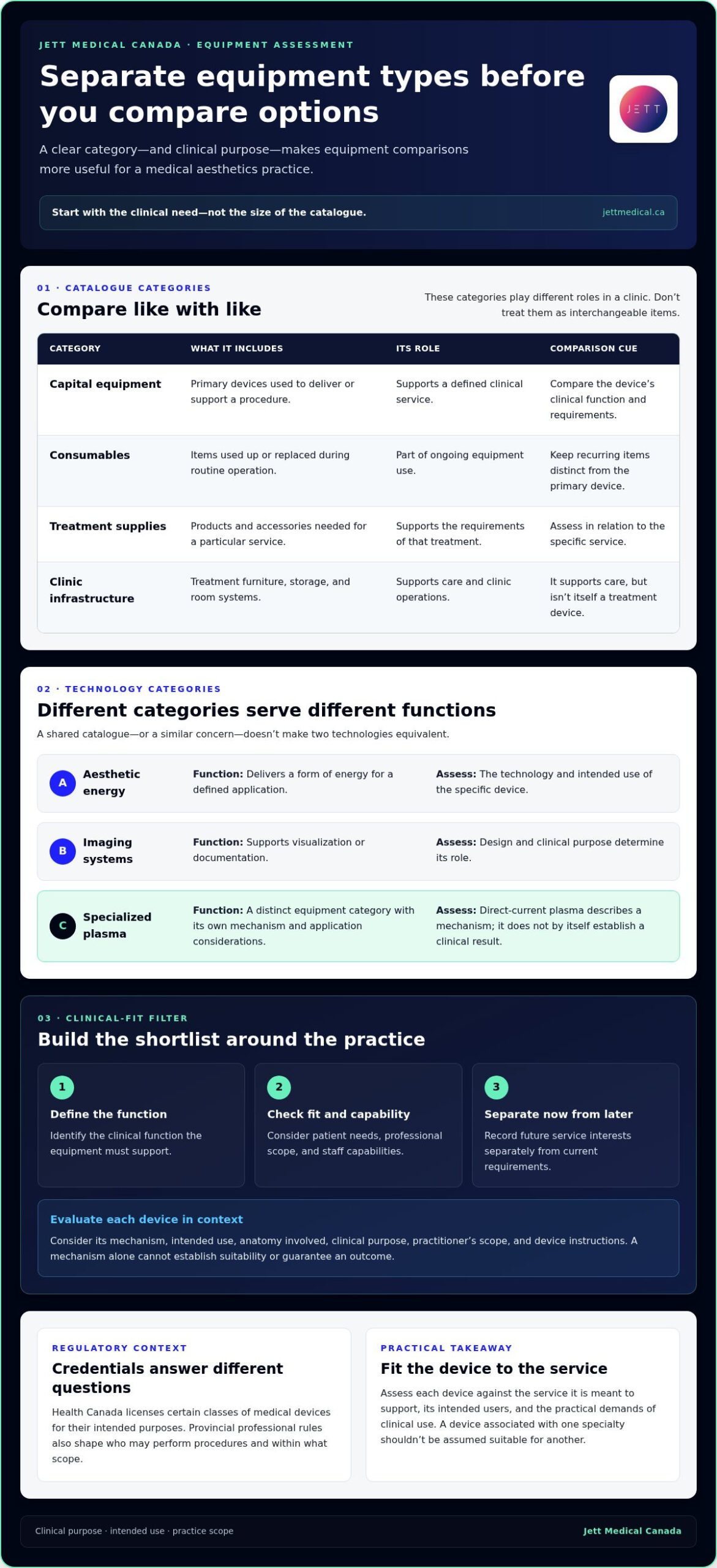
Start by separating equipment types that catalogues often group together. Capital equipment refers to primary devices used to deliver or support a procedure. Consumables are items used up or replaced during routine operation, while treatment supplies may include products and accessories needed for a particular service. General clinic infrastructure, such as treatment furniture, storage, and room systems, supports care but isn’t itself a treatment device. Distinguishing these categories makes comparisons and implementation planning more precise.
Define the clinical need before reviewing brands or browsing a broad catalogue. A device should have a clear role in a service the clinic is qualified and prepared to provide. This helps teams focus on relevant options rather than features that don’t correspond to patient needs or daily workflow. When assessing medical aesthetics equipment Canada clinics can use clinical purpose as the first filter, then consider each device’s requirements.
Which equipment categories may fit a medical aesthetics practice?
Different categories perform different functions and require separate evaluation:
- Aesthetic energy devices deliver a form of energy for a defined application; their technologies and intended uses vary.
- Imaging systems support visualization or documentation, depending on their design and clinical purpose.
- Specialized plasma technology is another distinct equipment category, with its own mechanism and application considerations.
These categories aren’t interchangeable. Assess each against the service it is meant to support, its intended users, and the practical demands of clinical use.
How clinical scope shapes an equipment shortlist
Build the shortlist around the clinic’s established services, relevant specialties, and patient needs. Separate current priorities from possible future expansion so that a potential new service doesn’t outweigh an immediate clinical need.
- Identify the clinical function the equipment must support.
- Consider whether the service fits the clinic’s professional scope and staff capabilities.
- Record future service interests separately from current requirements.
For a focused discussion of professional plasma devices, see the professional plasma pen guide. Using clinical scope to narrow the field gives the next stage of comparison a clear purpose.
How specialized medical aesthetics equipment works in clinical practice
A device’s category doesn’t tell a clinic everything it needs to know. Technologies may work through different mechanisms, address different clinical purposes, and have distinct intended uses. Two devices marketed for aesthetic practice aren’t equivalent simply because they appear in the same catalogue or address a similar concern.
Assess mechanism, intended use, and clinical context together when deciding whether a device is appropriate for a particular service. Consider the anatomy involved, the clinical purpose, the practitioner’s scope, and the specific device’s instructions. Technology selection is a clinical-fit decision, not just a comparison of headline features.
For example, an energy-based device and a plasma device represent different technology categories. Their operating principles and intended applications shouldn’t be assumed to overlap. Device documentation and instructions provide the relevant context for evaluating a specific model and proposed use.
What direct-current plasma technology contributes
Direct-current plasma is a distinct technology in Jett Medical Canada’s specialized device portfolio. At a high level, the term describes plasma technology that uses direct current. The mechanism helps explain how a device operates, but it doesn’t by itself establish a particular clinical result.
Relevance depends on the specific device and its intended application. For a clinic considering plasma equipment in a dermatological or other specialty setting, the practical question is whether the device’s documented purpose aligns with the service and the staff’s clinical responsibilities. A technological mechanism alone cannot establish suitability or guarantee an outcome.
Why intended use matters across clinical specialties
Jett Medical Canada supplies specialized plasma devices for dermatological, ophthalmic, aesthetic, and gynecological applications. These are distinct clinical contexts, not one interchangeable use category. Assess each device according to its intended purpose and instructions; a device associated with one specialty shouldn’t be assumed suitable for another.
For an ophthalmic context, the ophthalmic plasma guide for dry eye offers a focused discussion. For any proposed application, use device-specific documentation to understand its stated purpose and operating instructions, then consider how that purpose relates to the anatomy, clinical objective, and practitioner’s role.
This distinction is useful when comparing medical aesthetics equipment Canada clinics may encounter across specialties. Start with the procedure and patient need, then assess the technology and its intended use in that context. Jett Medical Canada’s specialized plasma equipment is one professional equipment category to consider in that assessment.
How to compare medical aesthetics equipment and assess device credentials
A consistent comparison makes technical claims easier to evaluate and prevents catalogue breadth from standing in for clinical fit. Review each device individually: documentation or credentials for one model shouldn’t be assumed to apply to another, even within the same product family. In Canada, Health Canada licenses medical devices in applicable classes for their intended purposes. A licence is not a guarantee of a particular patient outcome.
Compare each device’s intended use, clinical fit, documentation, operating requirements, training needs, and support before deciding whether it belongs on your shortlist.
| Criterion | What to assess |
|---|---|
| Intended use | Does the stated purpose align with the service the clinic plans to provide? |
| Clinical fit | Does the device suit the clinic’s patient needs, specialty, and professional scope? |
| Documentation | Are device-specific instructions and supporting records available for review? |
| Training | What preparation will staff need to operate the equipment within its instructions? |
| Support | What training and implementation support will contribute to staff readiness and routine use? |
Which technical and clinical criteria belong in a comparison?
Apply the same criteria to every candidate. Match its stated purpose to the clinic’s planned service, then review available documentation and operating requirements. Consider how training fits staff roles and workflow. Keep a written record of unresolved clinical or technical questions so assumptions don’t become decision criteria.
Assess evidence in context. Interpret performance statements and technical features in relation to the device they describe, its documented purpose, and the evidence provided. Don’t transfer claims between devices or infer that a feature establishes suitability for an application not stated in the device information.
How to interpret Health Canada licensing and other credentials
Health Canada licensing and international credentials serve different purposes. For applicable medical device classes, a Health Canada Medical Device Licence indicates that regulatory requirements for the device’s intended purpose have been met. CE and MDSAP credentials aren’t substitutes for checking Canadian licensing status or intended use. Confirm the exact device and current details in Health Canada’s Medical Devices Active Licence Listing (MDALL).
Jett Medical Canada’s products are Health Canada licensed and hold CE, MDSAP, and other international certifications. Treat these as distinct credentials, and assess their relevance against the specific device and its documentation rather than assuming one portfolio-wide claim settles every comparison. The 2026 Health Canada licensed-device reference provides focused detail for clinics reviewing plasma devices.
For clinics comparing medical aesthetics equipment Canada offers, this framework turns claims into practical questions: What is the device for? What documentation supports that purpose? What will staff need to use it appropriately?
Planning equipment adoption, staff training, and clinic workflow
A device may fit a clinic’s service plans on paper yet create friction in day-to-day practice if staff roles, room layout, and patient flow aren’t considered early. Treat adoption as a clinical and operational process, not simply a purchasing decision. A structured sequence helps the team identify practical requirements before the equipment enters routine use.
A practical sequence for introducing new equipment
Use these four steps to move from a defined need to staff readiness:
- Define the clinical need. Specify the service the equipment is intended to support, the relevant patient needs, and how the service fits the clinic’s scope. Identify who may use the device within the team’s professional roles.
- Map the workflow. Consider where the device will be placed, how patients and staff will move through the room, and whether the planned location supports the manufacturer’s operating instructions. Account for storage and the space needed to prepare for and complete the service.
- Prepare procedures and documentation. Establish how staff will follow device instructions, document equipment use, and maintain relevant records within clinic processes. Make responsibilities clear so team members know which procedures apply before, during, and after use.
- Train and review readiness. Schedule appropriate training for the staff who will use or support the equipment. Before routine use, review whether team members understand the device’s intended purpose, operating procedures, documentation practices, and their assigned roles.
These steps can reveal implementation needs that a product comparison may miss. For example, a room layout may need to change to preserve a workable patient pathway, or the clinic may need to clarify who is responsible for equipment-related documentation. Resolve these issues during planning rather than leaving them to informal workarounds.
Why training and support matter after selection
Training connects a device’s instructions with the people and procedures involved in its use. It can help doctors and nurses understand device-specific information, align team practices, and identify questions that need resolution before adoption. Training supports informed use; it doesn’t replace professional judgement, clinical scope, or the device’s intended purpose.
Jett Medical Canada provides training and support for doctors and nurses. Include this in adoption planning by identifying which team members need training, how new information will be reflected in clinic procedures, and how the team will assess readiness. A clear approach can support consistent equipment use within appropriate clinical practice, without implying a particular patient outcome.
For clinics evaluating specialized plasma devices, this implementation framework connects equipment selection with staff preparation and workflow. Explore Jett Medical Canada’s professional device information as part of your planning.
Jett Medical Canada’s plasma equipment for professional clinics
Jett Medical Canada supplies professional clinics across Canada with specialized plasma devices for dermatological, ophthalmic, aesthetic, and gynecological applications. This portfolio is a focused equipment category to assess alongside the clinic’s services, patient needs, staff capabilities, and the intended use of each device.
The portfolio includes Jett Plasma Pen Medical, Jett Plasma Lift Medical, and Jett Plasma Medical II, as well as Edge EOM-P EVO, Jett Plasma For Her II, and Edge O Tech. These are distinct devices, not interchangeable choices. Their shared association with plasma technology doesn’t establish that they have the same purpose, application, or operating instructions.
A specialized portfolio for professional clinical applications
Consider each device in relation to the clinical role it is intended to serve. Begin with the clinic’s relevant specialty and planned service, then review the specific device’s documentation and instructions. The portfolio spans several clinical areas, but that doesn’t mean every device is intended for every specialty or application.
This distinction matters when reviewing a shortlist. A clinic may have different equipment needs across its services, and a device’s name alone can’t establish whether it fits a particular clinical purpose. Compare the intended use and device information for each option. Don’t transfer application claims from one device to another or assume a technology category guarantees a specific result.
For practices evaluating medical aesthetics equipment Canada-wide, specialized plasma devices may be relevant when their documented purpose aligns with the clinic’s clinical scope. A careful review keeps the decision anchored in appropriate use rather than catalogue breadth. It also gives the team a clearer basis for planning staff preparation and integrating the selected device into clinic procedures.
Explore device information, training, and support
Jett Medical Canada provides training and support to doctors and nurses, which clinics can build into equipment-adoption planning. Education helps clinical teams become familiar with device-specific information and prepare for appropriate use within their professional responsibilities. It complements, rather than replaces, a clinic’s review of the intended purpose, instructions, and local practice requirements.
Jett Medical Canada’s products are Health Canada licensed and hold CE, MDSAP, and other international certifications. These credentials have distinct roles and don’t replace clinical evaluation or review of information for an individual device. For a well-grounded decision, consider relevant device documentation alongside the clinic’s intended application and implementation needs.
To explore the professional plasma portfolio and consider how a device may relate to your clinic’s needs, explore Jett Medical Canada’s plasma technology.
Make your next equipment decision with clinical purpose
Turn your clinic’s priorities into a focused evaluation: identify the service a device would support, determine how it fits your practice, and plan for staff readiness before adoption. This keeps the decision grounded in clinical need rather than catalogue breadth. When assessing medical aesthetics equipment Canada clinics are considering, keep device-specific intended use and implementation central to the review.
Jett Medical Canada supplies Health Canada licensed products that hold CE and MDSAP certifications, and provides training and support for doctors and nurses. Consider these factors alongside the documentation and clinical fit of the individual device as your team evaluates professional plasma technology.
Explore the portfolio to identify options relevant to your practice and take the next step in your equipment assessment. Explore Jett Medical Canada’s professional plasma technology. A deliberate, informed approach can help your clinic plan for technology that aligns with its clinical direction.
Frequently Asked Questions
What is considered medical aesthetics equipment?
Medical aesthetics equipment includes professional devices used to support clinical aesthetic services, along with accessories or tools required for their operation. A treatment device differs from a single-use item used during a procedure or furniture that supports the clinic room. Consumer beauty tools aren’t automatically suitable for clinical use. Classification depends on the product’s purpose and design, not solely on how it is marketed.
How should a Canadian clinic compare medical aesthetics devices?
Compare devices against a defined clinical service rather than ranking them by feature count. Check the intended use, device-specific instructions, operating requirements, available documentation, staff training needs, and implementation support. For medical aesthetics equipment Canada clinics are assessing, record the source of each technical or regulatory claim and keep unresolved questions visible in the decision record. This helps distinguish documented information from assumptions during procurement review.
Is medical aesthetics equipment in Canada required to have Health Canada licensing?
Health Canada Medical Device Licences are required for Class II, III, and IV medical devices sold in Canada. Requirements depend on the device’s classification, so the term “medical aesthetics equipment” alone doesn’t establish whether a licence applies. For a device in a licensable class, look up its exact name or licence details in Health Canada’s Medical Devices Active Licence Listing. Licensing relates to the device’s intended purpose, not guaranteed results.
Can one aesthetic device be used across different clinical specialties?
Not necessarily. A device’s mechanism may be relevant to more than one area of care, but that doesn’t establish that its intended use covers each specialty. For example, a clinic considering a device for both dermatological and ophthalmic services should assess the specific model’s instructions and authorized purpose for each proposed use. The practitioner’s professional scope and applicable practice requirements also matter. Don’t extrapolate an application from another device.
How much does medical aesthetics equipment cost in Canada?
Costs vary by equipment category, device configuration, and the clinic’s implementation needs. Compare the full budget, not just the device purchase: include applicable consumables, room or workflow changes, staff training, and ongoing operational requirements. These factors differ between technologies and models, so a single industry-wide figure may not reflect a clinic’s actual investment. For plasma devices, review device-specific commercial information rather than relying on treatment prices.
What does MDSAP certification mean for medical equipment?
MDSAP stands for the Medical Device Single Audit Program, an audit program for medical device manufacturers’ quality management systems. It is distinct from a Health Canada licence for an individual device. An MDSAP credential shouldn’t be treated as proof that every device from a manufacturer has the same licence, intended use, or clinical evidence. Consider it alongside the specific device’s Canadian regulatory status and documentation.
Does Jett Medical Canada provide training for its plasma devices?
Yes. Jett Medical Canada provides training and support for doctors and nurses adopting its plasma devices. Clinics can incorporate this education into their onboarding plan by identifying which team members will use or support a device, then aligning training with its instructions and clinic procedures. Training complements professional responsibilities; it doesn’t expand a practitioner’s scope or replace device-specific review and clinical judgement.