
Choosing a medical device for improving vaginal laxity by energy source alone can obscure the questions that matter most: what concern is being assessed, what evidence supports the proposed use, and what the device is authorized to do in Canada.
Clinicians face a genuine challenge. “Vaginal laxity” can overlap with pelvic floor concerns, genitourinary symptoms and other conditions, while broad terms such as “vaginal rejuvenation” don’t define a precise clinical indication. A device’s regulatory status matters, but it doesn’t establish benefit for every use or patient.
This guide offers a consistent framework for assessing device-based approaches in Canadian practice. It compares technology and indication-specific evidence, distinguishes general gynaecological applications from claims relating specifically to laxity, and outlines clinical and operational questions to resolve before adoption. It also considers Jett Plasma For Her II within Jett Medical Canada’s women’s health portfolio. Product labelling and authorized intended use remain central to any evaluation.
Key Takeaways
- Start with clinical assessment: vaginal laxity is a reported concern, not a diagnosis or automatic indication for device treatment.
- Evaluate a medical device for improving vaginal laxity by its intended use and supporting clinical evidence, not by its energy source alone.
- Assess Canadian licensing, product-specific authorized use, evidence, clinician training and support as distinct decision factors.
- Plan for documentation, clinical governance, training, workflow and patient communication before adopting a device.
- Consider Jett Plasma For Her II within Jett Medical Canada’s women’s health portfolio, grounding any clinical use in the applicable product labelling.
What does a medical device for improving vaginal laxity address?
Vaginal laxity is best understood as a patient-reported concern, not a diagnosis. Someone may describe a sensation of looseness or a change in vaginal sensation, but that report alone doesn’t establish a particular tissue condition or show that a device is appropriate.
Working definition: Vaginal laxity is a subjective concern about looseness or reduced tightness in the vaginal opening or canal. It doesn’t identify the cause or determine treatment.
The concern can relate to different factors, including pelvic floor function, vaginal tissue changes or anatomy at the vaginal opening. Symptoms may also overlap with pressure, a vaginal bulge, discomfort, dryness or urinary concerns. A general overview of the term appears in Vaginal Introital Laxity, but clinical decisions require more than a general definition.
How clinicians should frame vaginal laxity concerns
Begin with the patient’s description and goals. Ask what feels different, when the concern began, and whether it affects comfort, daily activities or sexual well-being. A neutral discussion allows patients to describe their experience without implying that a particular body shape or sensation is abnormal.
History and assessment help put the concern in context. Relevant considerations may include childbirth history, hormonal changes, pelvic floor symptoms, pain and other vaginal or urinary symptoms. Distinguish the concern being reported from findings that may suggest a separate clinical issue. A patient’s description matters, but it doesn’t prove a specific tissue change, pelvic floor weakness or prolapse.
When device-based options enter the discussion
Consider a device only after assessing the concern and identifying an appropriate clinical objective. Selection depends on the device’s authorized intended use, evidence for that specific application and the clinician’s judgement. The technology category or energy source alone cannot establish that a device is effective for vaginal laxity.
Keep general gynaecological applications separate from claims about laxity. A device may have an authorized use in another area of gynaecology, but that doesn’t establish a specific indication for vaginal laxity or related symptoms. For any medical device for improving vaginal laxity, use the applicable product labelling and evidence for the proposed use to guide the discussion.
Set expectations carefully. Avoid promising changes in tissue, sexual function, durability or other outcomes unless those claims are supported for the specific device and use. If assessment points to another clinical concern, let that finding guide the next step rather than relying on a broad “tightening” label.
How do device technologies differ for vaginal laxity applications?
Device categories describe how technology is generated or delivered, not whether a particular device benefits a specific patient concern. Laser systems deliver optical energy, while radiofrequency systems use electromagnetic energy. Plasma is a separate technology category, but the label alone doesn’t establish how a specific device is designed for gynaecological use. Device-specific documentation is essential.
A mechanism describes how a device delivers energy; it isn’t proof of clinical benefit for vaginal laxity. Evidence for one device, treatment protocol or indication can’t automatically be applied to another.
What a technology description can, and cannot, tell clinicians
Start with the manufacturer’s official instructions and technical documentation. These should clarify the device’s technology, intended use and operating parameters. A general description of its mechanism may explain how energy is delivered, but it doesn’t independently establish tissue effects, safety, effectiveness or suitability for a specific patient.
Keep claims specific to the indication. Evidence or authorization for a device’s use in another area of medicine, including a general gynaecological application, doesn’t demonstrate benefit for vaginal laxity on its own. The same caution applies across technologies: similar terminology doesn’t mean devices have identical designs, protocols or evidence.
How to assess the evidence for a specific application
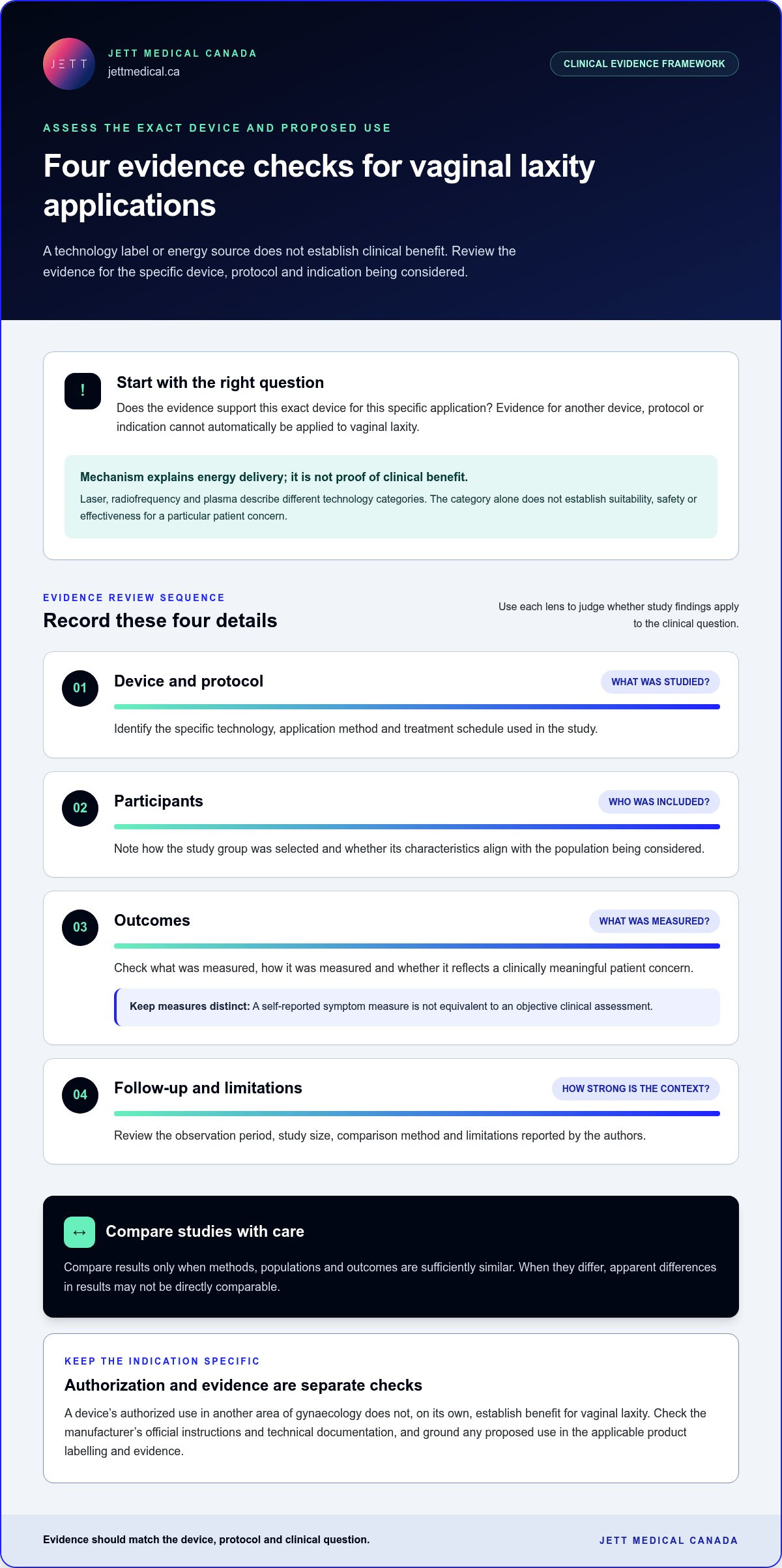
Evaluate evidence for the exact device and proposed use. Study design, participants, treatment protocol, comparison group and measured outcomes all affect what findings can support. For example, results based on a self-reported symptom measure shouldn’t be treated as equivalent to results based on an objective clinical assessment. A study of another indication shouldn’t be presented as direct evidence for laxity.
When reviewing published research, record the details that determine whether it applies to the clinical question:
- Device and protocol: Identify the specific technology, application method and treatment schedule studied.
- Participants: Note how the study group was selected and whether its characteristics align with the population being considered.
- Outcomes: Check what was measured, how it was measured and whether it reflects a clinically meaningful patient concern.
- Follow-up and limitations: Review the observation period, study size, comparison method and limitations reported by the authors.
Compare results across studies only when their methods, populations and outcomes are sufficiently similar. If these elements differ, apparent differences in results may not be meaningful. Preliminary findings can inform further evaluation, but shouldn’t be described as established clinical practice.
For clinics evaluating plasma technology, Jett Medical Canada supplies professional devices, including Jett Plasma For Her II. The company’s portfolio is described as Health Canada licensed and MDSAP approved, while product-specific intended use and evidence remain separate considerations. Clinicians can review professional plasma technology as part of a broader, indication-focused assessment.
How to compare medical devices for vaginal laxity responsibly
A useful comparison separates five questions: what the device is intended to do, how it is authorized in Canada, whether evidence supports the proposed use, what training is available, and how implementation fits the clinic. These factors are related but not interchangeable. A licence doesn’t prove benefit for every application, and evidence for one device or indication doesn’t automatically transfer to another.
Match intended use and regulatory documentation
Start with product-specific labelling and regulatory documentation. In Canada, confirm the device’s applicable licence status and authorized intended use using current records and Health Canada terminology. A portfolio-level statement about licensing doesn’t establish that every product has the same authorization or that every possible indication is included. The Health Canada licensed device reference guide provides context for reviewing device status.
Use a consistent decision matrix to document the comparison. Record the proposed use, not just the device category or marketing description.
| Comparison factor | What to document | Decision question |
|---|---|---|
| Intended use | Product labelling, target application and relevant limitations | Does the proposed clinical use align with the device’s documented purpose? |
| Canadian authorization | Product-specific Health Canada licence information and applicable status | Does the record correspond to this device and intended use? |
| Evidence fit | Study design, protocol, outcomes, limitations, patient population and indication | Does the evidence directly address the proposed use and population, or is it extrapolated from another application? |
| Training | Clinician education and support for adopting the technology | Can the clinical team develop appropriate competence for the proposed workflow? |
| Clinic implementation | Governance, documentation and practical workflow requirements | Can the clinic integrate the device within its professional standards and processes? |
Compare evidence, training and clinic support
Evidence should match the proposed indication and patient group as closely as possible. Review how outcomes were measured, the study design and follow-up, and the authors’ stated limitations. A study of a different application may help explain a technology, but it isn’t direct evidence of benefit for vaginal laxity. Keep that distinction clear in the clinic’s comparison notes.
Licensing, certification and clinical evidence answer different questions. A quality-management or certification claim isn’t proof of a clinical outcome; published evidence doesn’t replace product-specific authorization review. Training and implementation support inform adoption and governance, not efficacy. For broader context on professional plasma technology, review this clinical comparison of professional plasma pen brands.
What should a clinic plan before adopting a vaginal laxity device?
Adoption involves more than acquiring equipment. A clinic needs a documented basis for the proposed use, clear clinical accountability, trained staff and a workflow that supports informed decisions and follow-up. Qualified clinicians determine patient suitability and practise according to applicable professional standards. The sequence below can help clinics identify readiness gaps before introducing a device.
- Assemble and review documentation. Collect the device’s current instructions, product-specific labelling, Canadian regulatory information, evidence for the proposed application and relevant safety information. Record what the documentation supports, distinguishing direct evidence for the intended use from evidence drawn from another indication.
- Establish clinical governance. Define who assesses patients, determines whether a device-based option is appropriate, documents the rationale and oversees its use. Set out how clinical questions, adverse events or concerns will be managed under existing clinic policies. Assign responsibilities before the device enters routine practice.
- Prepare clinician training. Identify which doctors, nurses or other qualified team members need education for their roles. Training and ongoing support should complement, not replace, professional judgement and applicable standards. Jett Medical Canada provides training and support to doctors and nurses adopting plasma-based therapies. Its guide to professional plasma lift standards offers additional context for clinical planning.
- Design the clinic workflow. Decide how referrals or requests are assessed, where device documentation is kept, who maintains records and how follow-up is arranged. Align equipment handling and recordkeeping with manufacturer instructions and clinic policies. Don’t assume a treatment schedule or recovery timeline; use applicable documentation and clinical judgement.
- Plan patient communication. Explain the proposed use, available evidence, uncertainties, alternatives and material risks in clear, balanced language. Informed consent should reflect the specific device and intended application, not broad promotional claims. Document the patient’s goals, assessment, discussion, decision and any follow-up plan in the clinical record.
Set governance and expectations before use
Communication should make clear what is known and what remains uncertain. Don’t guarantee results, imply that a device addresses every cause of a reported concern or minimize risks. If evidence doesn’t directly match the proposed indication or patient group, explain that limitation. A consistent process helps the team communicate transparently while preserving individualized clinical judgement.
Check readiness as a team
Before implementation, review the plan with staff who will assess patients, operate or support the device, maintain records and coordinate follow-up. Confirm that each responsibility has an owner and that the workflow aligns with clinic governance. This preparation supports deliberate adoption without substituting a generic protocol for device-specific instructions or professional standards.
For clinics considering professional plasma technology, explore Jett Medical Canada’s clinician training and device support as part of implementation planning.
How Jett Medical Canada supports professional plasma technology decisions
Jett Medical Canada distributes professional plasma technology to medical clinics across Canada, including devices for gynaecological applications. Its portfolio is described as Health Canada licensed and MDSAP approved. The company also provides training and support to doctors and nurses adopting plasma-based therapies. These services inform clinics’ understanding of distribution and implementation, while device-specific intended use and clinical evidence remain essential when evaluating an application.
Where Jett Plasma For Her II fits in the portfolio
Jett Plasma For Her II is part of Jett Medical Canada’s women’s health offering. Assess its place in a clinical decision using the product’s applicable labelling and documentation, not assumptions based on its category or general portfolio statements. A product name or broad description of a women’s health application doesn’t, on its own, establish an indication for vaginal laxity. Base any proposed use on relevant product-specific information and evidence.
This distinction matters when considering a medical device for improving vaginal laxity. A manufacturer’s licensing or quality-related status, clinical research and authorized intended use each address a different consideration. Review them together, without treating one as a substitute for another or implying a particular patient outcome.
Evaluate the next step for your practice
Before deciding whether a professional plasma device fits your clinic’s plans, organize the review around four questions:
- Indication: What clinical concern is being considered, and does the product-specific documentation address the proposed application?
- Evidence: Does current clinical evidence relate directly to that indication and the patient population under consideration?
- Regulatory documentation: What is the product’s applicable Canadian status and intended use, based on current documentation?
- Practice readiness: Can the clinic support adoption with appropriate clinical governance, trained staff, patient communication and recordkeeping?
These criteria keep device evaluation grounded in clinical fit rather than technology terminology alone. Jett Medical Canada’s professional guide to licensed plasma technology offers further context on professional devices and licensing. It complements, rather than replaces, product-specific documentation and a review of evidence for the proposed use.
Clinics exploring plasma technology can discuss professional plasma technology and clinical fit with Jett Medical Canada. The discussion can cover the device portfolio, clinician training and practical considerations for evaluating a technology for practice, without presuming suitability or promising outcomes.
Make your next device decision evidence-led
A considered approach to a medical device for improving vaginal laxity starts by defining the clinical question your practice seeks to address. Use that question to guide a product-specific review of intended use, supporting evidence and regulatory documentation. Then consider whether your clinic is prepared to implement the technology within its governance and patient communication standards.
Jett Medical Canada distributes professional plasma technology devices nationally. The company’s portfolio is described as Health Canada licensed and MDSAP approved, and it provides training and support to doctors and nurses adopting plasma-based therapies. These resources can inform your evaluation, while clinical fit depends on the applicable product labelling and evidence for the proposed use.
Take the next step with a careful assessment. Explore Jett Medical Canada’s professional plasma technology and consider how it aligns with your clinic’s clinical priorities and readiness. An evidence-led process connects technology decisions with responsible, patient-centred care.
Frequently Asked Questions
Is vaginal laxity the same as pelvic organ prolapse?
No. Vaginal laxity is a concern someone may report, while pelvic organ prolapse involves pelvic organs descending towards or into the vaginal canal. The terms aren’t interchangeable, and one doesn’t establish the other. A feeling of pressure or a vaginal bulge may warrant clinical assessment for prolapse or another cause. Describe the specific sensation and any associated symptoms to a qualified clinician rather than relying on the word “laxity” alone.
Can pelvic floor physiotherapy be considered before a device-based option?
Yes. Pelvic floor physiotherapy may be considered if assessment suggests pelvic floor function is relevant to the person’s concern. A physiotherapist can assess muscle coordination and function, then discuss an approach suited to the individual. It isn’t a universal solution for every cause of vaginal changes, and it doesn’t replace assessment of other symptoms. A clinician can help determine whether physiotherapy, another care option or further evaluation is appropriate.
Does menopause cause vaginal laxity?
Menopause can be associated with hormonal changes that affect vaginal and vulvovaginal tissues, including dryness or discomfort. These symptoms don’t automatically mean a person has vaginal laxity, and the terms shouldn’t be used interchangeably. If changes include dryness, irritation, pain or urinary symptoms, describe them specifically during a clinical assessment. This helps distinguish possible tissue changes from pelvic floor concerns or other conditions and supports discussion of relevant care options.
Can vaginal laxity affect sexual function?
It may be connected to a person’s experience of sexual activity, but the effect varies. Someone might report a change in sensation or confidence, while another person with a similar concern may not experience a functional impact. Pain, dryness, pelvic floor symptoms, relationship factors and other health considerations can also affect sexual well-being. A respectful clinical conversation can clarify the person’s priorities without assuming a device will change sexual function.
Are consumer plasma pens suitable for vaginal laxity concerns?
No. Consumer plasma pens shouldn’t be used for vaginal application or self-treatment. Professional medical devices are distinct from consumer products, and a device’s technology label doesn’t establish that it’s suitable for a particular anatomical site or concern. Any clinical use must be grounded in the specific device’s instructions and applicable intended use, with decisions made by qualified clinicians. Don’t attempt an intimate procedure with a product not intended for that use.
Can a plasma device be described as a vaginal laxity treatment?
Only when the specific device’s applicable product labelling supports that intended use and the description accurately reflects the evidence. A general women’s health or gynaecological category isn’t enough to substantiate a vaginal laxity claim. For a medical device for improving vaginal laxity, distinguish what the labelling authorizes from what studies have evaluated. Don’t present a proposed or unproven use as an established treatment or guaranteed outcome.
What should patients ask their clinician about a device-based option?
Ask what clinical concern the device is intended to address and how that relates to your symptoms. You can also ask whether its Canadian product labelling covers the proposed use, what evidence applies to people with similar concerns, what uncertainties and material risks are known, and what alternatives may be appropriate. Clarify how suitability will be assessed and what follow-up involves. These questions support an informed discussion, not a predetermined treatment decision.