
A medical grade plasma lift is defined by clinical controls, not by the wording on a device page. Since “medical grade” is used inconsistently in aesthetic-device marketing, the label alone doesn’t explain how a system works, who it’s intended for, or what regulatory status it holds. Those distinctions matter when evaluating technology for clinical practice.
In Canada, Jett Plasma Lift Medical is listed by Health Canada as a Class 3 medical device. That status is separate from a practitioner’s authority to perform a procedure, which is governed by provincial scope-of-practice requirements. Device technologies also differ: direct-current plasma systems aren’t interchangeable with every device marketed as a plasma pen or lift.
This article explains what the term can mean in a clinical context, how plasma technologies and professional devices differ, and what Canadian practitioners should assess before adoption. It also covers device licensing, training, patient assessment, and safety protocols, with Jett Plasma Lift Medical as an example of a professional system using direct-current technology.
Key Takeaways
- Assess a medical grade plasma lift by its documented intended use and clinical controls, not marketing terminology alone.
- Understand how direct-current plasma fits within the broader range of plasma technologies and what to compare when assessing devices.
- Use a structured framework to review device documentation, training, and support before considering adoption.
- Plan clinical readiness in sequence, from scope of practice and documentation to staff training, workflow, and follow-up.
- Explore how Jett Plasma Lift Medical combines patented direct-current technology with professional training and support for Canadian clinics.
What Does Medical Grade Plasma Lift Mean in Clinical Practice?
The phrase medical grade plasma lift is often used for plasma-based equipment intended for professional clinical settings. By itself, it doesn’t prove a device’s safety, performance, regulatory status, or suitability for a particular use. Practitioners need to assess the technology, its documentation, and the clinical context separately.
A medical grade plasma lift is a plasma-based technology used with a device whose regulatory status, intended use, and clinical application must each be assessed on their own evidence. Plasma is ionized gas; the broader field of plasma medicine explores its use in medical applications. That scientific category doesn’t establish the authorization or expected results of a specific device.
How Is a Medical Plasma Lift Different from a Cosmetic Plasma Pen?
Assess the distinction through documentation and intended context, not appearance or naming. A device intended for healthcare professionals should have product-specific instructions and regulatory documentation relevant to its use. Clinical use also calls for appropriate clinician competency and safety processes, while a consumer-market product may be marketed without the same clinical context. Requirements vary by device, so “professional” on a label isn’t enough.
What Does “Medical Grade” Actually Tell a Practitioner?
“Medical grade” is a descriptive marketing term, not a standalone Health Canada device class or licence. Treat it as a prompt to review the manufacturer’s claims, the device’s Canadian licensing status and scope, any applicable certification, and the evidence supporting its intended use. These are distinct forms of information: certification or promotional wording doesn’t replace a Health Canada licence or clinical evidence. For more regulatory context, see the Health Canada licensed plasma devices guide.
For a practical evaluation, look for documentation tied to the exact manufacturer, model, and configuration. Check that the stated intended use aligns with the proposed clinical application, and distinguish evidence about a technology category from evidence about a particular device. For example, Health Canada identifies Jett Plasma Lift Medical as a Class III medical device. That classification provides regulatory context, but it doesn’t independently establish a practitioner’s authority to perform a procedure or guarantee an outcome.
Clinical equipment and consumer-market plasma pens shouldn’t be treated as interchangeable, and not every device marketed to professionals uses the same technology or has the same regulatory status. Start with the specific device record and its supporting documents, then consider clinician training and practice requirements. This keeps terminology in perspective and grounds adoption decisions in verifiable information rather than a label.
How Direct-Current Plasma Technology Relates to a Plasma Lift
Plasma is a gas in which some particles have become electrically charged, allowing it to conduct electricity. How a plasma-based device generates and controls electrical energy depends on its design. This distinction matters when comparing technologies, but it doesn’t establish clinical performance on its own.
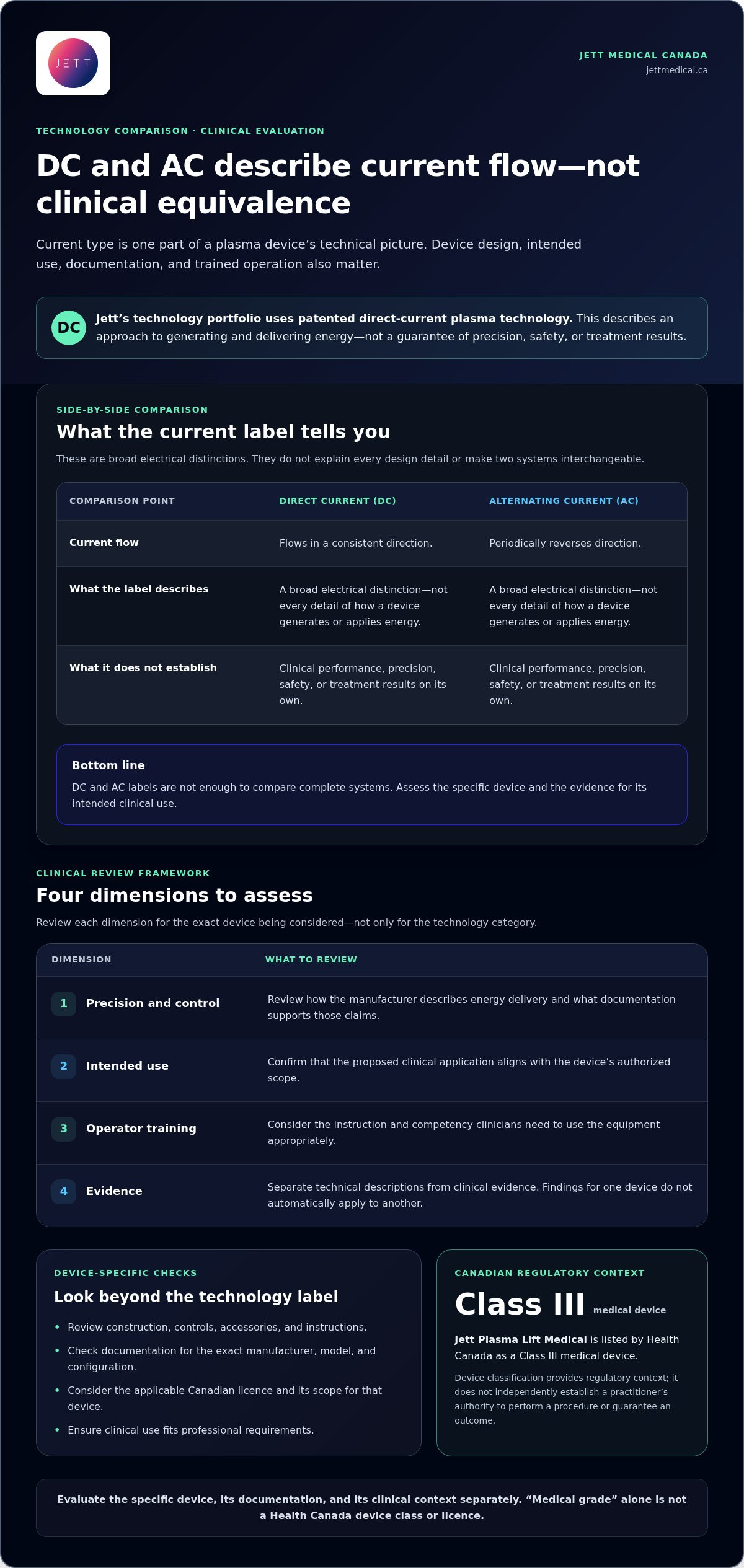
Direct-current plasma uses electrical current that flows in one direction; its clinical relevance depends on the device design, operating parameters, intended use, and trained operation. Jett’s technology portfolio uses patented direct-current plasma technology. This identifies an approach to generating and delivering energy, not a guarantee of precision, safety, or treatment results.
What Is Direct-Current Plasma?
Direct current (DC) flows in a consistent direction, while alternating current (AC) periodically reverses direction. These are broad electrical distinctions. Plasma devices can differ in how they generate and apply energy, so DC and AC labels don’t describe every design detail or make two systems equivalent. For a focused explanation of these approaches, see this direct-current versus AC plasma comparison.
In a medical grade plasma lift system, current type is one part of the technical picture. Device construction, controls, accessories, instructions, and authorized intended use also shape how a system should be evaluated in a clinical setting. A technical feature may help explain how a device operates, but claims about clinical benefits require evidence specific to that device and application.
Why Device Design Matters in Clinical Applications
Practitioners can assess a system across four connected dimensions:
- Precision and control: Review how the manufacturer describes energy delivery and what documentation supports those claims.
- Intended use: Confirm that the proposed clinical application aligns with the device’s authorized scope.
- Operator training: Consider the instruction and competency needed for clinicians to use the equipment appropriately.
- Evidence: Separate technical descriptions from clinical evidence. Don’t assume findings for one device apply to another.
Health Canada’s safety advisory on plasma pens reinforces why device-specific regulatory context matters in Canada. It doesn’t mean every plasma device has the same status. Consider the applicable licence and its scope for the specific device, and ensure clinical use fits professional requirements.
For clinics assessing this technology, Jett Plasma Lift Medical is one professional device in a portfolio featuring patented direct-current plasma technology. Explore Jett’s clinical plasma technology as a reference point while reviewing device documentation, training, and intended use.
Medical Grade Plasma Lift Devices: A Clinical Evaluation Framework
Start device selection with the clinic’s intended application and patient population, then review the specific system’s documentation and operating requirements. A comparison of a medical grade plasma lift device is most useful when it separates verifiable characteristics from promotional language. Claims such as “advanced” or “precision” need supporting documentation, while outcome claims need evidence relevant to the device and application.
Which Device Details Should Clinicians Compare?
Apply the same criteria to each device under consideration. Record the model and configuration, since specifications and authorized uses can differ between products.
| Evaluation area | What to review | Why it matters |
|---|---|---|
| Intended use | Manufacturer’s stated purpose and the device’s licensed scope in Canada | Helps determine whether the proposed application aligns with the device documentation and clinic practice. |
| Technology | How the manufacturer describes the operating technology and controls | Supports a meaningful technical comparison without assuming that similar labels mean equivalent systems. |
| Documentation | Device-specific instructions, licence information, and supporting technical material | Connects claims to the exact product rather than to a broad technology category. |
| Training | Available instruction, competency expectations, and user guidance | Helps the clinic plan appropriate preparation for the clinicians who will operate the equipment. |
| Maintenance and support | Manufacturer guidance for care, servicing, and ongoing technical support | Clarifies what is required to integrate and maintain the device in clinic workflows. |
How Should Evidence and Regulatory Information Be Read?
Keep regulatory status, certification, and clinical evidence distinct. Health Canada licensing provides Canadian regulatory information for a specific device and scope. CE marking and MDSAP certification are separate forms of certification; neither substitutes for Canadian licensing. Clinical evidence is another category, and its relevance depends on the device, intended use, and application being considered.
Check current, product-specific records rather than relying on a general statement about a brand or technology. Match the model and manufacturer in the documentation to the device under review, then compare its licensed scope with the clinic’s patient population and the practitioner’s scope of practice. If they don’t align, marketing descriptions can’t bridge the gap.
Jett Medical Canada describes its products as Health Canada licensed and its devices as holding CE and MDSAP certifications. Read device-specific claims against the relevant records and documentation. The professional plasma lift medical standards guide provides further context for evaluating standards and clinical documentation.
Clinical Readiness: Training, Safety, and Practice Integration
Introducing plasma technology involves more than acquiring a device. A medical grade plasma lift label doesn’t establish that a system is suitable for every clinic, application, or clinician. Readiness depends on aligning the device’s intended use with professional scope, understanding its documentation, and preparing the team and workflow before use.
What Should a Clinic Establish Before Introducing Plasma Technology?
Use an ordered review to turn device evaluation into a practical adoption plan:
- Scope: Confirm that the intended application aligns with the clinician’s credentials, practice protocols, and applicable provincial requirements.
- Device documentation: Review the product-specific instructions, licensing information, and intended use. Keep the exact model and configuration in view.
- Training: Identify who will operate the system and what device-specific education and competency preparation they need.
- Workflow: Plan staff responsibilities, equipment handling, patient communication, and clinical documentation to fit the practice.
- Follow-up: Establish how the clinic will document care and manage follow-up in keeping with its protocols and professional responsibilities.
This sequence connects regulatory information to day-to-day practice. For example, consider a device’s licensed scope alongside the clinic’s patient population and the clinician’s authority to provide the proposed care. A product description or “professional” label can’t replace that assessment. Training alone also doesn’t determine whether a particular use is appropriate; clinical judgment and applicable requirements remain central.
How Can Training Support Responsible Clinical Adoption?
Training supports professional implementation by helping clinicians understand device operation, documentation, and relevant safety processes. It complements, rather than replaces, clinical judgment, professional responsibilities, or the need to follow device instructions. Clinics should also consider how education will fit into staff onboarding and be maintained as workflows evolve.
Jett Medical Canada provides professional training and support for doctors and nurses. Clinics evaluating Jett plasma devices can include this support in their adoption plan alongside review of device-specific documentation and internal protocols. For the broader framework, read the professional plasma lift standards guide.
For clinics assessing device options and professional education, explore Jett plasma devices and training.
Jett Plasma Lift Medical and the Next Step for Canadian Clinics
For clinics evaluating professional plasma equipment, Jett Plasma Lift Medical is one device to consider within Jett Medical Canada’s broader plasma technology portfolio. Its technology uses patented direct-current plasma. Direct current describes the direction of electrical flow; by itself, it doesn’t establish superiority, clinical outcomes, or suitability for a particular practice.
Canadian regulatory context is specific to the device. As of October 2026, Health Canada’s active listing identifies Jett Plasma Lift Medical as a Class III medical device under licence No. 108642. Classification and licensing provide important regulatory information, but they don’t determine whether a specific clinician may perform a procedure or replace review of the licence scope and product documentation. Align any proposed application with current device records and applicable professional requirements.
Where Jett Plasma Lift Medical Fits in the Technology Landscape
Jett Plasma Lift Medical sits within a professional portfolio built around direct-current plasma technology. It represents one approach to plasma-device design and isn’t interchangeable with every system marketed as a plasma lift or pen. For a meaningful evaluation, consider the product’s intended use, device-specific instructions, training, and support alongside the clinic’s needs. Don’t extend a technology description into claims about performance or indications that aren’t established in the product’s current documentation.
What Canadian Clinics Can Explore Next
A structured next step is to review product information and regulatory records together, then consider how training and professional support fit into the clinic’s implementation plan. Jett Medical Canada provides training and support for doctors and nurses. These resources can inform onboarding, while clinical judgment, professional scope, and the device’s intended use remain central to adoption decisions.
For broader context on professional plasma technology and device evaluation, read the medical grade plasma pen guide. It can complement a product-specific review, but doesn’t replace current regulatory documentation.
If you’re assessing a medical grade plasma lift for your clinic, explore Jett Plasma Lift Medical and its professional device information as part of your evaluation.
Make Your Next Device Evaluation Evidence-Led
Assess a medical grade plasma lift through device-specific documentation, intended use, and clinical evidence, not marketing terminology alone. Direct-current technology describes an approach to device design, while licensing, practitioner scope, and clinical readiness each require separate consideration.
For Canadian clinics, a practical evaluation connects the device’s documented use with the practice’s patient population, clinician credentials, training needs, and workflow. Jett Medical Canada supplies plasma devices to professional clinics across Canada and provides training and support for doctors and nurses, helping clinics consider both the technology and the education needed for implementation.
Explore product information for Jett Plasma Lift Medical as part of your clinical evaluation. Explore Jett Plasma Lift Medical and take the next step with a clear, informed approach to device selection.
Frequently Asked Questions
What is a medical grade plasma lift?
A medical grade plasma lift refers to a clinical plasma-based technology or treatment category, not a guarantee of safety or results. Since “medical grade” is used differently in product marketing, it doesn’t replace checking a device’s intended use, Canadian regulatory status, supporting evidence, or training requirements. Clinicians should review documentation for the specific model and ensure any planned application aligns with applicable Canadian requirements and their professional scope.
Is a medical grade plasma lift the same as a plasma pen?
Not necessarily. “Plasma lift” may describe a treatment approach, while “plasma pen” commonly refers to a device format, but manufacturers and marketers don’t always use these terms consistently. The names alone don’t establish a device’s technology or clinical scope. To distinguish professional equipment from consumer-market devices, review the intended user, product documentation, operating technology, and regulatory status for the exact device rather than assuming products with similar labels are equivalent.
How does direct-current plasma technology differ from AC plasma?
Direct current flows in one direction, while alternating current periodically changes direction. That describes the electrical current, not the complete operation or clinical performance of a plasma device. Device design, operating parameters, and intended use can vary, so current type alone doesn’t establish suitability or results. Review product-specific technical documentation and the device’s authorized intended use. A focused direct-current versus AC comparison can provide more detail on the technology distinction.
Are medical grade plasma lift devices licensed by Health Canada?
Health Canada licensing is device-specific, so check the current Canadian record and scope for the exact product being considered. International certifications are distinct and shouldn’t be treated as substitutes for a Canadian licence. Jett Medical Canada describes its products as Health Canada licensed, but practitioners should review the relevant listing and intended use before relying on a claim about a named device. Licensing also doesn’t determine a clinician’s authority to perform a procedure.
Who can use a medical grade plasma lift device in a clinic?
Appropriate use depends on the device’s licensed intended use, applicable requirements, practitioner qualifications, and relevant training. There isn’t a single eligibility rule for every device and clinical context. Clinicians should align product documentation with their scope of practice and clinic protocols, without relying on a device label alone. Jett Medical Canada provides professional training and support for doctors and nurses adopting its plasma technologies.
What should a clinic assess before adopting a plasma lift device?
Review the intended use, technology, current regulatory documentation, relevant evidence, training, maintenance requirements, and fit with clinic workflows. A marketing label or international certification alone doesn’t establish clinical suitability. Compare the device’s documented scope with the planned application, patient population, and practitioners’ professional requirements. Recording the evaluation helps the clinic make a reasoned adoption decision and identify where staff education or workflow planning is needed before implementation.