
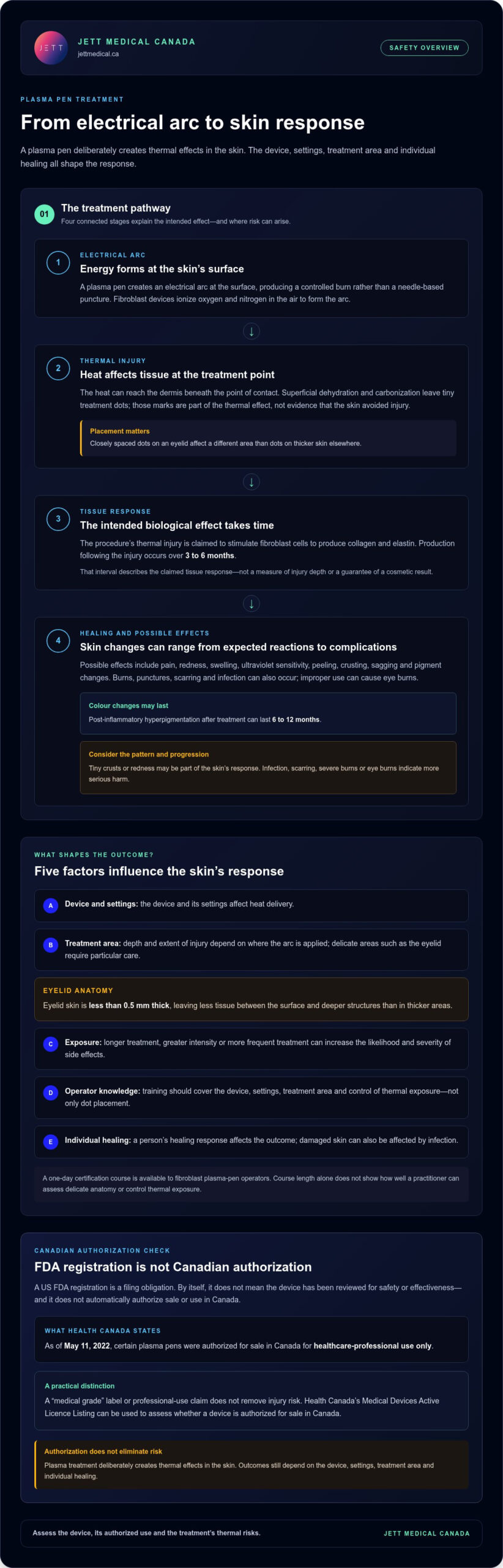
An FDA-registered plasma pen is not automatically authorized for sale or use in Canada. FDA registration is a filing obligation and, by itself, does not mean the device has been reviewed for safety or effectiveness; according to Health Canada, certain plasma pens were authorized for sale in Canada for healthcare-professional use only as of May 11, 2022. That distinction is central to understanding medical grade plasma pen safety standards.
It is reasonable to expect a device marketed as medical grade to have been assessed for its intended use. But labels and authorization terms can be confusing, and authorization does not eliminate the risk of injury. Plasma treatment deliberately creates thermal effects in the skin, and outcomes depend on the device, settings, treatment area and individual healing. Health Canada identifies pain, swelling, ultraviolet sensitivity and burns among the risks associated with plasma pens.
This article explains how plasma pens can affect the skin, which side effects and healing concerns may follow, and how Canadian authorization differs from US FDA registration. It also explains why professional-use restrictions matter, so you can assess safety claims in context rather than relying on a marketing label alone.
Key Takeaways
- Understand how a plasma pen’s heat creates controlled skin injury, and why treatment area, device settings and individual healing affect the response.
- Recognize that pain, swelling, pigment changes, crusting and scarring are possible risks, including when treatment is performed properly.
- Distinguish a US FDA registration from Canadian authorization; according to Health Canada, certain plasma pens are authorized for sale in Canada for use by healthcare professionals only.
- Learn which healing changes to monitor and how infection risk can be affected by skin damage and aftercare.
- See how to use Health Canada’s Medical Devices Active Licence Listing to assess whether a device is authorized for sale in Canada.
Plasma pen mechanism and thermal skin injury
A plasma pen creates an electrical arc at the skin’s surface, producing a controlled burn rather than a needle-based puncture. Fibroblast devices ionize oxygen and nitrogen in the air to form the arc. The resulting heat causes localized thermal injury, so visible treatment marks show where tissue has been deliberately affected.
Heat from the arc can reach the dermis beneath the point of contact. Although treatment aims to produce a controlled response, the depth and extent of injury depend on the device, settings, treatment area and individual healing. Even a small change in where or how the arc is applied can alter the skin’s response.
During treatment, superficial tissue dehydration and carbonization leave tiny dots across the treated area. These marks do not mean the skin has avoided injury; they are part of the thermal effect. For example, closely spaced dots on an eyelid affect a different area than dots used on thicker skin elsewhere.
The eyelid requires particular care because its skin is less than 0.5 mm thick. This anatomical detail matters when assessing energy delivery and treatment placement near the eye. An arc applied to thin eyelid skin has less tissue between the surface and deeper structures than an arc applied to a thicker treatment area.
Heat-related effects also explain the intended biological response. The procedure’s thermal injury is claimed to stimulate fibroblast cells to produce collagen and elastin. Production following plasma-pen thermal injury occurs over 3 to 6 months. That interval describes the claimed tissue response, not a measure of injury depth or a guarantee of a cosmetic result.
For clinics, understanding the mechanism is as important as selecting the device. The operator needs to know how the device produces an arc, how its settings affect heat delivery and how the treatment area influences the tissue response. Training should address these factors, not just the placement of visible treatment dots.
Fibroblast plasma-pen operators may receive certification through a one-day course. Course length alone does not show how well a practitioner can assess delicate anatomy or control thermal exposure. Treatment near the eyelid, for example, calls for an understanding of the area’s thin skin and the consequences of misplaced heat.
In practice, clinics should assess the whole process: the device, its settings, the treatment area, the operator’s training and the patient’s healing response. This is why “medical grade” alone cannot describe a treatment’s thermal effect or establish whether a specific procedure is suitable.
Risks and side effects of plasma pen treatments
Plasma pen treatments can cause unwanted effects even when performed properly, while misuse can cause more serious tissue injury. Health Canada identifies pain, swelling, ultraviolet sensitivity and burns among the risks.
Treatment Risks
Risks range from local reactions to injuries caused by excessive or misplaced heat. Health Canada identifies burns as a risk, and improper use can cause skin punctures, eye burns, scarring and infection. The intended cosmetic effect does not eliminate the possibility of tissue damage, particularly in delicate areas such as around the eyes.
Risk can increase with treatment duration, frequency and intensity. Repeated or prolonged exposure, for example, can increase the likelihood and severity of side effects. Health Canada advises that cosmetic plasma pen use may pose health risks, so a device label or professional-use claim is not proof that injury cannot occur.
Possible Side Effects
Possible side effects include pain, redness, swelling, skin sagging, peeling and crusting. Pigment changes, ultraviolet sensitivity and scarring can also occur, including after appropriate use. Recovery may involve visible skin changes, not just temporary discomfort. Darker marks after treatment, for example, may be post-inflammatory hyperpigmentation.
Post-inflammatory hyperpigmentation after plasma-pen treatment can last 6 to 12 months. The possibility of a prolonged colour change is relevant when discussing treatment on visible areas. Even properly used plasma pens may cause pain, redness or swelling and leave treated skin peeling, crusting or sagging.
It is important to distinguish a treatment reaction from a complication. Tiny crusts or redness may be part of the skin’s response, while infection, scarring, severe burns or eye burns indicate more serious harm. The distinction depends on the type and progression of the change, not simply on whether the skin looks red after treatment.
Risk assessment should account for treatment intensity and location. An application near the eye has different consequences from one on a less delicate area, because an eye burn can affect more than the skin’s appearance. Longer exposure or more frequent treatment can further increase the likelihood and severity of adverse effects.
- Thermal injury: burns, punctures and scarring can follow improper application.
- Inflammatory effects: pain, redness, swelling and ultraviolet sensitivity may occur.
- Healing changes: peeling, crusting, sagging and pigment changes are possible.
- Infection: damaged skin can be affected by infection after treatment.
For clinics reviewing device information alongside these risks, plasma pen device details can support a more informed assessment of the technology being considered.
Authorized use by healthcare professionals
In Canada, certain plasma pens are authorized for sale for healthcare-professional use only, according to Health Canada as of May 11, 2022. Training, infection-control practices and protective equipment should be considered together, following the device manufacturer’s instructions and the clinic’s applicable protocols.
Training and Infection Control
Training should cover device operation, treatment limits, infection prevention and how to recognize complications. Health Canada advises patients to ask about a practitioner’s training, certification and experience. A certificate alone does not show how well an operator can assess a treatment area or respond to an adverse reaction.
Fibroblast plasma-pen operators may receive certification through a one-day course. That duration provides context, but it does not replace practical competence with the specific device. Training should address how to follow the manufacturer’s instructions and adapt the treatment plan to the intended area.
Infection control is part of safe clinical practice because treatment affects the skin barrier. The procedure should follow the device’s instructions and the clinic’s infection-control protocols, including appropriate handling of equipment and the treatment environment. These steps are important when treated skin may be vulnerable to infection.
Patients considering treatment can ask about the practitioner’s relevant training, certification and experience. A clear answer should explain the operator’s preparation for that device and treatment area, rather than relying only on a general course certificate.
Protective Equipment
Protective equipment should follow the device instructions and account for the treatment site. Eye protection deserves particular attention because improper plasma pen use can cause eye burns. For treatment near the eyes, the clinic’s protective measures should address the possibility of heat or an arc reaching sensitive tissue.
Equipment selection should also fit the procedure’s infection-control plan. The manufacturer’s instructions provide device-specific handling guidance, while clinic protocols address the treatment environment. Following both supports consistent precautions instead of relying on a generic equipment list for every procedure.
Professional-use authorization does not mean every device is approved for every purpose. Practitioners should confirm that Health Canada has authorized the specific device for the planned treatment. Authorization, operator training and protective measures address different aspects of safety, and none replaces the others.
A practitioner involved in a case concerning an unapproved medical device could be reported and lose their licence. This makes it important to distinguish an approved device from one merely marketed as medical grade. The device’s authorization, intended treatment, instructions and the operator’s experience all inform responsible clinical use.
Healing time and infection risk
Plasma pen recovery can involve visible changes such as redness, swelling, peeling and crusting; infection is a possible complication. Before a cosmetic procedure, clients should expect the clinic to review the device’s Canadian authorization, the treatment area and the practitioner’s experience, then provide clear, device-specific aftercare instructions.
Infection Risk
Infection can occur if skin affected by plasma pen treatment becomes infected, so the condition of the treated area matters during recovery. Improper use can cause infection as well as burns, punctures and scarring. Both the clinic’s infection-control practices and the operator’s technique matter.
Crusting and peeling may follow treatment, but they do not establish whether infection is present. Clients should receive an explanation of expected skin changes and when to follow up. If a treated area changes in a way that concerns the client, they should contact the treating healthcare professional rather than disturb crusted skin.
Risk management starts before the arc is applied. The operator should follow the device’s instructions and the clinic’s infection-control procedures, then explain how to care for the treated skin. This preparation matters particularly when treatment affects multiple points across a visible area.
Treatment Safety Checks
Safety checks establish whether the device, intended use and treatment plan align before treatment begins. They matter because Canadian authorization may be limited to healthcare-professional use, and a device being present in a clinic does not establish authorization for every procedure.
Clients can ask whether Health Canada has authorized the device for the treatment being considered and about the practitioner’s training, certification and experience. They should also expect an explanation of the treatment area and foreseeable skin changes, including redness, swelling, peeling and crusting.
During the consultation, the operator should identify the treatment area and consider its sensitivity. Treatment near the eyes, for example, requires attention to the risk of eye burns associated with improper use. The discussion should clarify what the procedure involves and which risks apply to that area.
Aftercare instructions should be clear and practical for the client to follow at home. They should explain how to care for the treated area, what changes may occur and how to raise concerns. Device-specific directions matter because plasma pens differ, and the manufacturer’s instructions guide each device’s use and care.
Healing depends on the device, settings, treatment area and individual response. Pain, redness, swelling, peeling or crusting may occur even with proper use; pigment changes and scarring are also possible. Clients should understand that visible changes may continue during recovery and follow the instructions provided for their treatment.
Which Canadian regulations apply to plasma pen devices and their import or sale?
In Canada, device authorization is the key distinction for plasma pen sale, importation and clinical use. Health Canada states that unauthorized plasma pens cannot legally be advertised, imported for sale or sold without appropriate licensing.
Health Canada’s public information also requires careful, device-specific interpretation. Its advisory states that plasma pens are not authorized for sale or use in Canada, while certain plasma pens were authorized for sale for healthcare-professional use only as of May 11, 2022. These statements do not establish that every device or treatment is authorized. Clinics must match the specific device and intended treatment to its authorization.
Health Canada began contacting companies selling unauthorized plasma pens in June 2018 and issued its national plasma pen advisory on November 26, 2018. The advisory said plasma pens had not been evaluated for safety, effectiveness or quality before authorization for sale in Canada. According to Health Canada, medical devices approved in Canada have been evaluated for safety, effectiveness or quality.
Clinics can use Health Canada’s Medical Devices Active Licence Listing (MDALL) to check whether a medical device is authorized for sale in Canada. The listing is a starting point, not a substitute for matching the authorization to the planned treatment. Practitioners should confirm that Health Canada has authorized the specific device for that use.
- Identify the device: Match its name and details to the relevant Health Canada licence listing.
- Match the intended use: Confirm authorization for the treatment planned, rather than relying on a general “medical grade” label.
- Review safety notices: Health Canada advises checking its Recalls and Safety Alerts database for advisories about illegal health products on the Canadian market.
- Report concerns: Health Canada encourages consumers to report medical-device complaints, including sales of unauthorized devices.
Provincial oversight may add requirements for treatment settings. Provincial health authorities and regional bodies will not permit plasma pen use without a medical-device licence and adequate manufacturer’s instructions. Health Canada oversees national sale and distribution, while provincial health regulators monitor personal services facility safety across Canada. Clinics must account for the relevant jurisdiction.
Using an unapproved medical device may expose a practitioner to legal and career consequences, and an insurer might not cover lawsuit-related legal costs. To review device information in the context of Canadian authorization and maintain strict adherence to medical grade plasma pen safety standards, explore plasma pen device options.
Jett Medical Canada: Jett Plasma Pen Medical
Jett Medical Canada supplies the Jett Plasma Pen Medical for clinics assessing plasma technology for professional use. Its portfolio also includes Jett Plasma Lift Medical, Jett Plasma Medical II and Edge EOM-P EVO. Jett Medical Canada states that its products are Health Canada licensed and hold CE, MDSAP and other international certifications.
For clinics comparing devices, these products are a relevant next step after reviewing Canadian authorization, intended use and clinical requirements. Device selection should match the planned treatment and applicable instructions. Licensing does not remove the need for appropriate training, infection-control practices and patient-specific risk assessment.
To learn more about Jett Plasma Pen Medical and the available device options, visit jettmedical.ca.
Build your next step around clinical readiness
For a Canadian clinic, the next step is to turn the safety review into a clear device-selection and implementation process. Assess how the intended treatment fits your clinical scope, staff expertise and operating protocols. Make authorization, manufacturer instructions and training central to the decision, rather than treating “medical grade” as a complete measure of suitability. Applying medical grade plasma pen safety standards means considering both the device and how it will be used in your setting.
Jett Medical Canada supplies the Jett Plasma Pen Medical, Jett Plasma Lift Medical and Jett Plasma Medical II. Comparing these options with your clinic’s intended applications can focus the next discussion on practical clinical requirements rather than marketing terminology alone.
For a conversation about device options for your clinic, contact Jett Medical Canada. A deliberate, evidence-led approach helps your team move forward with greater clarity and a stronger foundation for responsible use.
Frequently Asked Questions
What About Devices Marketed as “FDA-Registered”?
FDA registration alone does not mean a device has been reviewed for safety or effectiveness, and it does not establish Canadian authorization. In the United States, a 510(k) clearance means the device is considered substantially equivalent to a legally marketed predicate device. For a Canadian clinic, the practical step is to look up the exact device in Health Canada’s Medical Devices Active Licence Listing and confirm authorization for its intended treatment.
What safety standards or certifications should a medical plasma pen meet?
In Canada, start by checking Health Canada authorization for the specific device and intended treatment. The phrase “medical grade” alone does not establish authorization, so compare the device’s identity and intended use with its Canadian licence information. CE certification and MDSAP approval may also appear in manufacturer materials, but they do not replace checking Canadian authorization. These distinctions give medical grade plasma pen safety standards practical meaning.
What evidence is required to verify a plasma pen’s manufacturer, model, and certification?
Use the device’s identification and manufacturer documentation, then compare the manufacturer and model with the relevant Health Canada Medical Devices Active Licence Listing entry. Confirm that the documentation refers to the same device and intended treatment, not just a related product or product family. A certificate naming a manufacturer but not matching the clinic’s model, for example, does not by itself demonstrate that the model is authorized for the planned use.
What are the risks, contraindications, and side effects of plasma pen skin treatments?
Possible effects include pain, redness, swelling, ultraviolet sensitivity, peeling, crusting, pigment changes, sagging skin and scarring; misuse can cause burns, eye injury or infection. Assess contraindications against the specific device’s manufacturer instructions and the patient’s clinical circumstances rather than assuming they apply from a generic list. Treatment near the eye, for example, calls for specific consideration of the area and the device’s intended use.