
A device’s pen-like shape doesn’t make it clinically appropriate for skin lifting. When evaluating a medical plasma device for skin lifting, focus on how it delivers energy, its documented intended use, and the controls and instructions that guide treatment. These details can be difficult to distinguish when professional systems and consumer-style pens are described in similar terms.
Plasma-based approaches use electrical energy to create an arc that interacts with the skin. The technology alone doesn’t establish suitability, predictable results, or a particular recovery course. Practitioners also need to consider patient selection, treatment parameters, training, safety information, and evidence for the specific device and intended application.
This clinical guide explains the principles and limitations of plasma-based skin lifting and outlines practical criteria for evaluating professional technology. It introduces Jett Plasma Lift Medical in that context, while distinguishing device credentials from evidence of clinical outcomes. Use the framework to assess a device, plan training and adoption, and decide whether it fits your Canadian practice.
Key Takeaways
- Assess a medical plasma device for skin lifting by its intended use, technology, and supporting documentation, not by its pen-like appearance.
- Compare devices model by model, matching the indication under consideration to relevant evidence and device-specific credentials.
- Use a consistent clinical planning process, with clinician training and device-specific protocols in place before treatment.
- Consider how energy delivery and device controls relate to procedural precision without assuming they guarantee a particular result.
- Include Jett Plasma Lift Medical and Jett Medical Canada’s training and adoption support in your clinic’s evaluation process.
What Is a Medical Plasma Device for Skin Lifting?
A medical plasma device for skin lifting is professional equipment that uses plasma energy for a defined skin-related application, as specified by the device’s design and intended use. “Plasma” describes an ionized gas, a state of matter used across several medical fields. The Plasma medicine overview offers broader scientific context, but it isn’t evidence for a particular device or cosmetic claim.
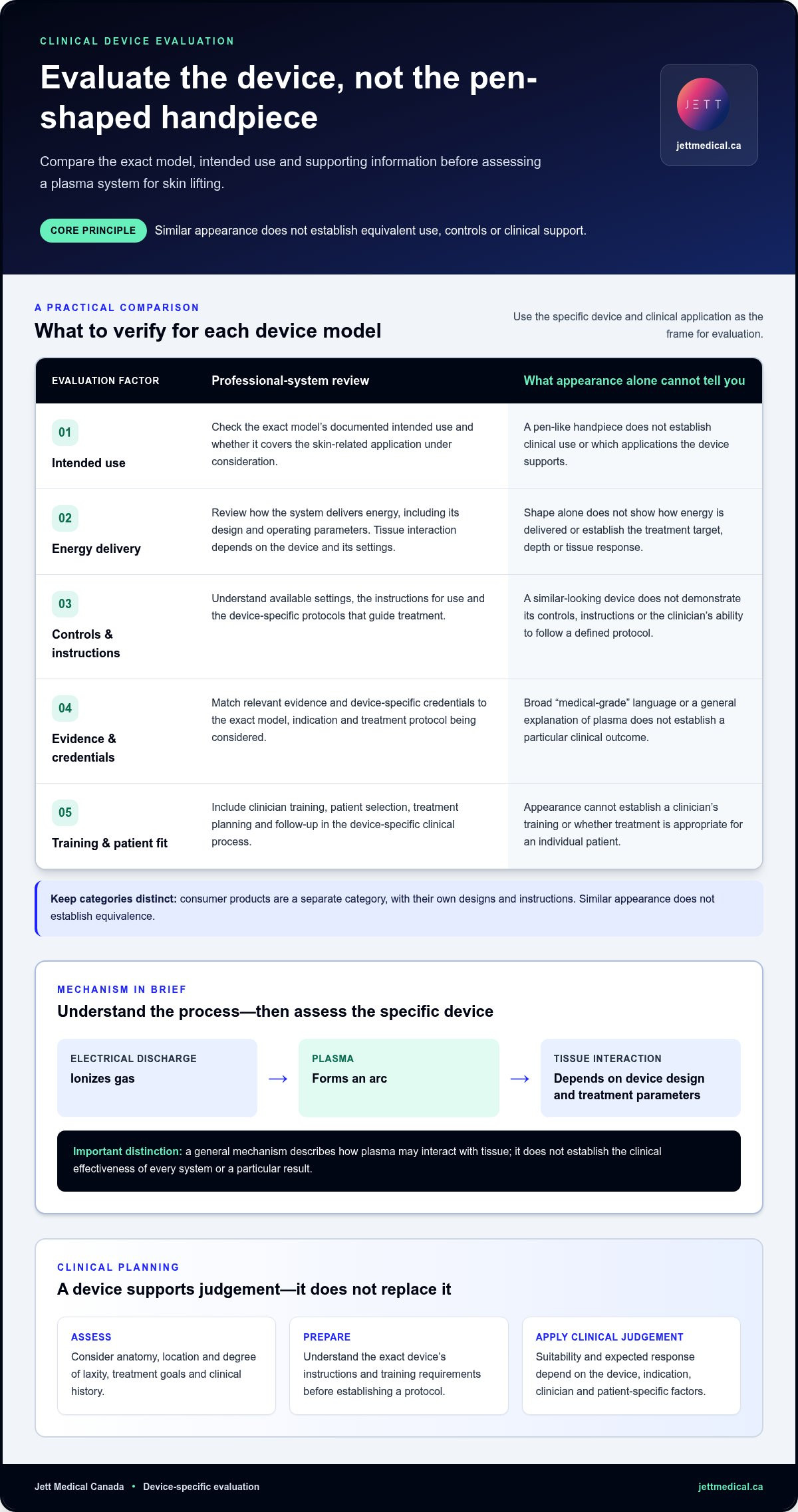
A pen-like handpiece doesn’t tell you whether equipment is intended for clinical use, which applications it supports, or how it controls energy delivery. Those distinctions depend on the specific device, its documentation, intended use, and applicable evidence. Evaluate professional equipment in relation to its model and clinical context. Consumer products are a separate category, with their own designs and instructions. Similar appearance doesn’t establish equivalence.
How plasma technology interacts with the skin
In some skin-focused systems, an electrical arc ionizes gas in the surrounding air and transfers energy to the skin. The resulting tissue interaction depends on the device and its operating parameters. Some systems are designed to create a localized thermal effect at the skin surface, but don’t assume the treatment target, depth, or tissue response is the same across all plasma technologies.
Claims about collagen stimulation, the degree of tightening, or lasting results require evidence relevant to the specific device, indication, and treatment protocol. A general explanation of plasma physics describes a mechanism; it doesn’t establish the clinical effectiveness of every system.
What skin lifting means in a clinical context
Skin laxity can vary by anatomical area, tissue characteristics, degree of change, and the individual’s treatment goals. A device’s suitability for one indication doesn’t establish suitability for another. Use the intended application and its supporting evidence to guide discussion of the treatment area and expected tissue response.
Medical plasma skin lifting is the use of a specified medical plasma device for a defined skin-related indication, with suitability and expected response assessed in the context of the device, clinician, and patient.
For clinical evaluation in Canada, consider the exact model’s intended use and relevant documentation instead of relying on broad “medical-grade” language or appearance. Outcomes and suitability depend on the device, indication, clinician’s training and protocol, and patient-specific factors. Separate the established operating principle from claims that require device-specific clinical support.
How a Medical Plasma Device Supports Precision in Skin-Lifting Procedures
Precision starts with understanding how energy reaches tissue and then using the device within its documented intended use. In plasma systems designed for skin applications, an electrical discharge ionizes gas and creates an arc. The energy delivered at the skin can produce a localized thermal interaction. The specific effect depends on the device design and treatment parameters, so the general mechanism shouldn’t be mistaken for evidence of a particular result.
Mechanism in brief: an electrical discharge ionizes gas to form plasma. The resulting energy interacts with tissue according to the device’s output, configuration, and application. Any claimed clinical response needs evidence for that specific model and indication.
Direct-current plasma and controlled clinical application
Direct current (DC) flows in one direction, while alternating current (AC) periodically changes direction. These terms describe different electrical behaviours; on their own, they don’t establish a device’s precision or clinical performance. Practical control depends on the system’s design, available settings, and instructions for use, as well as the clinician’s application of the device.
For a broader comparison of the technologies, see direct-current versus AC plasma technology. Assess any claimed control advantage against model-specific technical documentation and relevant clinical evidence instead of inferring superiority from current type alone.
Precision does not replace patient assessment
Device controls can help a trained clinician follow a defined protocol, but they can’t determine whether treatment is appropriate for an individual. Anatomy, the location and degree of laxity, treatment goals, clinical history, and other patient-specific considerations all inform suitability. Don’t generalize evidence for one model, indication, or anatomical area to another.
Technique and parameters matter, too. Before establishing a protocol, clinicians need to understand the specific device’s instructions and training requirements. Decisions about patient selection, treatment planning, and follow-up remain the responsibility of qualified clinicians. A device’s technical characteristics support clinical judgement; they don’t replace it or guarantee a predictable outcome.
For clinic teams assessing a medical plasma device for skin lifting, compare the exact model and intended use with its supporting documentation, then factor device-specific training into implementation. Jett Medical Canada distributes professional plasma technology and provides training and support for clinical adoption. Include professional plasma device evaluation in a structured review of technology and clinical workflow.
How to Evaluate a Medical Plasma Device for Skin Lifting
A structured comparison helps clinics separate clinically relevant information from surface-level marketing. A familiar pen shape, for example, doesn’t establish professional intended use, appropriate documentation, or suitability for a specific indication. Evaluate the exact device model and application together. Then compare evidence and implementation requirements on the same basis.
Licensing, intended use, and supporting documentation
In Canada, review Health Canada licence information alongside the exact model and its stated intended use. A licence isn’t, by itself, proof of comparative efficacy or suitability for every patient. International certification terminology refers to separate credentials and shouldn’t be treated as interchangeable with Canadian licensing. For broader context, see Health Canada licensed plasma devices. Check that claims and supporting evidence relate to the same model, indication, and treatment approach being evaluated.
Technology, training, and implementation support
Compare technical characteristics using manufacturer materials, not assumptions based on appearance or a general description of plasma. Controls and operating principles are relevant when documentation explains how they apply to the intended use. Training, clinical onboarding, and technical support also shape how a device can be incorporated into clinic workflows. Review professional plasma lift medical standards for related guidance.
For a medical plasma device for skin lifting, compare like with like: model against model, indication against indication, and relevant evidence against relevant evidence. This gives your clinical planning a sounder basis and avoids treating a credential, technology label, or pen-like form factor as a substitute for device-specific assessment.
Clinical Planning for Plasma-Based Skin-Lifting Treatments
A consistent planning sequence connects the patient’s goals with the specific device, indication, and documented protocol. It also makes the reasoning behind treatment decisions easier to record and review. Use the steps below as a framework within professional practice, not as a substitute for device instructions, training, or clinical judgement.
From clinical assessment to treatment planning
- Clarify the treatment goal. Discuss the concern the patient wants addressed, the anatomical area, and what they consider a meaningful outcome. Confirm that the goal aligns with the device’s documented intended use.
- Review relevant history and anatomy. Assess patient-specific factors that may affect suitability, including the area and degree of skin laxity. Follow the clinic’s established assessment process and professional standards.
- Consider suitability and alternatives. Review the clinical information available for the specific device and indication. Discuss appropriate alternatives, known limitations, and why an intervention may or may not fit the patient’s goals.
- Set realistic expectations and obtain informed consent. Explain that responses can vary and no particular outcome is assured. Discuss the material risks, limitations, and recovery information supported by the device-specific documentation and clinical assessment. Document the patient’s questions and consent.
- Confirm readiness before treatment. Ensure the treating clinician has completed device-specific training and is following the applicable manufacturer instructions and clinic protocols. If suitability or protocol alignment is unclear, pause and resolve that uncertainty before proceeding.
Training, documentation, and follow-up
Incorporate a medical plasma device for skin lifting into practice through model-specific training and protocols, rather than adapting instructions from another device. The clinician remains responsible for treatment decisions and for applying the manufacturer’s instructions within their professional scope.
Documentation supports continuity and review. Record the assessment and goals, relevant history, suitability rationale, device model, protocol followed, consent, and treatment details in the clinical record. Plan follow-up in keeping with the device documentation and the clinician’s judgement. Record patient feedback and observed response at follow-up, without assuming one patient’s experience predicts another’s.
Discuss recovery and aftercare using information relevant to the exact model and application. Avoid applying a universal timeline or generic aftercare directions when device-specific guidance is needed. For clinics building a structured adoption process, explore professional plasma device training and support.
Jett Plasma Lift Medical: A Professional Route to Device Evaluation
Once a clinic has defined its clinical requirements, Jett Plasma Lift Medical is a professional device to include in the evaluation. Consider how its documented intended use, device information, and training requirements align with the clinic’s needs. A product name or broad category alone doesn’t establish suitability for every indication or patient.
Connecting device characteristics with practice needs
Start with the clinical applications your practice is considering. Compare those needs with the model-specific instructions and supporting documentation, then assess how the device would fit the clinic’s assessment, treatment-planning, and follow-up workflows. This keeps the evaluation focused on practical adoption rather than assumptions based on appearance or general claims about plasma technology.
Review licensing, certifications, intended use, and clinical evidence in relation to the exact device model. None guarantees efficacy or universal suitability. For additional context, read this medical-grade plasma pen guidance for Canadian professionals.
Explore professional plasma technology with Jett Medical Canada
Jett Medical Canada distributes specialized plasma devices for professional clinical use and supports clinics across Canada with training and adoption assistance. This support can help medical professionals include device-specific learning in implementation planning, alongside review of the manufacturer’s instructions, clinical evidence, and applicable documentation.
For any medical plasma device for skin lifting, evidence-led adoption means keeping product claims tied to the specific model and its documented intended use. It also means preparing clinicians to use the device within appropriate protocols, with patient assessment and treatment decisions remaining under qualified clinical responsibility.
Explore Jett Plasma Lift Medical as part of your clinic’s professional device evaluation and clinical implementation planning.
Build a Confident, Evidence-Led Path to Clinical Adoption
A sound evaluation of a medical plasma device for skin lifting starts with the specific model and its documented intended use, not its appearance or broad marketing claims. Technology and controls can inform procedural planning, but they don’t replace clinician training, patient assessment, or evidence relevant to the indication.
Before implementation, align the device’s documentation and protocols with your clinic’s needs, prepare trained clinicians, and establish a consistent approach to assessment and follow-up. These steps support thoughtful adoption while keeping suitability and treatment decisions grounded in professional judgement.
Jett Medical Canada supplies specialized plasma technology to clinics across Canada and provides training and adoption support for medical professionals. Explore Jett Plasma Lift Medical to discuss your clinic’s device evaluation and implementation planning. With careful review and preparation, your team can take a considered next step toward integrating professional plasma technology into practice.
Frequently Asked Questions
How does a plasma device work for skin tightening?
Some plasma systems create an electrical arc by ionizing gas, then deliver energy to the skin. This may produce a localized thermal interaction, but the precise tissue response depends on the device, its parameters, and the application. A general explanation of plasma technology doesn’t establish that every device tightens skin, treats the same area, or produces a particular result. Base treatment decisions on evidence and instructions relevant to the specific model and indication.
Are medical plasma devices the same as consumer plasma pens?
No. Professional medical devices and consumer plasma pens are distinct categories, even if their handpieces look similar. Their intended users, documentation, instructions, and supported applications may differ. Clinics should evaluate a professional device by its exact model, intended use, applicable Canadian licensing information, training requirements, and relevant evidence. Appearance or broad marketing terms aren’t enough to establish equivalence between a consumer product and a professional device.
Is a medical plasma device suitable for every skin-lifting patient?
No single device or treatment approach is suitable for everyone. Candidacy depends on the patient’s anatomy, skin characteristics, clinical history, goals, and the device’s documented intended use. Some patients, including those with darker skin tones, may face a greater risk of post-inflammatory hyperpigmentation with certain plasma treatments. A qualified clinician should assess individual suitability, discuss limitations and alternatives, and avoid assuming that results for one patient apply to another.
What should Canadian clinics look for in a medical plasma device?
Compare the exact device model and intended indication, then review relevant Health Canada licensing information, manufacturer documentation, and clinical evidence. Assess the operating technology and controls using verified materials, not appearance or general claims. Also consider device-specific training, clinical onboarding, and ongoing technical support as part of implementation. Comparing like with like helps clinics distinguish documented capabilities from assumptions and assess whether a device fits their clinical workflow.
Does Health Canada licensing guarantee a particular skin-lifting result?
No. Review Health Canada licensing information for the specific model and intended use, but a licence doesn’t guarantee a particular outcome or prove that a device is suitable for every patient. It also doesn’t, by itself, establish comparative efficacy against other devices. When evaluating a potential application, consider licensing alongside model-specific instructions, relevant clinical evidence, clinician training, and patient assessment.
What training is needed to use a professional plasma device?
Training should be specific to the device model and its manufacturer instructions. Before incorporating a device into practice, clinicians need to understand its operation, applicable protocols, patient assessment considerations, and documentation expectations. The appropriate preparation depends on the device and the clinician’s professional scope. Jett Medical Canada provides training and adoption support for medical professionals implementing plasma-based therapies, helping clinics include device-specific learning in their clinical planning.