
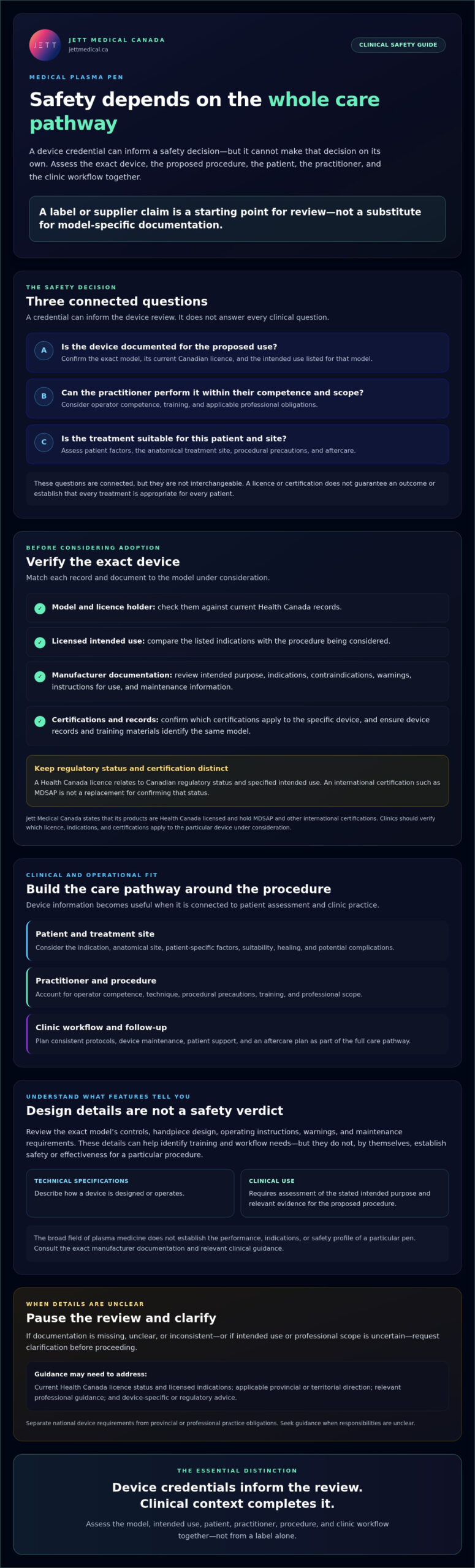
A device credential can support a safety decision, but it can’t make that decision on its own. Medical plasma pen clinical safety depends on the full care pathway, from confirming the exact device’s Canadian licence and intended use to assessing the patient, practitioner, and clinic workflow. A label or supplier claim is a starting point for review, not a substitute for model-specific documentation.
That distinction matters when clinics are considering a new technology. Patient selection, procedural risks, operator competence, and consistent protocols all influence whether use is appropriate in a particular clinical setting. A structured review can turn device information into practical questions to resolve before adoption.
This guide explains how to assess device credentials and their limits, identify patient and practitioner considerations, and prepare a clinic workflow that supports responsible use. It also covers when to seek device-specific, regulatory, or professional guidance, including how to confirm the current Health Canada licence status and licensed indications for the exact model under consideration.
Key Takeaways
- Assess medical plasma pen clinical safety across the complete care pathway, rather than drawing conclusions from a device label alone.
- Before adoption, verify the exact model’s current Health Canada licence, licensed indications, manufacturer instructions, and applicable certifications.
- Build patient selection, operator competency, procedural precautions, and aftercare into a consistent clinic workflow.
- Separate national device requirements from provincial or professional practice obligations, and seek guidance when responsibilities are unclear.
- Compare documentation, intended use, training, supplier support, and workflow fit to identify questions that need resolving before use.
What does medical plasma pen clinical safety involve?
Medical plasma pen clinical safety is the ongoing assessment and management of risks involved in selecting a device, delivering a procedure, and supporting the patient through follow-up. It brings together three questions: Is the device documented for the proposed use? Can the practitioner perform the procedure within their competence and professional scope? Is the treatment suitable for this patient, at this site, under these conditions?
These questions are connected, but they aren’t interchangeable. Device safety concerns the model, its instructions, and its authorized intended use. Procedure-related risk depends on factors such as the treatment site, technique, and precautions. Patient-specific considerations may affect suitability, healing, and the potential for complications. A credential can inform the first assessment, but it can’t answer the other two questions or guarantee an outcome.
What a device licence or certification can, and can’t, tell a clinic
Check the exact model and licence holder against current Health Canada records, then compare the listed intended use with the planned procedure. A supplier’s broad statement about a product range isn’t a substitute for model-specific documentation. For example, Jett Medical Canada states that its products are Health Canada licensed and hold MDSAP and other international certifications. Clinics should still confirm which licence, indications, and certifications apply to the specific device under consideration.
Health Canada licensing and international certification claims serve different purposes. A licence relates to the device’s Canadian regulatory status and specified intended use. A certification such as MDSAP shouldn’t be treated as a replacement for confirming that status. Neither credential shows that every treatment is appropriate for every patient or that procedural risk has been eliminated.
Why clinical context matters for plasma procedures
Plasma-based technologies have medical applications, but the broad field of plasma medicine doesn’t establish the performance, indications, or safety profile of a particular pen. Those details must come from the exact manufacturer documentation and relevant clinical guidance.
Assess each proposed procedure in context: the indication, anatomical treatment site, patient factors, practitioner competence, and aftercare plan. A device’s authorization or certification doesn’t automatically establish suitability for a specific site or patient. Professional requirements can also vary by jurisdiction and practice context. Verify current Health Canada information, applicable provincial or territorial direction, and relevant professional guidance before adopting a procedure. If the intended use or scope is unclear, seek device-specific or regulatory advice before proceeding.
How do device design and plasma technology affect clinical safety?
Device design can shape how a practitioner controls and applies energy, but assess features through the manufacturer’s documentation rather than inferring performance from appearance or marketing language. Review the controls, handpiece design, operating instructions, warnings, and maintenance requirements for the exact model. These details help a clinic understand how the device operates and identify training or workflow needs. They don’t, on their own, establish clinical safety or effectiveness for a particular procedure.
Technology features can support consistent clinical practice, but they don’t replace practitioner competence, patient assessment, or procedural controls. Technical specifications describe how a device is designed or operates. Evidence for a specific clinical use is a separate question and should be assessed using relevant evidence and the manufacturer’s stated intended purpose.
Reviewing device documentation before clinical adoption
Before introducing a device, check its intended purpose, indications, contraindications, warnings, instructions for use, and maintenance information. Confirm that training materials and device records identify the same model being considered. If a document is missing, unclear, or inconsistent, pause adoption and request clarification from the manufacturer or distributor. A professional supplier such as Jett Medical Canada can discuss device-specific information and training for medical professionals. Confirm details against the model’s current documentation.
Canadian regulatory status also requires model-specific verification. Health Canada’s safety advisory on plasma pens explains that some devices may be authorized for use by healthcare professionals, while others are unauthorized and may pose health risks. A general claim about licensing isn’t enough. Check the exact model and its current status in official records, and compare its licensed purpose with the proposed use.
Understanding direct-current plasma claims responsibly
Direct-current and alternating-current labels describe electrical characteristics, not a universal ranking of clinical safety. If a supplier or manufacturer makes a direct-current claim, verify that it applies to the model in question and review the supporting technical documentation. Don’t assume that a current type alone proves greater precision, safety, or effectiveness. A useful direct-current versus AC comparison should assess documented design, intended use, instructions, and evidence on a like-for-like basis.
Clinics evaluating Jett Medical Canada’s plasma devices can review the available medical plasma device information and ask for clarification about model-specific documentation or training. This supports an informed assessment without treating a technical feature or credential as a substitute for clinical judgement.
Which clinical and operational risks should a clinic assess?
A sound risk review considers more than the device. Assess patient suitability, practitioner competence, procedural conditions, and follow-up as connected parts of care. Health Canada’s Advisory on Plasma Pen Risks describes possible effects, including pain, swelling, redness, sagging skin, hyperpigmentation, and sensitivity to ultraviolet light. Improper use can result in more serious harm, such as burns, eye damage, scarring, or infection. These risks don’t mean every patient will experience complications, but they should inform consent, planning, and clinic readiness.
Patient selection, consent, and treatment planning
Base suitability on professional judgement, the proposed indication and treatment site, and the exact device’s instructions. Review relevant medical history and discuss the patient’s goals and expectations. If concerns fall outside the practitioner’s competence or scope, consider whether referral or another course of care is appropriate. Check contraindications and patient-facing information against current manufacturer documentation rather than relying on generic guidance.
Informed consent should explain the anticipated procedure, material risks, expected recovery considerations, aftercare responsibilities, and when to contact the clinic. Record the assessment, discussion, consent, and treatment plan in the patient record. Clear documentation supports continuity of care and helps the team respond consistently if concerns arise.
Operator competence, infection prevention, and follow-up
The person performing the procedure needs training and demonstrated competence appropriate to the device, indication, and treatment site. A training certificate alone may not establish competence for every procedure. Confirm that instruction applies to the exact model, and follow the manufacturer’s directions rather than improvising settings or technique. The clinic should also follow its infection-prevention policies and verify applicable provincial, territorial, and professional guidance for its setting.
Before treatment begins, define who patients can contact, how the clinic will assess reported concerns, and when escalation or referral is warranted. Provide written aftercare consistent with the device instructions and the planned procedure. Arrange follow-up appropriate to the patient and treatment, and document advice, communications, and any adverse events.
As part of medical plasma pen clinical safety, establish a response pathway for unexpected pain, visual symptoms, signs of infection, or other concerning changes. Staff should know whom to notify and how to direct the patient to timely assessment. These safeguards don’t make a procedure risk-free, but they help the clinic recognize issues and respond in a coordinated way.
How can Canadian clinics build a practical plasma pen safety workflow?
A written pre-adoption process helps a clinic turn device information into repeatable checks. Keep national medical device requirements distinct from provincial or territorial rules, professional standards, and clinic policies. The latter may depend on the practitioner’s profession, location, and proposed procedure. Verify current requirements with the relevant authorities and professional bodies rather than assuming one national workflow covers every setting.
A pre-adoption checklist for device and clinic readiness
Use this sequence before making a device available for clinical use:
- Identify the exact device. Record its model, manufacturer, and licence holder. Check current status in the Health Canada Medical Devices Active Licence Listing, then compare the listing with the device documentation.
- Confirm intended use and instructions. Review the manufacturer’s current intended purpose, indications, contraindications, warnings, instructions for use, and maintenance requirements. Resolve any mismatch between the proposed procedure and documented use before proceeding.
- Establish staff readiness. Identify who may use the device, what training applies to that exact model, and how competence and any supervision arrangements will be documented. Assign responsibility for maintenance and device records.
- Approve clinic protocols. Document processes for patient assessment, informed consent, infection prevention, aftercare, follow-up, and adverse-event escalation. Make sure staff know where current instructions and records are kept.
- Confirm jurisdiction-specific obligations. Check applicable provincial or territorial direction and professional-body guidance for the clinic’s location and practitioner roles. Record what was reviewed and when.
This sequence supports medical plasma pen clinical safety by making key decisions traceable, rather than relying on informal assurances or a one-time credential check.
Keeping safety documentation current
Assign a role to review manufacturer updates, revised instructions, training records, and maintenance documentation. Recheck relevant Canadian and local requirements when the device, proposed indication, practitioner roles, or clinic location changes. Treat licensing, scope, and practice claims as matters to verify against current primary sources, not as fixed assumptions.
For broader Canadian regulatory context, use current official Health Canada resources and confirm that the information applies to the device and activity in question. Jett Medical Canada supplies plasma technology devices to professional clinics and provides training and support for doctors and nurses. Discuss device-specific documentation and training as part of your clinic’s adoption review.
What should clinicians verify before choosing a medical plasma pen?
Compare devices against the clinic’s intended procedures and documented requirements, not broad claims of superiority. A consistent review helps identify gaps before procurement and supports medical plasma pen clinical safety without assuming that any one technology or credential guarantees suitability.
Questions to ask a device supplier
Request model-specific records and ask the supplier to identify the exact device name, manufacturer, and licence information. Confirm that the instructions, training materials, and safety documentation match that model. Ask what professional training, technical support, and maintenance information are available, and document any questions that remain unresolved before purchase or clinical use.
| Area to compare | What the clinic should verify |
|---|---|
| Documentation | Are current instructions, warnings, maintenance details, and relevant licence information available for the exact model? |
| Intended use | Does the documented purpose cover the clinic’s proposed indication and treatment site? |
| Training | Does the training apply to this model and proposed procedure, and can staff responsibilities be recorded? |
| Support | Can the supplier clarify technical documentation and explain how to request support or maintenance information? |
| Workflow fit | Can the clinic accommodate the documented operating requirements, patient-care protocols, record-keeping, and follow-up? |
Use the same questions for each device under consideration. Compare verifiable documentation and practical fit, not unsupported statements that one device is safer or more effective than another. If a supplier’s claims can’t be matched to the exact model’s records, seek clarification before relying on them.
Connecting clinical requirements with a suitable device
Start with the clinic’s intended use, practitioner scope, training needs, and operational capacity. Then assess whether the specific device’s documented indications and operating requirements align with those needs. Jett Medical Canada’s professional portfolio includes Jett Plasma Pen Medical. Its inclusion here is an example of a named offering, not a claim that any indication or licence applies to every model. Confirm current device-specific details before procurement.
Clinics seeking broader selection guidance can consult a professional plasma pen Canada guide, while verifying all product and regulatory claims against current primary documentation. For a practical next step, ask Jett Medical Canada about model-specific documentation and training relevant to your clinic’s evaluation.
Make your next device decision with confidence
Medical plasma pen clinical safety depends on connected decisions: verifying the exact device and its current Canadian licence and intended use, assessing patient and practitioner readiness, and establishing clinic protocols for treatment, aftercare, and escalation. No credential removes procedural risk or determines whether a device is appropriate for every indication.
Before adopting a model, compare its documentation, training, support, and operating requirements with your clinic’s needs. Jett Medical Canada states that its products are Health Canada licensed, but licence status and indications should be confirmed for each model. The company also provides training and support for doctors and nurses adopting plasma-based therapies.
For help reviewing model-specific information and professional training options, contact Jett Medical Canada to discuss device-specific information and professional support. A careful, well-documented evaluation can help your team make informed decisions and build a responsible pathway for clinical use.
Frequently Asked Questions
Is a Health Canada-licensed plasma pen automatically safe for every clinical use?
No. A Health Canada licence indicates regulatory authorization for a specific device and intended purpose. It doesn’t establish suitability for every procedure or patient. Confirm the exact model’s current licence details and compare its licensed indications with the proposed use. Patient assessment, practitioner competence, technique, and follow-up remain essential parts of medical plasma pen clinical safety. A licence also doesn’t guarantee an outcome or remove the possibility of adverse effects.
What should a clinic check before using a medical plasma pen?
Verify the exact device model, current Health Canada licence information, and documented intended use. Review the manufacturer’s instructions, warnings, contraindications, maintenance requirements, and training materials. Then assess whether the clinic’s practitioners are trained and competent for the proposed procedure, and whether patient assessment, informed consent, infection-prevention practices, aftercare, record-keeping, and escalation processes are in place. If requirements are unclear, check applicable provincial or professional guidance before proceeding.
Can nurses use a medical plasma pen in Canada?
That depends on the device’s authorized use and the nurse’s jurisdiction, professional scope, competence, and practice setting. Don’t assume that a device licence or training alone authorizes every nurse to perform every procedure. Confirm the exact model’s current licence conditions, consult the relevant provincial or territorial nursing regulator and employer policies, and verify that the procedure falls within the practitioner’s authorized scope and demonstrated competence. Seek professional guidance if any point is uncertain.
How can clinicians verify a plasma pen’s Health Canada licence?
Search the Health Canada Medical Devices Active Licence Listing using the exact device name, manufacturer, or licence holder. Check that the record matches the model being considered, then review its licence status and available intended-use details. A supplier statement or international certification isn’t a substitute for checking Canadian records. If the listing is difficult to interpret or the information doesn’t match the device documents, ask the manufacturer or distributor for clarification and confirm through Health Canada resources.
Does direct-current plasma technology eliminate clinical risk?
No. Direct-current technology doesn’t eliminate procedural or patient-specific risk. Electrical design is a technical characteristic, not proof that a device is inherently safer or more effective than another technology for every use. Review the exact model’s manufacturer documentation, intended purpose, and available evidence for the proposed procedure. Patient selection, operator competence, appropriate clinical controls, and follow-up still matter. Don’t rely on a current-type claim as a replacement for device-specific training.
What documentation should a clinic keep for medical plasma pen procedures?
Maintain current device identification and licence information, manufacturer instructions, maintenance records, and applicable staff training and competency records. For each patient, document assessment, relevant history, treatment planning, informed consent, and the procedure performed. Keep aftercare instructions, follow-up notes, and records of reported concerns or adverse events, including any escalation. Assign responsibility for keeping device documents and clinic protocols current, and follow privacy, record-retention, and professional requirements that apply in your jurisdiction.
Where can a clinic get device-specific plasma pen training and support?
Start with the device manufacturer or its authorized supplier, and confirm that training and support apply to the exact model and intended procedure. Jett Medical Canada supplies plasma technology devices to professional clinics across Canada and provides training and support for doctors and nurses adopting plasma-based therapies. The company states that its products are Health Canada licensed. Clinics should independently verify current licence status and indications for each model before use.