
“Plasma” doesn’t describe one procedure. Plasma skin regeneration, plasma pen treatments and platelet-rich plasma (PRP) differ in how they work, what patients may experience and which clinical details apply. Clear patient education materials for plasma skin regeneration help patients distinguish these approaches before a treatment discussion begins.
Patients need more than a brief description of a technology. They need plain-language information about the proposed procedure, preparation, recovery, potential risks, alternatives and realistic expectations. Clinicians need resources that are easy to understand without blurring important distinctions or making claims beyond the specific device and treatment plan.
This article explains how to build practical, evidence-informed education for patient conversations. It covers terminology, consultation and recovery information, education formats and a review checklist. The goal is to help clinics make resources clear and consistent while leaving suitability, outcomes and individual guidance to the clinician-led discussion.
Key Takeaways
- Use patient education materials for plasma skin regeneration to explain the relevant technology and procedure in clear, patient-friendly language.
- Keep device names, mechanisms, indications and protocols specific to the clinician’s device and practice.
- Choose education formats according to when patients need the information, from consultation visuals to written aftercare instructions.
- Use a balanced checklist covering suitability, potential benefits, risks, alternatives and follow-up without promising uniform results.
- Pair written resources with clinician training and individualized discussion to support consistent, responsible patient education.
What Patient Education Materials for Plasma Skin Regeneration Need to Explain
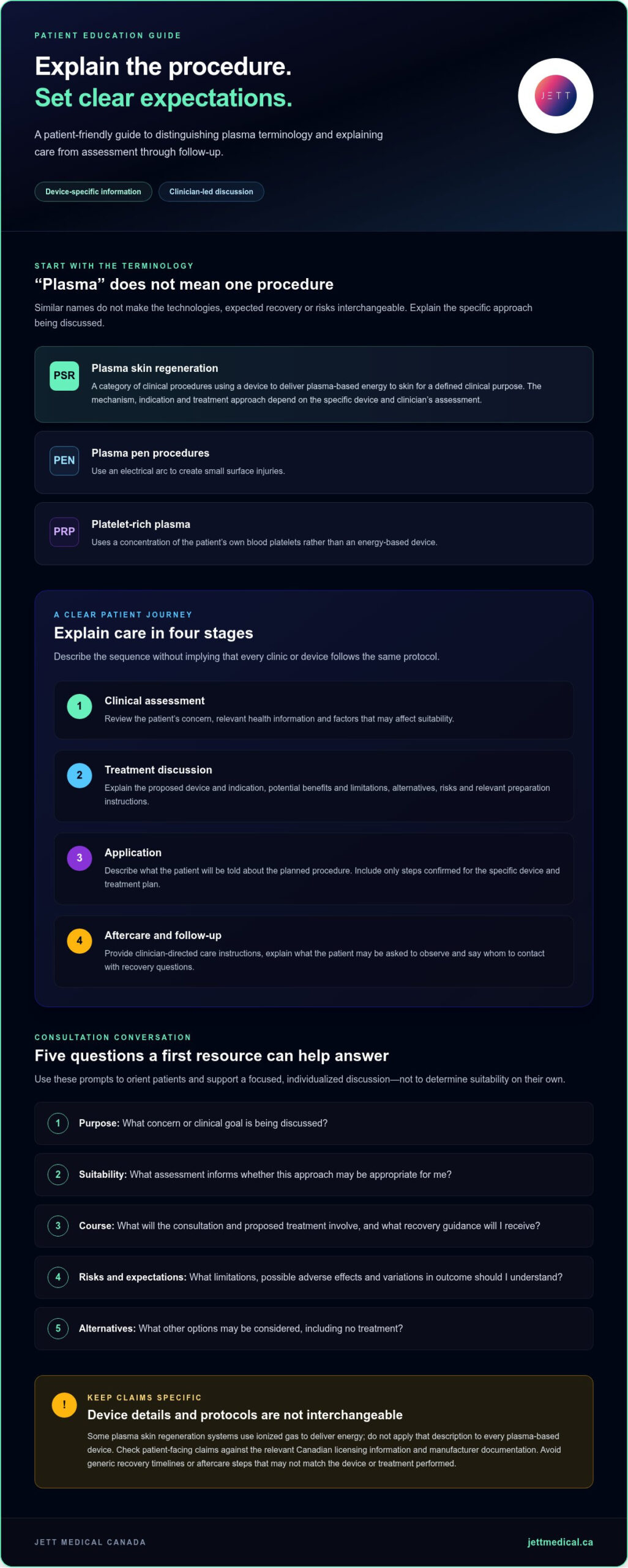
“Plasma skin regeneration” can sound like a single, standardized treatment. Patient education should clarify that it describes a category of clinical procedures, not a guaranteed result or a protocol that applies to every device. A concise definition is: Plasma skin regeneration uses a device to deliver plasma-based energy to skin for a defined clinical purpose. The mechanism, indication and treatment approach depend on the specific device and the clinician’s assessment.
That distinction matters. Plasma skin regeneration (PSR) is different from plasma pen procedures, which use an electrical arc to create small surface injuries, and from platelet-rich plasma (PRP), which uses a concentration of the patient’s own blood platelets rather than an energy-based device. Similar terminology does not make the technologies, expected recovery or risks interchangeable.
How to define plasma skin regeneration without creating confusion
Introduce unfamiliar terms once, in plain language, then use them consistently. Explain “plasma” in the context of the procedure being discussed, and distinguish that explanation from plasma pen and PRP terminology. Avoid broad descriptions that could suggest a particular device mechanism, indication or treatment protocol when those details have not been established for the procedure in question.
Patient education materials for plasma skin regeneration should match the specific device and clinical indication under discussion. Naming a device alone does not explain what a treatment involves. Clinicians should align patient-facing descriptions with current Canadian licensing information and manufacturer documentation, and have the clinical content reviewed before sharing it.
Which patient questions should the first resource answer?
A first handout or consultation resource should orient patients, not decide suitability for them. Explain why a clinician might discuss the procedure, what an assessment considers, and what patients can expect from the consultation through treatment discussion, recovery guidance and follow-up. Individual risks and options belong in a patient-specific clinical conversation.
Use questions like these to check whether the resource provides a useful starting point:
- Purpose: What concern or clinical goal is being discussed?
- Suitability: What assessment informs whether this approach may be appropriate for me?
- Course: What will the consultation and proposed treatment involve, and what recovery guidance will I receive?
- Risks and expectations: What limitations, possible adverse effects and variations in outcome should I understand?
- Alternatives: What other options may be considered, including no treatment?
These prompts support informed discussion; they do not replace it. Separate general information from device-specific details so patients can arrive with a clearer understanding and more focused questions.
How to Explain Plasma Technology, the Procedure, and Recovery
Patients benefit from a clear sequence explaining what happens before, during and after a proposed procedure. Describe the process without implying that every clinic or device follows the same protocol. A useful resource can organize the discussion into four stages:
- Clinical assessment: The clinician reviews the patient’s concern, relevant health information and factors that may affect suitability.
- Treatment discussion: The clinician explains the proposed device and indication, potential benefits and limitations, alternatives, risks and any relevant preparation instructions.
- Application: Describe what the patient will be told about the planned procedure. Include only steps confirmed for the specific device and treatment plan.
- Aftercare and follow-up: Provide clinician-directed care instructions, explain what the patient may be asked to observe, and say whom to contact with recovery questions.
What should materials say about how the technology works?
Use a clinician-reviewed explanation of the technology relevant to the procedure being discussed. Some plasma skin regeneration systems use ionized gas to deliver energy, but that description should not be applied to every plasma-based device. Name the device or treatment context when explaining a specific mechanism, and avoid unsupported claims about how skin responds or what results will follow.
Device terminology and protocols are not interchangeable. For example, energy settings or treatment patterns described for Portrait PSR should not be carried over to unrelated devices. The FDA Safety Information on Plasma Devices concerns the specific Renuvion/J-Plasma device. It illustrates why safety information needs to be device-specific, but does not establish the Canadian indication for another system. Check patient-facing claims against the relevant Canadian licensing information and manufacturer documentation.
How should patients be prepared for procedure and recovery information?
Set expectations before treatment is considered or scheduled. Explain which preparation instructions apply to the individual plan, what the clinician will review and what recovery guidance the patient will receive. Avoid generic timelines or aftercare steps that may not match the device or treatment performed.
Recovery instructions and timelines are specific to the treatment plan and device. Describe changes the clinician says patients may observe, and distinguish those observations from guaranteed outcomes. Give patients a clear way to raise questions with their treating clinic during recovery, and direct them to follow the clinician’s guidance if a concern arises. These principles make patient education materials for plasma skin regeneration more practical and device-specific.
Consistent explanations start with clinician familiarity with the technology. Jett Medical Canada provides training and support for clinicians adopting plasma-based therapies. Explore clinician training and device support as part of responsible implementation.
Compare Patient Education Formats for Plasma Skin Regeneration
No single resource needs to carry every detail. A concise handout can orient patients before or after a consultation. A visual can clarify a clinician-explained step, FAQs can address recurring general questions, and a post-treatment instruction sheet can serve as a reference during recovery. Choose each format based on when patients need the information and how they will use it.
| Format | Purpose and suitable content | Review needs | Limitations |
|---|---|---|---|
| Concise handout | Provides a take-home overview of the procedure, terminology, discussion topics, potential risks and alternatives. | Clinician review for accuracy, readability and alignment with the specific device and indication. | Cannot address every patient’s circumstances or replace a conversation. |
| Consultation visual | Uses labelled anatomy or a simple sequence to support an explanation when a visual is clinically appropriate. | Check labels, images and explanations against the treatment being discussed. | May oversimplify complex information or imply a result if not clearly contextualized. |
| Frequently asked questions | Answers recurring general questions about the consultation, preparation, recovery and follow-up. | Review regularly so answers remain consistent with current clinician guidance. | General answers cannot resolve individual suitability, symptoms or risk questions. |
| Post-treatment instruction sheet | Records clinician-directed aftercare information and the clinic contact route for recovery questions. | Confirm that instructions match the device and individual treatment plan. | Generic directions or timelines may not fit a patient’s care plan. |
Match each format to the patient’s next step
Use a handout to reinforce information patients may want to revisit after a consultation. A labelled visual can make a procedure sequence easier to follow, but it should support the clinician’s explanation, not stand alone. FAQs work well for common, non-individual questions; direct personal concerns to a consultation. After treatment, provide instructions that reflect the clinician’s plan and explain how the patient can contact the clinic with recovery questions.
Keep essential information consistent across formats, especially the procedure’s purpose, device-specific details, limitations, risks and expected course. The Health Canada licensed plasma device reference guide can help clinicians review regulatory context when developing device-specific materials.
Patient education materials for plasma skin regeneration should reinforce, not replace, clinician discussion or informed consent. A written resource can help patients prepare questions and revisit information, but it cannot determine individual suitability or capture a full discussion of personal options and risks.
Build a Balanced Patient Education Checklist for Plasma Skin Regeneration
A checklist helps clinics confirm that a patient resource covers the essentials without presenting a procedure as suitable for everyone. Use plain language, short sections and device-specific content. The clinician should review safety information and confirm that it aligns with current instructions for the device and proposed treatment.
A patient resource should address these points
- Purpose: State the clinical goal being discussed and the concern the proposed treatment is intended to address. Avoid promising a particular result.
- Assessment and suitability: Explain that the clinician will review relevant health and skin factors before discussing whether the procedure may be appropriate. Individual suitability requires clinical assessment.
- Procedure and device: Identify the treatment context and describe the proposed process using language specific to the device and indication. Do not combine protocols from different technologies.
- Expected outcomes: Describe reasonable expectations, including limitations and the possibility that responses may vary between individuals. Separate potential benefits from assured results.
- Risks and recovery: Include possible adverse effects and recovery considerations in clinician-approved language. Make clear which instructions apply to the specific treatment plan.
- Alternatives: Note that other options, including no treatment, may be discussed. The clinician can explain how individual circumstances affect those choices.
- Follow-up: Explain the planned follow-up process and give patients the clinic’s route for raising questions or concerns during recovery.
- Understanding: Invite patients to explain the key points in their own words: “To make sure I explained this clearly, what do you understand about the procedure, its risks and the next steps?” Use their response to clarify gaps, not to test or blame them.
These elements make patient education materials for plasma skin regeneration more useful while keeping the information balanced. A checklist supports discussion, but it does not replace individualized assessment or clinician-led informed consent.
Keep the resource clear and current
Review materials for readability, accessible formatting and consistency across print and digital versions. If translated versions are used, check that they communicate the same meaning as the reviewed source. Assign clinical responsibility for updating evidence, device instructions and the revision date. Remove or revise content when it no longer matches current guidance.
Clinicians developing or reviewing plasma education resources can explore Jett Medical Canada’s clinician training and support as part of responsible device-specific practice.
Use Clinician-Led Education to Support Responsible Plasma Care
Patient resources work best when they reflect the clinician’s actual device, indication and workflow. Shared principles can remain consistent across a practice: use plain language, explain uncertainty, describe potential risks and invite questions. Technical content, however, should be tailored to the system being used and the clinical discussion taking place.
Adapt education to the device and indication
Before distributing a resource, compare each device-specific statement with the relevant Canadian licensed indication and current manufacturer documentation. This includes explanations of how the technology works, what the proposed treatment involves, expected recovery and possible adverse effects. If a clinic uses more than one plasma technology, separate materials or clearly identified sections can help prevent patients from assuming that names, mechanisms or protocols are interchangeable.
A general overview can introduce terminology, but it should not function as a treatment protocol or replace device-specific training. Patient materials support communication; they do not replace clinician assessment, professional judgement or individualized discussion. Review the resource as part of the practice workflow: decide who gives it to patients, when questions are addressed and how aftercare instructions are shared.
Connect patient communication with professional support
Jett Medical Canada supplies medical plasma devices to professional clinics and supports doctors and nurses with training as they adopt plasma-based therapies. Clinician training supports an informed understanding of the technology, while device-specific patient communication translates relevant information into language patients can understand. Both contribute to responsible clinical adoption, and neither substitutes for the other.
For clinics, assign responsibility for keeping patient-facing explanations aligned with current device instructions and indications. The same review process can check that handouts, consultation materials and follow-up instructions use consistent terminology, while leaving room for clinicians to address individual circumstances directly.
Clear education starts with a precise understanding of the technology and continues through the patient conversation. Explore professional plasma device guidance and Jett Medical Canada’s clinician training and support.
Strengthen Patient Communication With Device-Specific Education
Effective patient education starts with clear distinctions: plasma technologies and device protocols are not interchangeable, and shared information must be adapted to the specific device, indication and clinical discussion. Well-organized materials can help patients understand the purpose, expected course, potential risks and alternatives, while supporting rather than replacing individualized assessment and informed consent.
For clinics, the next step is to keep patient resources consistent with current device instructions and clinician-reviewed information. Patient education materials for plasma skin regeneration are most useful when paired with clinician training, thoughtful assessment and opportunities for patients to ask questions.
Jett Medical Canada supplies professional plasma devices and provides training and support for doctors and nurses adopting plasma-based therapies. Its products are Health Canada licensed and hold CE and MDSAP certifications. Explore Jett Medical Canada’s professional plasma technology and clinician support.
With accurate, device-specific communication, clinics can help patients take part in clearer, more informed conversations about their care.
Frequently Asked Questions
What should patient education materials for plasma skin regeneration include?
Patient education materials for plasma skin regeneration should explain the procedure in plain language, including its purpose, how suitability is assessed, what the treatment discussion involves, potential risks, alternatives and recovery guidance. Identify details that depend on the device and individual treatment plan. A qualified clinician should review the content against current device-specific information. Materials can help patients prepare questions and revisit key points, but they support rather than replace individualized consultation and informed consent.
Is plasma skin regeneration the same as every plasma pen treatment?
No. Plasma-based procedures and devices can differ in technology, intended use, terminology and clinical instructions. Patient materials should identify the procedure or device where appropriate, rather than treating “plasma” as one standardized approach. Instructions or settings associated with one system should not be transferred to another. The treating clinician can explain how the information applies to the proposed treatment and discuss relevant considerations based on the patient’s circumstances.
Can a patient handout replace a consultation or informed consent discussion?
No. A handout can provide consistent information for patients to review before or after an appointment, but it cannot assess individual suitability or address every personal concern. The clinician should discuss the proposed treatment, relevant risks, alternatives and reasonable expectations directly with the patient. Written materials support that conversation; they do not substitute for it. Consent should follow the clinical and regulatory requirements that apply to the care being discussed.
How should clinics explain risks and recovery to patients?
Use clear, balanced language reviewed by a clinician and specific to the device and treatment plan. Explain that possible effects and recovery experiences can vary, and avoid promising a particular result or timeline. Provide the clinic’s approved aftercare instructions and tell patients how to raise questions or concerns during recovery. Before sharing the information, review it against current manufacturer guidance and relevant clinical evidence so it reflects the treatment being discussed.
What is the difference between Portrait PSR information and direct-current plasma education?
Portrait PSR refers to a specific plasma skin regeneration system, while direct-current plasma describes technology used by certain other devices. Their terminology, mechanisms, indications and protocols should not be assumed to match. Patient-facing materials should name the technology under discussion and draw on its relevant clinical documentation. Information developed for one system should not be used as a treatment guide for another; the clinician should explain which details apply to the proposed care.
How can a clinic check whether patients understand plasma skin regeneration information?
Use a respectful teach-back prompt, such as, “Could you tell me in your own words what you understand about the procedure and next steps?” This can reveal unclear explanations or unanswered questions without testing or blaming the patient. If the same misunderstandings arise, revise the material for clarity. Allow time for the clinician to explain individual risks, expectations and options, since a patient’s questions may need discussion beyond the written resource.
Who should review patient education materials for plasma skin regeneration?
A qualified clinician familiar with the procedure and device should review clinical content before use and when relevant evidence, device instructions or practice protocols change. Clinic staff can also assess readability, accessibility and consistency across print and digital versions. Check device-specific and regulatory statements against current authoritative documentation before publication. Assign responsibility for clinical review and include a revision date so staff can tell whether a resource needs updating before sharing it.