
A plasma device for periocular rejuvenation should be assessed by more than its proposed cosmetic effect. Around the eyes, the treatment area, energy delivery and the device’s intended use all shape the clinical decision.
Clinicians considering less invasive approaches to eyelid laxity or fine lines need to distinguish evidence for one plasma modality or treatment area from evidence for another. This guide offers a practical framework for reviewing periocular applications, evaluating device documentation and interpreting research without overstating expected outcomes.
We’ll distinguish thermal arc plasma from other plasma technologies, consider patient selection and risks in the delicate periocular region, and identify the device controls and documentation to review before adoption. We’ll also explain how to assess Health Canada licence status and manufacturer labelling for a specific model and intended use. Jett Medical Canada distributes professional devices using direct-current plasma technology. Each model should be evaluated against its current documentation. The goal is a measured, evidence-led basis for deciding whether a plasma approach belongs in your clinical workflow.
Key Takeaways
- Clarify which tissues and concerns periocular care addresses, and distinguish plasma technologies by mechanism, intended use and labelling.
- Assess a plasma device for periocular rejuvenation by separating its proposed mechanism from clinical observations and evidence of patient outcomes.
- Compare plasma with clinician-selected alternatives according to treatment objective, anatomical area, evidence and limitations.
- Use an ordered evaluation process that considers clinical need, supporting evidence, device documentation, training and clinic governance.
- Consider direct-current technology as a device characteristic, not proof of a particular result; assess each model against its current intended-use documentation.
What Does a Plasma Device for Periocular Rejuvenation Do?
Periocular rejuvenation refers to care directed at tissues around the eyes, not treatment of the eye itself. A plasma device for periocular rejuvenation is an energy-based medical device considered for selected concerns in this surrounding area. The phrase alone doesn’t identify a specific technology, treatment or clinical outcome. Device design, energy delivery and the manufacturer’s stated intended use determine what its evidence can support.
“Around the eyes” covers different tissues and concerns. Eyelid skin, the brow region and the area beside the eye aren’t interchangeable treatment sites. Aesthetic language such as “eyelid lift” also doesn’t establish that a device is intended or labelled for that use.
Which structures does periocular rejuvenation refer to?
“Periocular” commonly describes tissues surrounding the eyes, including the skin of the upper and lower eyelids and nearby areas. The ocular surface, including the cornea and conjunctiva, and internal eye structures are distinct from eyelid skin. A cosmetic procedure directed at surrounding skin shouldn’t be described as treatment of the eye.
Because these tissues sit close to the eye, the proposed treatment area and relevant anatomy are central to clinical decision-making. Consider the concern, tissue involved and device instructions together. “Periocular” describes a location, not a complete indication or a substitute for specialist clinical judgement.
What does the term plasma device include?
Plasma is a broad technology category, not one uniform device type. Plasma-based devices can differ in how they generate and deliver energy, how they interact with tissue, and what their manufacturers specify as intended use. A finding about one device or modality can’t automatically be applied to another.
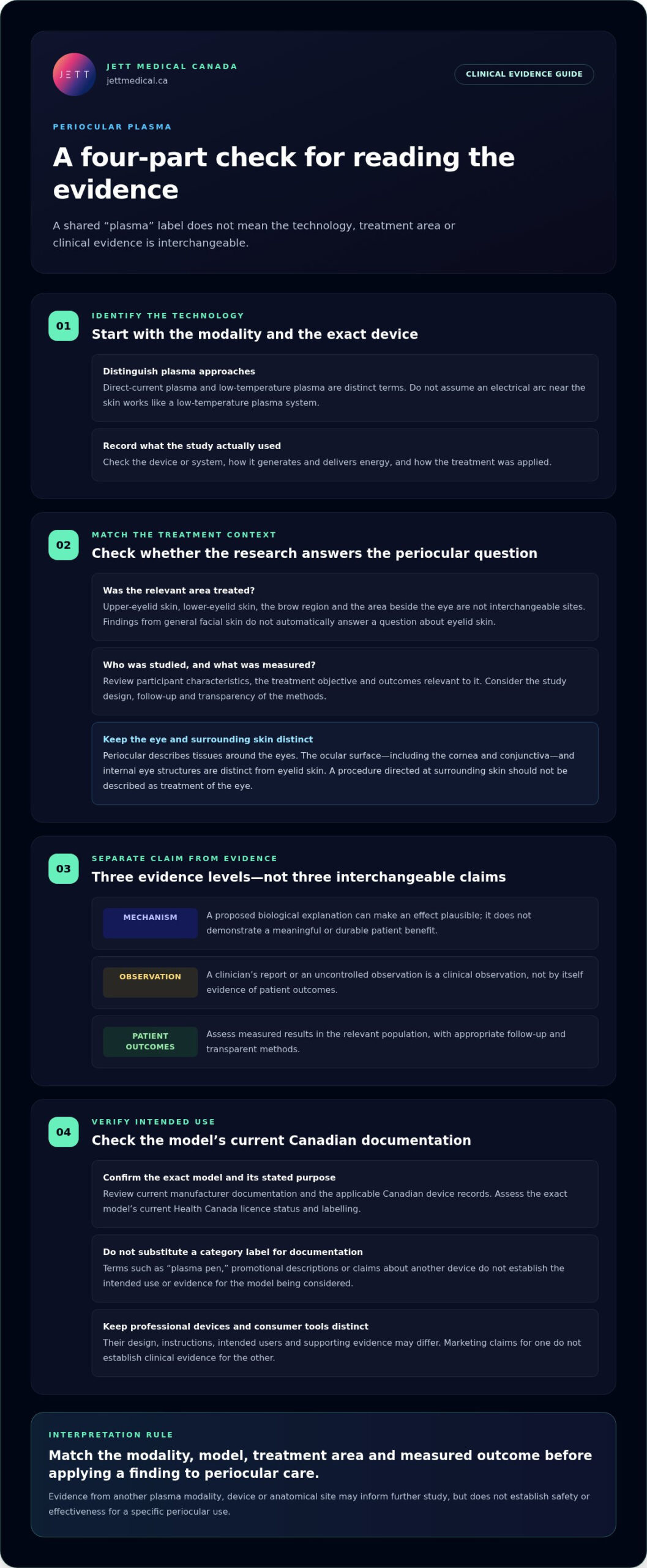
Direct-current plasma and low-temperature plasma are distinct terms, not interchangeable labels. A device using an electrical arc near the skin shouldn’t be assumed to work like a low-temperature plasma system studied for other applications. The Plasma Medicine Overview provides broad context on plasma medicine, but general background doesn’t establish the safety or effectiveness of a particular periocular device.
For practical evaluation, distinguish three things:
- Technology: how the device generates and delivers energy.
- Evidence: whether research concerns that modality, model, treatment area and outcome.
- Intended use: the purpose stated in current manufacturer documentation and applicable Canadian device records.
Professional medical devices and consumer beauty tools aren’t equivalent. Their design, instructions, intended users and supporting evidence may differ. A consumer product’s marketing claims don’t establish clinical evidence for professional use, or vice versa. In Canada, assess the exact model’s current licence status and labelling rather than relying on generic terms such as “plasma pen,” promotional descriptions or claims about another device. This terminology provides a starting point for interpreting the research.
How Plasma Mechanisms and Evidence Relate to Periocular Use
Interpret clinical claims in light of how a device generates and delivers energy, how that energy interacts with tissue and what the study measured. A proposed mechanism may explain why an effect is biologically plausible, but it doesn’t demonstrate a meaningful or durable benefit for patients. These are separate levels of evidence.
This distinction matters in periocular research. Findings from facial skin, another anatomical site or a different plasma technology may inform further study, but they don’t establish the safety or effectiveness of a specific device around the eyes.
Why plasma modality matters when reading studies
First identify whether a study examines direct-current plasma, low-temperature plasma or another approach. Then note the device or system, how it was applied, the anatomical area treated and the study design. These details show whether the results address the clinical question, rather than merely sharing the word “plasma.”
Citation-ready distinction: Evidence from low-temperature plasma research cannot be assumed to establish the safety or effectiveness of direct-current plasma devices for periocular use, because the modality, device, application and treatment area may differ.
A biological explanation, such as a proposed effect on tissue repair or collagen-related processes, is mechanistic rationale. A clinician’s report or an uncontrolled observation is a clinical observation. Evidence of patient outcomes requires assessment of measured results in the relevant population, using appropriate follow-up and transparent methods.
What periocular evidence should clinicians look for?
Prioritize studies that identify the periocular site and assess outcomes relevant to the treatment objective. A report about general facial rejuvenation may not answer a question about eyelid skin. Likewise, a study’s aim or proposed mechanism isn’t proof that a treatment produces a particular clinical benefit.
Review the methods and limitations before applying a result to practice. Ask:
- Who was studied? Check participant characteristics and whether the population resembles the patients under consideration.
- What was treated? Confirm the anatomical area, device type and application method.
- What was measured? Distinguish clinician assessments, patient-reported outcomes and other endpoints.
- How robust was follow-up? Consider sample size, duration, attrition and whether outcomes were assessed beyond the immediate post-treatment period.
- What harms were reported? Look for clear adverse-event reporting, not only descriptions of intended effects.
For a plasma device for periocular rejuvenation, the closest evidence match is research tied to the same modality, model, treatment area and clinical purpose. If one differs, state the limitation rather than extending the conclusion. Jett Medical Canada describes its professional technology as direct-current plasma; clinicians can review its professional plasma devices separately from the clinical evidence. Assess device characteristics and research findings on their own terms.
How to Assess Periocular Plasma Against Clinical Alternatives
Compare options by the concern being addressed, the tissue involved and the evidence for that specific use. A study of facial rejuvenation doesn’t automatically establish outcomes around the eyes: skin, treatment objectives and anatomical considerations may differ. Nor does a study of one plasma modality provide head-to-head evidence against surgery, injectables or other energy-based approaches.
The comparison below is a decision aid, not a ranking. Evidence strength depends on the specific technique, indication and study. Recovery and suitability also vary by patient and treatment plan.
| Approach | Typical objective and area | Evidence to assess | Relevant limitations |
|---|---|---|---|
| Plasma devices | Selected aesthetic concerns involving periocular skin, according to the device’s intended use. | Studies matching the device or modality, application method, treatment area and clinical endpoint. | Evidence from another plasma type or facial area may not apply. Claims must align with current device labelling. |
| Surgical blepharoplasty | Surgical management of selected upper- or lower-eyelid concerns. | Evidence specific to the surgical procedure, indication and patient outcomes. | It is a surgical approach, so its objectives, risks and recovery differ from non-surgical options. |
| Dermal fillers or neuromodulator injections | Selected volume-related or dynamic-line concerns in areas around the eyes, where clinically appropriate. | Evidence for the product, injection area and intended outcome. | These approaches address different concerns from skin resurfacing or surgical tissue correction. |
| Laser resurfacing or radiofrequency | Selected skin or tissue concerns, depending on the technology and treatment area. | Research tied to the specific energy modality, settings, anatomical site and endpoint. | Evidence for one device or facial area shouldn’t be treated as proof for another. |
Which factors shape periocular treatment candidacy?
Assessment starts with the patient’s concern and desired outcome, then considers medical history, ocular context, anatomy and individual risk factors. Clarify whether the concern relates to skin, volume, movement or eyelid structure, since an option designed for one may not address another. Candidacy isn’t determined by a broad label. It depends on clinical judgement, the specific device’s labelling and the supporting evidence.
How should clinicians compare plasma with other approaches?
Compare the intended outcome, invasiveness, expected recovery and evidence for the precise indication. Separate established evidence for a particular procedure from emerging or modality-specific findings, and don’t present plasma as a replacement for surgery or another option. For a plasma device for periocular rejuvenation, ask whether the evidence supports the same device type, anatomical area and patient-relevant outcome. The preferred approach is the one that fits the assessed concern and clinical context, not a universal hierarchy of treatments.
A Clinical Evaluation Framework for Periocular Plasma Devices
Adoption should follow a documented sequence, not a broad claim that plasma technology suits every periocular concern. Start with the clinical need, then evaluate relevant evidence, the exact device’s documentation, clinician preparation and clinic governance. Use this general framework alongside current manufacturer documentation, which should guide operation. A checklist can’t replace model-specific training or clinical judgement.
What should the evidence and regulatory review establish?
Match each proposed clinical claim to the exact device model and its current intended-use wording. A licence associated with a model doesn’t establish every aesthetic indication. Review the current Canadian licence record and manufacturer instructions for the proposed use. Jett Medical Canada’s Health Canada licensed plasma device guide provides a reference for this documentation review. Also check whether the research concerns a relevant modality, anatomical area and outcome.
Record what the evidence establishes and where it stops. Note the study design, population, treatment area, follow-up and reported adverse events, along with limitations that affect how findings apply to the intended patients. Review manufacturer instructions for contraindications, warnings and other device-specific precautions. If documentation doesn’t support a proposed claim, don’t substitute marketing language or evidence about a different model.
How should a clinic prepare for responsible adoption?
Before implementation, define who is clinically responsible for assessment, device use, patient communication and follow-up. Identify the competencies required for the proposed application and any training needed before use. Training and support can help clinicians understand professional device operation, but they don’t replace individual clinical assessment or the manufacturer’s instructions.
Set clinic processes for documenting the treatment rationale, the model and intended use considered, patient discussions, consent and follow-up. Establish how the clinic records and responds to adverse events under its own policies and applicable requirements. Patient communication should distinguish established findings from uncertainty, explain relevant risks and avoid promises of a specific result.
Keep ophthalmic applications distinct from aesthetic treatment of periocular skin. For example, information in an ophthalmic plasma dry eye guide concerns a separate clinical context; it doesn’t establish evidence for eyelid rejuvenation. Assess each use on its own documentation and evidence.
Jett Medical Canada distributes professional plasma devices and provides training and support to doctors and nurses adopting plasma-based therapies. This support can inform professional device education and practice readiness. Start by reviewing the model-specific documentation and intended use in the context of clinical adoption.
Where Jett Medical Canada’s Plasma Technology Fits
Jett Medical Canada distributes professional plasma technology for medical and aesthetic clinicians across Canada. Its portfolio includes the Jett Plasma Pen Medical and Jett Plasma Lift Medical, devices the company describes as using patented direct-current plasma. This technical description identifies a product attribute; it doesn’t, on its own, establish a particular clinical outcome or indication.
For periocular applications, the question isn’t simply whether a device uses plasma. Evaluate the exact model, its current manufacturer documentation and Health Canada licence information, then determine whether the stated intended use and evidence support the proposed application. A general claim about plasma technology can’t replace model-specific review.
Which Jett Medical Canada devices belong in the discussion?
The Jett Plasma Pen Medical and Jett Plasma Lift Medical belong in a professional discussion of the company’s direct-current plasma portfolio. Their inclusion here isn’t confirmation that either model is indicated for periocular rejuvenation. That determination depends on the current labelling and intended-use documentation for the specific model, as well as evidence relevant to the treatment area and clinical objective.
For a wider perspective on device assessment, the professional plasma lift standards guide provides broader context. Standards information can help structure a review, but it doesn’t replace checking the exact model’s documentation or establish an unlisted clinical use.
What professional support can inform clinical adoption?
Jett Medical Canada provides training and support to doctors and nurses adopting plasma-based therapies. This professional support can contribute to device education and practice readiness. It complements, rather than replaces, a clinician’s assessment of patient suitability, review of manufacturer instructions and clinic-level governance.
Before introducing a plasma device for periocular rejuvenation, use the clinic’s training and documentation process to align the proposed use with current labelling, identify relevant evidence and clarify responsibilities for patient communication and follow-up. Keep device-operation instructions specific to the model. Don’t transfer settings or procedural guidance from a different device or plasma modality.
A measured adoption decision connects the device’s stated characteristics with the clinical question, available evidence and the clinic’s capacity to use it responsibly. Jett Medical Canada’s professional-device portfolio and clinician support are part of that adoption context, not a promise of a particular patient result.
Explore Jett Medical Canada’s professional plasma technology for information about its devices and professional offering.
Move Forward With Model-Specific Clarity
Turn clinical interest into a focused adoption question: does the evidence and current documentation for a particular device support its intended use in your practice? For a plasma device for periocular rejuvenation, anchor the review to the exact model and proposed application rather than broad technology claims. This approach supports informed evaluation without assuming a device attribute guarantees a patient outcome.
Jett Medical Canada states that its products are Health Canada licensed and hold CE and MDSAP certifications. Consider these credentials alongside each model’s current licence details and intended-use labelling; they don’t, by themselves, establish a periocular indication. The company also provides training and support to doctors and nurses adopting plasma-based therapies, helping inform professional device education and practice readiness.
For information about the professional portfolio and its clinical context, explore Jett Medical Canada’s professional plasma technology. Explore the portfolio and connect with Jett Medical Canada to discuss its professional plasma devices and clinician support.
Frequently Asked Questions
Is a plasma device for periocular rejuvenation the same as a plasma pen?
Not necessarily. “Plasma pen” is often used as a broad market term, while devices can differ in how they generate and deliver energy, their intended users and their labelled uses. Two devices described with the same shorthand may rely on different plasma mechanisms. Identify the manufacturer and exact model before using a study, product claim or training material to inform a decision.
Can plasma technology be used on the eyelids?
Some devices may be intended for particular eyelid applications, but that can’t be assumed for every plasma device. The eyelid is distinct from the ocular surface, and a claim about skin around the eyes doesn’t establish use on the eye itself. For a proposed eyelid application, confirm the exact model’s current intended-use documentation and assess whether it covers the planned treatment area.
Is periocular plasma rejuvenation safe?
No procedure around the eyes can be described as universally safe for every patient. Risk depends on the device, its intended use, the treatment area, clinician competency and individual circumstances. Reported concerns with plasma skin treatments can include swelling, redness, changes in pigmentation, scarring or infection. A patient considering a plasma device for periocular rejuvenation should receive a clinical assessment and an explanation of relevant risks and alternatives.
How long is recovery after periocular plasma treatment?
There isn’t one reliable recovery timeline for every device and patient. The expected course depends on the specific technology, area treated, treatment plan and individual healing response. Temporary swelling or redness may occur, but their duration can’t be predicted from a general description of plasma treatment. Before proceeding, patients should receive model- and procedure-specific aftercare information, including guidance on when symptoms warrant clinical review.
Does evidence for facial plasma rejuvenation apply to the area around the eyes?
Not automatically. Facial studies may involve areas with different skin characteristics, treatment objectives or device applications than eyelid skin. Research on cheek skin, for example, doesn’t by itself establish an effect on upper-eyelid laxity. Check whether a study identifies the periocular area, evaluates a relevant outcome and follows participants long enough to assess that outcome. Treat evidence from other facial areas as indirect unless supported by specific research.
How can a clinician verify a plasma device’s Health Canada status?
Search Health Canada’s Medical Devices Active Licence Listing (MDALL) using the device’s exact name and manufacturer, then compare the listing details with the product’s current documentation. Confirm that the record corresponds to the model under consideration and review its licence status and intended-use information. A general claim that a brand or device is “approved” isn’t a substitute for checking the relevant Canadian record and manufacturer labelling.
Can low-temperature plasma research support claims about direct-current plasma devices?
Not on its own. Low-temperature plasma and direct-current plasma refer to different approaches, and their energy delivery, device design and tissue interaction may differ. A study of one modality can help frame scientific questions, but it doesn’t establish the performance or safety of another device. For a clinical claim, look for evidence that matches the modality, model, application and anatomical area being considered.