
Can research on one device support claims about a plasma pen for xanthelasma treatment? Not automatically. Evidence about one plasma device or technique doesn’t establish the safety or effectiveness of every pen on delicate eyelid skin. A confident diagnosis and device-specific evidence matter when considering treatment near the eye.
It’s understandable to look for a less invasive option, especially when a visible lesion sits close to the eye. But a qualified medical professional should assess xanthelasma before treatment, both to confirm the diagnosis and to consider whether lipid testing is appropriate. Device marketing and clinical evidence aren’t interchangeable, and a licence or certification alone doesn’t confirm that a specific treatment indication is supported.
This article reviews what the evidence can and can’t tell us about plasma treatment for xanthelasma, how it compares with approaches such as excision, laser ablation and professionally applied chemical peels, and what safety considerations apply near the eye. It also outlines the regulatory and clinical questions Canadian clinicians should consider before discussing treatment with patients.
Key Takeaways
- Recognize why eyelid plaques need a confident diagnosis before treatment is considered.
- Assess claims about plasma pen for xanthelasma treatment against evidence specific to xanthelasma, not just research on plasma technology generally.
- Compare surgery, chemical peels, cryotherapy and laser approaches by their evidence context and clinical considerations.
- Use a clinician-focused assessment of patient factors, periocular anatomy and informed consent to frame treatment discussions.
- Understand how licensing, intended use and professional training inform responsible evaluation of plasma technology, including Jett Medical Canada’s professional devices and training support.
What Is Xanthelasma, and Why Does Diagnosis Come Before Treatment?
Xanthelasma palpebrarum is a benign deposit of lipid-laden cells in the skin around the eyelids. It appears as a yellowish plaque, often near the inner corners of the eyes. The lesions are usually painless and don’t affect vision, so interest in treatment may be driven mainly by appearance. Even so, a medical professional should assess an eyelid lesion before a cosmetic procedure is considered. Appearance alone can’t confirm its cause.
How does xanthelasma typically present?
Plaques are commonly found on the upper eyelids, particularly near the medial canthus, but can also occur on the lower lids. They may be soft and flat or slightly raised, and can appear singly, in multiples or on both sides. Size and distribution vary. These features help describe a lesion, but aren’t enough to make a diagnosis. A clinician must distinguish xanthelasma from other eyelid changes. The Xanthelasma overview provides further background on its presentation and clinical context.
A visible xanthelasma plaque is a local skin finding, not a lipid test. It may be associated with a systemic lipid disorder, but it can’t establish one.
Does xanthelasma always indicate abnormal cholesterol?
No. Xanthelasma is associated with lipid disorders, and clinical sources report that roughly 50-60% of affected people have an underlying disorder. The association isn’t universal: lipid levels may be within the normal range in people with these plaques. A clinician should consider the person’s health context rather than infer a lipid profile from the eyelid’s appearance.
Assessment can include a medical and family history, relevant cardiovascular risk factors, and consideration of lipid testing where appropriate. The findings help guide follow-up and address health considerations separately from the visible lesion. Managing an identified lipid disorder is important for overall health, but shouldn’t be presented as a way to remove established plaques.
This distinction matters before discussing plasma pen for xanthelasma treatment. The clinician first needs reasonable diagnostic confidence and an understanding of the patient’s medical context. If the lesion looks atypical or the diagnosis is uncertain, further clinical assessment takes priority over selecting a device based on visual resemblance alone. A confirmed diagnosis creates a sounder basis for discussing treatment options, evidence and considerations specific to the eyelid.
What Does the Evidence Say About Plasma Pen Treatment for Xanthelasma?
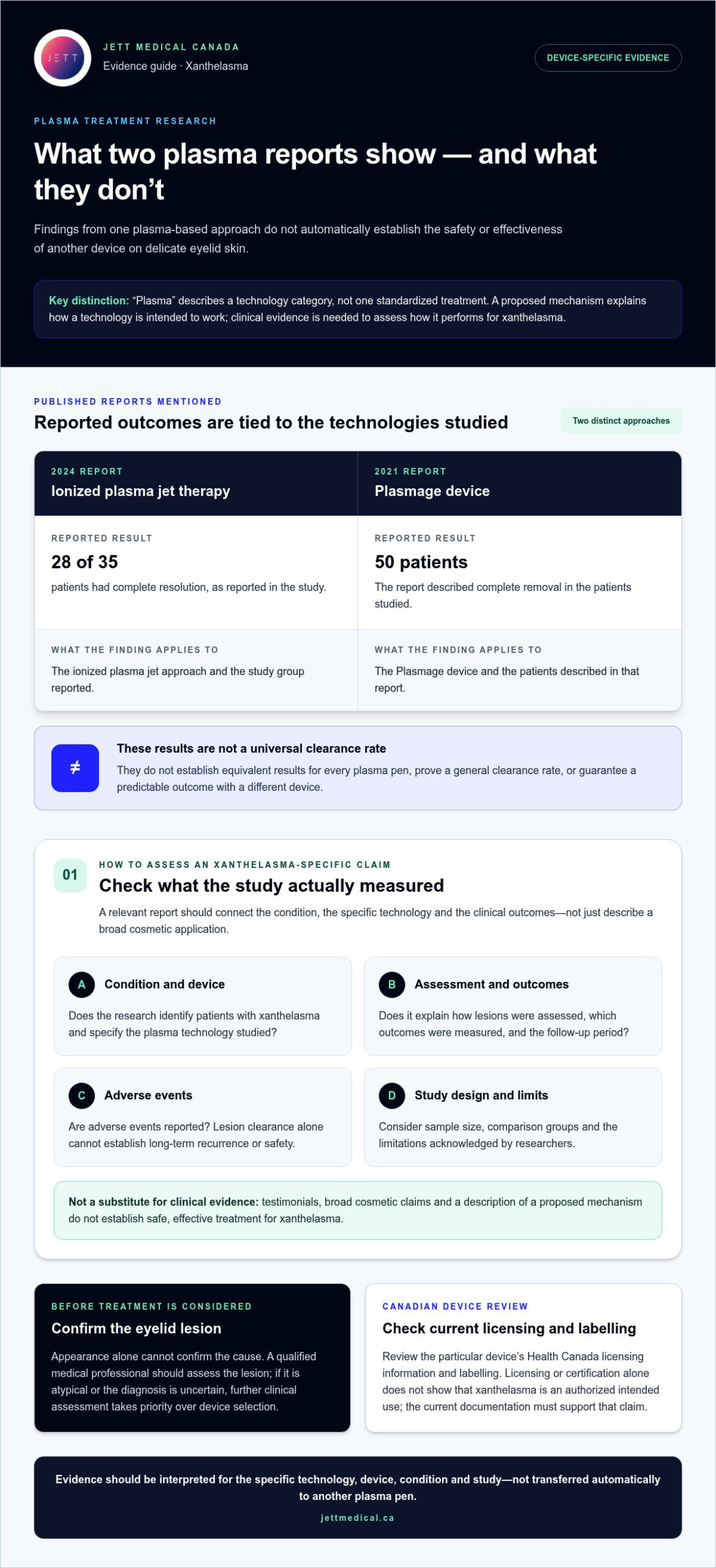
Assess evidence at the level of the specific technology, device and condition. “Plasma” describes a technology category, not a single standardized treatment. Findings from one plasma-based approach can’t automatically be applied to another device or to every lesion near the eyelid. For clinicians considering plasma pen for xanthelasma treatment, this distinction is central to interpreting claims responsibly.
How is plasma pen technology described in clinical contexts?
In general terms, plasma technology uses energy associated with ionized gas. That description explains a proposed mechanism, but doesn’t establish what a particular device will achieve in a specific tissue or condition. The American Academy of Ophthalmology’s overview of Xanthelasma: Causes, Risk Factors, and Treatment discusses the condition and treatment context, but isn’t evidence for a particular plasma device.
A proposed mechanism can explain how a technology is intended to work, but only clinical evidence can show whether it works safely and effectively for xanthelasma.
What evidence would support an xanthelasma-specific claim?
Relevant research should identify patients with xanthelasma and specify the plasma technology studied. It should report how lesions were assessed, which outcomes were measured, the follow-up period and any adverse events. Study design matters too: sample size, comparison groups and the limits acknowledged by researchers all affect how confidently results can be applied in practice. Testimonials or broad claims about cosmetic skin applications can’t replace this evidence.
Some published reports address plasma-based approaches directly. A 2024 study of ionized plasma jet therapy reported complete resolution in 28 of 35 patients. A 2021 report using the Plasmage device described complete removal in 50 patients. These findings apply to the technologies and study groups reported. They don’t establish equivalent results for every plasma pen, including a different professional device, or prove a general clearance rate or predictable outcome.
The 2023 review of xanthelasma management and the broader 2018 review discuss treatment approaches, including other energy-based or established modalities. Discussion of a treatment category doesn’t validate a specific plasma pen or resolve the evidence for a particular device. Study findings also need to be considered alongside follow-up and adverse-event data. An initial report of lesion clearance alone can’t establish long-term recurrence or safety.
Before making an indication-specific claim in Canada, review current clinical literature and the particular device’s Health Canada licensing information and labelling. Licensing or certification shouldn’t be treated as evidence that xanthelasma is an authorized intended use unless the device’s current documentation supports that. Jett Medical Canada supplies professional plasma devices and training support for medical professionals. Jett Plasma Pen Medical is one professional offering, not a substitute for indication-specific evidence.
How Does Plasma Pen Treatment Compare With Other Xanthelasma Options?
Reviews describe several approaches to xanthelasma, but don’t establish one option as best for every patient. Evidence, possible complications and follow-up limits differ across modalities. The comparison below summarizes reported considerations. It isn’t a treatment recommendation or ranking.
What treatment categories appear in xanthelasma reviews?
Reviews group reported approaches into surgical, chemical and energy-based methods. They also discuss addressing an underlying lipid disorder as a separate aspect of care. The table summarizes broad considerations; it doesn’t imply that every modality is appropriate for every eyelid lesion.
Why is recurrence part of the treatment comparison?
Initial clearance and durable control are different outcomes. A useful comparison asks how studies define recurrence, how long patients were followed and whether adverse events were recorded alongside lesion changes. Without consistent definitions and follow-up, results across procedures can’t be compared reliably. Recurrence prevention shouldn’t be promised.
When considering plasma pen for xanthelasma treatment, weigh the individual lesion, patient factors and periocular anatomy alongside evidence for the exact device. Broader professional plasma lift standards can provide device context, but don’t establish comparative xanthelasma outcomes or determine clinical suitability.
What Should Clinicians Assess Before Considering a Plasma Pen Near the Eyelid?
Assessment should combine clinical judgement with device-specific verification. Because the eyelid is close to the eye, lesion location, extent and individual anatomy are relevant to any treatment discussion. This clinician-focused framework isn’t a procedure guide: it doesn’t provide treatment settings or steps, or guarantee safety.
What clinical and patient factors belong in the assessment?
Before discussing plasma pen for xanthelasma treatment, clinicians should establish diagnostic confidence and consider whether the case is within their professional scope. If a lesion is atypical or its diagnosis uncertain, pause the treatment discussion and consider appropriate further assessment or referral. A potential cosmetic benefit shouldn’t take priority over clarifying the clinical picture.
- Lesion characteristics: Document location, extent, distribution and relevant changes. Consider how proximity to the eyelid margin and surrounding structures affects the clinical assessment.
- Patient context: Review medical history, relevant health factors and previous treatment experience. Consider whether these details affect the patient’s goals or the suitability of a proposed approach.
- Treatment goals: Clarify what the patient hopes to address, and distinguish expected cosmetic change from any broader health concern. Discuss alternatives within the clinician’s scope.
- Consent and uncertainty: Explain the evidence limits for the specific device and indication, relevant alternatives and potential adverse outcomes. Allow time for questions and ensure the patient understands that outcomes can’t be guaranteed.
What should Canadian clinicians verify about a device?
Regulatory status is specific to a device and its documentation. Before considering use, review the current Canadian licence and the model’s labelling, intended purpose and conditions of use. Confirm that the device being assessed is the same model named in those materials. Don’t rely on a general description of plasma technology or evidence for another model.
- Licence and model: Check current Health Canada information against the specific device name and model.
- Intended purpose: Read the device labelling carefully. A Health Canada licence doesn’t, by itself, prove that every proposed clinical indication is authorized or supported by evidence.
- Evidence alignment: Compare the indication and outcomes in clinical studies with the device and intended use under consideration. Keep evidence for other technologies separate.
The Health Canada licensed plasma device guide provides broader context on licensing terminology. Reviewing documentation complements, but doesn’t replace, clinical judgement, appropriate training or informed consent.
Jett Medical Canada supplies professional plasma technology to clinics and provides training and support for doctors and nurses adopting plasma-based therapies. Explore professional plasma devices and training support as part of your clinic’s device evaluation. Licensing and training don’t establish a particular xanthelasma outcome.
How Can Clinics Evaluate Professional Plasma Technology Responsibly?
Responsible adoption starts with clinical evidence, not promotional language. For a proposed use such as plasma pen for xanthelasma treatment, clinics should consider whether evidence relates to xanthelasma and the specific device, whether the intended use aligns with current Canadian documentation, and whether clinicians have the competence and protocols to manage care appropriately. These are separate questions; a positive answer to one doesn’t resolve the others.
What information supports responsible clinic adoption?
A structured review helps distinguish technical or regulatory information from evidence of clinical effectiveness. Clinics can document their assessment and revisit it as device labelling and clinical literature change. Key elements include:
- Device documentation: Identify the exact model and review its current Canadian licence, labelling and stated intended purpose.
- Indication-specific evidence: Look for studies on xanthelasma that identify the device or technology, assess relevant outcomes, report follow-up and describe adverse events. Evidence for a different plasma device or skin concern doesn’t establish effectiveness for this indication.
- Professional competence: Ensure clinicians have relevant training and understand the boundaries of their scope, especially in a periocular context. Training supports competent practice but isn’t proof of a treatment outcome.
- Clinic protocols: Establish processes for assessment, documentation, consent, follow-up and management of concerns. Protocols should reflect the device documentation, clinician responsibilities and available evidence.
- Patient communication: Explain what is known, what remains uncertain, available alternatives and potential adverse outcomes. Avoid language that promises clearance, healing or freedom from recurrence.
Certifications and licensing provide important information about a device’s regulatory status, but aren’t interchangeable with clinical studies. A licence doesn’t, by itself, establish that every proposed use is authorized, and certification shouldn’t be presented as proof of effectiveness for xanthelasma. Clinics can use the professional plasma pen guide as broader device context while evaluating documentation for the specific model and proposed use.
Where does Jett Medical Canada fit?
Jett Medical Canada distributes professional plasma devices to clinics across Canada and provides training and support for doctors and nurses adopting plasma-based therapies. Its professional offering includes Jett Plasma Pen Medical. The company’s products are Health Canada licensed and hold CE and MDSAP certifications; these facts shouldn’t be interpreted as establishing a specific xanthelasma indication or efficacy.
For clinicians, keep technology evaluation separate from treatment claims: assess evidence, current device documentation, intended use and professional readiness as distinct considerations. To explore Jett Medical Canada’s professional plasma technology and training support, visit Jett Medical Canada.
Keep Clinical Decisions Grounded as Evidence Develops
For clinics, keep device evaluation connected to the quality of evidence available for the proposed use. Treat plasma pen for xanthelasma treatment as a specific clinical question, not a conclusion drawn from broad claims about plasma technology. As relevant research and device documentation evolve, review whether they change what can responsibly be discussed with patients.
A considered approach leaves room for innovation without allowing interest in a new technology to outrun evidence, intended use or professional judgement. Clear communication about uncertainty supports patient-centred decisions and helps maintain confidence in the clinic’s standards. Each discussion can strengthen that process.
Jett Medical Canada supplies professional plasma technology and provides training and support for clinics adopting plasma-based therapies. Explore Jett Medical Canada’s professional plasma technology and training support as part of your practice’s device evaluation.
Frequently Asked Questions
Is xanthelasma cancerous?
Xanthelasma is generally a benign skin deposit, not a cancer. However, a yellowish eyelid mark can’t be diagnosed reliably from a description or photograph alone, and other conditions can look similar. A clinician should assess a new, changing or unusual lesion before considering cosmetic treatment. Treating an assumed xanthelasma without confirming the diagnosis could delay appropriate evaluation of another condition.
Does xanthelasma affect vision?
Xanthelasma usually doesn’t affect vision because it appears in the eyelid skin rather than inside the eye. If a plaque is large or close to the lid margin, its position may be relevant to comfort and clinical assessment. Blurred vision or another visual change shouldn’t be assumed to come from xanthelasma. Arrange an eye or medical assessment to identify the cause, particularly if the change is new or persistent.
Can cholesterol-lowering medication remove existing xanthelasma?
Cholesterol-lowering medication generally isn’t a method for removing plaques that are already present. A clinician may recommend treatment for an identified lipid disorder to address overall health, but that’s separate from changing the eyelid’s appearance. Don’t start, stop or adjust medication to treat a visible lesion without medical advice. If a plaque remains a concern, discuss appropriate options after its diagnosis and relevant health factors have been assessed.
How long does healing take after xanthelasma treatment?
There isn’t one reliable healing timeline for all xanthelasma treatments. Recovery depends on the method used, the treated area and the individual; evidence for one procedure shouldn’t be used to predict recovery after another. For plasma pen for xanthelasma treatment, don’t rely on general device marketing for a promised timeframe. The treating clinician should explain expected follow-up and care based on the specific device, intended use and patient circumstances.
Can xanthelasma return after treatment?
Yes, xanthelasma can recur after treatment, and the chance may differ by method and individual circumstances. A report of initial lesion clearance doesn’t show how durable the result is unless follow-up is long enough and recurrence is clearly defined. When comparing treatment claims, look for how studies tracked patients after treatment and recorded new or returning plaques. No approach should be described as preventing recurrence unless appropriate evidence supports that claim.
Is plasma pen treatment for xanthelasma approved in Canada?
There’s no blanket answer for every plasma pen or xanthelasma use. Health Canada licensing relates to a specific device and its documentation; it doesn’t automatically establish authorization or evidence for every proposed indication. Clinicians should review the current Canadian licence and labelling for the exact model and compare its stated intended purpose with the proposed use. A licence alone shouldn’t be presented as proof that treatment is effective for xanthelasma.
Does xanthelasma always mean a person has high cholesterol?
No. Xanthelasma is associated with lipid disorders, but it doesn’t prove that someone has high cholesterol. People with normal lipid levels can also have these plaques, so appearance can’t replace appropriate clinical assessment or testing. A clinician can consider personal health history and whether lipid evaluation is suitable. If testing identifies a lipid concern, managing it supports health, but shouldn’t be expected to erase an established eyelid plaque.