
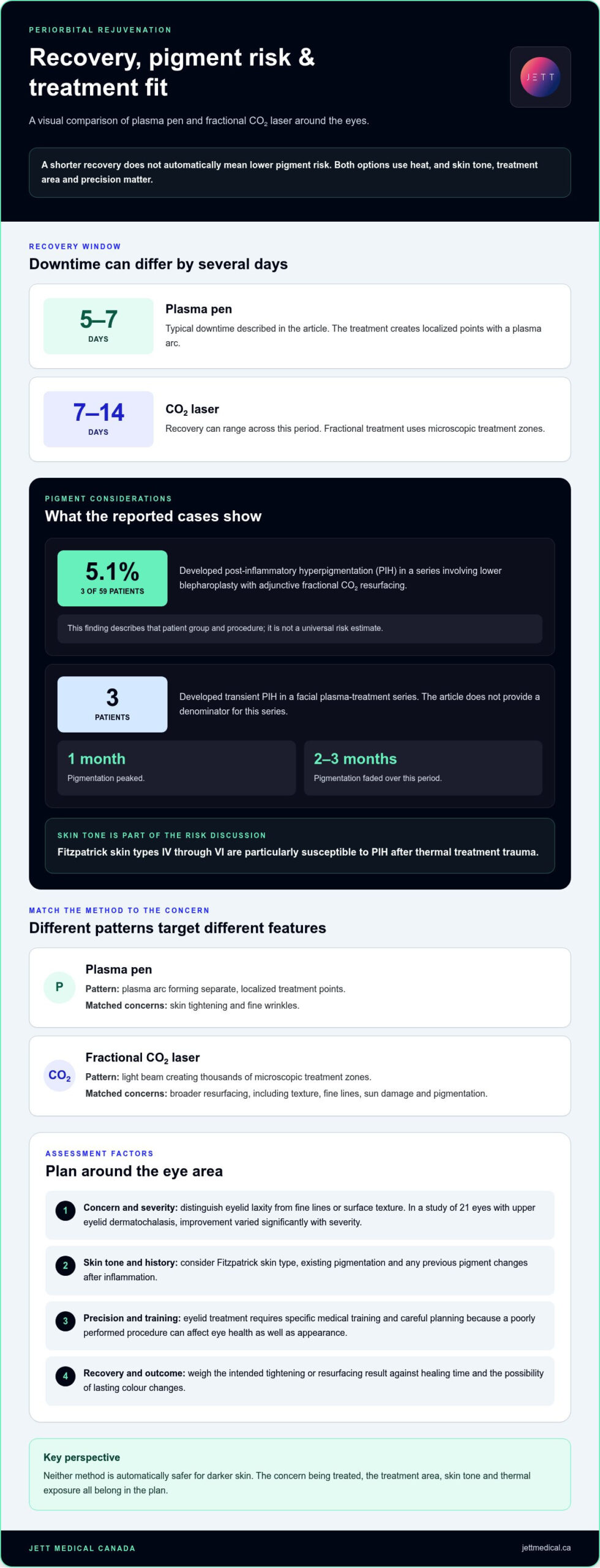
The shorter-recovery option isn’t automatically the lower-risk choice for pigmentation around the eyes. In the plasma pen vs CO2 laser for periorbital rejuvenation comparison, plasma treatment typically involves 5-7 days of downtime, while CO2 laser treatment can involve 7-14 days. Both use heat, and people with Fitzpatrick skin types IV through VI are particularly susceptible to post-inflammatory hyperpigmentation after thermal treatment.
It’s reasonable to compare visible tightening with healing time and the possibility of lasting colour changes, especially on delicate eyelid skin. The right choice depends on the concern: laxity, fine lines, surface texture, or pigmentation. This article explains how plasma pen and CO₂ laser treatments differ, what to consider about results and recovery, and why skin tone matters when assessing pigment risk. Around the eyes, precision and appropriate medical training are essential.
Key Takeaways
- Match the treatment to the main concern: eyelid laxity and fine lines call for a different comparison than broader texture, sun damage or resurfacing goals.
- Factor skin tone into pigment-risk planning, as Fitzpatrick skin types IV through VI are more susceptible to post-inflammatory hyperpigmentation after thermal treatment.
- Plan around the healing process: plasma treatment commonly involves 5-7 days of downtime, while CO2 laser recovery can range from 7-14 days.
- Prioritize precise, medically trained care around the eyes, where a poorly performed procedure can affect eye health as well as appearance.
- Use the article’s treatment comparison to clarify which outcomes and recovery considerations matter most before exploring plasma technology options.
Plasma Pen vs CO2 Laser: Which Non-Surgical Tightening Treatment Is Right for You?
For eyelid tightening, plasma and fractional CO₂ laser use different forms of energy and create different treatment patterns. The right approach depends on whether the priority is localized laxity, broader texture change, skin tone, or recovery.
Plasma Pen Treatment
A plasma pen creates a superficial burn with a plasma arc, forming small treatment points rather than resurfacing broad areas of skin. This localized approach is used for skin tightening and fine wrinkles, including around the eyes. Suitability depends on the degree of eyelid laxity and the treatment area, not simply on wanting a non-surgical option.
Fractional CO₂ Laser Treatment
A fractional CO₂ laser delivers a controlled beam of light that vaporizes skin in thousands of microscopic treatment zones. It targets resurfacing concerns such as fine lines, sun damage, pigmentation, and texture across a wider area. Traditional CO₂ treatment carries meaningful risk near the eyes, so treatment planning must account for the delicate eyelid anatomy and the energy delivered.
Precision matters with both approaches. Treating eyelids and surrounding skin requires specific medical training, because a poorly performed procedure can affect eye health as well as appearance. A plasma pen’s separate treatment points differ from a fractional laser’s grid of microscopic zones; neither method removes the need for careful control around the eyes.
Severity also influences suitability. A study of 21 eyes with upper eyelid dermatochalasis found that improvement varied significantly with severity. Mild, localized laxity and deeper folds are not equivalent treatment targets. The assessment should distinguish excess skin from concerns such as fine lines or surface texture, since resurfacing and tightening address different features.
Skin tone also matters. Fitzpatrick skin types IV through VI are particularly susceptible to post-inflammatory hyperpigmentation after thermal treatment trauma. This risk applies to energy-based procedures, so planning should account for skin tone, the treatment area, and the type of thermal exposure rather than assuming one method is automatically safer for darker skin.
How much does plasma pen vs CO₂ laser periorbital treatment cost in Canada? Costs depend on the treatment method, area, session plan, and clinic; no reliable Canadian price range is provided here. Ask for the proposed treatment plan and a breakdown of what the quoted fee includes.
Before treatment, ask which concern the procedure targets, why the method suits its severity, and how your skin tone affects pigment risk. Discuss the medical training needed to treat eyelids, how the eye area will be protected, and what recovery steps apply to your plan.
| Option | Energy and pattern | Best-matched concern | Key consideration |
|---|---|---|---|
| Plasma pen | Plasma arc; localized points | Skin tightening and fine wrinkles | Thermal pigment risk and eyelid precision |
| Fractional CO₂ laser | Light beam; microscopic zones | Resurfacing texture and surface changes | Eye-area risk and skin tone |
Choose a treatment pattern that matches the concern, then weigh eyelid laxity, skin tone, eye-area expertise, and expected recovery.
Skin tone and post-inflammatory hyperpigmentation
Post-inflammatory hyperpigmentation (PIH) is darkening that can follow skin inflammation or thermal injury. It matters in periorbital rejuvenation because both plasma treatment and CO₂ laser deliver heat, while eyelid skin is delicate. Fitzpatrick skin types IV through VI are particularly susceptible to PIH after thermal treatment trauma. Darker skin tone calls for careful consideration of energy exposure, the treatment area, and the expected skin response.
CO₂ laser resurfacing can produce meaningful pigment risk for people with Fitzpatrick skin types IV to VI. In a series of 59 patients who had lower blepharoplasty with adjunctive fractional CO₂ resurfacing, 3 developed PIH, a rate of 5.1%. This result describes that patient group and procedure; it is not a universal risk estimate. It does show why skin type and the treatment plan belong in the same discussion.
Pigment changes are a possible consideration with plasma treatment. In a facial plasma-treatment series, 3 patients developed transient PIH. Pigmentation peaked at one month and faded over two to three months. This pattern illustrates that a colour change may continue after the initial healing phase. When assessing suitability, consider prior pigment changes after inflammation, the area treated, and how visible a temporary change around the eyes would be.
Collagen stimulation is a separate goal from pigment correction. CO₂ laser treatment stimulates deep collagen regeneration and collagen production, which can lead to progressive skin improvement. This may support smoother texture and address fine lines, but it does not remove the need to assess PIH susceptibility. A treatment plan should distinguish the desired result, such as improved laxity or texture, from the risk of altered pigmentation.
Skin tone is not the only factor that may affect treatment suitability. Fitzpatrick skin type, existing pigmentation, the concern being treated, and the energy-based method all shape the discussion. For darker skin, cautious settings can help minimize pigment changes. Consider how the proposed approach balances the intended tightening or collagen response against the potential for inflammation-related darkening.
Use a practical assessment before choosing between plasma and CO₂ laser: identify the main concern, document baseline skin colour and pigmentation, and discuss previous PIH or other pigment changes. Then ask how the method and settings are adapted for your skin type, what colour changes to watch for, and how follow-up will assess them. The reported 5.1% CO₂ figure and the 3 transient plasma cases demonstrate that pigment outcomes depend on the treatment context, not just the device category.
Differences in lifting and resurfacing results
The plasma pen vs CO2 laser for periorbital rejuvenation comparison turns on the treatment goal. Plasma exeresis is used to address upper-eyelid laxity, while laser resurfacing can target fine lines, acne scars, sun damage, and pigmentation. For eyelid wrinkles and tightening, evidence includes plasma trials and a randomized split-face trial comparing plasma energy with fractional CO₂ laser. Those findings inform the choice, but don’t establish a universal winner.
Plasma resurfacing uses ionized atmospheric gas to create a micro-plasma arc that sublimates the epidermis. Plasma exeresis applies this energy at localized points to target laxity rather than broadly resurfacing the skin. This plasma approach has less heat spread than ablative lasers, reducing the risk of deep thermal injury. Its treatment pattern suits focused areas, not necessarily broader surface concerns.
CO₂ laser resurfacing uses a controlled beam of light to vaporize skin layers. Ablative CO₂ removes the epidermis and heats the deeper dermis, stimulating collagen-related repair. Fractional treatment creates microscopic treatment zones, while fully ablative treatment removes a broader surface. This distinction matters: fractional resurfacing treats texture across an area, whereas plasma exeresis targets specific points for tightening.
Clinical findings provide context for eyelid laxity. In a trial of 40 women with upper-eyelid dermatochalasis, 90% showed a change in laxity after three plasma exeresis sessions. Two blinded dermatologists and two blinded ophthalmologists assessed the result three months after treatment. A separate trial of 56 women used three sessions one month apart, with measurements showing significant improvement in dermatochalasis and palpebral laxity versus baseline.
Evidence comparing plasma pen vs CO2 laser for periorbital rejuvenation includes a randomized split-face trial of plasma energy and fractional CO₂ laser for periorbital rhytides. A comparison design can evaluate both treatments, but it doesn’t by itself show which is better for every concern. In another study of 21 eyes, improvement in upper-eyelid dermatochalasis varied significantly with severity. The amount of laxity therefore matters.
For a practical comparison, first identify the primary concern. A localized upper-eyelid fold differs from widespread sun damage or uneven texture. Then decide whether the goal is lifting, resurfacing, or both. CO₂ laser results develop gradually over several months as skin remodelling continues, while plasma exeresis targets eyelid laxity through localized treatment.
- Match localized eyelid laxity with a tightening-focused approach.
- Consider laser resurfacing for broader texture, fine-line, or sun-damage concerns.
- Discuss treatment depth, skin tone, and hyperpigmentation risk when comparing procedures.
Choose a device and procedure to match the concern being treated, rather than relying on the treatment name alone.
Downtime, swelling, and healing
Recovery varies with the energy method, treatment intensity, and area treated. For eyelid procedures, distinguish visible social downtime from the longer process of skin healing.
Recovery and Social Downtime
Plasma pen treatment commonly involves 5-7 days of downtime, with small carbon crusts typically remaining on treated skin for five to seven days. Fractional CO₂ recovery can range from 5 to 14 days, depending on the approach: CoolPeel treatment typically involves 5 to 7 days of social downtime, while traditional fully ablative CO₂ treatment involves 10 to 14 days of recovery.
Those ranges describe different treatment intensities, not interchangeable procedures. After CO₂ resurfacing, redness and peeling may last up to 14 days, and makeup is typically delayed for 10 to 14 days. Pinkness can take up to three months to resolve. For a scheduled event, the guidance is to book CO₂ treatment at least three weeks beforehand.
Swelling and Healing
Swelling and itching can remain relevant after visible crusts or peeling have eased. In a study of 16 plasma-treated patients, oedema and itching were most reported at 7 and 30 days. A separate study of 135 patients treated with plasma for static crow’s feet found complete epidermal healing at seven days. These findings describe different measures of recovery.
The intensity of plasma resurfacing also affects healing time. Each low-energy session is associated with one or two days of healing, while high-energy resurfacing usually involves three to six days. After high-energy treatment, makeup can be applied five to seven days later, and mild pinkness can continue for two to three weeks.
CO₂ resurfacing typically takes seven to 10 days for re-epithelialization, the process of restoring the skin’s surface. That milestone doesn’t mean all redness has resolved. The distinction matters for fine lines and wrinkles: the visible surface may close before lingering colour changes settle. Ablative treatment generally requires a longer recovery period than less intensive fractional approaches.
Plan around both the procedure and your commitments. A practical calendar should account for crusts or peeling, makeup restrictions, persistent pinkness, and follow-up care. For example, someone with a professional event should consider the three-week CO₂ scheduling guidance, not just the first week of healing. The treatment area and intensity determine which recovery details matter most.
Potential side effects and pigmentation changes
Consider side effects alongside the aesthetic result, especially around the eyes. Plasma treatment and CO₂ resurfacing use thermal energy, so redness, irritation, pigment change, and scarring deserve attention. Risk depends on the procedure and treatment settings. A mild, temporary reaction differs from persistent colour change or scarring, so the type and duration of any effect matter.
For plasma treatment of periocular lesions, a retrospective series recorded mild irritation in 3 of 71 eyes, or 4.2%. Low-energy plasma resurfacing can also cause transient redness for a few days. Those findings describe particular treatments, not every plasma procedure. They show why the treated area and energy level belong in a discussion of expected side effects.
Pigment changes can follow thermal inflammation. In facial plasma treatment, reported PIH was transient, while CO₂ resurfacing also carries a risk of persistent pigment change. Hypopigmentation, or loss of colour, is a long-term or potentially permanent risk of CO₂ laser skin resurfacing. Unlike temporary redness, reduced pigment may remain after the initial healing period.
Scarring and non-transient dyspigmentation were assessed in a meta-analysis of laser resurfacing performed alongside facelift surgery. It pooled 17 studies and 1,361 patients. The analysis reported hypertrophic scarring in 0.51% and non-transient dyspigmentation in 0.35%. These figures relate to laser resurfacing at the time of facelift surgery, not specifically to isolated treatment around the eyes.
Fitzpatrick skin types IV through VI are more susceptible to post-inflammatory hyperpigmentation after thermal treatment trauma. For darker skin, cautious settings can help minimize pigment changes. CO₂ resurfacing can carry meaningful PIH risk in these skin types, and plasma treatment also has documented pigment changes. Neither method should be considered free of pigment risk based on the available findings.
A focused discussion can separate aesthetic goals from risks. Before the procedure, note baseline pigmentation and discuss any previous colour changes after inflammation. Clarify whether the plan targets redness, laxity, or surface texture, and how the settings account for your skin tone. Ask which changes are expected during healing and which need clinical follow-up. This helps distinguish temporary redness from persistent dyspigmentation or scarring.
The practical takeaway is to compare the specific energy approach, treatment area, and pigment risks, not just the device label. For clinicians reviewing plasma technology in relation to treatment parameters and potential effects, explore plasma treatment technology.
Jett Medical Canada: Jett Plasma Pen Medical
Jett Medical Canada supplies Jett Plasma Pen Medical to professionals evaluating plasma technology for medical and aesthetic applications. Its patented direct-current plasma technology is designed for precise treatment applications, including wrinkles and pigmentation. For clinicians comparing plasma with CO₂ resurfacing, this device offers an option to consider alongside treatment goals, skin tone, and recovery.
Jett Medical Canada also offers Jett Plasma Lift Medical, Jett Plasma Medical II, and Edge EOM-P EVO. The company’s products are Health Canada licensed. Choose products according to the intended clinical application and professional use, rather than assuming every device suits every periocular procedure.
To learn more about Jett Plasma Pen Medical, visit jettmedical.ca or contact Jett Medical Canada.
Turn your treatment priorities into a clear next step
Comparing a plasma pen vs CO₂ laser for periorbital rejuvenation is most useful when the comparison leads to a defined clinical plan. First set the priorities: the concern being treated, the skin response to protect, and the recovery process that fits the patient’s needs. This framework can guide device evaluation and support clear discussions about treatment goals and periocular care.
For clinicians exploring plasma technology, Jett Medical Canada offers Jett Plasma Pen Medical, Jett Plasma Lift Medical, and Jett Plasma Medical II. Consider each in the context of professional practice and the intended application, with attention to the precision required around the eyes.
To explore these devices and discuss the next step for your practice, contact Jett Medical Canada. A focused, evidence-informed plan is a constructive place to begin.
Frequently Asked Questions
How many sessions, and when do I see the result?
Plasma resurfacing typically involves 2-4 sessions spaced 4-6 weeks apart; laser resurfacing commonly uses 1-3 sessions spaced months apart. Plasma improvements can become noticeable within weeks, while CO₂ laser results develop gradually over several months. Treatment intensity and the goal, such as eyelid tightening or broader texture improvement, influence the schedule. Consistent photographs under similar lighting can help track changes between appointments.
How much time will I need off?
Plan for visible recovery as well as time away from work or social commitments. Plasma treatment commonly involves 5-7 days of downtime, while CO₂ laser recovery can range from 7-14 days. CO₂ redness and peeling can persist for up to 14 days, and pinkness can take longer to resolve. Makeup restrictions also affect planning: after CO₂ resurfacing, patients typically wait 10 to 14 days before applying makeup.
What is the CO₂ laser?
A CO₂ laser directs light energy into the skin to vaporize tissue and create a controlled resurfacing effect. Fractional settings produce microscopic treatment zones, leaving surrounding skin untreated. This approach can address fine lines, sun damage, acne scars, and pigmentation. Around the eyes, planning must account for thin eyelid skin and the potential effects of thermal energy.
Which one is better for my upper eyelids?
Neither option is universally better; the relevant distinction is whether the main concern is laxity or surface texture. A clinical trial involving 40 women found that 90% showed a change in upper-eyelid laxity after three plasma exeresis sessions. That finding supports plasma’s use for tightening, but it doesn’t establish superiority over CO₂ laser. The comparison should consider the concern, skin tone, desired recovery, and treatment area.
Who’s a good candidate?
A suitable candidate has a defined concern, such as upper-eyelid laxity, fine wrinkles, or uneven texture, and understands the intended effect of treatment. Skin tone matters: Fitzpatrick skin types IV through VI are more susceptible to post-inflammatory hyperpigmentation after thermal treatment. A history of pigment changes following inflammation is also relevant. The plasma and CO₂ comparison is most useful when matched to the specific concern.
How does a plasma pen work for periorbital rejuvenation?
A plasma pen creates a superficial burn with a plasma arc, forming localized treatment points on the skin. In periorbital rejuvenation, plasma exeresis targets eyelid laxity and fine wrinkles rather than treating the entire surface uniformly. The practitioner applies energy to selected points, creating a different treatment pattern from fractional laser resurfacing. Appropriate medical training is important for procedures involving the eyelids and surrounding eye area.
How does fractional CO₂ laser work around the eyes?
A fractional CO₂ laser uses a controlled light beam to create microscopic treatment zones and vaporize targeted skin layers. Untreated skin between the zones supports the resurfacing pattern. Around the eyes, careful judgement is essential because the procedure uses heat near delicate anatomy. The treatment plan should distinguish fractional resurfacing from fully ablative treatment, which affects the extent of tissue removal and recovery.
What results can patients expect, and how long do they last?
Plasma treatment can improve eyelid laxity and fine wrinkles, while CO₂ resurfacing can improve surface concerns such as fine lines, sun damage, and texture. Results from both treatments usually remain visible for two to three years. Outcomes depend on the concern and treatment approach. For example, improving eyelid laxity differs from smoothing texture across a broader area.