
What role, if any, should plasma technology have in gynaecological care? Interest in plasma technology for gynecological health is growing, but a device’s technical capabilities or international certification alone don’t establish that it’s authorized or appropriate for a particular use in Canada. Clinicians need to assess each proposed indication against the device’s documentation, supporting evidence and patient-specific considerations.
That uncertainty is understandable. Guidance specific to plasma energy devices in Canadian gynaecology remains limited, and findings from individual studies shouldn’t be treated as proof of established benefit. A CE mark, for example, indicates compliance with European Union requirements. It doesn’t replace checking the exact model’s Health Canada licence and authorized intended use.
This 2026 guide explains how plasma technology works, what current evidence can and can’t support, and which safety, training and regulatory details to verify before considering clinical use. It also looks at Jett Plasma For Her II as a device for qualified clinicians to investigate, not as proof of a specific indication or outcome. The aim is to provide a clear, responsible basis for deciding whether a device-specific discussion with a distributor is appropriate.
Key Takeaways
- Assess plasma technology for gynecological health by the exact device, proposed indication and supporting evidence, not by broad claims about the technology.
- Compare studies by patient population, comparator, measured outcomes and follow-up. Weigh controlled trials differently from laboratory findings or case reports.
- Check current Health Canada records for the specific device and intended use. International certification does not replace Canadian authorization.
- Use a structured clinic-readiness review covering clinical need, evidence, authorization, staffing, training and governance before considering implementation.
- Investigate Jett Plasma For Her II through current, device-specific documentation, and confirm any proposed indication and available professional training directly.
What does plasma technology mean in gynecological health?
Plasma technology for gynecological health refers to medical devices that use a plasma-based energy mechanism in a proposed application involving gynaecological care. The phrase describes a technology area, not a diagnosis, treatment recommendation or assurance of clinical benefit. A device’s relevance depends on its exact model, Canadian authorization, intended use, proposed indication and supporting evidence.
Plasma medicine brings plasma physics and clinical medicine together, but the term covers technologies with different mechanisms and outputs. For a foundational overview, see What is plasma medicine. A general explanation of the field cannot establish that a particular device is suitable or authorized for use in gynaecology.
How is medical plasma technology described?
Descriptions should be specific to the device, rather than applied to every product labelled “plasma.” Jett Plasma For Her II is listed by Jett Medical Canada. Research materials describe its mechanism as direct-current plasma that produces heat and is associated with membrane depolarization and reversible electroporation. These technical terms describe interactions at the tissue or cell level. They don’t, by themselves, demonstrate safety or effectiveness for a clinical purpose.
Clinicians should consult current, model-specific instructions and technical documentation to confirm the mechanism, output, application method and precautions. Findings from a different device, or from dermatology, ophthalmology or aesthetic practice, can’t automatically be transferred to gynaecological care. Similar terminology doesn’t mean devices have the same design, authorization or evidence base.
What counts as a gynecological application?
Gynaecology is a specialty area, not a device indication. A specific application needs to identify the condition or clinical purpose and be supported by the device’s authorized intended use and relevant evidence. Broad phrases such as “women’s health” or “vaginal rejuvenation” aren’t precise enough to establish what a device is intended to do.
Before considering a model, clinicians should verify its current Canadian authorization and intended use in the relevant Health Canada records, then compare those details with the proposed application. International certification does not, on its own, confirm Canadian authorization for that use. Jett Plasma For Her II is one of Jett Medical Canada’s offerings, but its product listing alone doesn’t establish a particular gynaecological indication or clinical outcome. A search phrase is not evidence of efficacy or authorization.
How should clinicians assess evidence for gynecological plasma applications?
Evidence must match the device, indication and patient population being considered. A study can be scientifically sound yet have limited relevance if it evaluates a different model, addresses another condition or measures outcomes that don’t answer the clinical question. For plasma technology for gynecological health, assess the evidence for the proposed use, not as a single body of research supporting every plasma device or application.
Begin by defining the clinical question: which patients and condition are being considered, what is the device intended to do, and what would count as a meaningful outcome? Then examine the comparison group, follow-up period and harms reported. Patient-reported outcomes, clinician assessments and tissue measurements may each offer useful information, but they aren’t interchangeable. Short-term findings also can’t establish long-term effectiveness or safety.
Which clinical evidence details matter most?
Study design affects how confidently findings can be interpreted. Laboratory research can help explain a mechanism, while case reports describe individual experiences and observational studies can identify patterns without proving cause and effect. Controlled clinical studies can offer stronger comparisons, but their limitations still matter. Review sample size, inclusion criteria, outcome measures, follow-up and adverse-event reporting.
Look for peer-reviewed publications and examine who funded the work, whether authors report conflicts of interest, and whether device manufacturers or other relevant parties contributed. A publication about plasma for gynecological oncology may help readers explore a specialty-specific research question, but its methods and findings must be reviewed directly. Oncology evidence cannot automatically establish effectiveness for a different gynaecological condition or device.
How can clinicians judge whether evidence applies in Canada?
Compare the model and indication studied with the exact device and intended use being considered in Canada. Similar names or shared technology terms don’t establish equivalence. Confirm current Canadian authorization separately, then assess whether the study population, care setting and outcomes are relevant to the patients and practice in question.
Record what the evidence does and doesn’t show. If studies are small, follow-up is limited, or the tested model differs from the device under review, identify those gaps rather than filling them with broad claims about plasma technology. This review can also help clinicians frame focused questions for a distributor. Qualified professionals assessing Jett Plasma For Her II can request device-specific information, then verify any proposed indication against current Canadian records and relevant clinical evidence.
What should clinicians verify about safety and Canadian authorization?
Before considering plasma technology for gynecological health, verify the exact device model, its current Canadian authorization and the intended use stated in official records. Jett Medical Canada identifies its devices as Health Canada licensed, but clinicians should still confirm the current licence details and authorized intended use for the specific model and application.
Health Canada licensing and international certification are distinct. A CE mark indicates conformity with European Union requirements. It doesn’t replace checking Canadian records or establish a device’s authorized use in Canada. A licence for one model, such as JETT PLASMA LIFT MEDICAL, doesn’t confirm the intended use of another model. Verify the records and documentation for the exact device under consideration.
How can a clinician verify device status and intended use?
Match the manufacturer and full model name in current official records, then compare any licence details and authorized intended use with the device labelling and proposed application. If the records or documentation don’t clearly match, treat the point as unresolved and seek clarification before relying on it in clinical planning or public-facing material.
| Claim to check | Supporting documentation | Verification status |
|---|---|---|
| Health Canada licence for the exact model | Current Medical Devices Active Licence Listing entry with matching manufacturer and model details | Jett Medical Canada identifies its devices as Health Canada licensed; confirm the current listing and exact model details |
| Authorization for a specific gynaecological use | Licence details and current device labelling that clearly identify the intended use | Verify for the exact model and application |
| International certification | Certificate identifying the device and applicable certification | Assess separately; it does not replace Canadian verification |
Which safety questions belong in a clinical review?
Review the current manufacturer instructions for use, including contraindications, warnings, precautions, operating instructions and known risks. Confirm how adverse events should be recognized, documented and reported, and establish who is responsible for follow-up. These details should be specific to the model and proposed use.
Before implementation, clarify operator qualifications, training requirements and infection-prevention procedures. Jett Medical Canada reports offering training and support to medical professionals. Clinicians should confirm the programme’s scope and eligibility directly. Patient selection, informed consent and clinical decisions remain the responsibility of qualified professionals, guided by verified device information and applicable institutional policies.
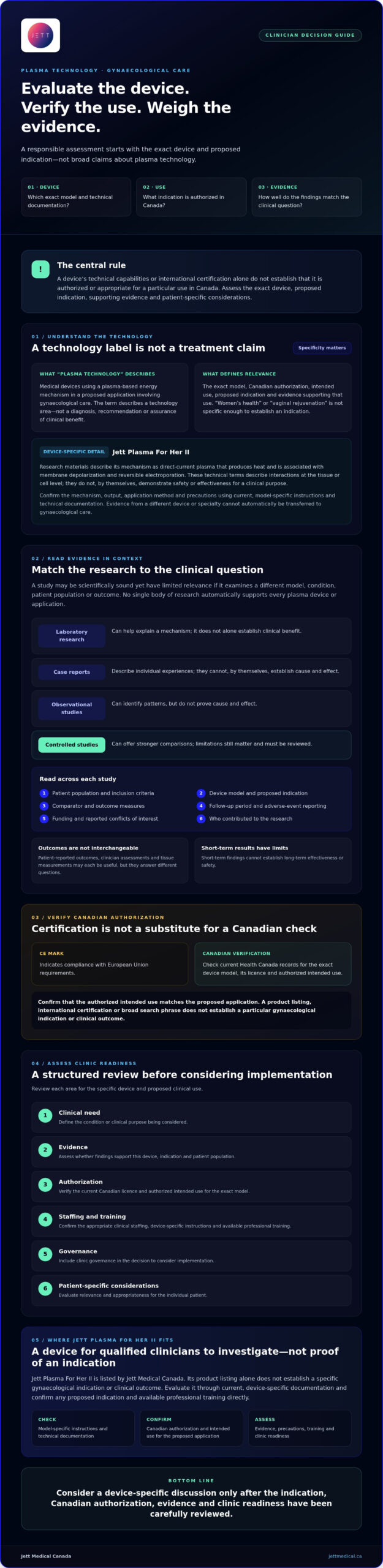
How can a clinic evaluate readiness for plasma technology?
Readiness involves more than acquiring a device. A clinic considering plasma technology for gynecological health should establish a clinical rationale, confirm device-specific authorization and evidence, and define who is accountable for safe implementation. Use this assessment to identify gaps before making a procurement or practice decision.
- 1. Define the clinical need. Specify the patient group and clinical question. Confirm that the proposed use addresses a recognized need and that other care options have been considered.
- 2. Review the evidence. Assess whether research matches the proposed indication, patient population and exact device. Document limitations and uncertainties rather than assuming findings transfer across models or specialties.
- 3. Verify authorization. Check current Canadian records and compare the model’s authorized intended use with the clinic’s proposed application. The Health Canada licensed plasma device guide offers broader context for device verification.
- 4. Assign qualified staff. Identify the responsible clinician, confirm relevant scope-of-practice considerations, and determine who may operate the device and manage follow-up.
- 5. Confirm training and competency. Ask what training covers, who can participate, how competency is assessed, and whether support is specific to the model and consistent with its manufacturer instructions.
- 6. Establish governance. Define internal approval, documentation, patient communication, infection-prevention procedures, equipment maintenance and adverse-event escalation before implementation.
What operational requirements should a clinic assess?
Map the workflow from patient assessment through follow-up. Confirm that the clinical space, equipment handling and infection-prevention processes align with the manufacturer’s instructions. Decide what information will be recorded, who will review it, and how concerns or adverse events will be escalated. Patient selection and informed consent are clinician-led processes. Discussions should use verified information about the exact device, proposed use, evidence and uncertainties.
How should clinics evaluate training and support?
Request details on training content, eligibility, competency assessment and ongoing device-specific support. Jett Medical Canada reports providing training and support to medical professionals, but clinics should confirm the current programme scope and availability directly. For wider procurement considerations, consult the professional plasma device guide.
If key details remain unclear, pause the readiness review and seek model-specific documentation before proceeding. Qualified clinicians can request device-specific information to support their evaluation.
How does Jett Plasma For Her II fit a clinician’s evaluation?
Jett Plasma For Her II is a device listed by Jett Medical Canada. Its name alone doesn’t establish a specific Canadian gynaecological indication, clinical benefit or suitable use. For clinicians assessing plasma technology for gynecological health, it’s a product to investigate through current, model-specific documentation, then compare with the clinic’s needs, evidence review and authorization checks.
Start by requesting information that identifies the exact device and clarifies what the manufacturer intends it to do. Review the documents as a set, since a product description, study, training outline or certification may each address a different question. If a document refers to another model or a broader application, ask whether it applies to the device and proposed use under consideration.
What product information should clinicians request?
Ask the distributor for current materials and seek clarification wherever the model, intended use or evidence isn’t clear. A focused request can include:
- Device identification: manufacturer, exact model name and current specifications.
- Canadian status: applicable licence details and documentation identifying the authorized intended use for that model.
- Clinical evidence: studies involving the exact device and proposed indication, including study limitations and reported adverse events.
- Instructions and safety: current instructions for use, contraindications, warnings and maintenance requirements.
- Training and support: programme scope, eligibility, competency assessment, ongoing support and how technical questions are handled.
Jett Medical Canada reports providing training and support to medical professionals. Confirm the current programme details directly, and assess whether training addresses the specific model and aligns with its manufacturer instructions. Training information can inform implementation planning, but it doesn’t replace evidence appraisal or confirmation of authorization.
What is the next step for interested Canadian clinics?
Have qualified clinical and regulatory leads review the documentation before considering adoption. They can compare the verified intended use and evidence with the clinic’s clinical need, staffing, training capacity and governance requirements. If a key document or answer is unavailable, record the gap and resolve it before making a decision.
For broader professional procurement context, see the Canadian clinical guide to professional plasma devices. Qualified clinicians seeking device-specific information can request professional information from Jett Medical Canada for review. This is an information-gathering step, not a commitment to purchase or use the device.
Make the Next Step an Informed One
Responsible evaluation of plasma technology for gynecological health starts with a specific clinical question, then follows the evidence and authorization for the exact device and intended use. A technology label or international certification alone can’t establish that a model is appropriate for a proposed application in Canada. Clinics should also confirm staffing, training, patient communication and governance requirements before considering implementation.
Jett Medical Canada lists Jett Plasma For Her II among its professional device offerings and reports providing training and support to doctors and nurses. The company identifies its devices as Health Canada licensed and internationally certified. For a gynaecological application, verify the exact device’s current licence details, authorized intended use, relevant evidence and training scope before drawing conclusions.
Qualified clinicians can request professional information from Jett Medical Canada to support a device-specific review. A measured, evidence-led assessment helps clinics ask better questions and make decisions centred on patient safety and appropriate care.
Frequently Asked Questions
What is plasma technology for gynecological health?
Plasma technology for gynecological health refers to medical devices that use a plasma-based energy mechanism in a proposed gynaecological application. The term describes a technology area, not a diagnosis or proof of treatment benefit. Mechanisms and intended uses vary by device. Clinicians should assess the exact model, its manufacturer instructions, Canadian authorization, proposed indication and relevant clinical evidence before considering its use.
Is plasma technology approved for gynecological treatments in Canada?
There is no blanket Canadian authorization for every plasma device or gynaecological use. Health Canada licensing and intended use must be checked for the exact model in current official records. Jett Medical Canada identifies its devices as Health Canada licensed. Clinicians should independently verify the current status and authorized use for the specific model and application.
Can plasma technology treat specific gynecological conditions?
Whether a device can be used for a specific condition depends on its authorized intended use and evidence for that exact application. A broad label such as “women’s health” doesn’t establish an indication, and evidence from another device or medical specialty can’t automatically be applied. Clinicians should check device labelling, relevant clinical studies and current professional guidance before discussing a potential application with patients.
How should clinicians evaluate evidence for plasma applications?
Match each study to the proposed indication, device model and patient population. Review its design, sample size, inclusion criteria, comparator, outcomes, follow-up and adverse-event reporting. Laboratory findings, case reports and observational studies answer different questions from controlled clinical trials. Also examine peer review, funding and author conflicts. If the device, population or use differs, document that limitation rather than treating the findings as directly applicable.
Is Jett Plasma For Her II indicated for a specific gynecological use?
The product listing alone doesn’t establish a specific Canadian gynaecological indication or clinical outcome for Jett Plasma For Her II. Clinicians should request current instructions for use and model-specific licence details, then verify the intended use in current Health Canada records before drawing conclusions.
What should a clinic verify before considering a plasma device?
Confirm the exact manufacturer and model, current Health Canada licence details, authorized intended use, device instructions, warnings and contraindications. Review evidence for the proposed indication, and establish who is qualified to operate the device, what training is available, and how maintenance, infection prevention, documentation, follow-up and adverse-event escalation will be managed. Qualified clinical and regulatory leads should review these details against clinic needs and governance processes.