
A signed consent form can document a decision without showing whether the patient understood the procedure. For clinics seeking patient consent forms for plasma therapy Canada, the form should support a clear, procedure-specific discussion, not function as a generic waiver.
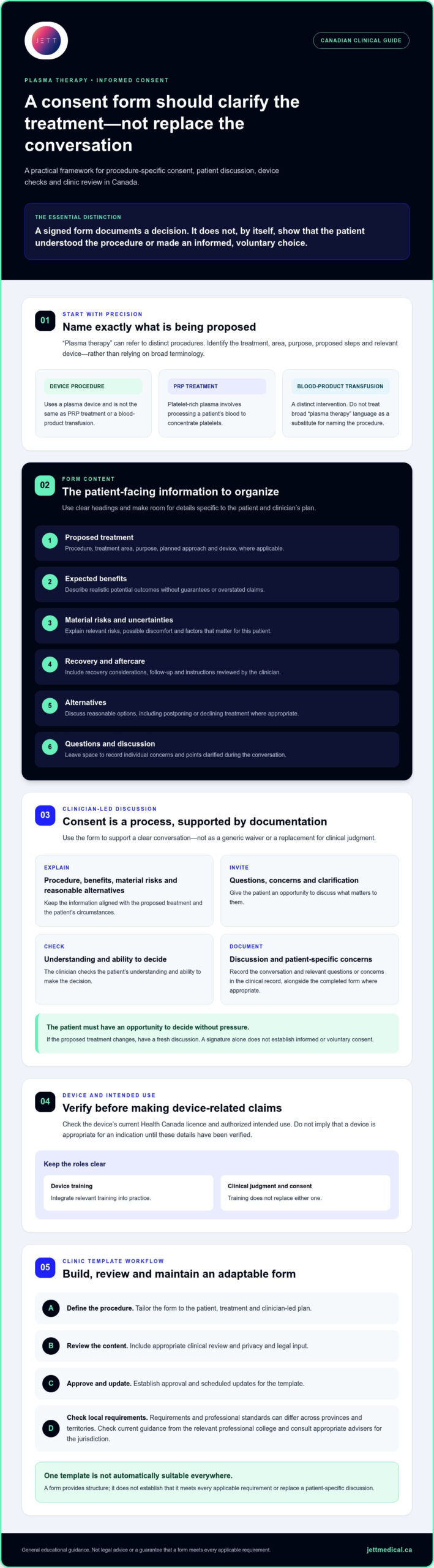
It’s reasonable to question what belongs in the form, especially when “plasma therapy” can refer to distinct procedures. A plasma device procedure is not the same as platelet-rich plasma (PRP) treatment or a blood-product transfusion. The form should identify the proposed treatment and relevant device rather than rely on broad terminology. Consent requirements and professional standards can also differ across provinces and territories.
This guide outlines an adaptable form structure for clinician review and a repeatable workflow for discussing benefits, material risks, alternatives, questions, and documentation. It also explains how to verify a device’s current Health Canada licence and authorized intended use, and why a signed form doesn’t replace a voluntary, informed conversation. Use it as a starting point for tailoring consent materials to the patient, procedure, and Canadian clinical setting.
Key Takeaways
- Use patient consent forms for plasma therapy Canada as procedure-specific discussion aids, then confirm local jurisdictional and professional requirements.
- Identify the treatment, area, purpose, and clinician-led plan clearly, and describe expected benefits without promising results.
- Compare generic, procedure-specific, and modular forms to choose a structure that reflects the proposed procedure and patient.
- Build a repeatable template workflow that includes clinical review, appropriate privacy and legal input, approval, and scheduled updates.
- Verify device details and authorized intended use, and integrate device training with, not in place of, clinical judgment and informed consent.
What Should Canadian Plasma Therapy Consent Forms Include?
A procedure-specific consent form is tailored to a defined treatment and records key information discussed with the patient, including its purpose, expected benefits, material risks, and alternatives. It supports informed decision-making, but a signature alone doesn’t establish that consent was informed, voluntary, or based on understanding.
For clinics developing patient consent forms for plasma therapy Canada, start by identifying the exact procedure and technology. “Plasma therapy” can describe different interventions. If the form doesn’t name the planned treatment, the patient may be unclear about what they’re agreeing to. Both the document and the discussion should reflect the intended procedure, the patient’s circumstances, and the clinician’s plan.
Consent requirements aren’t identical across Canada. They may depend on the province or territory, applicable professional standards, the procedure, and the clinical circumstances. Check current guidance from the relevant professional college and consult appropriate advisers for the jurisdiction. A template can provide structure, but it can’t establish that one form is suitable everywhere.
What does “plasma therapy” mean on a consent form?
Name the procedure, technology, treatment area, and proposed steps before drafting the form. A plasma device procedure and platelet-rich plasma (PRP) treatment are not interchangeable: PRP involves processing a patient’s blood to concentrate platelets, while a device procedure uses a different treatment approach. For general background, see this overview of Platelet-Rich Plasma (PRP). Don’t state or imply that a device is appropriate for a particular indication until its current Health Canada licence and authorized intended use have been verified.
Why is a signed form not the whole consent process?
Consent is a clinician-patient discussion supported by documentation. The clinician explains the proposed procedure, relevant benefits and risks, and reasonable alternatives; invites questions; and checks the patient’s understanding and ability to make the decision. The patient must have an opportunity to decide without pressure. Record the discussion and any patient-specific questions or concerns in the clinical record, alongside the completed form where appropriate.
A form helps organize information and document the conversation. It doesn’t replace clear communication, clinical judgment, or a fresh discussion if the proposed treatment changes. This is general educational guidance, not legal advice or a guarantee that a form meets every applicable requirement.
What Information Belongs in a Plasma Therapy Consent Form?
A useful form translates the clinician’s plan into information the patient can understand and consider. For clinics preparing patient consent forms for plasma therapy Canada, the content should match the actual procedure, the patient’s circumstances, and the device’s verified instructions for use. A template can prompt a consistent discussion, but the clinician must determine which details apply.
How should the form explain the proposed procedure?
State the procedure, treatment area, purpose, and planned approach. Identify the device when relevant, and describe what the patient may experience before, during, and after treatment in language that reflects the clinician’s plan. Check device information and authorized intended use before including claims about how the technology works or what it is authorized to do.
Use clear headings and leave space for patient-specific details. A practical structure for clinician review may include:
- Proposed treatment: procedure, area, purpose, and device, where applicable.
- Expected benefits: realistic potential outcomes, without guarantees or overstated claims.
- Risks and uncertainties: material risks, possible discomfort, and factors relevant to this patient.
- Recovery and aftercare: expected recovery considerations, follow-up, and instructions the clinician has reviewed.
- Alternatives: reasonable options, including postponing or declining treatment where appropriate.
- Questions and discussion: space to record individual concerns and points clarified during the conversation.
How should risks, alternatives, and expectations be presented?
Risks aren’t interchangeable across procedures or patients. The clinician should explain relevant risks and uncertainties in context rather than rely on a generic list. Describe expected benefits accurately and in line with available evidence and the device’s verified intended use. Avoid wording that suggests a particular result is assured.
Use plain language, readable headings, and short explanations. Define technical terms patients need to understand, and leave room to document questions, responses, and patient-specific discussion. The CMPA guide to consent offers Canadian physician guidance on consent principles and documentation. Clinics should also check relevant professional standards and jurisdictional requirements.
When reviewing a template, compare each statement with the planned procedure, current device information, and aftercare protocol. Device-specific training and support can help professionals understand the technology. Clinics can review professional plasma device information as part of that work. Training doesn’t replace clinical judgment or patient-specific consent.
How Should Clinics Compare Generic and Procedure-Specific Consent Forms?
A consent form should describe the treatment the patient is actually considering. “Plasma treatment” alone may not clarify whether the plan involves a plasma device or platelet-rich plasma (PRP), what area will be treated, or what the clinician proposes to do. For clinics assessing patient consent forms for plasma therapy Canada, the decision isn’t simply between a short and a long form. The important question is whether the document prompts the right discussion for the procedure and patient.
Each format has a different purpose and limitation:
| Form type | Useful for | Limitation to review |
|---|---|---|
| Generic clinic form | Capturing shared administrative or consent-process information. | Broad wording may not identify the procedure, treatment site, device, or relevant patient-specific points. |
| Procedure-specific form | Explaining a defined treatment, its plan, risks, alternatives, and expectations. | May become inaccurate if the protocol, device information, or intended use changes. |
| Modular clinic template | Combining stable clinic information with procedure-specific and patient-specific prompts. | Still needs clinician completion, review, and adaptation to applicable jurisdictional standards. |
When can a generic clinic consent form fall short?
A form that says only “plasma treatment” could leave the patient unsure about the proposed procedure. Broad language can also miss the specific treatment area or an individual concern. Review copied risk statements and benefit claims particularly carefully: they may not match the device, its verified intended use, or the clinic’s current protocol. This doesn’t automatically make a generic form invalid; it means a clinician should assess whether it supports an informed discussion.
PRP requires distinct consideration from plasma device procedures. Health Canada’s guidance on PRP treatments addresses PRP specifically. Don’t transfer its descriptions to a different procedure. Device details also require verification. Clinics can consult this Health Canada licensed plasma devices guide for device-status context, then confirm current licence information and authorized intended use.
What makes a modular template easier to adapt?
A modular format separates reusable clinic information from procedure and patient details. Include prompts for the proposed device, treatment area, plan, relevant risks, alternatives, and questions. The clinician can then complete the relevant sections instead of relying on broad language or duplicating whole forms. Review each module against current device information and local professional standards; no template is universally compliant across Canada.
More signatures don’t automatically create better understanding. Choose the form structure that helps the clinician explain the specific plan and document the patient’s discussion. Review it whenever practice protocols or relevant guidance changes.
How Can Canadian Clinics Build and Review a Plasma Consent Template?
A reliable template starts with a defined clinical use, then moves through drafting, review, approval, and controlled use. For clinics developing patient consent forms for plasma therapy Canada, a documented workflow helps keep patient-facing wording aligned with the procedure, device information, and applicable professional standards. It doesn’t make one template suitable for every clinic or jurisdiction.
What steps should a clinic follow before using a template?
Assign responsibility for drafting and approval, and keep a review record showing who checked the document and when. A practical workflow is:
- Define the procedure: Specify the clinical procedure, intended patient group, treatment setting, device, and proposed treatment plan.
- Draft patient-facing content: Use plain language and prompts that help the clinician explain the procedure, benefits, material risks, alternatives, expectations, and aftercare.
- Check source information: Compare device descriptions and intended use with current manufacturer documentation, and verify the device’s current Health Canada licence and authorized intended use.
- Review for the clinic: Ask appropriate clinical, privacy, and legal advisers to assess the template for the clinic’s practices and jurisdiction.
- Approve and control the document: Record the version date, reviewer, approver, and location of the current form. Remove or clearly archive superseded versions so staff can identify the approved copy.
- Use and reassess: Train relevant staff to use the form as part of a consent discussion, then review it on a planned schedule and whenever a change makes its content outdated.
Set review triggers as well as a scheduled review date. Triggers might include a change to the procedure, device documentation, clinic protocol, or relevant professional guidance. Device-specific training and support can help clinicians understand the technology, but the treating clinician remains responsible for clinical judgment and the patient discussion.
What should clinics review across Canadian jurisdictions?
Requirements and professional standards may vary by province or territory and by regulator. Before approving a form, identify where it will be used and check current authoritative guidance from the relevant professional college. Don’t assume a template reviewed for one setting is suitable in another. For broader context, see this Canadian medical device distribution guide.
Keep the review specific: confirm that the form reflects the clinic’s procedure and workflow, that privacy-related handling has been considered by an appropriate adviser, and that any jurisdiction-specific statements have been verified. For support with professional plasma technology implementation, explore device training and support.
How Should Consent Fit Into Plasma Device Training and Clinical Practice?
Consent is strongest when the clinician’s explanation matches the device and the clinic’s actual plan. For clinics using patient consent forms for plasma therapy Canada, device information, staff preparation, patient discussion, and documentation should work together. A form drafted from unverified or outdated details can create confusion, even if the clinic’s workflow is otherwise well organized.
How can device-specific information support patient understanding?
Use current device documentation to explain relevant features and the planned procedure in clear, patient-facing language. Check that the form’s descriptions match the device’s current Health Canada licence, authorized intended use, and the clinician’s plan. Don’t imply an indication or outcome that hasn’t been verified. The professional plasma pen guide for Canadian clinicians provides additional context about professional devices.
Training can help clinicians understand device operation and relevant documentation. It doesn’t replace clinical judgment, individual assessment, or the need to follow applicable local professional standards. The clinician should explain what the device means for the specific procedure, invite questions, and check the patient’s understanding rather than relying on technical descriptions alone.
What should clinics confirm before adopting a consent workflow?
Before introducing or revising a workflow, confirm the procedure being offered, which staff members explain and document consent, and what training they need for their roles. Set a process for checking device documentation and reviewing consent materials when protocols or relevant guidance change. Confirm local professional requirements with current authoritative sources and appropriate advisers.
After the discussion, document the procedure reviewed, the patient’s questions and the responses provided, the patient’s decision, and any agreed follow-up plan. The record should reflect the conversation that took place, not just that a form was signed. If the plan changes, revisit the discussion and update the documentation as appropriate.
Clinics assessing professional plasma technology can start by aligning device information, staff preparation, and consent-document review before implementation. Explore professional plasma device information as one resource for that planning.
Make Consent Part of a Strong Clinical Workflow
Effective patient consent forms for plasma therapy Canada are built around the specific procedure, device, patient, and clinical plan. They support a meaningful discussion of expected benefits, material risks, alternatives, questions, and follow-up, while clear documentation records what was discussed and decided.
A generic form may provide a starting structure, but it needs clinical review and adaptation to the relevant provincial or territorial standards. Keep device information current, confirm the specific device’s Health Canada licence and authorized intended use, and treat training as support for implementation, not a substitute for clinical judgment or informed discussion.
Jett Medical Canada supplies professional plasma devices to clinics nationally and provides training and support for doctors and nurses. Clinics assessing technology and implementation needs can explore Jett Medical Canada’s professional plasma technology. Verify the current status and intended use of any specific device before relying on those details in patient-facing materials.
A carefully reviewed form and a thoughtful conversation give patients a clearer basis for decision-making and help clinics build a more consistent consent process. To explore professional plasma devices, training, and support for your clinic, contact Jett Medical Canada.
Frequently Asked Questions
What should a patient consent form for plasma therapy include?
A plasma therapy consent form should identify the proposed procedure and treatment area, explain its purpose, and support discussion of relevant benefits, risks, alternatives, recovery expectations, and aftercare. Clinicians developing patient consent forms for plasma therapy Canada should tailor these details to the patient and treatment plan, with space to record questions and discussion. Have appropriate clinical and jurisdictional reviewers assess the form before use; a generic checklist can’t determine what information is material for every patient.
Is one plasma therapy consent form valid across all of Canada?
Don’t assume one template meets every Canadian clinic’s needs. Applicable legislation, professional standards, privacy practices, and clinical circumstances may differ by province or territory and practitioner. A shared framework can provide consistent prompts, but clinics should adapt it through appropriate clinical, regulatory, and legal review. Before introducing or revising a form, confirm current requirements for the jurisdiction and practice where it will be used.
Can a signed consent form replace a discussion with the patient?
No. A signature documents part of the process, but doesn’t by itself show that the patient received and understood relevant information or had an opportunity to ask questions. Consent should be a clinician-patient discussion supported by clear documentation. The clinician should address the planned procedure, relevant risks and alternatives, and patient-specific concerns. Follow the current professional standards and local requirements that apply to the practice.
What is the difference between plasma therapy and platelet-rich plasma therapy?
“Plasma therapy” can refer to different approaches, so the terms shouldn’t be used interchangeably in patient materials. Professional plasma devices use plasma technology, while platelet-rich plasma (PRP) treatment uses components of the patient’s blood. A consent form should name the actual procedure and explain it in patient-friendly language. Before preparing or presenting the form, verify the technology and, where relevant, the device’s current authorized intended use.
How often should a clinic review its plasma therapy consent form?
Set a documented review schedule, and review the form sooner if the procedure, device documentation, clinical protocol, professional guidance, or applicable requirements change. Assign responsibility for checking the current version and recording its approval. The appropriate review interval depends on the clinic’s governance process and relevant standards, so don’t assume one schedule fits every practice. Keep retired versions controlled so staff can identify and use the approved form.
Who should review a plasma therapy consent form before a clinic uses it?
Arrange review by people with relevant clinical and operational responsibility, and seek legal or regulatory advice where appropriate. Involve clinicians familiar with the procedure, and check that device descriptions match verified documentation and intended use. Reviewers should also consider privacy, recordkeeping, accessibility, and local professional standards. A device distributor may provide product information or training, but that support doesn’t replace independent clinic review or clinical judgment.