
What does “precision” mean when plasma technologies differ in how they deliver energy and interact with skin? For clinicians, precision plasma technology for dermatology is not a single treatment category, and evidence for one device or indication cannot automatically be applied to another. To assess claims of targeted treatment and clinical benefit, start with the specific technology and the evidence supporting its intended use.
This guide explains how precision is understood in dermatological practice and how plasma fibroblast approaches differ from cold plasma and platelet-rich plasma (PRP). It outlines practical ways to assess study design, device-specific findings and safety claims without generalizing beyond the evidence. It also covers considerations for Canadian clinicians, including intended indications, regulatory context, training and clinical judgement. Jett Medical Canada supplies professional plasma devices and provides training and support to medical professionals adopting plasma-based therapies.
Key Takeaways
- Assess precision plasma technology for dermatology as a clinical approach, not a promise of uniform results across devices or patients.
- Before comparing applications, distinguish systems by energy source, device design, treatment setting and intended indication.
- Evaluate research in context: match each finding to the device studied, indication, study design and reported outcomes.
- Structure clinician-led planning around the indication, patient factors and treatment goals instead of relying on a universal protocol.
- When evaluating a device for practice, review its intended use, relevant evidence, Health Canada licensing and training. Jett Medical Canada supplies professional plasma devices and provides training and support to medical professionals.
What precision plasma technology means in dermatology
Precision plasma technology for dermatology is a clinical approach in which a plasma-based device is selected and applied to address a defined tissue area for a specific indication. “Precision” describes the intention to control delivery and target the treatment area. It is not a standardised technology label, and it does not guarantee a particular result, safety profile or suitability for every patient.
The term needs context because plasma systems differ in their energy source, device design and intended use. Direct-current plasma, cold atmospheric plasma and platelet-rich plasma (PRP) are not interchangeable: PRP uses a component of a patient’s blood, while plasma devices use an energy-based system. The broad field of plasma medicine includes different sources and applications, so the shared word “plasma” does not establish that technologies work in the same way.
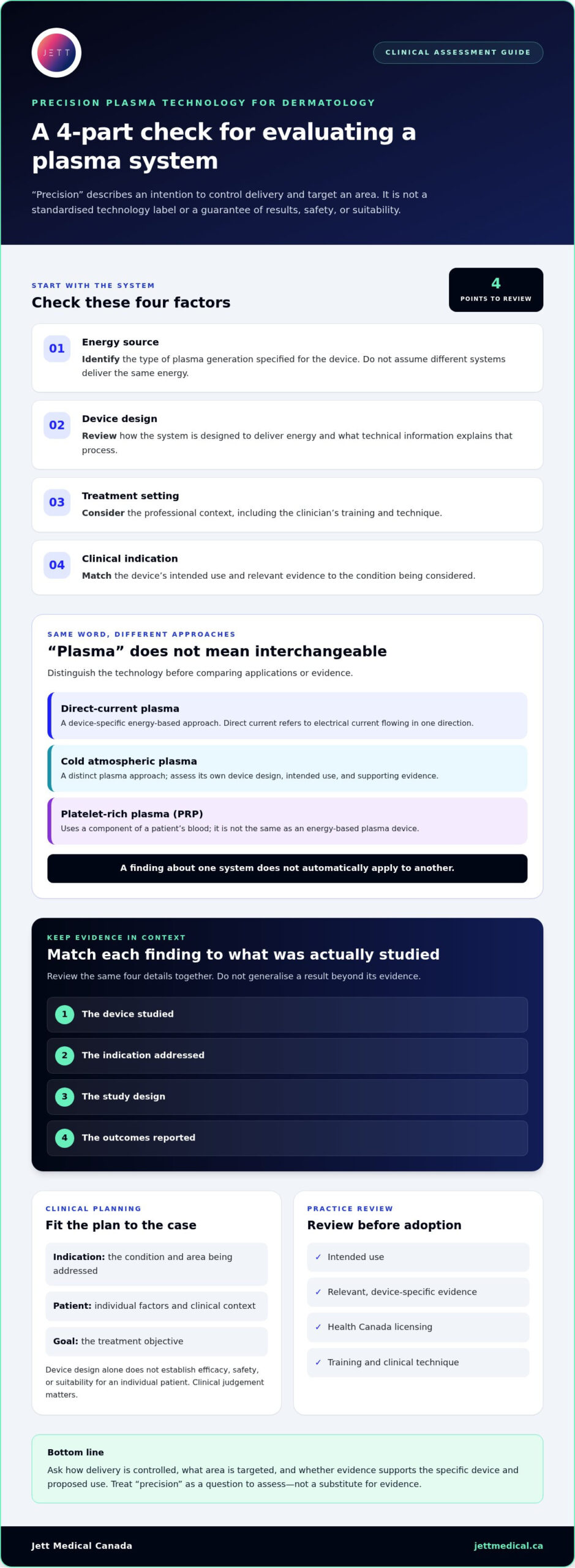
When comparing systems, assess four factors:
- Energy source: Identify the type of plasma generation specified for the device. Do not assume all systems deliver the same energy.
- Device design: Review how the system is designed to deliver energy and what technical information explains that process.
- Treatment setting: Consider the professional context, including the clinician’s training and technique.
- Clinical indication: Match the device’s intended use and relevant evidence to the condition being considered.
These distinctions make “precision” more useful in clinical evaluation. Instead of relying on a broad marketing term, clinicians can ask how delivery is controlled, what area is targeted and whether evidence supports the proposed use.
How clinicians should interpret the term precision
Precision can refer to how a device is designed to direct or control treatment at a selected area. That is only one part of clinical decision-making. Device design alone does not establish efficacy or safety for a particular indication, or determine whether a treatment is suitable for an individual patient.
Application also depends on clinician technique and patient factors. The area and condition being addressed, the treatment objective and the patient’s clinical context all matter. A device feature may support controlled delivery, but clinical judgement is needed to decide how it applies in practice.
Where plasma technology fits in dermatology
Evaluate dermatological applications indication by indication. Jett Medical Canada describes potential areas of interest including wrinkles, scars and pigmentation. These examples identify clinical contexts for assessment; they do not mean every plasma device is intended for all three, or that every patient is an appropriate candidate.
For each proposed use, distinguish the condition being addressed from the technology’s general description. Then assess the device, its intended indication and the applicable evidence together. This keeps the discussion focused on the clinical question rather than treating “precision” as a substitute for evidence or a treatment recommendation.
How plasma technology is applied to targeted dermatological tissue
Applying plasma to tissue involves more than generating an energy source. A device produces plasma according to its design, and the clinician uses its delivery method and treatment parameters to address a defined area. The mechanism, degree of control and intended clinical use depend on the specific system. Read technical descriptions alongside device-specific clinical evidence, rather than treating them as a universal explanation of what every plasma device does.
Jett Medical Canada’s professional devices use patented direct-current technology designed for precise treatment. Direct current refers to electrical current flowing in one direction. This technical characteristic identifies the system, but does not by itself establish a particular tissue response or clinical outcome. Settings and delivery details for one device should not be assumed to apply to another system.
From plasma generation to clinical application
At a high level, the process is: a device generates plasma, its design governs how that energy is delivered, and the clinician applies it in the context of the intended use. Treatment parameters are device-specific settings that shape delivery. They matter because controlled application depends on the system’s capabilities and how it is used, not on the word “plasma” alone.
For clinicians evaluating precision plasma technology for dermatology, two practical questions are whether technical information explains the device’s energy source and delivery, and whether clinical research addresses that same device and indication. This keeps mechanism claims within their evidentiary limits. A technical explanation describes how a system is designed to operate; clinical evidence is needed to assess outcomes for a defined use.
Why device and treatment context matter
Plasma systems are not interchangeable. Their energy sources, device designs, delivery methods and intended indications can differ. A finding about one system cannot automatically be applied to another, even if both are described as plasma-based or used in dermatology. The same caution applies to treatment approaches: a report on non-ablative treatment, meaning an approach described as not removing tissue, does not establish the performance of a different treatment method or device.
A report in Dermatology Times describes a separate plasma-based system and approach. Its procedural details belong to that study’s context and should not be turned into a general protocol for other technologies. Jett Medical Canada’s direct-current devices should be evaluated using their own technical information, intended use and applicable evidence. Clinicians can explore the distinctions in this direct-current and AC plasma comparison.
A device mechanism describes how a system is designed to deliver energy; it does not, on its own, prove a clinical outcome. Keeping those concepts separate helps distinguish technical claims from evidence about effectiveness and safety. Jett Medical Canada supplies professional plasma devices and provides training and support to medical professionals across Canada. Learn about its professional plasma technology when evaluating device design and clinical adoption.
What dermatology evidence can, and cannot, say about plasma precision
Assess evidence for plasma-based dermatological treatment at the level of the specific device and indication, not by the word “plasma.” A study’s design, participant group, treatment context, outcome measures and follow-up determine what its findings can support. For precision plasma technology for dermatology, a result reported for one system is not evidence that another device will produce the same outcome.
How to appraise plasma treatment studies
Start by matching the study to the proposed clinical use. Check whether it examines the same technology and device, and whether participants were treated for the same indication. Then review how the research was conducted: sample size, comparator, follow-up period, assessment method and adverse-event reporting all affect how confidently its findings can be interpreted.
Outcome measures also need context. Patient-reported satisfaction reflects participants’ experiences, while standardized clinical assessments use defined criteria to evaluate a treatment result. Neither measure should be mistaken for the other. Check whether outcomes were assessed consistently and whether the report explains how they were measured. A percentage without that context can sound more definitive than the evidence warrants.
Why published findings should not be overgeneralized
Dermatology Times describes a 2005 study of a different plasma-based system. The report involved eight patients receiving four full-face treatments about three weeks apart. It reports improvements in skin smoothness of 30-60%, tightness of 20-30%, and fine wrinkles of 10-50%. These figures apply only to that study and system. They must not be attributed to JETT devices or treated as expected results for other indications.
The small participant group limits how broadly the outcomes can be applied. The report summary also does not provide enough detail to establish every element of study quality, including the comparator and assessment methods. Interpret the figures cautiously rather than assuming they predict an individual patient’s response.
| Evidence example | Study population | Treatment context | Reported outcome | Key limitation |
|---|---|---|---|---|
| 2005 system, as reported by Dermatology Times | Eight patients | Four full-face treatments, about three weeks apart | Smoothness: 30-60%; tightness: 20-30%; fine wrinkles: 10-50% | Specific to the reported system and study; not transferable to JETT devices or other indications. |
| PMC page with no identifiable article details | Not identifiable | No study details available | No findings can be reliably stated | The available content does not identify an article or provide assessable evidence. |
The PMC page contains no identifiable study details, so it cannot support a clinical claim unless the underlying article is identified and reviewed. For a distinct regulatory perspective, consult the Health Canada licensed plasma devices guide. Licensing context and clinical evidence answer different questions; neither substitutes for the other.
How clinicians assess indications, patients, and treatment planning
Clinical planning for plasma-based dermatology is an individualized professional assessment, not a universal protocol. Begin with a defined concern, then consider the evidence, device-specific intended use, patient factors and treatment goals together. Candidacy and treatment decisions require qualified professional judgement; a technology’s general description is not enough to determine whether it is appropriate for a particular person.
Matching the clinical question to the evidence
First, identify the specific dermatological concern and the outcome being considered. Wrinkles, scars and pigmentation are distinct examples, not interchangeable indications. Evidence relevant to one concern may not apply to another. Compare the proposed use with the device documentation and studies that evaluate the same or relevant technology and indication. This keeps interest in precision plasma technology for dermatology focused on a clinical question that can be assessed.
Organize a planning discussion around four connected questions:
- Indication: What concern is being assessed, and what clinical objective is under consideration?
- Device and intended use: Does the device documentation address the proposed application?
- Evidence: What research supports that use, and what are its design and limitations?
- Patient and goals: How do individual clinical factors and the person’s expectations shape the discussion?
This framework prevents a study protocol from being treated as a general recommendation. It also keeps claims about a device tied to the use and evidence being evaluated, rather than extending them to different conditions or patients.
Planning around patient factors and expectations
Patient assessment should account for relevant history and individual clinical factors, considered by a qualified professional in the context of the indication and device. The aim is not to use a checklist as a substitute for judgement, but to understand the person’s circumstances and whether the proposed treatment objective is realistic based on the available information.
Informed consent is part of that conversation. Discuss the intended objective, the evidence and its limits, potential benefits and uncertainties, and any relevant risks described for the specific device and use. Avoid predicting a particular result. A clear discussion supports informed decisions without presenting a possibility as a promise.
Follow-up planning also belongs in the clinical conversation. The clinician can explain how progress or concerns will be reviewed in the context of the treatment plan, without assuming one schedule applies to every device or patient. For example, the treatment frequency reported in a study is part of that research context, not a default recommendation for other systems.
For background on professional fibroblast devices in Canada, the professional fibroblast device guide offers related technology context. Jett Medical Canada supplies professional plasma devices and provides training and support to medical professionals. Explore professional plasma devices and clinician training as part of assessing how device information and professional adoption fit your practice.
Evaluating precision plasma technology for a dermatology practice
Introducing plasma technology into a practice calls for a structured review, not a decision based on a broad technology label. When evaluating precision plasma technology for dermatology, review five connected areas: intended use, supporting evidence, device-specific licensing, professional training and fit with the practice’s clinical scope. This approach separates a technical feature from the evidence and operational considerations relevant to adoption.
- Intended use: Define the indication under consideration and compare it with the specific device’s documentation. Do not assume one system is suitable for every dermatological concern.
- Evidence: Review research for the device and indication, including study design, outcomes and limitations. Findings from a different system are not a substitute.
- Licensing and certifications: Jett Medical Canada’s products are Health Canada licensed and hold CE and MDSAP certifications. Review the current Health Canada licence and intended indication for the specific device. A licence or certification is not universal authorization for every use or proof of every clinical outcome.
- Training: Consider the knowledge and practical preparation needed for professional adoption, alongside device information and clinical judgement.
- Practice fit: Assess whether the device’s intended use, available evidence and training needs align with the practice’s patient population, clinical objectives and capacity to support responsible use.
These factors work together. A favourable feature in one area does not resolve questions in another. For example, evidence for a particular indication does not establish that the same use is appropriate for every patient or setting. Document the clinical question, the device being considered, the evidence reviewed and the training needed before making adoption decisions.
Professional technology and clinical implementation
Jett Medical Canada supplies professional plasma devices, including Jett Plasma Pen Medical and Jett Plasma Lift Medical. The company provides training and support for doctors and nurses adopting plasma-based therapies across Canada. This professional support can inform implementation alongside device-specific documentation and the clinical team’s own assessment; it does not replace clinician judgement or establish a guaranteed result.
For more device-focused context, the medical-grade plasma pen professional guide discusses professional technology and licensing considerations. Use that information as one part of a broader review, considering the specific device, intended indication and applicable evidence together.
A responsible next step for interested clinicians
Responsible adoption brings four elements into alignment: the device, its intended indication, relevant evidence and qualified clinical judgement. Jett Medical Canada connects professional plasma devices with training and support for medical professionals. Clinicians considering implementation can use the company’s device information and professional support as part of their evaluation.
Explore Jett Medical Canada’s professional plasma technology and support.
Make your next evaluation evidence-led
Turn interest into a focused clinical review. For precision plasma technology for dermatology, identify the indication your practice is considering, then assess the relevant device documentation, available evidence and training needs together. This keeps adoption grounded in the clinical question rather than broad claims about what plasma technology can do.
Jett Medical Canada supplies professional plasma devices and supports clinical adoption. Its products are Health Canada licensed and hold CE and MDSAP certifications. These credentials provide useful context, but they do not replace device-specific review of licensing, intended use and supporting evidence.
A thoughtful evaluation can help your team determine whether a technology aligns with its clinical objectives and practice capabilities, while keeping patient care and realistic expectations central. Explore Jett Medical Canada’s professional plasma technology and support for your practice.
Frequently Asked Questions
Is precision plasma technology the same as laser treatment?
No. Plasma-based devices and lasers are different technology categories, with distinct energy-generation and delivery methods. The word “precision” does not make them equivalent or establish that they produce the same tissue response. For a specific clinical question, compare the device’s technical information and evidence with those for the laser alternative. This helps clinicians assess the appropriate modality without assuming one can substitute for another.
Can precision plasma technology be used for every dermatological concern?
No. A device’s potential use depends on its specific design, intended indication and supporting evidence, as well as professional assessment of the concern. For example, evidence related to wrinkles should not automatically be treated as support for using a device for scars or pigmentation. The phrase precision plasma technology for dermatology describes a broad area, not a universal treatment option for every skin condition.
What does non-ablative plasma treatment mean?
Non-ablative generally describes an approach intended not to remove tissue. The term identifies a treatment context, but it does not fully describe a device’s mechanism, establish how it affects tissue or predict a clinical result. Interpret it alongside the specific device, treatment method, indication and study details. A report using non-ablative parameters should not be assumed to describe other plasma-based systems or approaches.
Does a study of one plasma device apply to other plasma technologies?
Not automatically. A study’s findings relate to the device, indication, treatment context and outcomes it actually evaluates. Before applying a result elsewhere, consider whether the other system has a comparable mechanism and intended use, and whether evidence supports that comparison. A percentage reported for one device is not a forecast for another device or an individual patient. Similar terminology alone does not establish clinical equivalence.
Is precision plasma technology suitable for every patient?
No single technology can be assumed suitable for everyone. A qualified clinician must consider the individual’s concern, relevant health history, clinical factors and treatment objectives in relation to the specific device and its intended use. The discussion should also address uncertainties and realistic expectations. General device information can inform that assessment, but it cannot determine personal candidacy or replace professional judgement.
What should clinicians review before introducing a plasma device into practice?
Review the device’s intended use and technical documentation, evidence for the proposed indication, current licensing information, available training and fit with your practice’s clinical scope. Consider how staff will communicate the treatment’s limits and document the clinical rationale and follow-up. For example, distinguish evidence for the intended use from research involving another device before discussing adoption or patient selection.
Does Health Canada licensing guarantee a particular treatment outcome?
No. Health Canada licensing does not guarantee that a device will produce a specific result for every patient or indication. Consider it in relation to the particular device and its licensed intended use, while clinical evidence and professional judgement inform decisions about application. Jett Medical Canada’s products are Health Canada licensed, but clinicians should review current device-specific licensing information rather than infer universal authorization or outcomes.