
What if two plasma devices list similar technical specifications but operate differently and serve distinct clinical purposes? That’s why professional medical plasma device specs need to be read in context, not compared as a set of numbers alone.
For Canadian clinicians, product pages can make that evaluation difficult: terminology varies, operating principles aren’t always clear, and intended use must be considered alongside regulatory status. A specification alone doesn’t establish whether a device is appropriate for a particular practice or authorized for sale in Canada.
This guide explains how to assess model-specific documentation by clinical purpose, plasma technology, technical output and Health Canada licensing, including how to use the Medical Devices Active Licence Listing for applicable devices. You’ll also learn how to distinguish professional medical equipment from consumer-oriented plasma pens, identify documentation for an informed comparison, and consider the training and support needed for clinical adoption. The aim is a clearer, evidence-informed way to evaluate devices for your practice.
Key Takeaways
- Read professional medical plasma device specs in the context of each model’s clinical purpose and supporting documentation.
- Compare energy modality, output controls, power, accessories and intended application, but don’t treat settings as equivalent without matching measurement context.
- Distinguish direct-current plasma from cold atmospheric plasma by operating principle and documented use, not headline figures alone.
- Use a step-by-step evaluation process to align clinical need, intended users, device documentation and workflow requirements.
- Explore how Jett Medical Canada’s professional plasma portfolio, training and support connect device evaluation with clinical practice.
Professional medical plasma device specs: why context matters
A product page may list output settings, accessories and clinical applications, but those details don’t tell the whole story. A specification is meaningful only when it’s tied to the exact model, its documented intended use and evidence supporting its stated capabilities. For a clinician, the task isn’t simply to compare feature lists. It’s to determine whether the device’s documented scope aligns with the practice’s clinical needs and users.
Professional medical plasma device specs are model-specific statements of a device’s documented technical capability, operating conditions and intended use. Use this as a practical starting point: each specification should be traceable to the model’s current official documentation, not inferred from a product category or a similar device.
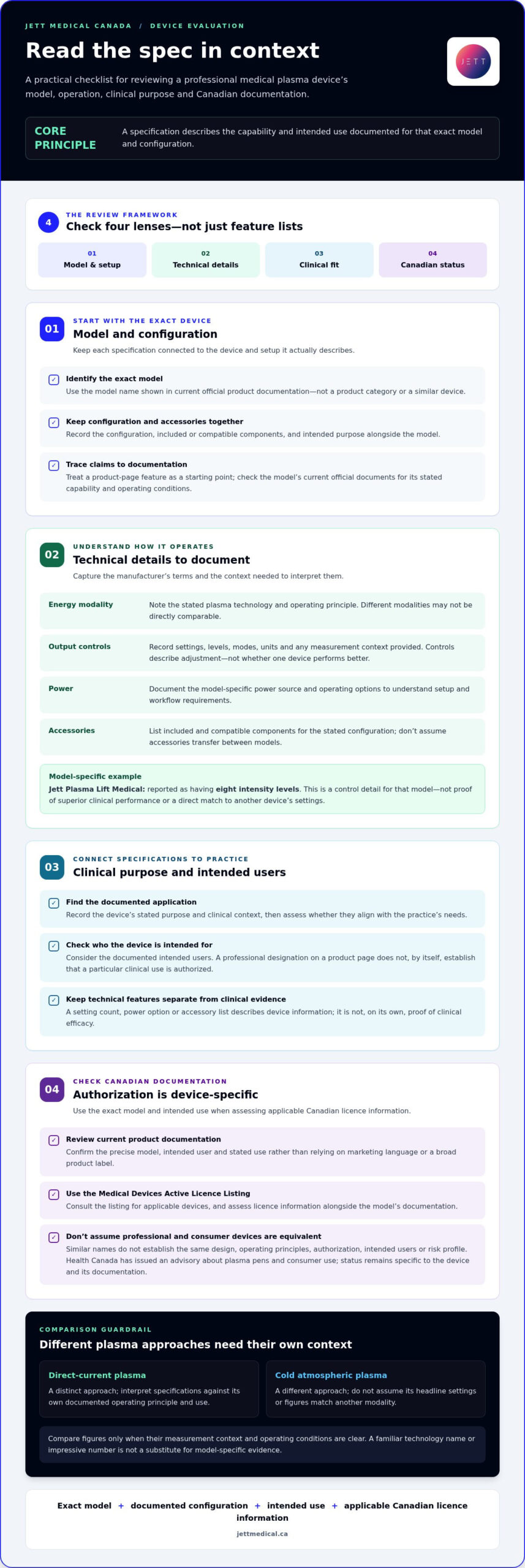
Organize the information into four categories: technical details, such as energy modality; operational details, such as controls and configuration; clinical details, including intended application and users; and regulatory documentation, including Canadian authorization where applicable. Together, these provide a more complete basis for evaluating a device.
What belongs in a professional plasma device specification?
Interpret every detail against the model and configuration it describes. Accessories can affect setup and use, while intended-use statements define the clinical context for a device’s documented capabilities. A feature presented without those boundaries may sound relevant but offer little basis for comparing clinical fit. Keep the model name, configuration, accessories and intended purpose together when reviewing specifications.
Why professional and consumer plasma devices are not equivalent
Similar names don’t establish equivalent design, authorization or intended users. Health Canada has issued an advisory about plasma pens and consumer use, while a 2022 update noted that certain devices had been authorized for healthcare professionals. The advisory shouldn’t be read as proof that every product called a plasma pen has the same regulatory status or risk profile. Authorization and intended use are specific to the device and its documentation.
For evaluation in Canada, look beyond marketing language. Identify the exact model and intended user, then examine its current product documentation and applicable Health Canada licence information. A professional designation on a product page isn’t, by itself, evidence that a particular clinical use is authorized. A consumer-oriented label also doesn’t establish that two devices share operating principles or limitations.
Technology names need context, too. Direct-current plasma and cold atmospheric plasma refer to different approaches, so a headline setting or feature from one device can’t automatically be compared with a figure from another. The overview of plasma medicine describes different plasma sources and mechanisms, offering scientific context for interpreting these terms. Assess each specification alongside the model’s documented purpose rather than treating a familiar name or impressive number as a substitute for evidence.
Which technical specifications matter in a medical plasma device?
A useful specification review groups technical details by what they tell you about device operation and clinical fit. Compare like with like, and record the exact model and configuration beside each detail. The table below provides a framework for extracting relevant information from official product documentation without treating a feature as proof of clinical efficacy.
| Specification category | What to document | Why it matters |
|---|---|---|
| Energy modality | The stated plasma technology and operating principle | Different modalities may not be directly comparable. |
| Output controls | Documented settings, levels, modes and any associated measurement context | Shows how operation is adjusted, not whether one device performs better. |
| Power | Model-specific power source and operating options | Helps assess setup and workflow requirements. |
| Accessories | Included and compatible components for the stated configuration | Clarifies what equipment is available for the documented setup. |
| Intended application | Documented purpose, clinical context and intended users | Allows the specification to be assessed against practice needs. |
Model-specific context matters because a specification describes only the capability and intended use documented for that exact device and configuration. Read a setting count, power option or accessory list alongside the relevant instructions and product documentation, not as a detail that can be transferred from one model to another.
Output, controls, and operating modes
Output parameters and controls describe how a device is designed to operate. Record the manufacturer’s terms, available settings and any units or conditions that explain them. For example, the Jett Plasma Lift Medical is reported as having eight intensity levels. That count is a model-specific control detail, not evidence of superior clinical performance or proof that its levels correspond to settings on another device.
Settings can’t be compared reliably unless the measurement method and operating conditions are equivalent. Keep technical data separate from clinical evidence: a feature describes a device, while evidence is needed to support claims about clinical outcomes.
Power, handpieces, and device configuration
Power source and supplied components can affect room setup, portability and how a device fits into an established workflow. The Jett Plasma Lift Medical is reported to offer internal battery and plug-in operation. Treat those options as specific to this model, not as features of the entire product family. For each comparison, note the exact configuration and the documentation identifying included accessories or handpieces.
Use this framework to organize model-level details before assessing clinical fit. Jett Medical Canada distributes professional plasma technology and provides training and support to medical professionals. Reviewing its professional plasma device information can help connect documented specifications with the technologies available for clinical practice.
How to compare plasma technologies and Canadian device credentials
A professional-sounding specification doesn’t establish that a device is authorized for sale in Canada or that its stated use matches your clinical need. Compare the operating principle, model-specific intended use and Canadian licence information as separate parts of the evaluation. Similar product names and headline figures aren’t substitutes for this evidence.
Direct-current plasma and cold atmospheric plasma
Direct-current plasma and cold atmospheric plasma are different technology categories. Jett Medical Canada’s portfolio includes direct-current plasma technology, while 4T Medical’s product page describes its own cold-plasma system. That product-specific description isn’t a universal standard for cold atmospheric plasma. For either category, use the relevant manufacturer documentation to understand the mechanism, operating conditions and intended clinical use.
Compare direct-current and cold atmospheric plasma by documented mechanism, intended use and measurement context, not by a headline specification alone. A number reported for one system may not describe the same parameter or conditions as a number reported for another.
| Comparison entry | Technology or scope | What to establish from current documentation |
|---|---|---|
| Direct-current plasma | A technology included in Jett Medical Canada’s portfolio | Confirm the specific model’s operating details and intended use. |
| Cold atmospheric plasma | A separate technology category; 4T Medical describes its own system | Use that system’s documentation, not its figures as a category-wide benchmark. |
| Jett Plasma Pen Medical, Jett Plasma Lift Medical, Jett Plasma Medical II, Edge EOM-P EVO, Jett Plasma For Her II and Edge O Tech | Named models in the Jett Medical Canada portfolio | Match each model to its own stated technology, intended users and intended use; don’t infer these from another model’s description. |
Jett Medical Canada’s portfolio is described for dermatology, ophthalmology, aesthetics and gynecological applications. That broad scope doesn’t assign an indication to each model. Use each model’s official documentation to determine its intended use rather than assuming every device serves every specialty.
Health Canada licensing, CE marking, and MDSAP
Check Canadian licence information for the exact device. Health Canada’s Medical Devices Active Licence Listing (MDALL) is the database for licensed Class II, III and IV medical devices. Search by device or company name, or by licence number, then compare the result with the model and intended use in its documentation. A professional label or technical specification alone doesn’t verify licence status.
Keep credentials distinct. A Health Canada medical device licence addresses Canadian authorization for the licensed device. CE marking and MDSAP relate to other regulatory or audit frameworks, and aren’t interchangeable with a Canadian licence. Jett Medical Canada’s products hold Health Canada licences and CE and MDSAP certifications, but the relevant model and use still require model-specific review. For additional Canadian context, consult this guide to Health Canada-licensed plasma devices.
A practical checklist for evaluating medical plasma device specs
A consistent review process helps turn product information into a decision that reflects clinical purpose, documentation and day-to-day practice. Follow the steps below and record the model and configuration you assess, so details stay connected to the device they describe.
- Define the clinical need. Note your specialty, clinical objective and intended patient population. Separate the need you’re addressing from the features emphasized on a product page.
- Match the intended use. Compare that need with the exact model’s documented intended use and instructions for use. Confirm that its intended users and clinical context align with your practice.
- Review the technical details. Record the stated energy modality, output controls, operating settings, power options and measurement context. Don’t use a feature or setting as a proxy for clinical efficacy.
- Check the configuration. Identify the model, included accessories and configuration differences that could affect setup or workflow. Use model-specific documentation rather than assumptions based on a related device.
- Review Canadian credentials. Match the device to its applicable Health Canada licence information and documented intended use. Keep Canadian authorization distinct from other certifications or markings.
- Assess implementation fit. Consider setup, staff training, operating workflow and the documentation clinicians need to use the device within its stated scope.
In brief: define the clinical need, match documented use, review specifications and credentials, then assess configuration and workflow fit. This sequence keeps professional medical plasma device specs connected to the decision they’re meant to inform.
Match the intended clinical use to the device documentation
Start with the practice’s specialty, objective and patient population, then compare them with the model-specific intended use and instructions for use. This helps distinguish a relevant clinical application from a broad specialty description that may not apply to every device. This professional plasma pen guide for Canadian clinicians offers additional context for evaluating professional technology and documentation.
Assess workflow, training, and ongoing support
Technical fit is only part of implementation. Consider how the documented setup, power options and accessories align with the clinic’s workflow, and what training staff need to understand operation and relevant documentation. Jett Medical Canada provides training and support to doctors and nurses adopting plasma-based therapies, connecting device evaluation with professional practice.
Once your evaluation criteria are clear, explore Jett Medical Canada’s professional plasma technology to consider how its portfolio aligns with your practice’s documented clinical needs.
Jett Medical Canada plasma devices: connect specifications to practice
Jett Medical Canada distributes professional plasma technology for medical practices, connecting specialized devices with clinical applications in dermatology, ophthalmology, aesthetics and gynecology. Its portfolio includes several named models, but a shared distributor or technology category doesn’t mean they have identical specifications, indications or regulatory status. Evaluate each device against its own current official documentation.
Professional medical plasma device specs are most useful when they answer a practical question: does this model’s documented capability and intended use align with the clinical application under consideration? A model-specific review keeps product features, clinical scope and Canadian credentials distinct, rather than relying on family names or broad specialty descriptions.
Explore the professional Jett Medical Canada portfolio
The portfolio includes Jett Plasma Pen Medical, Jett Plasma Lift Medical, Jett Plasma Medical II, Edge EOM-P EVO, Jett Plasma For Her II and Edge O Tech. These names identify devices to evaluate, not a basis for assuming that every model serves every specialty or shares the same operating details. Start with the model that aligns with your practice’s area of interest, then review its documentation for intended application and user.
For a focused comparison, record each model’s stated use, technology, controls, configuration and applicable Canadian licence information in separate fields. Confirm claimed features, certifications and indications against current official materials for that exact model. This avoids transferring a specification from one device to another and keeps the comparison clinically relevant.
- Clinical fit: Does the model’s documented intended use correspond to the practice’s application?
- Technical fit: Do the documented operating details and configuration support the clinical workflow being considered?
- Documentation: Do current model-specific materials support the stated indication and credentials?
Move from specification review to clinical implementation
Selection is one part of adoption. Consider how the device’s documented setup and operating workflow fit the practice, which clinicians will use it, and what information staff need to work within the manufacturer’s instructions. Training can help doctors and nurses understand the technology and its documented use; ongoing support can help orient implementation in a professional setting.
Jett Medical Canada provides training and support to doctors and nurses adopting plasma-based therapies. This support complements, but doesn’t replace, a clinician’s review of the model’s official documentation, Canadian licence information and intended scope. Together, these steps connect technical evaluation with informed implementation.
If you’re assessing professional plasma technology for your practice, connect with Jett Medical Canada to explore the portfolio and its professional training and support.
Turn your evaluation into a confident next step
Bring your clinical priorities and device documentation into the same conversation. Use your evaluation to identify which model-specific information will guide your decision, then consider how the device could fit your intended application and professional workflow. Clear questions at this stage can make the transition from comparison to implementation more focused.
Jett Medical Canada’s products hold Health Canada licences, CE and MDSAP certifications, and the company provides professional training and support for doctors and nurses. Review current model-specific materials alongside these resources to keep technical details, credentials and implementation considerations connected.
Use professional medical plasma device specs as a practical basis for discussion, not as isolated figures on a product page. A thoughtful evaluation can clarify the technology under consideration and the support that accompanies adoption.
Explore Jett Medical Canada’s professional plasma technology and take the next step toward an informed fit for your practice.
Frequently Asked Questions
Are professional plasma devices the same as consumer plasma pens?
No. A product’s name doesn’t establish its intended users, authorization or risk profile. Health Canada’s advice about plasma pens includes a 2022 update noting that certain devices have since been authorized for healthcare professionals. For a clinic, the practical distinction is the exact device and its documented intended user, not whether a product is casually described as a “plasma pen.” Don’t assume all devices with similar names share the same status.
Can one medical plasma device be used across multiple specialties?
Only if the device’s documentation supports the relevant uses. A clinic considering a device for more than one specialty should compare each proposed application with the model’s authorized intended use and instructions for use. A broad portfolio description covering dermatology, ophthalmology or aesthetics doesn’t establish that every model is intended for every specialty. Record each application separately so clinical protocols don’t extend beyond the device’s documented scope.
Does a higher number of intensity settings mean a better plasma device?
No. The number of settings indicates how many control levels are described, not whether a device is more effective or suitable for a particular clinical task. Two devices may have different setting counts but use different output definitions or operating conditions. Compare what each level represents in the model-specific documentation, then assess whether the controls fit the intended workflow. Don’t rank devices by setting count alone.
Does CE marking alone mean a plasma device is licensed in Canada?
No. CE marking isn’t a substitute for checking Canadian authorization. A clinic reviewing a device for use in Canada should identify the exact model and examine its Canadian licence information and documented intended use. Treat CE marking as a distinct credential, not proof of a Health Canada medical device licence. The same principle applies to other certifications: each has a defined scope and shouldn’t be used to imply another approval.
How can a clinic check a plasma device’s Canadian licence status?
Search Health Canada’s Medical Devices Active Licence Listing (MDALL) using the device name, company name or licence number, then compare the listing with the exact model under review. MDALL includes licensed Class II, III and IV medical devices. Class I devices don’t require a medical device licence, so their regulatory pathway differs. Keep a record of the search details and product documentation used to identify the model.
What specifications should clinicians compare when evaluating plasma devices?
Compare the details that affect the intended clinical task: energy modality, output controls and their measurement context, power options, accessories, configuration and intended users. For a multi-model review, create one row per exact model and note the document source beside each entry. This makes it easier to spot missing specifications or differences in how they’re defined, rather than treating similar wording as evidence that devices operate alike.
What does MDSAP certification tell a clinic about a medical device?
MDSAP relates to the medical device quality management system audit programme. It can provide information about the manufacturer’s audited quality system, but it doesn’t by itself establish that a particular device or clinical indication is licensed in Canada. Keep the certificate’s scope separate from model-level authorization. Identify the device and intended use, then review the relevant Canadian licence information where applicable.