
A blepharitis treatment medical device should be assessed by its indication and evidence, not by how advanced its mechanism sounds. Blepharitis can present in different ways and overlap with meibomian gland dysfunction (MGD), so a device suited to one clinical target may not address another.
For clinicians, the key question is which device, if any, fits an individual patient’s clinician-led care. This guide explains how device-based approaches may complement ongoing eyelid management and how to assess claims by mechanism, clinical evidence, patient suitability and regulatory indication.
We compare eyelid thermal treatment, intense pulsed light, lid exfoliation and direct-current plasma without treating these technologies as interchangeable. We also explain why a Health Canada licence and the device’s specific intended use matter in Canadian practice, and how to interpret limitations in the evidence. The goal is a practical framework for considering professional ophthalmic technology as one part of individualized care, not a replacement for clinical assessment.
Key Takeaways
- Start with the eyelid presentation and contributing factors. Blepharitis can involve different clinical targets and requires individual assessment.
- Compare a blepharitis treatment medical device by its intended use, anatomical target, mechanism and supporting evidence, not by technology category alone.
- Distinguish devices aimed at the eyelid margin from those addressing meibomian-gland function, tear-film concerns or the ocular surface.
- Use a structured appraisal: define the clinical need, review the device-specific Canadian indication and evidence, assess patient suitability, then plan follow-up.
- Consider direct-current plasma as a technology used in professional ophthalmic practice, but do not assume a device’s general licence establishes a blepharitis indication.
Blepharitis and medical devices: clarify the treatment question first
A device can only be evaluated meaningfully once the clinical problem is defined. Blepharitis describes inflammation at the eyelid margin, but it is not a single-cause diagnosis: the pattern, contributing factors and associated conditions can vary. Blepharitis is inflammation of the eyelid margin; meibomian gland dysfunction (MGD) is impaired function of the oil-producing glands within the eyelids. The conditions can coexist, but they are not interchangeable.
Symptoms such as irritation, burning, crusting or a gritty sensation need to be considered alongside examination findings. A general overview of Understanding Blepharitis can provide background, but it cannot establish a diagnosis or determine whether an intervention is suitable. That requires assessment by a qualified clinician, including consideration of other causes of similar symptoms.
What does blepharitis involve clinically?
Anterior blepharitis primarily affects the outer eyelid margin near the eyelashes, where redness, scaling or debris may be observed. Posterior blepharitis involves the inner margin and is often associated with MGD. These patterns can overlap, but they involve different structures and should not be treated as identical targets for care.
Clinical assessment considers symptoms, eyelid and ocular-surface signs, relevant history and possible differential diagnoses. MGD may contribute to inflammation or tear-film disturbance, but its presence does not explain every case of blepharitis. Identifying the likely pattern helps determine which management options are relevant and what outcomes to monitor.
What does “medical device treatment” mean in this context?
The phrase can refer to distinct roles. Some devices support clinical assessment or routine management; others deliver a therapeutic intervention. A device’s appearance, mechanism or broad technology category does not establish its role or show that it is appropriate for a particular presentation.
For a blepharitis treatment medical device, clinicians need to distinguish the proposed target from the documented intended use. Does the device-specific indication apply to the clinical problem? What evidence supports that use? Is the patient suitable? Professional judgement and the applicable standard of care remain central.
A practical first review keeps the decision focused:
- Define the target: Identify whether the concern is eyelid-margin inflammation, gland function, tear-film disturbance or another finding.
- Check the intended use: Review the device-specific indication and supporting evidence rather than inferring benefit from its technology alone.
- Assess fit and follow-up: Consider the patient’s findings, relevant alternatives and how response will be evaluated within clinician-led care.
This approach separates a plausible mechanism from a clinically supported use. It also treats devices as interventions to appraise, not diagnostic tools or universal solutions. The next step is to compare approaches by their intended clinical purpose and the evidence relevant to it.
How device mechanisms may relate to blepharitis care
Device discussions are clearer when organized around the clinical target rather than a marketing label. An intervention may act at the eyelid margin, address meibomian-gland function, support tear-film management or target another ocular-surface concern. These purposes can overlap in some patients, but they are not interchangeable. A proposed mechanism may explain why a device is being considered; by itself, it cannot show that the device improves a particular condition.
Match the proposed mechanism to the clinical target
Start with what the device is intended to do and where it acts. Lid-cleaning approaches, for example, target material on the eyelid margin. Thermal approaches may be designed to affect meibomian-gland secretions, while intense pulsed light (IPL) is discussed in relation to dry-eye care. The American Academy of Ophthalmology’s overview of Medical Devices for Blepharitis and Dry Eye illustrates why these categories need to be distinguished: relevance to dry eye does not automatically establish suitability for every blepharitis presentation.
Device relevance depends on its specific indication and supporting evidence. For a blepharitis treatment medical device, compare the documented intended use with the finding being addressed instead of inferring a match from the technology name. Direct-current plasma is another technology area for clinical evaluation in ophthalmic practice, but the mechanism alone does not establish a blepharitis-specific use. Device-specific documentation matters.
- Eyelid-margin target: Determine whether the proposed action concerns debris or other features at the lid margin.
- Meibomian-gland target: Establish whether the intended purpose relates to gland function rather than assuming it addresses inflammation generally.
- Tear-film or ocular-surface target: Distinguish symptom or surface-management objectives from treatment of an eyelid-margin condition.
Separate technology rationale from demonstrated outcomes
Evidence should be read in layers. Laboratory or mechanistic findings can support a biological rationale, but they do not prove clinical benefit. Manufacturer claims describe the company’s position and should be distinguished from independently conducted clinical research. A study’s relevance also depends on whether it evaluates the same device, indication and patient group under consideration.
When reviewing clinical evidence, note the study design, participant characteristics, comparator, measured outcomes and follow-up duration. Ask whether the outcome reflects a meaningful change in the target condition and whether the results apply to the patient group and clinical setting in question. Short follow-up, limited comparisons or a different diagnosis can leave important uncertainties.
Keep conclusions proportionate to the evidence. Results for a device used in dry-eye management should not be transferred automatically to blepharitis, or from one device to another because both use a similar technology. Where evidence is limited, identify the gap rather than filling it with assumptions based on mechanism. Clinicians evaluating professional plasma technology can review its intended clinical context alongside available training and support through professional plasma technology for clinics.
Compare blepharitis treatment devices using clinical evidence
A useful comparison starts with intended clinical use, not a ranking of technologies. Eyelid-cleaning devices, thermal approaches and intense pulsed light (IPL) differ in their targets and mechanisms, so evidence for one cannot establish effectiveness for another. Use the table as a framework for appraisal, then review device-specific indications and evidence before drawing conclusions.
| Device category | Intended target and mechanism | Evidence to examine | Regulatory indication |
|---|---|---|---|
| Eyelid cleaning or exfoliation | Eyelid margin; mechanical removal or cleaning, depending on the device | Look for clinical studies of the exact device and intended condition. A study of a particular deep-cleaning device, for example, should not be generalized to every lid-cleaning system. | Confirm the specific device’s Canadian licence and authorized intended use. |
| Thermal approaches | Often directed at meibomian-gland function through heat, sometimes with gland expression | Check whether participants had MGD, blepharitis or another defined diagnosis, and whether outcomes measured gland function or symptoms. | Verify the device-specific Canadian indication; a rationale related to MGD is not proof of a blepharitis indication. |
| Intense pulsed light | Used in some dry-eye management contexts; the proposed target and protocol are device-specific | Assess the study population, comparator, endpoints and follow-up. Dry-eye findings alone do not establish benefit for all blepharitis presentations. | Confirm Canadian authorization for the exact model and use being considered. |
| Direct-current plasma | Technology area for clinical evaluation; the target and mechanism must come from device-specific documentation | Separate clinical evidence for the device and indication from general mechanism claims. | Do not infer a blepharitis indication from a licence for another use. |
Which evidence matters when comparing devices?
Prioritize peer-reviewed clinical research that matches the exact device, intended indication and patient population. The Clinical Evidence for Blepharitis Treatment Devices link concerns a study of a deep-cleaning device. Interpret its methods and findings for that device and study population, not as evidence for an entire category.
Check whether outcomes measure symptoms, clinical signs, function or another defined endpoint. Study design, comparator and follow-up affect how confidently results can be applied. Small samples, brief follow-up or the absence of an appropriate comparator may limit interpretation. Keep laboratory rationale, clinical findings and manufacturer statements distinct.
How should regulatory status inform the comparison?
In Canada, Health Canada licensing is relevant to a device’s authorized use; it does not by itself establish comparative effectiveness for every clinical claim. CE marking relates to conformity within the European regulatory framework, while MDSAP is a quality-system audit programme, not proof that a device is clinically effective for blepharitis. These terms are not interchangeable.
Verify the exact device, licence and authorized intended use before discussing a treatment claim. For further Canadian regulatory context, consult the Health Canada licensed plasma devices reference guide. A sound comparison states both what the evidence supports and what remains uncertain, without ranking modalities where direct comparative evidence is lacking.
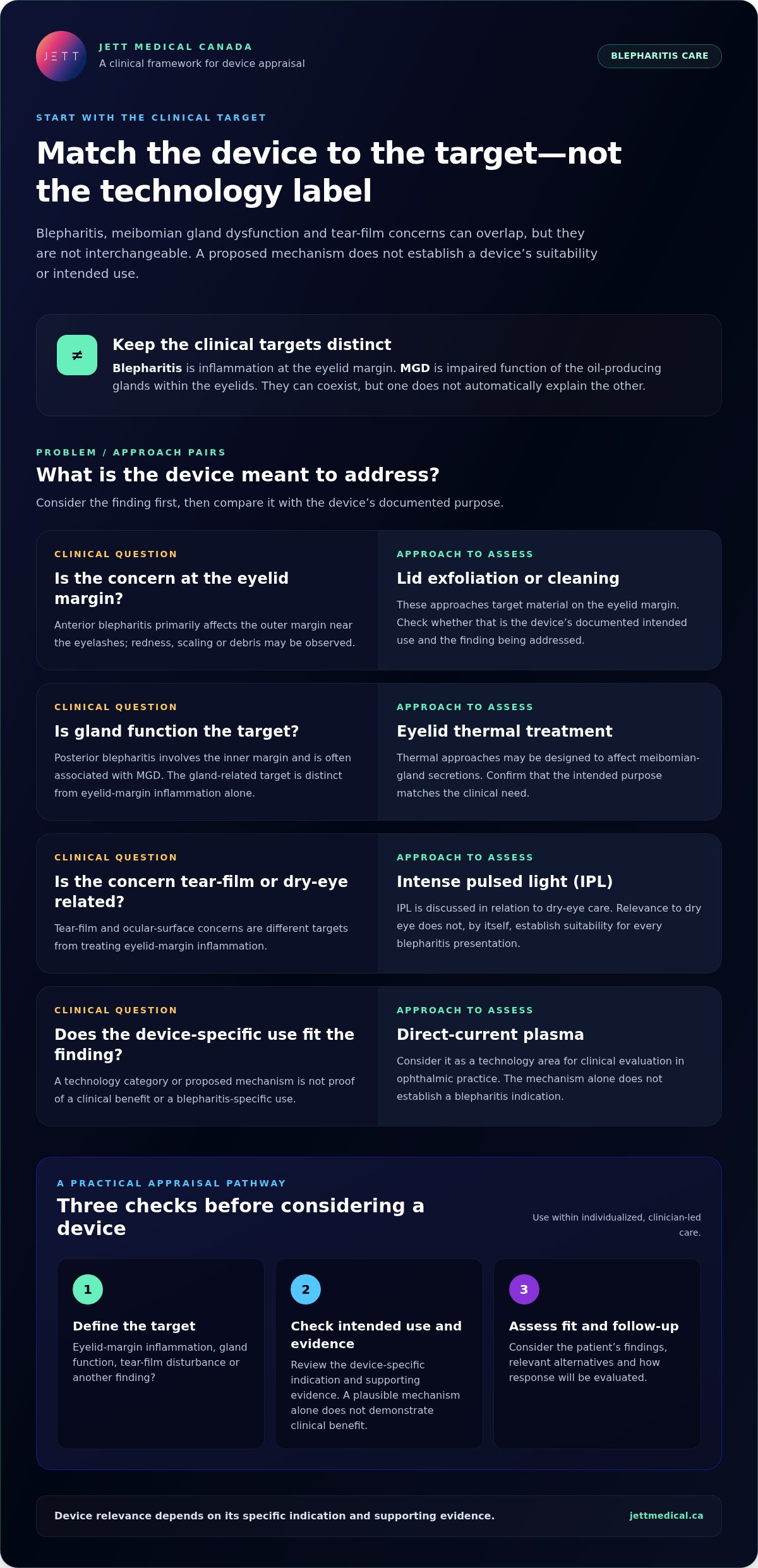
A practical clinical appraisal pathway for blepharitis devices
A structured appraisal helps clinical teams decide whether a device has a defined role in a patient’s care or whether another approach better fits the need. A qualified clinician should lead the process, grounding diagnosis and treatment decisions in the patient’s findings and relevant professional guidance. A device is a possible intervention, not a substitute for clinical judgement or established management.
A five-step device appraisal for clinical teams
- Define the presentation and unmet need. Record relevant symptoms and clinical findings, identify the target of care, and clarify what current management is not addressing. Do not select a device before the clinical question is clear.
- Verify the specific indication. Review documentation for the exact device and model, including its Health Canada licence and authorized intended use. A broad technology description or a licence for a different purpose does not establish suitability for blepharitis.
- Appraise evidence and guidance. Look for clinical studies that match the device, indication and intended patient population. Consider study design, outcomes, follow-up and limitations alongside current professional guidance relevant to the case.
- Assess suitability and implementation. Consider patient-specific factors, documented contraindications, potential risks and alternatives. Confirm that the clinical team has appropriate training and understands the device’s use within its intended scope.
- Plan consent and follow-up. Discuss expected benefits without promising outcomes, explain uncertainties, risks and alternatives, and obtain informed consent. Define in advance how response will be monitored and when the plan should be reassessed.
Integrate technology without overstating its role
This sequence creates a practical decision record: the clinical need, indication, evidence, suitability rationale and monitoring plan. It also helps distinguish a device that may complement care from one whose proposed use does not align with its documented indication. Decisions remain individualized, and device use should not displace other management appropriate to the patient.
For context on a related but distinct area, Jett Medical’s ophthalmic plasma technology guide for dry eye discusses technology in relation to dry-eye practice. Dry eye and blepharitis may overlap, but that context is not interchangeable evidence or confirmation of a blepharitis-specific indication.
Jett Medical Canada supplies professional plasma technology for clinics and provides training and support to doctors and nurses adopting plasma-based therapies. Explore Jett Medical’s professional ophthalmic technology as part of a clinician-led review of device documentation and clinical fit.
Jett Medical’s professional plasma technology in ophthalmic practice
Jett Medical Canada distributes professional plasma technology to medical clinics across Canada, including for ophthalmic practice. Its devices use direct-current plasma, a technology clinicians can assess by reviewing the specific device’s documentation, intended use and supporting evidence. The technology itself does not establish that a device is appropriate for blepharitis or effective for a particular presentation.
Where direct-current plasma fits in the discussion
In a clinical appraisal, separate the general technology from the device-specific clinical claim. Confirm what the device is designed and authorised to do, which patient group and condition its intended use covers, and whether clinical research evaluates that same device for that use. Consider ophthalmic applications within their documented scope. Do not extend them to blepharitis without an applicable indication and evidence.
This distinction is central when evaluating a blepharitis treatment medical device. A proposed mechanism may provide a rationale for further study, but it cannot replace evidence of clinical outcomes or confirm that a device’s licence covers the intended treatment. Jett Medical Canada’s professional plasma pen guide for Canadian clinicians offers broader context on professional plasma devices; it is not proof of a blepharitis-specific indication.
Professional adoption, training, and next steps
Jett Medical Canada’s products are Health Canada licensed and hold CE and MDSAP certifications. These credentials have different scopes and should not be treated as interchangeable evidence of effectiveness. A company-wide credential or general statement about product licensing does not establish the authorised use of every individual device. For a blepharitis-related claim, review the exact device’s Canadian licence and indicated use.
Doctors and nurses adopting plasma-based therapies can access training and support through Jett Medical Canada. This support helps clinical teams understand device operation, while the treating clinician remains responsible for diagnosis, patient selection and care decisions. Before implementation, align the device’s authorised indication and evidence with practice protocols, consent processes, safety considerations and outcome monitoring.
For clinicians exploring professional ophthalmic technology, review device documentation alongside the clinical need, evidence and applicable practice guidance. Explore Jett Medical Canada’s professional plasma technology information and training support as part of a considered adoption process, not as a substitute for individualised clinical judgement.
Turn clinical appraisal into a confident next step
For a clinic, the next step is to make device evaluation part of a consistent decision process, not a response to a technology’s novelty. Define the clinical need, document why a proposed intervention fits that need, and set a clear plan for reviewing patient response. This gives the care team a practical basis for revisiting decisions as evidence and professional guidance evolve.
For any blepharitis treatment medical device, focus on the exact intended use and the evidence relevant to it. Where the indication or supporting data does not match the clinical question, restraint is part of responsible adoption. Where it does, a defined protocol can help clinicians introduce technology thoughtfully while preserving individualized care.
Jett Medical Canada supports doctors and nurses exploring professional plasma technology with information, training and clinical adoption support. Explore Jett Medical’s professional plasma technology to consider how device information and training may inform your clinic’s next steps.
Evidence-led evaluation connects innovation to patient-centred practice. With a clear clinical rationale, teams can move forward deliberately and continue refining care with confidence.
Frequently Asked Questions
Can a medical device treat blepharitis?
Some medical devices may have a therapeutic role when their specific authorized indication and clinical evidence support the proposed use. Consider a blepharitis treatment medical device only after a clinician identifies the relevant presentation and determines that the device’s intended use applies. For example, a device aimed at cleaning the eyelid margin should not automatically be assumed to address gland dysfunction or another cause of irritation.
Is plasma technology an established treatment for blepharitis?
Direct-current plasma is used in professional medical devices, including ophthalmic applications, but that alone does not establish it as a blepharitis treatment. The relevant question is whether the exact device has an authorized indication for blepharitis and clinical evidence supporting that use. Clinicians should distinguish broader ophthalmic applications from a blepharitis-specific claim and avoid assuming evidence for one condition applies to another.
How do clinicians evaluate a blepharitis treatment device?
Clinicians can begin by documenting the finding the device is intended to address, then compare that need with the device’s authorized use and evidence. They should also consider patient-specific risks, contraindications, operator training and available alternatives. Before use, define what a meaningful response would look like, such as a change in a relevant clinical sign or symptom, and how that response will be recorded and reviewed.
Does Health Canada licensing prove that a device is effective for blepharitis?
No. A Health Canada licence provides regulatory information about a particular device and its authorized use; by itself, it is not proof of comparative effectiveness or benefit for every condition. Clinicians should verify the exact device and indication, then assess clinical evidence for the intended patient group. A licence for another application should not be interpreted as authorization or evidence for blepharitis treatment.
Can one device approach suit every type of blepharitis?
No single approach can be assumed to suit every presentation. A patient with visible material at the eyelid margin may have a different clinical target from someone whose symptoms are associated with MGD or another ocular-surface issue. These findings can overlap, so clinicians need to match an intervention to the individual examination rather than select a device based only on a broad diagnosis.
What evidence should clinicians look for before considering a device?
Look for peer-reviewed studies evaluating the same device for the same intended condition and a comparable patient population. Review whether outcomes include clinically relevant signs, patient-reported symptoms, function and adverse events. A comparison with usual care or an appropriate control can help interpret results, and follow-up should be long enough to assess durability. Findings from a different device or diagnosis offer context, not direct proof.
Is direct-current plasma the same as other plasma technologies?
No. “Plasma technology” can describe devices with different electrical designs and operating characteristics, so the term alone does not identify how a particular device works or what it is intended to do. Jett Medical Canada’s technology uses patented direct-current plasma. For clinical appraisal, review the exact device documentation and evidence rather than transferring assumptions from another plasma system or application.