
The distinction between a legal medical device and an illicit ‘fibroblast’ pen isn’t just a matter of marketing; it’s a matter of federal compliance that carries significant liability for Canadian practitioners. You’ve likely encountered the confusion that arises when comparing international standards, such as FDA clearances, against the specific requirements of Health Canada. Selecting a professional plasma pen for dermatology clinic applications requires more than just an aesthetic eye. It demands a rigorous understanding of the Medical Device Single Audit Program (MDSAP) and the verification of active Class III licences to ensure patient safety and professional accountability.
You’re right to prioritize clinical efficacy and rigorous testing over the lower price points of grey market alternatives that lack scientific grounding. This guide provides a clear framework for navigating the 2026 regulatory landscape, ensuring your procurement process aligns with the latest Health Canada standards. You’ll gain a technical understanding of why patented direct current (DC) technology outperforms alternating current (AC) variants. We’ll also examine how to evaluate distributors to ensure they provide the clinical training and technical support necessary to integrate these sophisticated devices into your practice safely and effectively.
Key Takeaways
- Understand the mandatory role of Health Canada licensing and the Medical Device Single Audit Program (MDSAP) in maintaining clinical compliance and protecting your practice from liability.
- Learn why patented direct current (DC) technology is the superior choice for a plasma pen for dermatology clinic use, offering the precision required for delicate ophthalmic and dermatological procedures.
- Identify a framework for evaluating medical device distributors that prioritizes long-term clinical training and technical support over simple hardware acquisition.
- Distinguish between medical-grade innovations and unauthorized ‘fibroblast’ pens to ensure your equipment meets 2026 safety standards.
- Discover how the Jett Medical Canada portfolio, including the Jett Plasma Pen Medical and Edge O Tech, bridges the gap between global innovation and Canadian regulatory requirements.
The Landscape of Medical Aesthetic Device Distribution in Canada
The Canadian medical aesthetic market is undergoing a significant transformation in 2026. Clinicians are increasingly moving toward non-surgical precision tools that offer surgical-like results without the associated downtime. This shift is particularly evident when selecting a plasma pen for dermatology clinic use, as practitioners prioritize devices backed by rigorous clinical data. Professional clinics are actively distancing themselves from consumer-grade “fibroblast” pens. Health Canada continues to identify these unauthorized tools as hazardous, leading to a market-wide consolidation around licensed, medical-grade hardware.
Growth of the Canadian Aesthetic and Ophthalmic Markets
Demand for non-invasive interventions is rising, driven by an aging demographic seeking effective skin tightening and rejuvenation. Procedures such as non-surgical blepharoplasty and advanced dry-eye therapy are now at the forefront of clinical procurement. Modern plasma technology allows physicians and nurses to achieve high-precision results that were previously reserved for the operating theatre. This evolution in care is supported by the 2026 regulatory environment. Mandatory MDSAP certification ensures that only devices meeting the highest international quality standards enter the Canadian market, providing clinicians with the confidence to expand their service offerings.
The Strategic Role of the Specialized Distributor
A specialized distributor acts as a critical filter within the Canadian healthcare ecosystem. They don’t just supply hardware; they validate global innovations against local regulatory requirements. Choosing a partner with a national service scope is vital for long-term operational success. A distributor’s role extends beyond the initial sale to include the provision of specialized clinical training and ongoing technical support. This comprehensive approach ensures that the technology remains calibrated and that staff members are fully competent in its application.
Reliable distribution protects a clinic’s reputation by ensuring equipment meets the 2026 standards for safety and efficacy. There are several ways a specialized partner adds value:
- Regulatory Assurance: Every device must hold an active Health Canada Medical Device Licence (MDL). This protects the clinic’s liability insurance and professional standing.
- Technical Reliability: Localized maintenance and calibration services are essential to minimize clinical downtime and ensure consistent energy delivery.
- Product Authenticity: Distributors verify the provenance of their equipment, shielding clinics from the risks associated with grey-market devices that lack proper certification.
In a market where unauthorized devices are frequently marketed to unsuspecting professionals, a trusted distributor provides the necessary documentation to prove compliance. This relationship is foundational for any medical practice looking to integrate a high-performance plasma pen for dermatology clinic operations while maintaining the highest standards of patient-centric care.
Navigating Health Canada Licensing and MDSAP Compliance
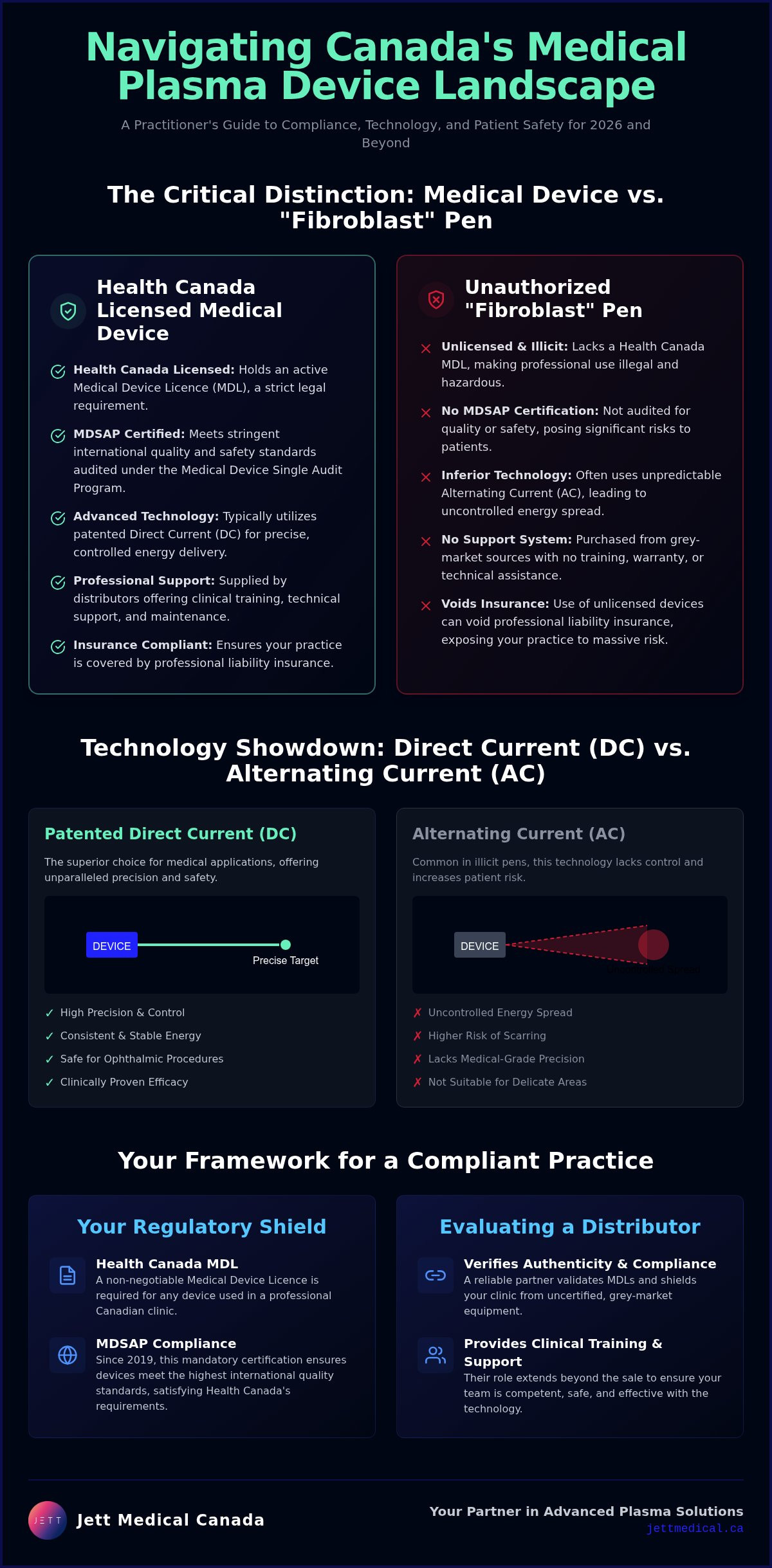
The Medical Device Single Audit Program (MDSAP) is a unified regulatory framework where a single audit of a manufacturer’s quality management system satisfies the requirements of multiple participating jurisdictions, including Health Canada. This program ensures that any plasma pen for dermatology clinic use meets stringent international standards before it reaches a Canadian practitioner. Since January 1, 2019, MDSAP certification has been a mandatory requirement for all manufacturers of Class II, III, and IV medical devices sold in Canada.
Legal compliance is not optional for Canadian medical professionals. A valid Health Canada Medical Device Licence (MDL) is a strict requirement for the professional use of aesthetic technologies. Operating unlicensed equipment exposes a practice to severe risks, including the denial of insurance claims and potential legal action. Most professional liability insurance providers in Canada require proof of a valid MDL to maintain coverage; using non-compliant hardware can result in an immediate insurance denial in the event of a patient complication.
Understanding the Medical Device Single Audit Program (MDSAP)
The MDSAP audit covers five major global markets: Canada, the United States, Australia, Brazil, and Japan. By satisfying the regulatory criteria of all five nations through a single, comprehensive audit process, manufacturers demonstrate an elite level of manufacturing consistency. For a clinician, this provides the assurance that their device is produced under the same rigorous quality control standards required for surgical-grade instruments. This prevents the variance in energy delivery often seen in cheaper, non-certified alternatives.
Health Canada Classification and Compliance
Medical devices in the aesthetic sector are categorized into four classes based on their risk profile. Most professional plasma devices are categorized as Class II or Class III. For example, high-precision tools like the Jett Plasma Lift Medical are registered as Class III devices (Licence #108642). This classification reflects a higher level of regulatory scrutiny than Class II devices, involving a more detailed review of safety and effectiveness data by Health Canada. Practitioners can verify the status of any prospective equipment through the Medical Devices Active Licence Listing (MDALL), which serves as the official federal database.
Consulting the Health Canada Licensed Plasma Devices: The 2026 Clinician’s Reference Guide is an essential step for any clinic owner. It helps distinguish between authorized medical hardware and the illegal ‘fibroblast’ pens often found on the grey market. If you’re looking to upgrade your clinical capabilities, selecting a partner like Jett Medical ensures your equipment is fully compliant with these evolving federal standards.
Differentiating Plasma Technologies for Diverse Clinical Specialties
Medical practitioners must recognize that not all plasma devices utilize the same underlying physics. While consumer-grade fibroblast pens typically rely on alternating current (AC), high-end medical devices utilize patented direct current (DC) technology. This distinction is vital for a plasma pen for dermatology clinic environment, where precision directly correlates with patient safety. AC devices often produce an unstable, flickering discharge that creates a larger thermal footprint, increasing the risk of collateral tissue damage. In contrast, DC technology generates a continuous, focused arc as narrow as 0.1 mm, allowing for surgical accuracy in delicate areas.
The Clinical Advantage of Direct Current (DC) Plasma
Direct current plasma is a more stable, precise energy source for medical applications. Because the discharge is constant rather than oscillating, clinicians maintain absolute control over the depth of penetration. This stability significantly reduces patient downtime and lowers the risk of post-inflammatory hyperpigmentation (PIH), a common concern in diverse Canadian patient populations. Beyond ablative treatments, medical-grade systems like the Jett Plasma Lift Medical utilize specialized gold and silver applicators for non-ablative procedures. These applicators facilitate elective treatments such as skin tightening and product infusion without causing epidermal trauma, expanding the clinic’s service portfolio.
Specialized Applications: From Dry Eye to Skin Laxity
The versatility of DC plasma extends far beyond traditional skin resurfacing. In the ophthalmic field, ophthalmic plasma technology for dry eye is revolutionizing optometry by offering a non-pharmacological solution for meibomian gland dysfunction. Devices like the Edge O Tech allow specialists to treat complex conditions including conjunctivochalasis, blepharitis, and xanthelasma with minimal thermal spread to surrounding ocular structures. This level of control is essential when working within millimetres of the eye’s surface.
For dermatology clinics, this technology provides a reliable alternative to invasive surgery for deep wrinkle reduction and non-surgical blepharoplasty. The ability to treat the upper and lower eyelids safely is a significant advantage of the DC arc. The technology’s application in gynecology, through specialized devices like the Jett Plasma For Her II, further demonstrates its broad clinical utility. By investing in a high-precision plasma pen for dermatology clinic use, practitioners can address a wide spectrum of medical and aesthetic concerns with a single, MDSAP-approved platform that ensures consistent, repeatable outcomes.
Evaluating a Medical Device Distributor: A Framework for Clinic Owners
Procuring a plasma pen for dermatology clinic operations is a significant capital investment that extends beyond the initial hardware purchase. A clinic owner doesn’t just acquire a tool; they enter a multi-year partnership with a distributor. This relationship determines the practice’s ability to maintain safety standards, achieve consistent clinical outcomes, and realize a return on investment. It’s essential to evaluate a distributor’s history of research and development. Reliable partners provide access to peer-reviewed clinical trials and longitudinal studies that validate the efficacy of their technology in real-world medical settings.
Professional Training and Certification Requirements
Device-specific training isn’t a luxury; it’s a mandatory requirement for aesthetic nurses and physicians to ensure patient safety and professional liability coverage. A comprehensive training program must go beyond basic operation. It should encompass the underlying physics of plasma, advanced safety protocols, and contraindication management. Effective certification programs include a theoretical component followed by supervised, live-model practice to ensure the clinician can precisely control energy delivery in sensitive areas. For a deeper look at these requirements, consult Medical Grade Plasma Pen Canada: The Professional’s Guide to Licensed Technology.
Post-Sale Technical Support and Reliability
Clinical downtime represents a direct loss of revenue and can damage patient trust. When evaluating a distributor, prioritize those with a dedicated Canadian-based technical support team. Rapid response times are critical when hardware requires calibration or troubleshooting. A professional distributor should offer clear warranty terms and, ideally, a loaner device program to keep your clinic operational during repairs. The evolution of treatment protocols is also a key factor. As clinical research advances, your distributor should provide regular firmware updates and updated training modules to ensure your practice remains at the forefront of plasma technology.
A reliable distributor serves as a bridge between international innovation and local clinical excellence. They should offer the following support structures:
- On-Site Calibration: Regular technical checks to ensure the direct current arc remains within therapeutic specifications.
- Marketing Support: Providing evidence-based collateral to help educate patients on the benefits of medical-grade plasma.
- Clinical Troubleshooting: Access to a medical director or senior clinical trainer for advice on complex cases.
Choosing the right partner ensures that your plasma pen for dermatology clinic remains a safe, effective, and profitable asset for years to come. To begin your evaluation of a professional-grade distribution partner, connect with the experts at Jett Medical Canada today.
Partnering with Jett Medical Canada for Advanced Plasma Solutions
Jett Medical Canada serves as the primary gateway for practitioners seeking to integrate world-class plasma solutions into their professional practices. By offering a refined portfolio that includes the Jett Plasma Pen Medical and the Edge O Tech, the organization ensures that Canadian clinics have access to the same high-precision technology used by leading specialists globally. Every device in the portfolio is selected for its ability to meet the rigorous safety and efficacy standards required by Health Canada. This provides a seamless transition from international innovation to local clinical application, ensuring that your plasma pen for dermatology clinic operations are both compliant and effective.
Patented Technology and International Recognition
The Jett Plasma Pen Medical is distinguished by its global footprint and extensive clinical validation. It’s recognized not only for its technical superiority but also for its ergonomic excellence, having received the prestigious Red Dot design award. For a specialist operating a device in a high-volume setting, this ergonomic focus translates into reduced practitioner fatigue and enhanced control during intricate treatments. The device’s design supports the steady delivery of the patented direct current arc, which is essential for maintaining the 0.1 mm precision required for ophthalmic and dermatological work.
Partnering with Jett Medical Canada also provides access to a global network of medical experts. This community facilitates the exchange of clinical data and peer-reviewed research, ensuring that your practice remains informed of the latest procedural advancements. This collective knowledge base acts as a secondary layer of validation, reinforcing the brand’s commitment to scientifically grounded results and patient-centric care. Clinicians benefit from shared protocols that have been refined through thousands of successful procedures worldwide.
Streamlined Procurement and Implementation
Acquiring medical-grade technology requires a partner who understands the specific needs of different clinical specialties. Jett Medical Canada simplifies this process by providing expert consultations to help clinic owners select the most appropriate hardware for their specific patient demographic. Whether your focus is on non-surgical blepharoplasty, dermatological lesion removal, or advanced ophthalmic care, the procurement process is designed to be transparent and efficient. This ensures that the plasma pen for dermatology clinic use you select aligns perfectly with your practice goals.
The “Jett Advantage” represents a holistic commitment to your practice’s long-term success. This framework combines patented DC technology with comprehensive clinical training and dedicated technical support. By integrating these elements, Jett Medical Canada ensures that the implementation of new technology is safe, efficient, and profitable. To ensure your practice meets the 2026 standards for medical aesthetics and ophthalmic care, Contact Jett Medical Canada to discuss your clinic technology needs and schedule a professional consultation.
Advancing Clinical Standards with Compliant Plasma Technology
Integrating advanced technology into a Canadian practice requires a strategic balance of innovation and regulatory adherence. By prioritizing Health Canada licensed devices and MDSAP certified manufacturers, you ensure your clinic remains protected against liability while delivering superior patient outcomes. The transition to patented direct current technology represents the modern standard for non-surgical precision, offering the stability required for a high-performance plasma pen for dermatology clinic environments. Selecting a distributor that provides comprehensive clinical training ensures that these sophisticated tools are utilized to their full therapeutic potential.
Success in the 2026 medical aesthetic market depends on the reliability of your equipment and the strength of your professional partnerships. Jett Medical Canada bridges the gap between international engineering and local clinical excellence, providing the support necessary to grow your practice safely and effectively. Partner with Jett Medical Canada for Health Canada licensed technology and take the next step in advancing your dermatological or ophthalmic offerings. We look forward to supporting your commitment to patient-centric results and technological excellence.
Frequently Asked Questions
What is the difference between a Health Canada licensed device and an FDA approved one?
Health Canada licensing is the only legal authorization for medical devices sold and used within Canada. While FDA clearance is a significant regulatory benchmark in the United States, it doesn’t grant legal status in the Canadian market. Every medical device must undergo a separate, rigorous review by Health Canada to obtain a Medical Device Licence (MDL). This ensures the hardware meets specific Canadian safety and efficacy standards before clinical use.
Is MDSAP certification mandatory for medical aesthetic device distribution in Canada?
Yes, the Medical Device Single Audit Program (MDSAP) is a mandatory requirement for manufacturers of Class II, III, and IV medical devices in Canada. This regulation has been in effect since January 1, 2019, replacing the previous conformity assessment system. MDSAP ensures that a manufacturer’s quality management system is audited to a high international standard, providing consistency across global markets including Australia, Brazil, Japan, and the USA.
Can aesthetic nurses in Canada operate medical-grade plasma pens?
Aesthetic nurses can operate a medical-grade plasma pen for dermatology clinic use, provided they follow their provincial regulatory college’s guidelines. In most provinces, this involves working under the direction of a medical director and completing specialized clinical training. Because plasma technology involves controlled tissue injury, practitioners must demonstrate competence in energy delivery, wound healing, and complication management to ensure patient safety and maintain professional liability insurance.
Why is Direct Current (DC) plasma considered safer for ophthalmic procedures?
Direct current (DC) plasma is considered safer for ophthalmic procedures because it produces a continuous, stable arc with minimal thermal spread. Unlike alternating current (AC) devices that flicker and create irregular heat patterns, DC technology allows for a focused discharge as narrow as 0.1 mm. This precision is vital when treating delicate areas like the eyelid or the ocular surface, as it prevents collateral damage to surrounding sensitive tissues.
How do I verify if a medical device distributor is authorized in Canada?
You can verify authorization by searching the Medical Devices Active Licence Listing (MDALL) on the Health Canada website. This database lists every Class II, III, and IV device licensed for sale in Canada. A reputable distributor should provide the specific license number for their hardware upon request. Additionally, you can check if the distributor holds a Medical Device Establishment Licence (MDEL), which is required for companies that import or distribute medical devices.
What training is required to use the Jett Plasma Pen Medical?
Using the Jett Plasma Pen Medical requires a multi-faceted training program that covers both theoretical and practical components. Clinicians must complete modules on the physics of direct current plasma, patient selection, and safety protocols. Practical training involves supervised sessions with live models to ensure the practitioner can manage energy settings effectively for various skin types. This rigorous certification process is essential for achieving consistent results and minimizing the risk of adverse events.
Does Health Canada license consumer-grade plasma pens for home use?
Health Canada doesn’t license consumer-grade plasma pens for home use and has issued multiple public safety warnings regarding these unauthorized tools. Often marketed as ‘fibroblast’ pens, these devices haven’t been evaluated for safety, quality, or effectiveness. They carry significant risks, including permanent scarring, skin discolouration, and infection. Only medical-grade devices used by trained healthcare professionals are legal and authorized for use within the Canadian aesthetic and medical markets.
What are the common clinical applications for plasma technology in 2026?
In 2026, plasma technology is utilized for a broad range of clinical applications beyond simple aesthetic skin tightening. Common procedures include non-surgical blepharoplasty, the removal of benign skin lesions, and the treatment of meibomian gland dysfunction for dry eye disease. Specialists also use a plasma pen for dermatology clinic treatments involving deep wrinkle reduction, scar revision, and pigmentation correction. The versatility of the technology allows it to be a foundational tool in dermatology and ophthalmology.