
What does “plasma” mean in ophthalmology: a blood-derived therapy, an ionized gas, or a device-based treatment? The distinction matters. Plasma technology for ophthalmology covers different mechanisms, and the label alone does not explain how a technology works or what evidence supports a particular use.
That range can make it difficult to assess clinical relevance, patient suitability and safety. This article distinguishes blood plasma approaches from ionized-gas technologies, including direct-current plasma and cold atmospheric plasma, then considers where each is studied or used. It also explains why evidence should be assessed for each indication rather than generalized across technologies.
You’ll learn key terminology, review applications such as blepharitis, meibomian gland dysfunction, trichiasis and conjunctivochalasis, and consider practical steps for responsible clinical integration. These include reviewing a device’s regulatory status in Canada, planning appropriate training and weighing the available evidence against each patient’s circumstances. Jett Medical Canada supplies professional devices using direct-current plasma technology and provides training and support for doctors and nurses adopting plasma-based therapies.
Key Takeaways
- Assess plasma technology for ophthalmology by matching its mechanism and intended tissue interaction to a specific clinical objective.
- Interpret evidence by indication and modality. Findings about one plasma approach do not necessarily apply to another.
- Use a structured clinical assessment that considers the patient population, intended tissue, safety, evidence and training requirements.
- Distinguish Jett’s direct-current devices and listed ophthalmic applications from findings about cold atmospheric plasma or other research technologies.
- Jett Medical Canada supplies professional ophthalmic plasma devices and provides training and support for doctors and nurses adopting plasma-based therapies.
What plasma technology means in ophthalmology, and why the mechanism matters
In physics, plasma is an ionized gas containing charged particles, often described as the fourth state of matter. In medicine, the term can refer to technologies that generate or apply this gas, but it does not identify a particular device design, energy profile or clinical purpose. It is also distinct from blood plasma, the liquid component of blood used in separate therapies.
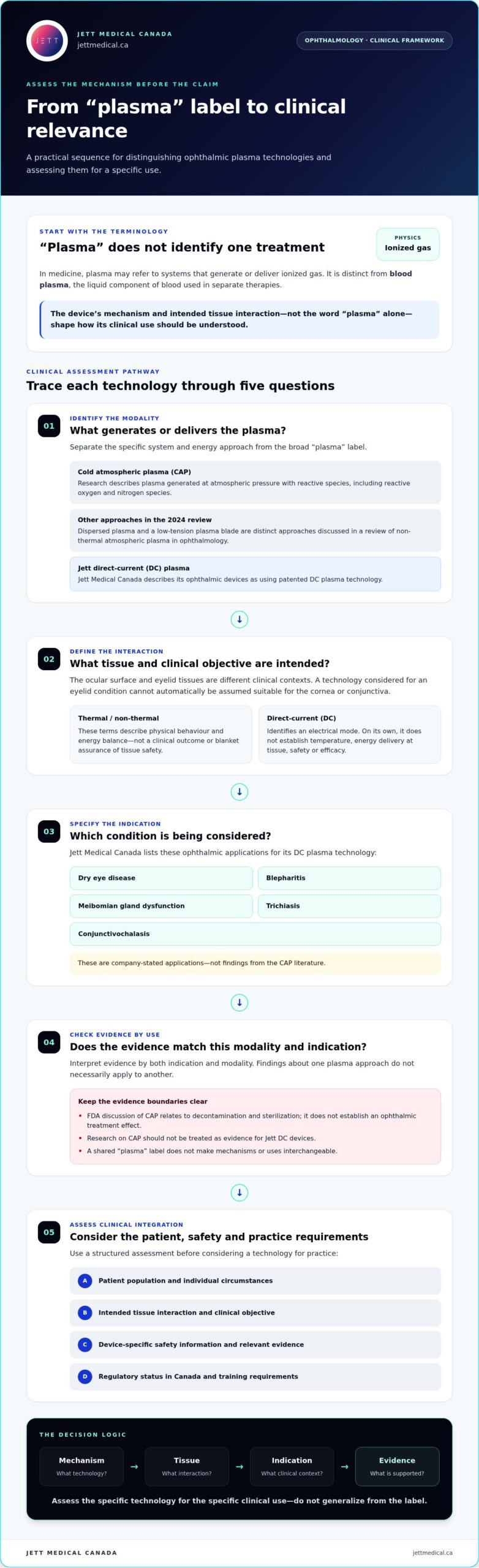
Extractable definition: Plasma is an ionized gas; a plasma medical device is a system that generates or delivers plasma for a defined purpose. The device’s mechanism and intended tissue interaction, not the word “plasma” alone, determine how its clinical use should be understood.
This distinction is central when evaluating plasma technology for ophthalmology. A broad description of plasma medicine may include disinfection, tissue effects or other research areas, but those topics do not establish that a particular device is intended for the eye or supported for a specific ophthalmic indication. The overview of Plasma Medicine provides wider context on the field. Clinical interpretation still requires attention to the individual modality and evidence.
How plasma becomes relevant to eye care
The ocular surface and eyelid tissues involve different clinical contexts. A technology considered for an eyelid condition cannot automatically be assumed suitable for the cornea or conjunctiva. Relevance depends on the intended tissue interaction, clinical objective and indication. This is why applications associated with one plasma system should not be transferred to another simply because both use the same broad term.
Thermal, non-thermal and direct-current terminology
Thermal plasma generally describes a state in which the gas and its constituent particles are at high, more closely aligned temperatures. Non-thermal plasma describes a different energy balance: energetic electrons can drive plasma chemistry while the bulk gas remains comparatively cooler. These labels describe physical behaviour, not a clinical outcome or a blanket assurance of tissue safety.
Direct-current (DC) plasma identifies the electrical mode used by a system. Jett Medical Canada describes its ophthalmic devices as using patented DC plasma technology. DC is not a synonym for all plasma, and the term alone does not establish a device’s temperature, energy delivery at tissue, safety profile or efficacy. Those characteristics need to be assessed using device-specific information and relevant clinical evidence.
For a practical comparison, keep three questions separate: what generates the plasma, what tissue interaction is intended, and what clinical indication has been studied or specified. Cold atmospheric plasma research, for example, should not be treated as evidence for Jett’s DC devices. The shared word identifies a broad technological field, not interchangeable mechanisms or uses.
This framework helps clinicians interpret claims precisely. A mechanism explains how a technology operates; an indication describes the clinical context in which it is used or studied; and evidence addresses what has been demonstrated for that use. Keeping these elements distinct supports careful assessment of emerging ophthalmic applications.
How ophthalmic plasma technologies work: distinguish the mechanism before the claim
Plasma systems should not be compared by name alone. Their energy source, delivery approach and intended interaction with tissue may differ, so a result reported for one modality does not establish performance for another. The 2024 review of non-thermal atmospheric plasma in ophthalmology discusses distinct approaches, including dispersed plasma and a low-tension plasma blade. These are approaches within the review’s scope, not interchangeable labels for every ophthalmic plasma device.
The comparison below separates the mechanisms and applications described in the available sources. It is a guide to interpreting claims, not a ranking of technologies.
- Cold atmospheric plasma (CAP): Research describes plasma generated at atmospheric pressure with reactive species, including reactive oxygen and nitrogen species. The U.S. FDA discusses CAP in relation to decontamination and sterilization. This context does not establish an ophthalmic treatment effect.
- Dispersed plasma and a low-tension plasma blade: These are approaches named in the 2024 review of non-thermal atmospheric plasma in ophthalmology. Their inclusion identifies modalities discussed, not evidence that their mechanisms or findings apply to other devices.
- Jett direct-current (DC) plasma: Jett Medical Canada describes its patented technology as direct-current plasma and lists ophthalmic applications including dry eye disease, blepharitis, meibomian gland dysfunction, trichiasis and conjunctivochalasis. These are company-stated applications, not findings from the CAP literature.
For background on the FDA’s discussion of CAP in the context of decontamination, see FDA on Cold Atmospheric Plasma. Read that reference within its stated scope, rather than as proof of effectiveness for a particular eye condition.
What non-thermal atmospheric plasma research describes
The 2024 review focuses on non-thermal atmospheric plasma and emerging ophthalmic applications. It names dispersed plasma and a low-tension plasma blade, illustrating that the literature covers more than one approach. Interpret each finding in relation to the modality and study examined. A review of CAP research can provide scientific context, but it does not validate Jett DC devices or establish their performance for a specific indication.
What to clarify about direct-current plasma
Jett Medical Canada identifies its patented system as DC plasma and lists the ophthalmic applications above. This information describes the technology and its stated application areas. It does not, by itself, provide treatment parameters, comparative device data or clinical outcomes. Those questions require device-specific documentation and evidence tied to the particular indication.
Modality-specific evidence matters because the mechanism, delivery approach, intended tissue interaction and study indication determine what a finding can support. Results from CAP research cannot be transferred to Jett DC devices without direct comparative evidence. This distinction helps clinicians assess claims without treating a shared “plasma” label as proof of shared performance. For information about Jett’s professional ophthalmic plasma devices, review the company’s device resources.
Ophthalmic plasma applications: assess each indication and its evidence separately
A list of possible applications is a starting point, not a single body of evidence. Dry eye disease, blepharitis and meibomian gland dysfunction (MGD) are related ocular-surface concerns, but they are distinct indications. Evidence about one condition, device or plasma modality does not establish efficacy for another. Clinical claims need to be specific to both the indication and the device studied.
The table separates applications identified by Jett Medical Canada from modalities discussed in the 2024 review of non-thermal atmospheric plasma. It does not imply that every row has the same evidence base or level of clinical validation.
| Indication or research area | Clinical context | Cited modality | Evidence caveat |
|---|---|---|---|
| Dry eye disease | An ocular-surface condition identified as a Jett application. | Jett Medical Canada’s direct-current plasma technology. | A listed application is not, by itself, proof of benefit. Assess evidence for this indication and device specifically. |
| Blepharitis | An eyelid-margin condition, distinct from dry eye disease and MGD. | Jett Medical Canada’s direct-current plasma technology. | Evidence about another condition or plasma modality cannot establish outcomes here. |
| Meibomian gland dysfunction | A disorder involving the meibomian glands, identified separately from blepharitis. | Jett Medical Canada’s direct-current plasma technology. | Interpret findings in relation to the specific device, patient population and indication. |
| Trichiasis and conjunctivochalasis | Two additional ophthalmic applications named by Jett Medical Canada. | Jett Medical Canada’s direct-current plasma technology. | The company’s application list does not substitute for indication-specific clinical evidence. |
| Dispersed plasma and low-tension plasma blade | Approaches discussed in the 2024 review of non-thermal atmospheric plasma in ophthalmology. | Non-thermal atmospheric plasma research. | Review findings belong to the modalities and studies examined, not automatically to Jett’s direct-current devices. |
Ocular surface and eyelid applications
Jett Medical Canada identifies dry eye disease, blepharitis and MGD as applications of its direct-current technology. These conditions may involve overlapping clinical concerns, but they should not be treated as interchangeable research categories. For a closer look at dry eye disease in this context, see the ophthalmic plasma dry eye guide. Interpret its condition-specific discussion in relation to the device and supporting evidence.
Other ophthalmic indications and evidence boundaries
Trichiasis and conjunctivochalasis are also identified by Jett Medical Canada as applications. Separately, the 2024 atmospheric-plasma review discusses non-thermal approaches, including dispersed plasma and a low-tension plasma blade. These sources describe different kinds of information: a company’s stated device applications and research on other modalities. Neither should be used to fill evidence gaps for the other.
For each claim, identify the exact indication, device and modality, then examine the supporting clinical source and the population studied. This keeps discussion of plasma technology for ophthalmology precise, especially where evidence is developing or device-specific findings are limited. It also prevents a broad application list from being mistaken for a promise of clinical outcome.
How clinicians can evaluate ophthalmic plasma for responsible practice integration
Responsible adoption starts with a defined clinical question, not a device category or broad list of possible uses. A structured review helps clinicians assess whether a particular system, indication and patient population align with the intended clinical objective. The steps below support professional evaluation; they are not patient-specific treatment advice or a procedural guide.
A practical clinical evaluation sequence
- Define the clinical need. Specify the indication, intended patient population, tissue of interest and clinical objective. An eyelid-related concern and an ocular-surface condition are distinct contexts, even if both appear in a device’s application information.
- Match evidence to the exact use. Review evidence for the specific device, plasma modality and indication under consideration. Note the study population, design and outcomes measured. Research on cold atmospheric plasma, for example, should not be treated as evidence for a direct-current device unless a source directly supports that comparison.
- Review the Canadian licence scope. Confirm the device’s current Health Canada licence information and the indication and conditions of use associated with that specific device. A device licence does not establish universal approval for every possible application or replace indication-specific evidence. Jett Medical Canada’s Health Canada licensed plasma device reference provides context for this review.
- Plan training and clinic processes. Identify the training clinicians and staff need, how the technology will fit existing workflows, and how patient communication, documentation and follow-up will be managed. These steps support consistent expectations and a clear record of the clinical rationale.
Regulatory status, training and clinic readiness
Jett Medical Canada states that its products are Health Canada licensed and identifies MDSAP and other international certifications. Read these statements precisely: MDSAP is a certification framework, not proof that every indication is authorized for every device. Clinicians should understand the applicable licence information and device instructions for the specific system and proposed use, rather than infer scope from a general technology description or certification alone.
Readiness also involves professional competence and communication. Clinicians need to understand device-specific information, evidence limitations and the intended role of the technology before incorporating it into practice. Jett Medical Canada provides training and support to doctors and nurses adopting plasma-based therapies. This supports professional implementation without replacing clinical judgement or the clinician’s responsibility to assess each case.
Use the same disciplined approach from review through integration: define the indication, appraise matching evidence, understand the device’s Canadian regulatory context, and prepare the team and workflow. For information about professional ophthalmic plasma devices and adoption support, visit Jett Medical Canada.
Jett Medical Canada’s direct-current plasma technology for ophthalmic clinics
For clinics evaluating plasma technology for ophthalmology, Jett Medical Canada supplies professional devices using a specific mechanism: patented direct-current plasma. The company supplies plasma devices to professional clinics, including for ophthalmic applications. Jett Medical Canada is a device supplier and adoption resource, not a clinic providing patient treatments. Its technology should be assessed using its own device information and indication-specific evidence, rather than findings from cold atmospheric plasma research.
From technology overview to professional device consideration
The distinction between plasma modalities provides a practical starting point for reviewing Jett’s offering. Direct-current describes the technology identified by the company; it does not establish a result, clinical protocol or comparative advantage. Professional consideration centres on the particular device, intended ophthalmic application and supporting materials for that use.
Jett Medical Canada states that its products are Health Canada licensed and identifies MDSAP and other international certifications. These statements are useful context, but they do not mean every possible use is authorized or supported equally. Device-specific materials and applicable licence information remain important to a clinic’s assessment.
Explore Jett Medical Canada’s ophthalmic plasma offering
Jett Medical Canada identifies dry eye disease, blepharitis, meibomian gland dysfunction, trichiasis and conjunctivochalasis among the ophthalmic applications of its direct-current plasma technology. This overview describes the range of applications associated with the professional offering; it is not a promise of clinical outcomes. Clinicians can use this information alongside their review of the specific device, intended indication and relevant evidence.
Adoption also involves preparing the clinical team. Jett Medical Canada provides training and support to doctors and nurses adopting plasma-based therapies. That support complements, rather than replaces, clinicians’ responsibility to understand device materials, evaluate intended use and communicate clearly with patients. A considered implementation approach connects the technology to the clinic’s clinical objectives and professional practice.
Clinics can review Jett Medical Canada’s professional ophthalmic offering and device information in the context of applications relevant to their practice. Explore Jett Medical Canada’s ophthalmic plasma devices and the training and support available for professional adoption.
Make the next step a focused clinical review
Turn interest in plasma technology for ophthalmology into a clear evaluation plan for your clinic. Identify the clinical question you want to address, the evidence that would inform a decision, and the professional resources your team needs to assess the technology responsibly. This keeps consideration grounded in clinical priorities rather than broad claims about plasma.
As research and device information develop, maintain a clear distinction between modalities and indications. This helps your team revisit its assessment as relevant evidence emerges without assuming that findings for one technology apply to another. A measured approach leaves room for innovation while keeping clinical judgement at the centre of adoption.
Jett Medical Canada supports professional clinics considering ophthalmic plasma devices, with training and support for doctors and nurses. Explore Jett Medical Canada’s ophthalmic plasma technology to review its professional offering and assess how it aligns with your clinic’s evaluation priorities.
Frequently Asked Questions
What is plasma technology in ophthalmology?
In ophthalmology, plasma technology refers to medical systems that generate or use ionized gas for a defined clinical purpose. The term describes a family of technologies, not one treatment. For example, a clinic evaluating an eyelid application should check whether the supporting information concerns a device intended for that tissue, rather than relying on general plasma research. Plasma-based devices are also distinct from blood-derived products, such as serum eye drops.
Is direct-current plasma the same as cold atmospheric plasma?
No. Direct-current plasma describes the electrical mode identified for Jett Medical Canada’s technology, while cold atmospheric plasma describes a different area of plasma research. A shared reference to plasma does not make their mechanisms or clinical findings interchangeable. When reviewing a paper or device description, note the specific modality and system studied. Do not use findings about one technology to infer another’s temperature, safety or performance without supporting evidence.
Can plasma technology be used for dry eye disease?
Jett Medical Canada lists dry eye disease among the ophthalmic applications of its direct-current plasma technology. That listing identifies an application, but it does not establish that every plasma device is appropriate for dry eye or guarantee symptom improvement. Clinicians should consider evidence for the specific device and indication, along with the device’s Canadian licence information. The term plasma technology for ophthalmology alone is not enough to determine clinical suitability.
What ophthalmic conditions does Jett Medical Canada list for plasma technology?
Jett Medical Canada identifies dry eye disease, blepharitis, meibomian gland dysfunction, trichiasis and conjunctivochalasis as applications of its direct-current plasma technology. These are separate clinical indications, not interchangeable diagnoses. For instance, a source concerning blepharitis should not be treated as evidence for conjunctivochalasis. The list describes Jett’s stated ophthalmic applications; clinicians still need to assess device information and evidence relevant to the condition under consideration.
How should clinicians evaluate evidence for ophthalmic plasma devices?
Start by checking whether the evidence concerns the same device, plasma modality and indication being considered. Then review who was studied, how outcomes were measured, and whether the study design supports the conclusion. A broad review can help frame questions, but it may not establish device-specific effectiveness. Keep a clear record of the sources informing the clinical assessment and distinguish published findings from a company’s description of its applications.
Are plasma devices used in ophthalmology licensed by Health Canada?
Some specific plasma devices are licensed in Canada, but that does not mean every device or every possible use is licensed. Jett Medical Canada states that its products are Health Canada licensed. Clinicians should identify the particular device and consult current Health Canada information to understand its licence scope and applicable indications. A general claim about plasma devices should not be taken as confirmation of a separate device’s status or intended use.
What training and support are available when adopting ophthalmic plasma technology?
For a clinic, this supports the professional learning involved in considering a device and integrating it into practice. Training does not replace review of device-specific information, clinical evidence or the clinician’s own judgement. Teams should also plan how they will communicate the technology’s intended role, document their assessment and organize appropriate follow-up within existing workflows.