
A plasma therapy protocol can be clinically sound for one intervention and misleading for another. That distinction matters when developing a plasma therapy for meibomian gland dysfunction protocol: direct-current plasma devices and platelet-rich plasma (PRP) eye drops are different technologies, with different proposed mechanisms, evidence, and clinical considerations. Treating them as interchangeable can obscure what a study evaluated and what a patient may reasonably expect.
For clinicians, comparing protocols can be challenging when “plasma therapy” refers to both an energy-based device and a blood-derived biological treatment. Canada has no national, consensus-based clinical guideline for either approach specifically for MGD, so patient selection, safety, and outcome measurement require careful clinical judgement. This guide explains how the approaches differ, reviews the evidence and its limitations, and outlines a clinician-led framework for assessment, treatment planning, and follow-up. It also covers how intended use, current instructions for use, and appropriate training should inform an evaluation of ophthalmic plasma technology.
Key Takeaways
- Distinguish autologous PRP eye drops from direct-current plasma devices. They use different mechanisms and require separate evidence and safety assessments.
- Assess MGD evidence carefully. Separate changes reported in a study from proof of causation, comparative benefit, or long-term effectiveness.
- Use a plasma therapy for meibomian gland dysfunction protocol as a clinician-led planning framework that includes diagnosis, baseline measures, follow-up outcomes, and documentation.
- Compare plasma approaches with established MGD care by considering purpose, evidence, uncertainty, and measurable outcomes rather than assuming one is more effective.
- When evaluating a device in Canada, review its Health Canada licence, authorized intended use, current instructions for use, and training requirements.
What does plasma therapy for meibomian gland dysfunction mean?
Meibomian gland dysfunction (MGD) is a disorder in which the eyelid’s meibomian glands produce or release oil abnormally. This oil contributes to the tear film’s outer lipid layer. When gland function is disrupted, tears may evaporate more readily, contributing to evaporative dry eye. The overview of Meibomian Gland Dysfunction (MGD) and its relationship to dry eye disease provides background on causes, symptoms, and diagnosis.
In clinical discussions, “plasma therapy” can refer to two fundamentally different approaches: autologous platelet-rich plasma (PRP) eye drops or a device that generates direct-current plasma. The modality determines which evidence is relevant. Findings for PRP drops cannot establish the safety or effectiveness of a plasma device, and device research cannot validate a biological eye-drop preparation. The word “plasma” alone identifies neither a shared mechanism nor a shared protocol.
How MGD contributes to evaporative dry eye
Healthy meibomian glands secrete meibum, an oily substance that forms the tear film’s lipid layer. This layer helps limit water loss from the eye’s surface between blinks. If gland openings become obstructed, or the meibum changes in quality or flow, the lipid layer may be disrupted. Tears can then evaporate more readily, contributing to dryness and irritation.
These mechanisms describe MGD, not a treatment effect. Identifying gland obstruction or altered meibum can inform diagnosis and care planning, but it does not establish that a particular plasma-based approach will restore gland function or improve symptoms.
PRP drops and device-based plasma are not interchangeable
PRP drops are a biological preparation made from a patient’s own blood. The blood is processed to concentrate platelets in plasma, which is then prepared as eye drops. PRP is therefore a blood-derived material, not energy emitted by a device. When reviewing research on PRP drops, consider how the preparation was made, how it was used, and which outcomes were measured.
Direct-current plasma, by contrast, refers to a device-based technology that generates plasma using electrical current. It is not made from the patient’s blood. Its operating principles, intended application, device instructions, and evidence base must be considered separately. For an overview of this technology in an ophthalmic context, see the ophthalmic plasma and dry-eye buying guide.
This distinction matters when interpreting study titles, clinic descriptions, or proposed treatment plans. A paper about PRP drops should not be presented as evidence for direct-current plasma, and a device’s general description does not establish a specific MGD indication. In Canada, device evaluation should account for the relevant Health Canada licence and authorized intended use, as well as current instructions for use and training requirements.
A plasma therapy for meibomian gland dysfunction protocol must therefore name the modality before clinicians compare evidence or plan assessment and follow-up. Without that detail, apparently similar protocols may refer to different interventions and answer different clinical questions.
What clinical evidence supports plasma therapy for MGD?
Assess the evidence by modality. A clinical report on autologous platelet-rich plasma (PRP) eye drops may help clinicians evaluate that biological preparation, but it cannot establish the effects of direct-current plasma generated by a device. The term “plasma” is not enough to make two interventions scientifically comparable.
What the PRP pilot can and cannot show
A citation-ready description is: The PRP pilot was a retrospective consecutive case series involving 20 eyes from 10 patients with MGD-associated evaporative dry eye. It examined outcomes after patients used autologous PRP drops. The authors reported changes in dry-eye symptoms and clinical measures. Those observations describe what happened in a small group; they do not demonstrate that PRP caused the changes.
That distinction is essential. A retrospective case series generally looks back at care already provided rather than randomly assigning participants to PRP or a comparison treatment. Without a suitable control group, improvement could reflect other care, natural fluctuation, measurement variation, or factors the study did not account for. The small sample also limits how confidently the findings can be applied to patients with different disease severity or clinical characteristics.
The study offers an early signal for further investigation, not a validated standard or a guaranteed outcome. Its findings also cannot establish comparative benefit over established MGD care or long-term effectiveness. A review discussing PRP in dry-eye care describes its potential, but that interpretation should be weighed against the design and limitations of the underlying studies. Review of PRP’s potential role in stimulating meibomian gland activity and tear production is a starting point for examining the broader discussion, not proof of a settled clinical effect.
How to appraise evidence for another plasma modality
Before applying a study to a clinical decision, check whether it examined the same intervention under consideration. For device-based plasma, identify the specific technology and treatment method studied. PRP-drop findings cannot validate a device protocol. A comparison of direct-current and AC plasma can help explain why electrical modality matters, but it does not replace clinical evidence about MGD outcomes.
Then compare the study population, diagnosis, treatment conditions, follow-up period, and outcome measures with the planned clinical use. Symptom scores, tear-film assessments, and gland-related findings answer different questions. A change in one measure does not automatically mean gland function improved or patients experienced lasting relief.
For a plasma therapy for meibomian gland dysfunction protocol, document the intervention studied, the certainty of the findings, and the unanswered questions. This keeps exploratory PRP results separate from device-specific evidence and helps clinicians set measurable, realistic objectives. Clinicians evaluating ophthalmic plasma technology can also review professional device information and training resources from Jett Medical Canada.
How should clinicians compare plasma approaches with established MGD care?
Start with the clinical question, not a presumed ranking of effectiveness. PRP drops, device-based plasma, and established MGD care differ in mechanism and evidence base. Assess outcomes using relevant measures, including symptoms, tear-film stability, gland findings, and tolerability, rather than treating results from different interventions as interchangeable.
| Approach | Mechanism and clinical purpose | Evidence and uncertainty | Relevant outcome measures |
|---|---|---|---|
| Autologous PRP drops | Blood-derived preparation used as eye drops, with a proposed role in supporting the ocular surface. | Evidence includes small clinical studies and reviews; preparation methods and study designs may differ. | Symptoms, ocular-surface findings, tear-film measures, tolerability, and duration of any observed change. |
| Device-based plasma | Electrical technology that generates plasma; clinical purpose depends on the specific device and its authorized intended use. | Requires evidence for the particular device, application, and patient group. Findings from PRP research do not establish device outcomes. | Outcomes relevant to the studied use, plus safety observations and follow-up findings. |
| Established MGD care | May include approaches such as lid care, lubricants, medication, or in-office procedures, selected to address a patient’s clinical findings. | Evidence varies by intervention and indication; recommendations should reflect the specific treatment and individual assessment. | Symptoms, tear-film stability, eyelid and gland findings, treatment tolerance, and need for ongoing management. |
Comparison criteria for clinicians evaluating a modality
Appraise the study design and quality, how closely participants resemble the patient being considered, and how long outcomes were followed. A short-term symptom change and a lasting improvement in an objective measure are different findings. Check which outcomes were defined in advance and whether the report describes adverse effects as well as potential benefits.
For a device, review its specific Health Canada licence, authorized intended use, current instructions for use, and contraindications. Consider whether the clinical team has appropriate training, whether the patient is suitable, and whether the proposed outcomes can be measured consistently. These factors help turn a technology assessment into a reasoned clinical decision rather than an assumption based on the word “plasma.”
Where plasma approaches fit within MGD management
Standard care is individualized to examination findings, symptoms, patient needs, and treatment suitability. A plasma approach should have its own clinical rationale and evidence; it does not replace diagnosing MGD or assessing other contributors to dry-eye symptoms. Evidence for one modality cannot substantiate another, even when both interventions use the word “plasma.”
In a plasma therapy for meibomian gland dysfunction protocol, document why a particular modality is being considered and how response will be assessed alongside other care. Canadian device licensing is distinct from broad claims about certification or technology. The Health Canada licensed plasma device reference provides context for evaluating device status, but licensing is not proof of every proposed clinical use.
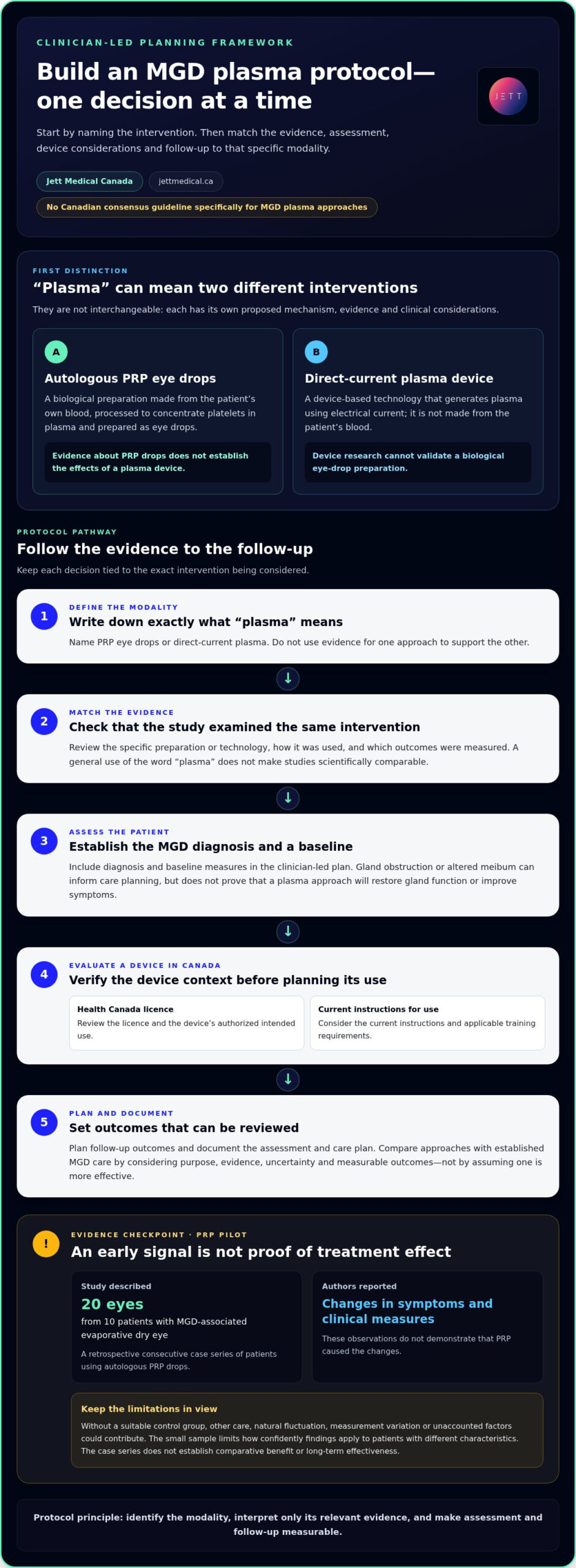
What belongs in a clinician-led MGD plasma protocol?
A responsible protocol is a planning and documentation framework, not a universal treatment recipe. It should identify the specific modality, explain the clinical rationale, and define how suitability and outcomes will be assessed. The sequence below is intended for clinicians; it does not replace professional judgement or a device’s current instructions for use.
For device-based plasma in Canada, clinicians must follow the applicable Health Canada licence and authorized intended use, the manufacturer’s instructions, and relevant professional standards. Do not infer device settings, treatment intervals, or recovery expectations from a study of a different modality. A PRP-drop method, for example, cannot supply operating parameters for an energy-based device.
Before treatment: diagnosis, suitability, and baseline
Begin by establishing the diagnosis and recording the findings that support it. A clear baseline makes later review more meaningful and helps distinguish changes in symptoms from changes observed on examination.
- 1. Confirm the clinical question. Record relevant history, symptom pattern, examination findings, previous care, and differential considerations. Clarify whether the concern is consistent with MGD and whether other contributors to ocular discomfort need assessment.
- 2. Identify the modality and rationale. State whether the proposed approach is PRP drops or device-based plasma. Document why that modality is being considered for this patient and how it relates to the diagnosis and care plan.
- 3. Establish repeatable baseline measures. Select appropriate symptom measures and examination findings that can be recorded consistently at follow-up. Depending on the clinical assessment, these may include patient-reported symptoms, tear-film findings, and eyelid or gland observations. Use the same measures where practical so comparisons remain interpretable.
- 4. Assess suitability and discuss the plan. Consider patient-specific risks, relevant clinical guidance, contraindications, and applicable instructions for use. Discuss the rationale, uncertainties, alternatives, expected monitoring, and possible adverse events. Document consent in accordance with professional practice.
During and after treatment: document and reassess
Documentation should allow another clinician to understand what was selected, why it was selected, and what happened next. For a device, follow the current instructions for use for required procedure details; this framework does not prescribe settings or session timing.
- 5. Record the intervention accurately. Note the device or biological preparation, clinical rationale, consent, relevant protocol details required by its instructions, and any deviations or immediate observations. Keep records specific to the modality used.
- 6. Review predefined outcomes. Set follow-up according to clinical judgement and the intervention’s applicable guidance. Reassess the baseline measures and patient-reported symptoms, noting improvement, no meaningful change, or deterioration without assuming causation.
- 7. Document safety and next steps. Record adverse events and treatment tolerance. Reconsider the plan if findings, outcomes, or patient suitability warrant a change, and document the reasoning.
This clinician-led plasma therapy for meibomian gland dysfunction protocol framework supports consistent decisions without implying that one schedule or device-specific approach suits every patient. For professional information and training support related to ophthalmic plasma technology, explore Jett Medical Canada’s clinical resources.
How can Canadian clinics evaluate ophthalmic plasma technology responsibly?
Responsible evaluation starts with the individual device, not broad claims about plasma technology. In Canada, a device’s Health Canada licence and authorized intended use are distinct from general statements about international certification or quality systems. Review the licence for the specific model and proposed clinical application; its existence alone does not establish evidence for every use a clinic might consider.
Regulatory and clinical implementation considerations
Before considering a device for clinical use or describing it in educational materials, review the applicable Canadian licence and compare its scope with the proposed purpose. Read the current instructions for use, including contraindications and training requirements. CE marking or MDSAP status may provide information about other regulatory or quality-system processes, but neither replaces review of the Canadian licence and the device’s authorized intended use.
Implementation also depends on clinical governance. Assign responsibility for training, maintain competency records, and establish how the clinic will document patient suitability, consent, use, outcomes, and adverse events. These steps support consistent practice and help the clinical team identify when a device or approach needs reassessment.
Jett Medical Canada supplies plasma technology for medical and ophthalmic applications, including Edge O Tech. Any device-specific MGD consideration must remain within the verified Canadian licence scope and current instructions for use. A general description of ophthalmic technology does not establish an MGD indication or treatment protocol.
A practical evidence-to-adoption checklist
Use a staged review before adopting a technology or incorporating it into a clinical pathway:
- Match use to authorization. Compare the proposed clinical purpose with the specific device’s current Health Canada licence and authorized intended use. Do not infer an MGD indication from a broad reference to ophthalmic applications.
- Match evidence to the device. Review studies of the same technology and application. Consider whether the population, treatment method, follow-up period, and measured outcomes are relevant to the patients and use being considered.
- Confirm implementation requirements. Ensure the current instructions and available professional training support safe, consistent use. Define who is trained, how competency is maintained, and where the clinic will record required details.
- Set review criteria. Decide how patient suitability, baseline status, clinical outcomes, symptoms, tolerability, and safety events will be assessed. Establish how the team will document findings and reconsider continued use if results or tolerance warrant a change.
This sequence keeps licensing, evidence, training, and clinical outcomes in view without treating technology adoption as proof of effectiveness. A plasma therapy for meibomian gland dysfunction protocol should be specific to the modality and grounded in the device’s authorized use and professional standards. To explore professional plasma technology supplied by Jett Medical Canada, review its plasma technology offerings.
Turn clinical interest into a considered next step
Before adding a new modality to clinic planning, define the question it should answer. A brief decision record can capture the clinical rationale, the evidence still needed, the outcome that would matter to patients, and when the team will reassess its approach. For any device under consideration, keep proposed use aligned with its current Health Canada licence scope and instructions for use.
This disciplined approach gives a plasma therapy for meibomian gland dysfunction protocol a clear foundation without treating emerging technology as a universal solution. It also helps clinics distinguish an area for further evaluation from an established clinical conclusion.
Jett Medical Canada supplies plasma technology for professional medical and ophthalmic applications and provides training and support for doctors and nurses. Device-specific licensing and intended use remain the reference point for clinical evaluation. Explore Jett Medical Canada’s professional plasma technology as your clinic considers its next evidence-informed step. Careful assessment and ongoing learning help clinicians evaluate innovation while keeping patient needs at the centre.
Frequently Asked Questions
Is plasma therapy for MGD the same as platelet-rich plasma eye drops?
No. PRP eye drops are a blood-derived preparation, while device-based plasma uses electrical technology to generate plasma. The distinction affects how each approach is studied, regulated, and assessed clinically. A paper evaluating drops made from a patient’s blood, for example, cannot establish the effects of an ophthalmic device. Look for the specific intervention in the study methods, not just the word “plasma” in its title.
Can plasma therapy restore damaged meibomian glands?
Restoration of damaged glands should not be assumed. A change in symptoms or a clinical measurement does not necessarily show that gland structure has regenerated. Clinicians should distinguish functional outcomes, such as changes in gland secretion or tear-film measures, from structural claims, and consider whether the relevant study measured them directly. Patients should receive realistic information about uncertainty, not promises of gland recovery or lasting relief.
How strong is the evidence for PRP drops in MGD-related dry eye?
The evidence is exploratory rather than conclusive. A small retrospective case series can describe outcomes among treated patients, but it cannot reliably separate a treatment effect from other influences or establish superiority over another approach. When assessing PRP research, clinicians can examine preparation methods, outcome definitions, follow-up, and whether results were consistent across participants. The findings may inform further study, but they do not establish a universal treatment standard.
Is a plasma therapy protocol for MGD standardized?
No consensus-based Canadian protocol specific to plasma therapy for MGD is established in the available guidance. A plasma therapy for meibomian gland dysfunction protocol should therefore be specific to the intervention and grounded in the clinician’s assessment, relevant evidence, and applicable device instructions. A protocol reported in a study does not automatically transfer to another clinic, patient group, or technology. Document the rationale and review outcomes consistently.
Can plasma therapy be combined with other MGD treatments?
It may be considered alongside other care when a clinician determines the combination is appropriate for the patient. The plan should specify each treatment’s purpose and how its contribution will be evaluated. If several interventions begin at once, for example, it may be harder to interpret which change relates to which component. Consider suitability, possible interactions, timing, and monitoring under relevant clinical guidance and device instructions.
How should clinicians measure outcomes in an MGD protocol?
Choose a small set of measures before treatment and repeat them consistently. A clinic might track a patient-reported symptom measure alongside examination findings relevant to the diagnosis, such as tear-film stability or gland observations. Record the assessment method and follow-up point so results can be compared meaningfully. Include tolerability and adverse events as well. A symptom change alone should not be treated as proof of structural improvement or lasting benefit.
Does a Health Canada licence establish that a device treats MGD?
A licence applies to a specific device and its authorized purpose. It should not be read as approval for every proposed application or as proof of a particular clinical outcome. Review the current device-specific licence and instructions for use to determine whether the intended clinical use falls within scope. Then assess the clinical evidence separately. International certifications or quality-system credentials do not replace review of the Canadian licence scope.