
The difference between a predictable clinical outcome and a permanent complication often comes down to the physics of the electrical discharge itself. For Canadian practitioners, selecting a professional plasma pen for skin tightening is no longer just about expanding a service menu; it’s about navigating a complex regulatory environment where technical precision is the only safeguard against adverse events. You likely recognize the surge in patient interest for non-surgical blepharoplasty and skin laxity solutions, yet the market’s saturation with under-regulated, alternating current (AC) devices has created significant concern regarding scarring and inconsistent results.
This clinical guide bridges the gap between technological theory and practical application, promising to uncover why patented direct current (DC) technology is the gold standard for medical-grade efficacy. We’ll examine the specific Health Canada licensing requirements that distinguish professional instruments from consumer-grade risks. By the end of this article, you’ll understand how to identify MDSAP-certified devices that minimize patient downtime while achieving the refined, predictable tightening results your clinic demands in a competitive aesthetic landscape. We will move from the fundamental science of plasma states to the rigorous standards of international certification, providing a clear path for professional adoption.
Key Takeaways
- Analyze the biological mechanism of fibroblasting and how medical-grade plasma technology uses the fourth state of matter to trigger neocollagenesis.
- Distinguish between Direct Current (DC) and Alternating Current (AC) physics; it’s essential for ensuring precise energy delivery and predictable clinical outcomes.
- Navigate Canadian regulatory requirements, including Health Canada licensing and MDSAP certification, to ensure you’re maintaining high standards of safety and professional liability.
- Evaluate the clinical versatility of a professional plasma pen for skin tightening in specialized applications such as non-surgical blepharoplasty and perioral rejuvenation.
- Realize how precision-engineered devices like the Jett Plasma Pen Medical optimize healing potential while ensuring patients don’t face unnecessary recovery periods.
What is a Professional Plasma Pen for Skin Tightening?
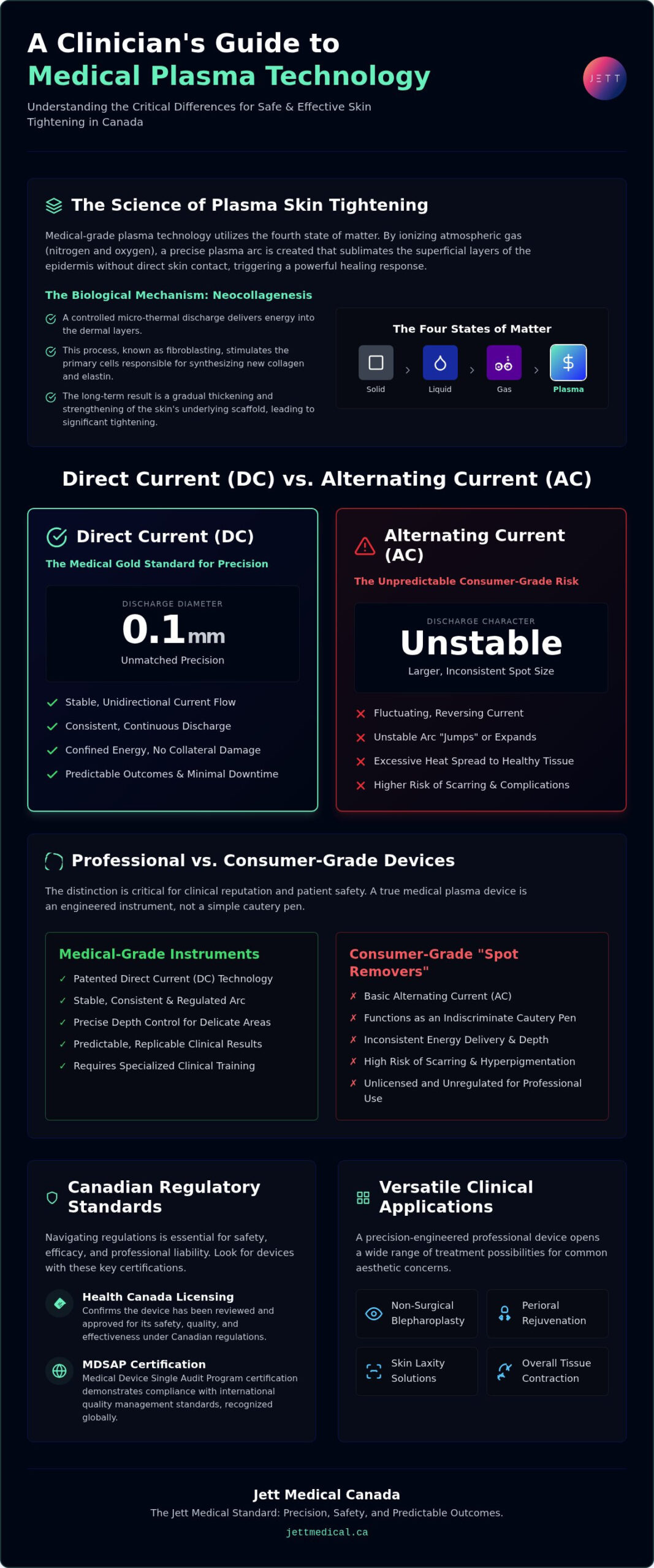
A professional plasma pen for skin tightening is a medical instrument that utilizes ionized gas to create a precise electrical discharge. While often confused with simple electrocautery devices, medical-grade plasma technology operates on the principles of the fourth state of matter. This process involves the ionization of atmospheric nitrogen and oxygen, creating a plasma arc that sublimates the superficial layers of the epidermis without direct physical contact. Professional plasma technology serves as a sophisticated, non-invasive surgical alternative for patients seeking significant tissue contraction without the risks associated with traditional incisions.
The Science of Plasma Skin Tightening
The core of this technology lies in its ability to generate a controlled micro-thermal discharge. When the device’s probe approaches the skin surface, it creates a bridge of ionized gas that delivers thermal energy into the dermal layers. This interaction is a cornerstone of Plasma medicine, where the energy triggers a specific biological response known as fibroblasting. Fibroblasts are the primary cells responsible for synthesizing collagen and elastin, the proteins that maintain skin elasticity. By inducing a targeted thermal injury, the device stimulates the dermis to realize long-term structural protein growth. The immediate result is a visible tissue contraction caused by the heat, while the secondary, long-term benefit is the gradual thickening of the skin’s underlying scaffold.
Professional vs. Consumer-Grade Devices
The market is currently saturated with low-cost “spot removers” often marketed as plasma pens, yet these consumer-grade devices rarely produce true plasma. Most function as basic alternating current cautery pens that burn tissue indiscriminately, which leads to unpredictable scarring and post-inflammatory hyperpigmentation. A genuine professional plasma pen for skin tightening provides consistent, regulated energy output that ensures both safety and clinical efficacy. These medical instruments require specialized clinical training to manage depth control and energy intensity effectively. Precision is the hallmark of a medical instrument; it allows a practitioner to treat delicate areas, such as the upper eyelid, with professional confidence. Unlicensed pens lack the sophisticated internal circuitry needed to maintain a stable arc, which often results in inconsistent energy delivery and significantly increased patient downtime.
Practitioners must distinguish between these categories to protect their clinical reputation. Medical-grade devices are engineered to provide:
- Stability: A consistent arc that does not flicker or change intensity.
- Depth Control: The ability to target the papillary dermis without damaging deeper tissues.
- Predictability: Results that can be replicated across different skin types and concerns.
Choosing a professional instrument ensures that the healing potential of plasma is harnessed without the volatility of uncertified hardware.
Direct Current (DC) vs. Alternating Current (AC) Plasma
The efficacy of a professional plasma pen for skin tightening depends largely on the type of electrical current used to generate the plasma arc. Most entry-level or consumer devices utilize Alternating Current (AC), where the flow of electrons reverses direction periodically. In contrast, medical-grade instruments prioritize Direct Current (DC). This unidirectional flow provides a stable, continuous discharge that is far easier for a clinician to manage during delicate procedures. Specifically, DC plasma allows for a 0.1mm discharge diameter for unmatched precision, ensuring that the thermal energy remains confined to the intended target area without spreading to the surrounding epidermis.
When using AC plasma, the fluctuating current often results in larger, less predictable treatment dots. This lack of consistency occurs because the arc is less stable, frequently “jumping” or expanding in diameter as the current cycles. For the practitioner, this translates to an increased risk of collateral thermal damage. Excessive heat spread is the primary cause of prolonged patient downtime and a higher incidence of post-procedure complications. By contrast, the steady nature of a DC discharge allows for a more controlled sublimation process, which is essential for adhering to the safety expectations set by Canadian Regulatory Standards regarding medical device safety.
Precision and the “Henna Dot” Effect
DC technology creates what clinicians often refer to as the “henna dot” effect. This term describes the small, uniform, and precisely spaced carbonization points that appear on the skin surface immediately following treatment. Because the energy is so localized, there is minimal heat diffusion into the surrounding skin. This precision allows practitioners to achieve consistent results across various skin types and thicknesses, from the thin tissue of the eyelids to the thicker skin of the neck. Clear, predictable patterns help manage patient expectations, as the healing “dots” are smaller and more organized than those produced by volatile AC devices.
Clinical Advantages of DC Technology
The clinical benefits of utilizing a professional plasma pen for skin tightening with DC technology extend to long-term safety profiles. One of the most significant advantages is the lower risk of post-inflammatory hyperpigmentation (PIH), particularly in patients with higher Fitzpatrick skin types. The reduced thermal footprint means the inflammatory response is more contained. Additionally, DC devices offer enhanced control for delicate areas like the periocular region, where even a fraction of a millimetre of deviation can impact the outcome of a non-surgical blepharoplasty. While battery-operated units may suffer from energy drops as the charge depletes, corded DC units ensure a constant voltage that never wavers during a session. To see how these technical specifications translate into clinical practice, you can explore the patented DC technology utilized in our medical-grade platforms.
Canadian Regulatory Standards for Medical Plasma Devices
The regulatory landscape for energy-based aesthetic devices in Canada underwent a significant shift on May 11, 2022. Prior to this date, Health Canada had issued warnings regarding the sale of unauthorized plasma pens, citing potential risks such as permanent scarring and hyperpigmentation. Today, the sale and use of these instruments are strictly restricted to licensed healthcare professionals. Selecting a professional plasma pen for skin tightening within this framework is a matter of both legal compliance and professional liability. A device must possess an active Medical Device Licence (MDL) to be legally advertised, imported, or utilized in a clinical setting across the country.
Health Canada Licensing Explained
Verification of a device’s status is a critical step for any clinical lead. Practitioners can confirm authorization through the Medical Devices Active Licence Listing (MDALL). For instance, devices manufactured by Compex, Spol. S R.O. were first issued their Canadian licence on December 14, 2022. This certification ensures the technology has survived rigorous safety and efficacy testing tailored to the Canadian market. Using an unlicensed or grey-market device poses a severe risk to a practitioner’s professional insurance coverage. Most liability providers require that all equipment used in a medical aesthetic practice meet current federal standards. If a complication occurs with an unauthorized device, the clinician may find themselves without legal or financial protection.
MDSAP and International Certifications
The Medical Device Single Audit Program (MDSAP) represents the pinnacle of global manufacturing quality. It allows a single regulatory audit of a medical device manufacturer to satisfy the requirements of multiple jurisdictions, including Canada, the USA, Australia, Brazil, and Japan. When a professional plasma pen for skin tightening carries MDSAP certification, it indicates that the manufacturer adheres to the highest international standards of ISO 13485. These certifications provide a layer of safety that exceeds basic CE marking, ensuring that every unit produced meets consistent technical specifications. For Canadian nurses and doctors, this global proof of quality is essential for maintaining a safe and compliant aesthetic practice.
Identifying authentic devices requires vigilance against grey-market imports that often bypass Canadian safety checks. These unauthorized pens frequently lack the internal voltage regulators necessary for safe energy delivery. While they may appear identical to licensed models, their internal components are often substandard and prone to failure. Maintaining a modern practice involves regular audits of equipment licences to ensure ongoing compliance with Health Canada’s evolving standards. This due diligence protects the patient’s health and the clinic’s professional reputation.
Clinical Applications for Skin Laxity and Beyond
The primary utility of a professional plasma pen for skin tightening is most evident in non-surgical blepharoplasty. This procedure addresses upper and lower eyelid laxity by sublimating excess tissue, offering a viable alternative for patients who wish to avoid the risks and recovery time associated with invasive surgery. Beyond the periocular region, the technology provides significant results in treating perioral wrinkles and neck laxity. By delivering precise thermal energy, the device triggers an immediate contraction of the skin’s surface while initiating the long-term collagen remodelling necessary for sustained lifting and firming.
Practitioners can also utilize medical-grade plasma for scar revision and the treatment of various benign skin lesions. The controlled nature of the discharge allows for the targeted remodelling of fibrotic tissue in hypertrophic scars. Because the energy delivery is so localized, it is also highly effective for removing small, benign growths without damaging the surrounding healthy epidermis. This versatility allows a clinic to expand its service offerings from purely aesthetic skin tightening to more complex dermatological and ophthalmic procedures.
Ophthalmic Precision: Treating Dry Eye and Eyelid Laxity
Modern plasma technology has found a specialized role in ophthalmology due to the stability of Direct Current (DC) discharges. Clinicians use these devices to treat conjunctivochalasis and blepharitis, where precision is not just an aesthetic preference but a clinical necessity. The safety of DC plasma near the delicate eye area is superior to alternating current alternatives because it eliminates the risk of current “jumping” to unintended structures. For a comprehensive look at how these instruments serve ocular health, practitioners should consult our guide on ophthalmic plasma technology for dry eye. This application demonstrates the high level of control that medical-grade instruments provide in the most sensitive anatomical zones.
Dermatological Versatility
In a dermatological setting, a professional plasma pen for skin tightening is an excellent tool for removing xanthelasma and cherry angiomas with minimal scarring. Traditional methods of removal often carry a higher risk of pigmentary changes, whereas the precise sublimation of plasma leaves the underlying tissue largely undisturbed. For specific clinical protocols on these removals, refer to our plasma device for xanthelasma resource. Additionally, the technology is used to improve overall skin texture and address acne scarring by promoting the growth of a more organized collagen matrix. This dual-action approach of immediate removal and long-term rejuvenation makes it a cornerstone of a modern aesthetic practice.
Expanding your clinical capabilities with these diverse applications ensures a higher return on investment and better patient outcomes. To explore how these advanced medical platforms can elevate your current treatment standards, you can view our full range of Jett Plasma Medical devices and technical specifications.
The Jett Medical Standard: Precision Skin Tightening
The Jett Plasma Pen Medical represents the professional benchmark for clinicians who prioritize technical reliability and patient safety. While the market is flooded with lower-tier alternatives, Jett Medical Canada provides a system defined by its patented Direct Current (DC) technology. This engineering choice ensures that energy delivery is constant and precise, which is a fundamental requirement for high-end medical aesthetic clinics. Integrating this technology allows practitioners to offer a professional plasma pen for skin tightening that delivers predictable outcomes without the volatility of alternating current devices. By standardizing on DC plasma, a clinic can ensure that its results are both reproducible and safe across its entire patient demographic.
Engineered for Outcomes
Practitioners utilizing the Jett Plasma Lift Medical benefit from a device designed specifically for skin laxity and tissue remodelling. This hardware is MDSAP-certified, ensuring it meets the stringent manufacturing and safety standards required by Health Canada. Realizing superior results depends on the device’s ability to maintain a 0.1mm discharge diameter, which minimizes collateral damage and speeds up recovery. For a deeper analysis of these clinical benchmarks, clinicians can review our Professional Plasma Lift: Medical Standards Guide 2026. This resource details the intersection of electrical physics and dermatological health, providing the evidence-based foundation necessary for a modern practice.
Professional Partnership and Training
Acquiring a professional plasma pen for skin tightening is only the first step in achieving clinical excellence. Jett Medical Canada offers comprehensive medical-grade plasma training for Canadian clinicians, ensuring that every user understands the nuances of DC energy application across various anatomical zones. This training covers everything from non-surgical blepharoplasty to specialized dermatological removals, allowing your team to maximize the utility of the platform. Beyond initial education, clinic owners have access to ongoing technical support and maintenance, which preserves device longevity and ensures operational uptime. This partnership ensures that your clinic remains at the forefront of non-invasive surgical alternatives while maintaining a reputation for safety and precision. If you’re ready to elevate your clinical standards, you can inquire about Jett Plasma technology for your clinic to discuss integration strategies and technical specifications.
Advancing Clinical Standards with Medical-Grade Plasma
Selecting a professional plasma pen for skin tightening requires a deep understanding of the intersection between electrical physics and clinical safety. We’ve explored how patented direct current technology provides the thermal precision necessary to minimize patient downtime while ensuring predictable tissue contraction. By prioritizing Health Canada licensed and MDSAP certified instruments, Canadian practitioners can mitigate professional liability and provide a higher standard of care in both aesthetic and ophthalmic applications.
The transition from alternating current devices to medical-grade DC platforms represents a significant advancement in non-invasive surgical alternatives. Whether you’re addressing eyelid laxity or complex dermatological lesions, the reliability of your hardware remains the most critical factor in your clinical success. Maintaining compliance with federal standards ensures your practice remains both legally secure and technologically competitive in an evolving marketplace. Precision is not just a technical specification; it’s a commitment to patient safety and long-term healing potential.
Explore Health Canada Licensed Plasma Devices for Your Practice and discover the difference that precision-engineered technology can make for your patients. We look forward to supporting your clinic’s commitment to safety and innovation.
Frequently Asked Questions
Is the plasma pen safe for all skin types in a professional setting?
Safety depends on the precision of the energy delivery. While a professional plasma pen for skin tightening utilizing direct current (DC) offers enhanced safety for various skin types, caution is always required for higher Fitzpatrick scales. The stable DC arc minimizes the thermal footprint, which reduces the risk of post-inflammatory hyperpigmentation compared to volatile alternating current (AC) units. Clinicians must still perform thorough assessments to ensure the patient’s skin can realize optimal healing without complications.
What is the difference between a Health Canada licensed plasma pen and others?
A Health Canada licensed device has undergone rigorous testing to meet federal safety and efficacy standards. Since May 11, 2022, it’s illegal to sell or advertise unauthorized plasma pens in Canada. Licensed instruments provide clinicians with legal protection and professional liability coverage that grey-market imports cannot offer. Authentic devices are listed on the Medical Devices Active Licence Listing (MDALL), ensuring they meet the specific technical requirements for medical-grade performance in a clinical environment.
How much downtime should patients expect after a professional plasma treatment?
Downtime typically lasts between five and seven days for the superficial carbonization dots to naturally shed. Patients often experience mild swelling for the first 48 hours, particularly in the periocular region. Because patented direct current technology limits collateral thermal damage, the inflammatory response is more contained than with older AC devices. This precision allows patients to return to their normal routines faster while their skin begins the long-term process of collagen induction and structural remodelling.
Can a plasma pen really replace a surgical blepharoplasty?
Plasma technology serves as a highly effective non-invasive surgical alternative for patients with mild-to-moderate skin laxity. While it cannot remove significant fat pads or address severe muscle separation like a traditional blepharoplasty, it provides impressive tissue contraction without incisions or general anaesthesia. It’s an ideal solution for those who aren’t yet candidates for surgery or wish to avoid the associated risks. The results are natural and improve over several months as new collagen matures.
What qualifications do I need to operate a professional plasma device in Canada?
In Canada, the operation of authorized plasma devices is restricted to licensed healthcare professionals, such as physicians and registered nurses. Regulatory bodies and Health Canada emphasize that these are medical procedures requiring advanced clinical knowledge of skin anatomy and wound healing. Practitioners should also complete specialized training provided by the distributor to master the specific physics of the device. This ensures the technology is used safely and that patient outcomes remain predictable within a professional medical setting.
How does direct current (DC) plasma improve patient safety?
Direct current (DC) plasma improves safety by maintaining a constant, unidirectional flow of electrons. This creates a stable arc that does not flicker or jump, allowing for a precise 0.1mm discharge diameter. This level of control is essential when treating delicate areas where excessive heat spread could cause scarring. By confining the thermal energy to a specific point, DC technology reduces the overall inflammatory response and lessens the likelihood of complications like hyperpigmentation or permanent tissue damage.
What is the typical lifespan of a medical-grade plasma device?
Medical-grade plasma devices are engineered for high-volume clinical use and typically offer a lifespan of several years with proper maintenance. Devices like the Jett Plasma Pen Medical are constructed with high-quality internal components that resist the wear typical of cheaper, consumer-grade alternatives. Corded units often provide better longevity than battery-operated models because they avoid the inevitable degradation of lithium-ion cells. Regular technical support and following manufacturer protocols for probe sterilization will maximize the operational life of the hardware.
Can plasma technology be used for ophthalmic conditions like dry eye?
Yes, specialized plasma technology is now a standard for treating certain ophthalmic conditions, including dry eye disease caused by Meibomian Gland Dysfunction. Instruments like the Jett Plasma Medical II utilize specific applicators to address blepharitis and conjunctivochalasis with extreme precision. This application relies on the stability of direct current to safely treat the ocular surface. It provides a unique way for clinics to expand their portfolios beyond a traditional professional plasma pen for skin tightening into specialized medical fields.