
For decades, aesthetic medicine operated on a destructive premise: achieving deep dermal remodelling required burning or vaporizing the epidermal barrier. Practitioners know the clinical frustrations of this trade-off intimately. Between extended recovery periods, elevated hyperpigmentation risks across diverse Fitzpatrick skin types, and strict contraindications around ophthalmic margins, aggressive thermal devices often compromise clinical treatment plans. The rapid clinical adoption of non-ablative plasma technology resolves these limitations at the cellular level.
Discover how non-ablative plasma technology delivers cellular remodelling and tissue regeneration without epidermal trauma or extended patient downtime. Rather than relying on non-specific thermal shock, this modality harnesses precise ionized fields to stimulate fibroblast activity and restore cellular membrane potential, all while preserving the stratum corneum intact. This article breaks down the biophysical mechanisms that distinguish non-ablative ionization from destructive vaporization, assesses proven safety profiles across sensitive peri-oral and periorbital anatomies, and highlights how certified medical systems enable reliable, year-round clinical protocols.
Key Takeaways
- Learn how non-ablative plasma technology induces dermal neocollagenesis and cellular repolarization while preserving the stratum corneum intact to eliminate post-treatment downtime.
- Compare the histological mechanisms of sub-thermal ionized fields against ablative vaporization to evaluate cellular recovery pathways and minimize post-inflammatory hyperpigmentation risks.
- Examine safe treatment parameters across delicate anatomical regions, unlocking non-surgical options for periorbital laxity, Meibomian gland dysfunction, and anterior blepharitis.
- Understand the engineering differences between continuous direct-current (DC) architectures and alternating-current (AC) systems, focusing on how a stable 0.1 mm micro-beam prevents lateral thermal spread.
- Identify the regulatory standards, device licensing benchmarks, and clinical onboarding strategies needed to successfully adopt advanced medical plasma platforms nationwide.
The Evolution of Atmospheric Plasma: Defining Non-Ablative Technology in 2026
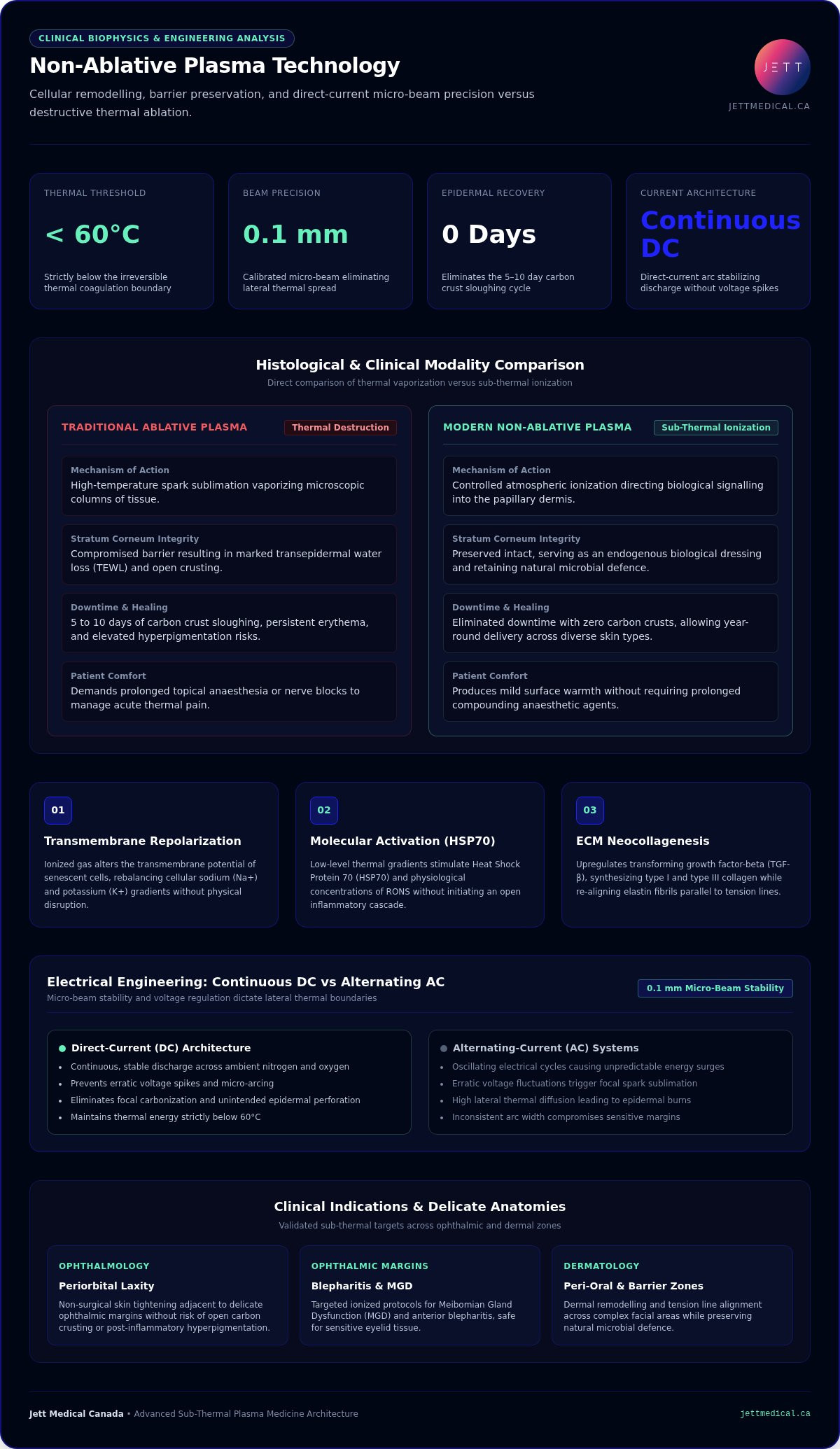
The clinical field often confuses consumer-grade cosmetic pens with advanced medical instrumentation. True non-ablative plasma technology represents a distinct physical modality. Instead of utilizing destructive electrical arcs that vaporize tissue, modern non-ablative systems operate via controlled, sub-thermal atmospheric ionization. This approach preserves the stratum corneum while directing biological signalling into the papillary dermis, bypassing the thermal necrosis and carbon crusting seen in traditional fulguration.
The broader discipline of plasma medicine demonstrates that cold and sub-thermal gas discharges exert therapeutic effects through biological stimulation rather than acute structural ablation. By generating physiological concentrations of reactive oxygen and nitrogen species (RONS), these systems initiate dermal remodeling pathways without inducing epidermal coagulation.
Biophysics of Sub-Thermal Ionization and Atmospheric Gas Discharge
Atmospheric plasma forms when a calibrated voltage gradient ionizes ambient nitrogen and oxygen molecules between an emission tip and target tissue. Sub-thermal ionization keeps bulk tissue temperatures strictly below the irreversible thermal coagulation boundary of 60 degrees Celsius. Highly regulated direct-current delivery stabilizes this discharge, avoiding the erratic voltage spikes that cause sudden micro-arcing, focal carbonization, or unintentional epidermal perforation.
Preserving the Epidermal Barrier While Inducing Dermal Signalling
Retaining an intact stratum corneum transforms the outer skin into an endogenous biological dressing. Clinical outcomes benefit in several measurable ways:
- Barrier preservation: Intact cornified envelopes limit immediate transepidermal water loss (TEWL), unlike the marked barrier breakdown caused by fractional lasers.
- Reduced infection risk: The fully retained skin architecture maintains natural microbial defence mechanisms.
- Molecular activation: Low-level thermal gradients stimulate Heat Shock Protein 70 (HSP70) and transformational growth factors without initiating an open inflammatory cascade.
This biological mechanism shifts aesthetic medicine away from overt tissue trauma toward targeted cellular biostimulation. Practitioners can initiate constructive dermal neocollagenesis while keeping the surface barrier completely undisturbed.
Ablative Versus Non-Ablative Plasma: Cellular Mechanisms and Clinical Endpoints
Ablative plasma relies on high-temperature spark sublimation. This vaporization process removes microscopic columns of tissue, creating immediate epidermal carbon crusts that require five to ten days to slough away. In contrast, non-ablative plasma technology functions through membrane repolarization. As ionized gas particles contact the tissue, they alter the transmembrane potential of senescent cells, rebalancing cellular sodium and potassium gradients without physical disruption. Patients avoid peeling crusts, secondary erythema, and mandatory recovery periods.
Procedural comfort differs sharply between these modalities. Ablative fulguration demands prolonged topical anaesthesia or nerve blocks to manage thermal pain. Non-ablative ionization produces only mild surface warmth, removing the need for pre-treatment compounding agents while supporting year-round clinical delivery unaffected by seasonal ultraviolet indices.
Fibroblast Proliferation and Extracellular Matrix Remodelling
Histological studies reveal marked variations in structural healing between both techniques:
- Targeted signalling pathways: Sub-thermal plasma upregulates transforming growth factor-beta (TGF-β), stimulating robust type I and type III collagen synthesis rather than fibrotic scar tissue.
- Elastin architecture: Non-ablative energy re-aligns elastin fibrils parallel to tension lines, providing structural elasticity without localized thermal contractures.
- Sustained cellular output: Rather than relying on acute wound contraction, clinical improvements develop progressively over twelve weeks through fibroblast-mediated extracellular matrix synthesis.
Melanocyte Safety and Risk Mitigation Across Higher Fitzpatrick Phototypes
A major limitation of traditional ablation is thermal scatter. When aggressive energy penetrates into the dermo-epidermal junction, it triggers widespread melanocyte degranulation in Fitzpatrick phototypes IV through VI. The result is often stubborn post-inflammatory hyperpigmentation (PIH) or permanent hypopigmentation. Clinicians treating skin of colour frequently avoid ablative pens for this reason.
Non-ablative energy transfer preserves basal layer melanocyte stability entirely. Because the ionization threshold remains sub-thermal, inflammatory mediator cascades remain minimal. This safety profile enables safe interventions on hyperpigmentation-prone tissue and reduces risks for individuals predisposed to hypertrophic or keloidal scarring. Progressive operators evaluating advanced tissue protocols can review clinical device platforms through jettmedical.ca to verify parameters suited to diverse demographic profiles.
Clinical Indications Across Dermatology, Ophthalmology, and Tissue Regeneration
The clinical scope of non-ablative plasma technology extends far beyond basic aesthetic skin conditioning. Because energy delivery occurs without thermal vaporization, practitioners safely apply ionized energy across fragile anatomical regions once considered unsuitable for energy-based devices. These therapeutic indications bridge aesthetic dermatology, restorative tissue care, and specialized medical ophthalmology.
Aesthetic indications include perioral lines, dynamic rhytids, and general epidermal laxity. However, the physical properties of ionized gas also confer potent, broad-spectrum anti-microbial activity. Cold and sub-thermal plasma eliminates cutaneous pathogens without provoking antimicrobial resistance, establishing this modality as a reliable option for chronic inflammatory tissue disorders.
Periorbital Rejuvenation and Ophthalmic Safety Margins
Periorbital skin poses distinct clinical challenges due to its thin dermis and close proximity to the tarsal plate. Traditional lasers risk ocular injury and prolonged erythema along lid margins. Applying certified ophthalmic plasma technology for dry eye allows clinicians to target anterior blepharitis and Meibomian gland dysfunction (MGD) safely. The sub-thermal discharge clears gland orifices and eradicates Demodex mites without transferring harmful thermal loads to the cornea.
Managing Acne Vulgaris, Rosacea, and Inflammatory Cutaneous Pathologies
Sub-thermal ionization alters the microbial and vascular environment of compromised skin:
- Targeted bactericidal action: Transient reactive species disrupt the cellular membranes of Cutibacterium acnes, reducing active pustular outbreaks rapidly.
- Microvascular stabilization: Controlled plasma exposure downregulates pro-inflammatory cytokines, calming the baseline erythema characteristic of erythematotelangiectatic rosacea.
- Mechanical sparing: Operators treat inflamed, fragile lesions directly without the mechanical friction or shearing forces associated with traditional chemical peels or microdermabrasion.
Transdermal Drug Delivery and Electroporation Dynamics
Beyond direct tissue remodelling, ionized atmospheric fields temporarily modify the lipid architecture of the stratum corneum. This transient electroporation phenomenon creates micro-pathways through intercellular lipids without compromising epidermal integrity. Clinicians leverage this delivery window to enhance the penetration of high-molecular-weight topicals, including bio-active peptides and sterile hyaluronic acid solutions, significantly boosting procedural outcomes.
Engineering Precision: Direct Current Versus Alternating Current Plasma Arcs
The clinical efficacy of non-ablative plasma technology depends directly on electrical circuit design. Most consumer-grade pens rely on inexpensive alternating current (AC) transformers. AC systems reverse electrical polarity dozens of times per second, creating an irregular, pulsating spark that flares unpredictably across the skin surface. This spark dispersion causes uneven energy transfer, lateral thermal spread, and unintentional epidermal burns. Achieving predictable sub-thermal effects requires stable direct current (DC) engineering.
A continuous direct-current architecture establishes a unidirectional, constant voltage gradient between the probe and tissue. By removing polarity oscillations, patented DC circuitry generates a stable, uninterrupted 0.1 mm micro-beam. This level of physical containment prevents spark wandering, allowing practitioners to administer precise sub-thermal ionization without damaging adjacent structures.
Electrical Continuity and Arc Stabilization Mechanisms
Stable arc generation relies on uniform charge transfer. Unregulated AC devices produce wide, erratic arcs that jump to random contact points on the skin. Conversely, DC systems maintain continuous electron flow. This technical difference ensures the ionized plasma channel remains focused at a diameter under 0.1 millimetres, delivering repeatable bio-electric stimulation exactly where targeted.
Thermal Dissipation Profiles and Surrounding Tissue Protection
Circuit configuration directly dictates lateral thermal damage across tissue planes:
- Uncontrolled AC spread: Pulsating discharges generate wide thermal dissipation cones, creating high risk for inadvertent full-thickness cutaneous burns and peripheral necrosis.
- Confined DC delivery: Unidirectional current limits heat strictly to target coordinates, sparing deep dermal architecture.
- Controlled energy depth: Sub-thermal DC parameters prevent micro-arcing from penetrating the basal layer, preventing thermal scar formation.
Medical Device Standards, MDSAP Protocols, and Canadian Regulations
Device engineering directly impacts clinical liability and operator safety. Operating uncertified, imported cosmetic pens exposes Canadian clinics to regulatory enforcement and significant malpractice risk. Legitimate medical platforms must adhere to Medical Device Single Audit Program (MDSAP) standards and secure appropriate licensing. Canadian practitioners should verify active listings for Health Canada licensed plasma devices before integrating any energy-based platform into practice.
Selecting systems holding active Class II or Class III medical device licences guarantees that manufacturing quality, voltage stability, and clinical indications meet strict safety benchmarks. Medical clinics looking to introduce precision direct-current platforms can explore certified technologies through jettmedical.ca to ensure total compliance across their treatment rooms.
Integrating Non-Ablative Plasma Platforms into Canadian Medical Clinics
Adopting non-ablative plasma technology reshapes clinical practice economics by removing treatment downtime barriers. Traditional ablative procedures restrict scheduling because patients must plan around prolonged healing windows and sun-exposure avoidance. Conversely, sub-thermal ionization allows medical clinics to offer reliable, year-round dermal conditioning protocols that maintain consistent appointment volumes across every season.
Operational profitability improves when clinics introduce a certified professional plasma lift device into daily practice. The high precision and consistent safety margin of direct-current systems enable predictable procedural outcomes, creating strong patient retention through multi-session regenerative treatment plans.
Expanding Patient Demographics with Zero-Downtime Treatment Options
Modern clinical demographics increasingly prioritize regenerative prejuvenation over aggressive surgical interventions. Non-ablative workflows address three key patient groups:
- Active working professionals: Patients resume immediate workplace commitments without managing oozing, localized scabbing, or visible carbon crusting.
- Aesthetic novices: Sub-thermal protocols serve as an approachable gateway for patients seeking collagen stimulation without needle trauma or thermal risks.
- Summer-active clients: Clinics avoid typical mid-year procedural lulls by scheduling treatments through high-sunlight months without elevating photosensitivity risks.
Clinical Onboarding, Delegation, and Nursing Protocols
Clinical delegation requires clear operational parameters. While ablative vaporization involves intensive pain management and physician-level oversight, non-ablative sessions follow structured, reproducible delivery protocols. Medical directors can establish standard operating guidelines that permit trained clinic nurses to deliver treatments safely within their professional scope.
Comprehensive onboarding must cover tissue resistance recognition, vector-based application pathways, and pre-procedural assessments. Standardized clinical consent forms should outline that non-ablative collagen synthesis operates through progressive cellular signalling across several sessions, setting realistic patient milestones.
Evaluating Technology Partners and Clinical Support Infrastructure
Selecting an equipment partner demands careful due diligence. Canadian medical facilities require domestic distribution partners capable of providing comprehensive clinical onboarding, direct manufacturer warranty maintenance, and regulatory documentation assistance. Clinical teams must ensure their supplier has established expertise in delivering authorized medical grade plasma pen Canada platforms backed by active licensing and ongoing clinical education.
Partnering with organizations that provide nationwide clinical support and specialized technical training ensures that practitioners transition seamlessly from basic device orientation to advanced multi-disciplinary applications.
Advancing Clinical Outcomes with Precision Ionization
The clinical shift away from aggressive thermal vaporization marks a decisive turning point for modern aesthetic and restorative practices. Adopting non-ablative plasma technology allows clinicians to trigger deep dermal neocollagenesis and membrane repolarization without puncturing the epidermal barrier or causing post-inflammatory hyperpigmentation. This biological approach protects delicate ocular margins while eliminating recovery periods for active patients.
Clinical success depends on precision engineering. Patented direct-current architecture delivers a steady 0.1 mm micro-beam, eliminating the unpredictable lateral thermal damage caused by alternating-current spark discharge. Backed by Class II and Class III Health Canada medical device licences and international MDSAP certification, these systems provide the regulatory confidence and clinical predictability required to expand year-round treatment menus nationwide. Clinicians gain access to structured onboarding and comprehensive certification designed specifically for Canadian physicians and registered nurses.
Explore Health Canada licensed direct current plasma systems to integrate certified non-ablative technology into your medical practice today.
Frequently Asked Questions
What is the primary scientific difference between ablative and non-ablative plasma technology?
The primary scientific difference centres on tissue vaporization versus cellular biostimulation. Ablative plasma generates high-temperature thermal arcs that vaporize epidermal cells, leaving microscopic carbon crusts. Conversely, non-ablative plasma technology utilizes sub-thermal ionized gas to repolarize cell membranes and stimulate dermal fibroblasts without breaching the stratum corneum. This preserves the skin’s physical barrier, completely eliminating open crusting and procedural downtime.
Can non-ablative plasma be safely administered to patients with darker skin tones?
Yes, non-ablative plasma can be safely administered across Fitzpatrick skin phototypes IV through VI. Traditional ablative devices generate uncontrolled thermal scatter that frequently triggers melanocyte degranulation and post-inflammatory hyperpigmentation. Sub-thermal ionization keeps tissue temperatures below inflammatory coagulation thresholds, protecting basal layer melanocytes. This mechanism makes it a predictable, year-round modality for richly pigmented skin without causing hypopigmentation or keloidal scarring.
How many clinical sessions are typically required to achieve visible tissue tightening?
Most patients achieve optimal, visible tissue tightening over a course of three to six treatment sessions spaced one to two weeks apart. Because the modality stimulates progressive extracellular matrix synthesis rather than acute thermal contracture, collagen fibril restructuring develops gradually. Initial improvements in tissue tone appear after several weeks, while neocollagenesis and elastin remodelling continue to strengthen skin firmness for up to three months post-protocol.
Does non-ablative plasma treatment require local or topical anaesthesia prior to application?
No, non-ablative plasma treatments don’t require topical numbing creams or local injectable anaesthesia. Ablative vaporization creates acute thermal discomfort, demanding pre-treatment anaesthetics. In contrast, sub-thermal ionized delivery produces only a gentle warming sensation across the skin surface. Patients tolerate the procedure comfortably. This eliminates pre-treatment compounding waiting times and streamlines appointment flow for medical operators.
What post-procedure side effects or skin reactions can patients expect following treatment?
Patients typically experience transient erythema and mild localized edema, which usually resolve within two to twelve hours. Because the stratum corneum remains intact, there’s no epidermal oozing, flaking, or carbon crust formation. Patients can apply mineral cosmetics and resume work immediately following their appointment. Mild temporary dryness occasionally occurs, which responds well to hydrating medical-grade serums.
Why is direct current (DC) plasma considered superior to alternating current (AC) for medical use?
Direct current architecture generates a stable, continuous 0.1 mm micro-beam with unidirectional charge transfer. Alternating current systems reverse electrical polarity constantly, producing an erratic spark that wanders unpredictably across tissue. This uncontrolled dispersion leads to irregular thermal damage and heightened burn risks. Patented DC engineering confines energy precisely to targeted coordinates, ensuring consistent cellular stimulation while safeguarding delicate structures like periorbital margins.
Are non-ablative plasma devices regulated as medical devices by Health Canada?
Yes, professional platforms utilizing non-ablative plasma technology are regulated as Class II or Class III medical devices by Health Canada. Legitimate clinical units must hold active Medical Device Licences listed on the Medical Devices Active Licence Listing database and maintain MDSAP quality certification. Operating uncertified, imported cosmetic pens exposes Canadian clinics to regulatory enforcement, product liability actions, and severe malpractice risks.