
The most severe aesthetic complications don’t stem from aggressive patient selection; they arise from uncalibrated energy delivery that turns controlled sublimation into uncontrolled thermal injury. For clinicians integrating advanced plasma skin resurfacing, erratic arc behaviour and prolonged erythema remain persistent clinical obstacles. You already know that achieving predictable tissue contraction across delicate periorbital and perioral zones requires absolute physical precision, yet unstandardized protocols and variable device classifications leave little margin for safety.
Predictable tissue contraction requires stable direct-current plasma delivery that eliminates lateral heat spread. In this guide, you’ll master the clinical parameters, tissue interactions, and standardized energy protocols governing advanced plasma skin resurfacing in modern medical practices. We examine direct-current versus alternating-current plasma physics, outline reproducible grid patterns for facial tightening, and clarify Health Canada regulatory standards to ensure optimal clinical outcomes and patient safety.
Key Takeaways
- Explore how advanced plasma skin resurfacing leverages ionized atmospheric gas to drive instant epidermal sublimation while safeguarding the underlying basal membrane.
- Compare direct-current and alternating-current arc dynamics to understand how continuous electron flow prevents erratic spark flaring and lateral tissue necrosis.
- Master standardized clinical preparation sequences and energy templates tailored specifically for sensitive periorbital and perioral anatomical zones.
- Implement a structured pre-treatment risk framework that includes melanocyte pre-conditioning and rigorous test-spotting for higher Fitzpatrick phototypes.
- Review essential compliance standards for Class III medical plasma instrumentation under Health Canada regulations and MDSAP quality frameworks.
Clinical Foundations of Advanced Plasma Skin Resurfacing
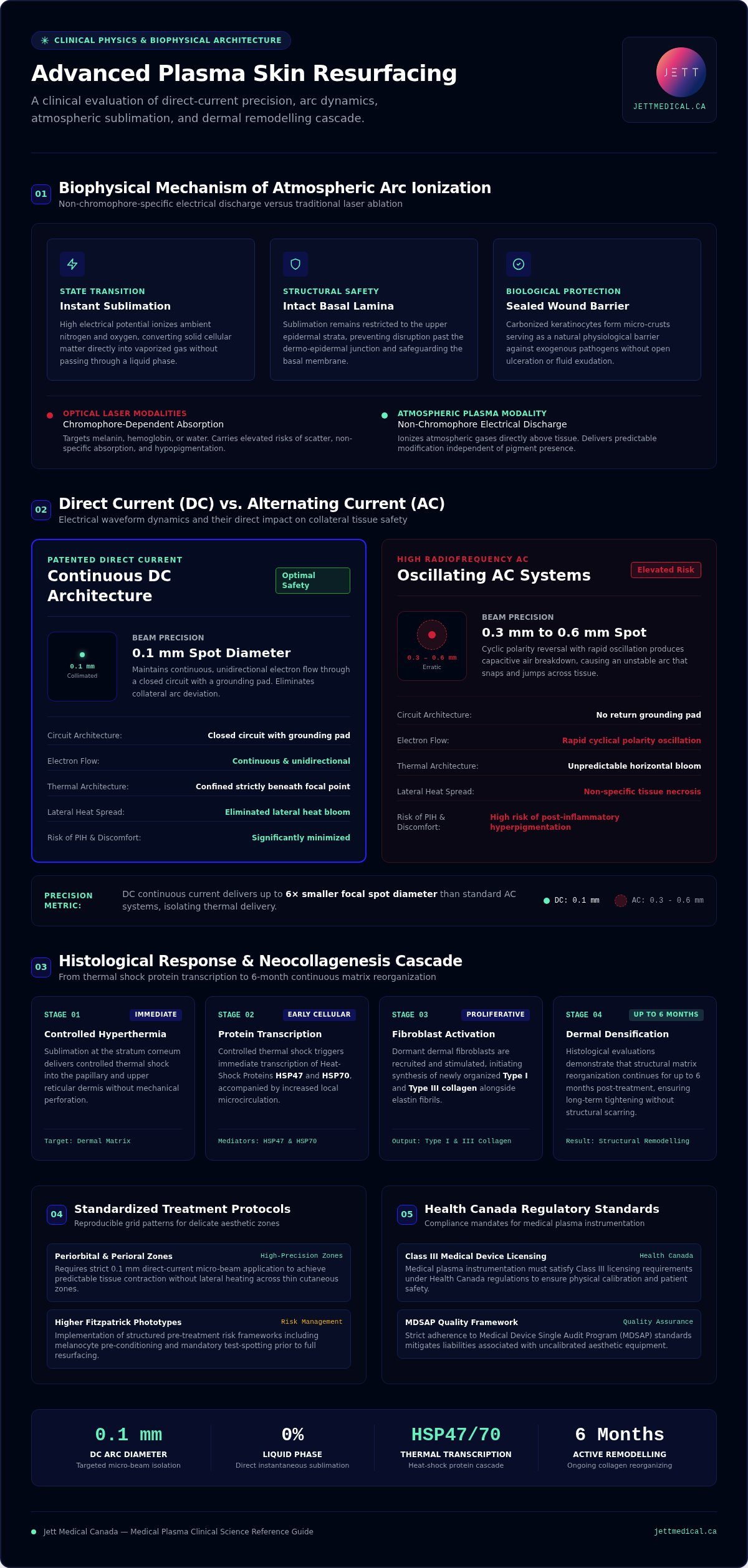
Modern cutaneous remodelling relies on precise thermal regulation rather than non-specific tissue ablation. Unlike chromophore-dependent optical lasers that target melanin, hemoglobin, or water, advanced plasma skin resurfacing operates via non-chromophore-specific electrical discharge. The process harnesses atmospheric gases to trigger immediate epidermal contraction without penetrating past the dermo-epidermal junction. Because this energy delivery bypasses selective photothermolysis, clinicians gain predictable control over tissue modification across anatomical zones where light-based modalities carry higher risks of hypopigmentation or scattering.
Biophysical Mechanism of Atmospheric Arc Ionization
The core physics rests on the principles of plasma medicine, where high electrical potential ionizes ambient nitrogen and oxygen in the gap between the instrument tip and cutaneous tissue. This ionization generates a targeted plasma arc. Upon contact with the stratum corneum, the arc causes instantaneous sublimation, converting solid cellular matter directly into vaporized gas without entering a liquid phase.
This rapid state transition produces distinct physiological benefits:
- Intact basal membrane: Sublimation restricts physical disruption to the upper epidermal strata, preserving the structural integrity of the basal lamina.
- Biological wound seal: Carbonized keratinocytes create micro-crusts that act as a physiological barrier against exogenous pathogens during re-epithelialization.
- Absence of open ulceration: The underlying tissue remains sealed, minimizing fluid exudation and stabilizing the local microenvironment.
Histological Response and Neocollagenesis Cascade
Beneath the superficial sublimation zone, energy dissipates as controlled thermal shock within the papillary and upper reticular dermis. This controlled hyperthermia prompts the immediate transcription of heat-shock proteins (HSP47 and HSP70). In response, local microcirculation increases, signaling the recruitment and activation of dormant dermal fibroblasts.
These activated fibroblasts initiate a robust regenerative cascade, replacing disrupted matrix components with newly synthesized Type I and Type III collagen alongside organized elastin fibrils. Histological evaluations show this matrix reorganization continues for up to six months post-procedure, translating into durable dermal densification and mechanical tightening without structural scarring.
Evaluating Energy Modalities: Direct Current Versus Alternating Current Plasma
The clinical efficacy of advanced plasma skin resurfacing depends entirely on the electrical waveform driving the ionization arc. In aesthetic medicine, plasma devices fall into two primary electrical architectures: alternating current (AC) and direct current (DC). While both ionize ambient atmospheric gases, their functional arc physics and tissue interactions diverge fundamentally.
Alternating current systems reverse electrical polarity cyclically, often operating at high radiofrequencies without a return grounding pad. This rapid oscillation produces capacitive air breakdown, yielding an unstable arc that snaps and jumps across the cutaneous surface. The resulting discharge creates an erratic focal spot between 0.3 mm and 0.6 mm in diameter. Conversely, patented direct-current systems utilize a closed circuit with a grounding pad to maintain a continuous, unidirectional electron flow. This continuous current produces a stable, collimated micro-beam with a spot diameter of precisely 0.1 mm, isolating the thermal point without collateral arc deviation.
Thermal Architecture and Lateral Heat Propagation
Arc geometry directly dictates the perimeter of thermal injury within the adjacent skin. In AC systems, the wide, flickering spark disperses energy unpredictably along horizontal tissue planes. This lateral thermal bloom increases non-specific thermal necrosis, elevating patient discomfort and escalating the risk of post-inflammatory hyperpigmentation (PIH). These safety liabilities are outlined in the Health Canada regulatory advisory on plasma devices, which highlights the hazards associated with uncalibrated aesthetic equipment.
In contrast, a 0.1 mm DC micro-beam confines energy strictly beneath the focal impact point, reducing the thermal coagulation perimeter by more than 50% compared to traditional ungrounded AC devices. This confined thermal architecture provides the safety margin necessary for treating delicate periorbital and perioral zones without unintended lateral burn margins.
Clinical Performance Metrics Across Electrical Waveforms
The clinical manifestations of these two electrical pathways differ significantly across key procedural parameters:
- Sublimation precision: Continuous DC energy generates uniform micro-crusts of identical depth and surface area, whereas AC arc instability causes fluctuating crust dimensions.
- Re-epithelialization timeline: The targeted precision of DC plasma facilitates complete crust detachment within 5 to 7 days, compared to 7 to 10 days or longer with ablative AC dot patterns.
- Technique flexibility: AC units restrict operators to static punctate dot grids, while DC technology allows both point-by-point sublimation and dynamic gliding passes across regional laxity vectors.
Practitioners seeking reproducible clinical outcomes can evaluate professional platforms through Health Canada licensed medical plasma systems designed specifically for controlled cutaneous remodelling.
Standardized Clinical Treatment Protocols and Energy Templates
Executing predictable advanced plasma skin resurfacing demands reproducible operative discipline. Energy calibration must match local tissue compliance rather than arbitrary machine defaults. Practitioners establish systematic clinical benchmarks by adhering to four procedural stages:
- Target preparation: Cleanse and degrease the stratum corneum using non-flammable antiseptic solutions such as aqueous chlorhexidine gluconate. Flammable alcohol residues must be fully evaporated to eliminate ignition hazards during atmospheric ionization.
- Baseline energy calibration: Establish power output based on localized dermal thickness, adjusting intensity downward for thin periorbital structures and upward for dense perioral tissue.
- Pattern geometry: Select either a structured checkerboard matrix or dynamic linear scans, preserving precise spacing between discharge points.
- Working distance control: Maintain an exact gap of 0.5 mm to 1.0 mm between the active tip and cutaneous surface. Touching tissue causes mechanical puncture, whereas excessive distance extinguishes arc generation.
Periororbital Non-Surgical Blepharoplasty Protocol
Upper eyelid tightening demands absolute spatial precision. Practitioners apply a staggered checkerboard pattern across redundant folds of the palpebral skin, ensuring 0.5 mm intervals between individual sublimation points. This intact dermal lattice preserves local vascularization and accelerates epithelial restoration. Clinicians can review our professional fibroblast device Canada pillar for comprehensive operational standards.
Perioral Rhytid and Deep Facial Resurfacing Parameters
Managing static rhytids around the mouth requires distinct technical adjustments. Position micro-beams strictly perpendicular to the vertical lines along the cutaneous lip. This perpendicular vector concentrates contractile forces across the relaxed skin tension lines, producing structural flattening without flattening the vermilion border itself.
Titrate energy dynamically across anatomical transitions. Use lower discharge intensities near mucosal margins to prevent hypertrophic reactions. For broad areas of solar elastosis across the cheeks or chin, pair focal micro-beams with low-intensity continuous scanning passes to promote general dermal tightening across broader zones.
Post-Procedure Barrier Management and Recovery Milestones
The superficial biological crust acts as a sterile physiologic seal. Patients must keep the treated zone dry and clean, avoiding mechanical picking or petrolatum occlusives that trap heat and provoke secondary maceration. Once spontaneous shedding occurs within 5 to 7 days, mandatory broad-spectrum mineral zinc oxide photoprotection begins. A mandatory clinical follow-up at day seven verifies complete re-epithelialization and ensures transient erythema remains within normal physiological limits.
Pre-Treatment Patient Assessment and Risk Mitigation Framework
Patient selection establishes the safety threshold for any energy-based procedure. In advanced plasma skin resurfacing, therapeutic success requires identifying individual cutaneous risks before ionizing energy touches tissue. Practitioners must balance anatomical indications against epidermal reactivity, systemic pathologies, and underlying pigmentary stability.
Fitzpatrick Phototype Stratification and Melanocyte Safety
Melanocyte density remains constant across human populations, but melanosome size, distribution, and enzymatic activity vary drastically by phototype. This biological reality dictates procedural safety margins:
- Phototypes I to III: These patients present the lowest risk profile for post-inflammatory hyperpigmentation (PIH). Standard micro-beam sublimation matrices and dynamic scanning protocols proceed safely with minimal pigmentary disruption.
- Phototype IV: Practitioners must exercise heightened vigilance. Mandatory pre-conditioning with topical tyrosinase inhibitors (such as azelaic acid, tranexamic acid, or hydroquinone) for 14 to 28 days prior to intervention suppresses melanogenesis. A localized test spot behind the preauricular crease is required, with evaluation conducted after four weeks.
- Phototypes V and VI: Ablative focal dotting carries high risks of intractable hypopigmentation or hypertrophic scarring. High-energy sublimation is generally contraindicated; clinicians should restrict treatment to non-ablative, low-energy continuous modalities.
Absolute and Relative Clinical Contraindications
Every clinical assessment must rule out systemic and cutaneous pathologies that impair wound healing. Absolute contraindications include oral isotretinoin therapy within the preceding six to twelve months, active bacterial or fungal cutaneous infections, and local herpes simplex virus (HSV) eruptions. Patients with a documented history of HSV require prophylactic oral valacyclovir (500 mg to 1000 mg twice daily) initiated 24 to 48 hours prior to perioral procedures.
Active electrical implants represent another non-negotiable boundary. Patients fitted with cardiac pacemakers or implantable cardioverter-defibrillators must not undergo direct-current plasma treatments that require neutral return electrode pads, as the closed electrical circuit can cause device malfunction. Metal osteosynthesis plates or structural dental implants directly within the treatment vector require careful thermal management. Practitioners managing benign skin changes can consult our professional plasma pen for benign lesions clinical guide.
Clinics ready to establish standardized assessment protocols and upgrade their practice standards can request a clinical consultation with Jett Medical Canada.
Integrating Health Canada Licensed Medical Plasma into Clinical Practice
Incorporating advanced plasma skin resurfacing into an aesthetic clinic requires strict adherence to regulatory standards and operational discipline. The distinction between unregulated cosmetic gadgets and certified medical instrumentation directly influences treatment predictability, clinician liability, and patient safety. Establishing a compliant practice demands systematic institutional benchmarks that govern device selection, clinical onboarding, and documented treatment workflows.
Regulatory Compliance and Device Licensing Standards
Under the Canadian Medical Devices Regulations, energy devices intended for cutaneous sublimation, tissue ablation, and coagulation are classified as Class III medical devices. Health Canada enforces rigorous pre-market technical scrutiny, evaluating arc stability, electrical containment, and clinical safety profiles before issuing a Medical Device Licence. Operating uncertified, grey-market pens exposes clinicians to substantial legal liability, disciplinary action, and voided professional insurance.
Clinicians can examine our clinical reference on Health Canada licensed plasma devices for essential compliance benchmarks. Beyond active federal licensing, verifying Medical Device Single Audit Program (MDSAP) certification ensures the manufacturing infrastructure satisfies strict international quality management standards. Clinical governance protocols should also incorporate standardized informed consent documents, cross-polarized medical photography, and mandatory post-procedure review intervals at day seven and day thirty.
The Jett Medical Direct-Current Technological Advantage
Jett Medical Canada supplies healthcare facilities nationwide with Health Canada licensed, MDSAP-certified instrumentation, including the Jett Plasma Pen Medical and Jett Plasma Lift Medical. Operating on patented direct-current architecture, these systems deliver an ultra-narrow 0.1 mm micro-beam diameter. This collimated discharge confines thermal energy strictly beneath the contact point, avoiding the lateral heat spread and excessive carbonization that compromise patient outcomes.
Eight calibrated intensity levels give practitioners the versatility to transition seamlessly between subtle non-ablative tightening sweeps and deep focal sublimation. Clinicians receive comprehensive clinical training and onboarding tailored for licensed medical professionals. By mastering direct-current physics, dynamic tissue vectors, and anatomical danger zones, clinical teams can integrate advanced plasma skin resurfacing with reproducible precision and reliable safety.
Elevating Clinical Precision in Modern Resurfacing Practices
Mastering advanced plasma skin resurfacing requires moving beyond entry-level spark tools to embrace genuine physical control. Standardized procedural protocols, disciplined patient stratification, and predictable energy delivery form the foundation of clinical excellence. By transitioning from erratic alternating-current devices to continuous direct-current arcs, practitioners eliminate peripheral lateral heat and protect vulnerable anatomical zones.
Investing in Health Canada licensed, MDSAP-certified instrumentation safeguards both your clinical outcomes and your institutional reputation. The patented direct-current technology powering the Jett Plasma Pen Medical delivers an ultra-narrow 0.1 mm micro-beam spot size. This focal precision enables instantaneous epidermal sublimation while preserving surrounding tissue integrity and accelerating re-epithelialization.
Equip your team with the engineering and clinical training required to lead in non-surgical tissue tightening. Request a clinical demonstration of the Jett Plasma Pen Medical to experience how true direct-current plasma technology transforms patient care across Canadian aesthetic medicine.
Frequently Asked Questions
What distinguishes advanced plasma skin resurfacing from traditional ablative laser therapy?
Advanced plasma skin resurfacing operates independently of skin chromophores, unlike ablative lasers that depend on water, melanin, or hemoglobin absorption. The ionized atmospheric arc sublimates surface keratinocytes instantly while leaving the basement membrane intact. This process forms biological micro-crusts that act as a natural physiological dressing, minimizing deep exudation and lowering the risk of thermal hypopigmentation often linked with deep laser photothermolysis.
Why is direct current (DC) plasma considered superior to alternating current (AC) devices?
Direct current generates a continuous, unidirectional electrical flow through a closed circuit, producing a stable, focused micro-beam measuring precisely 0.1 mm. In contrast, ungrounded alternating current oscillates polarity rapidly, causing erratic arc flaring that measures up to 0.6 mm. This uncontained AC energy spreads thermal damage horizontally into adjacent dermal tissue, increasing procedural discomfort, carbonization, and post-inflammatory complications.
Which Fitzpatrick skin phototypes are eligible for plasma skin resurfacing treatments?
Fitzpatrick skin phototypes I through III represent ideal candidates due to their lower melanocyte reactivity and minimal risk of post-inflammatory hyperpigmentation. Type IV candidates require mandatory pre-treatment conditioning with topical tyrosinase inhibitors for two to four weeks, accompanied by conservative test spotting. Types V and VI carry high risks of persistent dyschromia and hypertrophic scarring, making ablative sublimation generally contraindicated.
What is the typical clinical recovery timeline following periorbital plasma resurfacing?
Patients typically experience localized erythema and mild edema for the first 24 to 48 hours following treatment. Superficial micro-crusts form immediately, functioning as a sterile barrier, and shed naturally within 5 to 7 days when using focused direct-current systems. Transient pinkness beneath the shed crusts resolves over subsequent weeks, supported by daily broad-spectrum mineral zinc oxide photoprotection.
How many plasma resurfacing sessions are typically required to achieve structural tightening?
Mild to moderate skin laxity often responds favorably to one or two treatment sessions scheduled eight to twelve weeks apart. Clinical studies demonstrate that dermal remodelling and neocollagenesis continue for up to six months after intervention as fibroblasts synthesize fresh collagen and elastin matrices. Severe dermatochalasis or deep perioral rhytids may require staged maintenance protocols to achieve optimal tissue contraction.
What post-procedure complications are associated with uncalibrated consumer-grade plasma pens?
Uncalibrated consumer pens produce uncontrolled high-voltage alternating sparks that physically burn rather than cleanly sublimate the epidermis. These erratic discharges frequently cause permanent atrophic pitting, prolonged erythema lasting months, secondary microbial infections, and severe post-inflammatory hyperpigmentation. Their lack of energy regulation makes consistent focal depth impossible, transforming a non-invasive tightening procedure into an unpredictable deep thermal burn.
Why must Canadian clinics operate only Health Canada licensed plasma medical devices?
Under the Canadian Medical Devices Regulations, aesthetic plasma systems intended for soft-tissue sublimation are categorized as Class III medical devices. Health Canada mandates rigorous pre-market technical audits to verify electrical safety, manufacturing quality under MDSAP standards, and clinical efficacy. Operating unlicensed equipment is illegal across Canada, leaving practitioners vulnerable to regulatory enforcement, professional disciplinary action, and voided malpractice insurance.