
If you believe that any device marketed as a “fibroblast” tool is legally permitted for clinical use in Canada, you’re unintentionally risking your medical licence and your patients’ safety. Understanding the specific Health Canada requirements for medical plasma pens is no longer an administrative suggestion; it’s a foundational necessity for any modern aesthetic or medical practice. It’s frustrating to navigate the conflicting information regarding “unauthorized” versus “licensed” technology, especially when the stakes include legal repercussions and professional standing.
We’ve developed this definitive guide to help you master the complex regulatory environment of medical plasma technology while ensuring full compliance and patient protection. This resource provides the clarity you need to navigate the 2026 regulatory landscape, ensuring your technology meets MDSAP standards and protects you from professional liability. You’ll gain a clear understanding of the December 2026 regulatory amendments, the necessity of Medical Device Single Audit Program certification, and the precise steps required to verify a device on the Medical Devices Active Licence Listing (MDALL). By the end of this reference, you’ll have the technical knowledge to align your practice with the highest safety standards in the country.
Key Takeaways
- Trace the evolution of Canadian plasma regulations from historical safety alerts to the mandatory professional authorization standards in effect for 2026.
- Differentiate between the Medical Device Licence (MDL) and MDSAP certifications to ensure your clinic adheres to all Health Canada requirements for medical plasma pens.
- Identify the significant legal and clinical risks of using unauthorized devices, including the potential loss of medical malpractice insurance coverage.
- Gain a step-by-step methodology for utilizing the Medical Devices Active Licence Listing (MDALL) to verify device compliance and distributor legitimacy.
- Understand the clinical advantages of patented direct-current (DC) plasma technology for achieving superior precision in dermatology and ophthalmology.
The Evolution of Plasma Pen Regulations in Canada
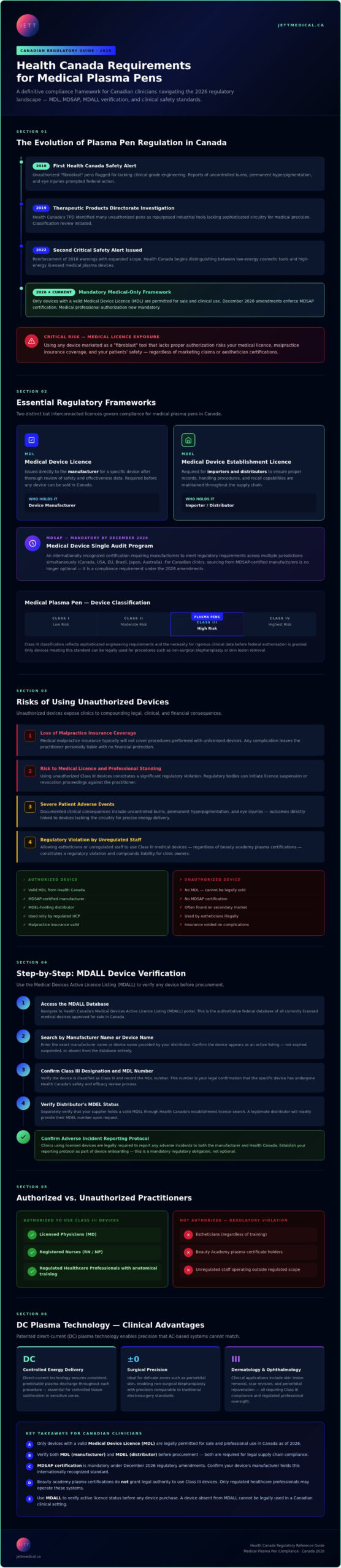
The regulatory environment for plasma technology in Canada has shifted from broad safety warnings to a precise, medical-only framework. In 2018 and 2022, Health Canada issued critical alerts regarding unauthorized “fibroblast” pens. These devices often lacked the engineering required for clinical safety, leading to severe adverse events. Today, the 2026 regulatory stance is definitive: only medical-grade devices with a valid Medical Device Licence (MDL) are permitted for sale and use. These authorized systems rely on the principles of electrosurgery to provide controlled tissue sublimation, ensuring that energy delivery remains consistent and predictable throughout the procedure.
Adhering to Health Canada requirements for medical plasma pens is essential for clinic owners who wish to avoid the legal pitfalls of “aesthetician-grade” equipment. While consumer-grade pens are still found on the secondary market, their use in a professional setting constitutes a significant regulatory violation. This transition from a ban on all devices to the authorization of specific medical technologies reflects a commitment to clinical precision and patient safety.
Understanding the 2019 Safety Alert and Its 2026 Impact
The initial 2019 safety alerts were a direct response to reports of uncontrolled burns, permanent hyperpigmentation, and eye injuries. Health Canada’s Therapeutic Products Directorate identified that many unauthorized pens were essentially repurposed industrial tools that lacked the sophisticated circuitry needed for medical precision. By 2026, the impact of these alerts has crystallized into a strict classification system. Health Canada now distinguishes between low-energy cosmetic tools and high-energy medical plasma devices. Only the latter, when properly licensed, can be legally marketed for procedures like non-surgical blepharoplasty or skin lesion removal.
Regulated Health Professionals vs. Unregulated Estheticians
A major pillar of the current Health Canada requirements for medical plasma pens is the limitation of use to regulated healthcare professionals. This group includes licensed physicians and nurses who possess the anatomical knowledge to manage potential complications. Beauty Academy certifications for plasma treatments don’t replace formal medical training or grant legal authority to use Class III medical devices. Clinics that allow unregulated staff to perform these procedures risk more than just patient safety; they risk their professional standing. If a complication occurs, medical malpractice insurance typically won’t cover procedures performed with unlicensed devices or by staff operating outside their regulated scope of practice. This distinction is vital for maintaining the integrity of a medical aesthetic clinic. Nurses seeking to understand the full scope of their professional obligations and clinical opportunities can benefit from reviewing the comprehensive plasma pen for aesthetic nurses guide that outlines Health Canada licensing requirements and evidence-based protocols for safe integration into practice.
Essential Regulatory Frameworks: MDL and MDSAP Explained
The regulatory landscape for medical devices in Canada is governed by two distinct yet interconnected licensing frameworks. To meet the Health Canada requirements for medical plasma pens, a device must possess a Medical Device Licence (MDL), while the entity importing or selling it must hold a Medical Device Establishment Licence (MDEL). High-energy plasma devices are typically designated as Class III medical devices. This classification reflects their sophisticated engineering and the necessity for rigorous clinical data before federal authorisation is granted. It ensures that only technology with proven efficacy and safety profiles enters the Canadian clinical environment, protecting both the practitioner and the patient from the risks associated with unverified equipment.
MDL vs. MDEL: What Clinic Owners Need to Know
Clinic owners must distinguish between these two licences to ensure full legal compliance. An MDL is issued directly to the manufacturer for a specific device after a thorough review of its safety and effectiveness. Conversely, an MDEL is required for importers and distributors to ensure they maintain proper records, handling procedures, and recall capabilities. Verifying both licences is a critical step in procurement, as the Health Canada 2018 safety alert demonstrated that many devices on the market lack these essential authorisations. Additionally, clinics using licensed devices are legally required to report any adverse incidents to the manufacturer and Health Canada. This mandatory reporting facilitates ongoing surveillance of medical technology and maintains the high standard of care expected in Canadian medicine.
The Significance of MDSAP for Canadian Clinicians
The Medical Device Single Audit Program (MDSAP) represents the highest standard of quality management in the global medical industry. Since January 1, 2019, Health Canada has mandated MDSAP certification for all manufacturers of Class II, III, and IV medical devices sold in Canada. This program allows a single regulatory audit to satisfy the requirements of multiple jurisdictions, including the United States, Australia, Brazil, and Japan. For a Canadian clinician, MDSAP certification is a guarantee that the manufacturer adheres to a rigorous quality management system. It prioritises patient-centric results and technological reliability through every stage of production. This certification isn’t just a badge; it’s a comprehensive validation of the manufacturer’s ability to maintain safety standards consistently. Jett Medical Canada remains committed to this standard, ensuring that our partners receive only MDSAP-approved plasma technology that meets every federal safety benchmark. This alignment with international standards provides a level of professional security that unauthorised consumer-grade tools cannot offer.
Clinical and Legal Implications of Using Unauthorized Devices
Operating outside the established Health Canada requirements for medical plasma pens introduces profound risks to both the patient and the practitioner. When a clinic utilizes unauthorized equipment, they’re not merely bypassing a bureaucratic step; they’re deploying technology that hasn’t undergone rigorous verification for thermal stability or electrical safety. The 2022 Health Canada update on plasma pens explicitly reiterated that unauthorized devices can cause permanent scarring, hyperpigmentation, and severe eye damage if used near the periorbital region. Beyond the clinical dangers, provincial regulatory bodies view the use of unlicensed medical devices as professional misconduct. This can result in disciplinary hearings, heavy fines, or the permanent revocation of a medical licence.
Insurance and Liability: The Financial Risk of Non-Compliance
Professional liability insurance is a cornerstone of medical practice, yet it offers no protection if the equipment used is illegal. Most Canadian medical malpractice policies contain specific clauses that exclude coverage for procedures performed with unauthorized medical devices. If a patient suffers a complication, such as a deep thermal burn or infection, the practitioner may face personal financial responsibility for legal fees and settlements. Insurance providers utilize the Medical Devices Active Licence Listing (MDALL) as their primary source of truth. If your device doesn’t appear in this database, you’re practicing without a safety net. Maintaining a “Health Canada Licensed” status is your most robust defence in a legal setting, proving that you’ve adhered to the highest standards of professional due diligence.
Technological Rigour: Why Medical Grade Plasma is Safer
The technical distinction between authorized and unauthorized devices often comes down to the current type utilized. Most consumer-grade or “aesthetician-grade” pens use Alternating Current (AC), which creates an erratic and unstable plasma discharge. This instability is the primary cause of the excessive burns cited in federal safety warnings. In contrast, medical-grade technology focuses on the science of DC plasma vs AC plasma to ensure clinical precision.
Direct Current (DC) plasma allows for a continuous, controlled discharge that sublimates the epidermis without causing uncontrolled collateral thermal damage to the dermis. This level of precision is mandatory for delicate procedures like non-surgical blepharoplasty or the removal of xanthelasma. By choosing a licensed DC system, clinicians can achieve predictable results while minimizing the inflammatory response. This controlled approach significantly reduces downtime and ensures that the healing process aligns with expected clinical outcomes. Using technology that meets Health Canada requirements for medical plasma pens isn’t just about following the law; it’s about providing the most sophisticated and safe care possible. Clinics seeking to understand how this investment translates to financial performance can benefit from reviewing a detailed plasma pen ROI for medical clinics analysis that examines revenue diversification and operational efficiency in the current regulatory environment.
Step-by-Step: Verifying Device Compliance for Your Practice
Ensuring your clinic adheres to Health Canada requirements for medical plasma pens requires a proactive verification strategy. The primary tool for this task is the Medical Devices Active Licence Listing (MDALL) database, a publicly accessible registry maintained by the federal government. This database provides the definitive status of every medical device authorized for sale in Canada. Before integrating new technology into your practice, you must confirm that the specific model and manufacturer have successfully navigated the federal review process. Relying on marketing brochures is insufficient; clinical due diligence demands direct verification through official channels.
Navigating the MDALL Database Like a Pro
To verify a device, start by locating the “Licence No.” or “Device ID” on the equipment’s physical label or within the technical specifications provided by the supplier. Once you have this information, access the Active Licence Search on the Health Canada website. You can search by the manufacturer’s name, the device name, or the specific licence number. When the results appear, pay close attention to the “Intended Use” section. It’s vital to confirm that the authorized clinical applications align with the procedures you intend to perform. For instance, if a device is only licensed for general dermatological use, using it for specialized ophthalmic procedures may void your insurance coverage and violate federal regulations. Always request a PDF copy of the Medical Device Licence (MDL) from your supplier to keep in your clinic’s compliance records.
Red Flags to Watch for When Sourcing Plasma Pens
Professional medical equipment represents a significant clinical investment, and certain “red flags” often indicate non-compliant technology. Be wary of suppliers who cannot immediately provide an MDL number for their specific device or those who use vague terminology like “Health Canada compliant” without providing proof of licensure. Another common tactic involves marketing high-energy devices as “for cosmetic use only.” This is frequently an attempt to bypass the rigorous Class III medical device regulations. If a device is priced significantly lower than the industry standard for licensed technology, it’s often a sign of a grey-market or consumer-grade tool. These units rarely possess the thermal stability or electrical safety features required for medical precision. If you’re uncertain about the status of a prospective tool, you can verify our compliance documentation to see the standard expected of a licensed Canadian distributor. Protecting your practice starts with refusing to compromise on the legitimacy of your technology.
The Jett Medical Standard: Licensed Innovation for Canadian Clinicians
Jett Medical Canada serves as a primary conduit for advanced plasma technology that aligns with federal safety standards. We prioritize regulatory integrity to ensure that every device we distribute, such as the Jett Plasma Pen Medical and Jett Plasma Lift Medical, provides the precision required for complex dermatological and ophthalmic procedures. By adhering strictly to Health Canada requirements for medical plasma pens, we empower clinicians to offer high-demand treatments without the risks associated with unverified equipment. This commitment transforms regulatory compliance from a hurdle into a competitive clinical advantage for your practice.
A Commitment to International Standards: MDSAP and Beyond
Our status as an MDSAP-certified distributor reflects a deep commitment to international quality management systems. This certification ensures that our manufacturing partners undergo rigorous, single-audit evaluations that satisfy the demands of global regulatory bodies. The clinical superiority of our technology is rooted in patented direct-current (DC) plasma. Unlike unstable alternating current systems, DC plasma offers a constant discharge that ensures predictable tissue sublimation and minimal thermal spread. We actively assist our partners in the Health Canada licensed plasma devices verification process, providing all necessary MDL documentation to secure their practice’s professional standing.
Next Steps for Your Practice
Transitioning to licensed technology is a strategic move for any clinic focused on long-term growth and patient safety. We offer comprehensive clinical demonstrations to showcase the operational efficiency and safety profiles of our authorized devices. Beyond the hardware, we provide specialized training modules designed for dermatology and ophthalmology nurses. These sessions ensure that every operator understands the technical nuances of DC plasma and its application in a medical setting. Nurses looking to deepen their clinical knowledge before adopting this modality can explore the 2026 Canadian plasma pen guide for aesthetic nurses, which covers DC plasma science, patient selection criteria, and Health Canada compliance protocols in detail. If you’re ready to align your clinic with the highest standards of safety and efficacy, you can Contact Jett Medical Canada to upgrade your practice’s technology today. Our team provides the ongoing clinical support and technical expertise required to maintain a leadership position in the Canadian aesthetic market. We don’t just sell devices; we build partnerships based on scientific rigour and clinical excellence.
Securing the Clinical Future of Your Aesthetic Practice
Aligning your clinic with the latest Health Canada requirements for medical plasma pens is a strategic investment in professional longevity and patient-centric results. By prioritizing licensed technology like the Jett Plasma Pen Medical, you ensure that your practice remains protected against professional liability and regulatory scrutiny. The transition to MDSAP-certified equipment and patented direct-current technology provides the precision necessary for advanced dermatological and ophthalmic care. It’s essential to verify every device on the MDALL database to maintain the high standards of safety expected in the Canadian medical landscape. Clinic owners looking to further strengthen their business case for this transition can explore how maximizing plasma pen ROI for medical clinics through versatile, licensed platforms supports both clinical excellence and long-term financial sustainability.
If you’re ready to elevate your service offerings with authorized innovation, Request a Compliance Consultation with Jett Medical Canada. Our team provides the specialized training and Health Canada licensed devices needed to lead the market with confidence. We’re here to support your commitment to clinical excellence and technological advancement. It’s time to build a foundation of safety that your patients can trust.
Frequently Asked Questions
Are all plasma pens illegal in Canada in 2026?
No. While many consumer-grade devices remain unauthorized, specific medical-grade devices have received Health Canada authorization. Devices like the Jett Plasma Pen Medical are licensed for professional use by regulated healthcare providers. It’s critical to verify the current status of any equipment on the Medical Devices Active Licence Listing (MDALL) to ensure it’s not part of the unauthorized category originally identified in federal safety alerts.
Can an aesthetician legally use a Health Canada licensed plasma pen?
No. Regulatory updates in 2022 and 2026 have solidified the requirement that authorized plasma devices be sold to and used by “healthcare professionals only.” This includes licensed doctors and nurses. Even if the device is licensed, its use by an unregulated esthetician constitutes a violation of the manufacturer’s intended use and can lead to professional liability issues and the loss of clinic insurance coverage.
What is the difference between an MDL and an MDEL?
An MDL (Medical Device Licence) is issued to the manufacturer for a specific device after it meets safety and efficacy standards. An MDEL (Medical Device Establishment Licence) is required for importers and distributors to ensure they maintain proper records and recall procedures. To satisfy Health Canada requirements for medical plasma pens, the device must have an MDL, and the distributor you purchase from must hold a valid MDEL.
How can I check if a specific plasma pen is Health Canada authorized?
You can verify authorization by searching the Medical Devices Active Licence Listing (MDALL) database. Search using the manufacturer’s name, the specific device name, or the licence number. If the device doesn’t appear in this active registry, it’s not authorized for sale or use in Canada. Always ask your supplier for a copy of their Medical Device Licence to confirm the equipment’s regulatory standing before finalizing any purchase.
What happens if I use an unauthorized plasma pen in my medical clinic?
Using unauthorized equipment exposes your practice to severe legal and professional risks. Provincial regulatory bodies may pursue disciplinary action, including the revocation of your medical licence. Additionally, medical malpractice insurance providers typically exclude coverage for procedures performed with unlicensed devices. This leaves the practitioner personally liable for any patient injuries, such as permanent scarring or eye damage, resulting from the use of non-compliant technology.
Does Health Canada license plasma pens for home use?
No. Health Canada has not authorized any plasma pen devices for consumer or home use. These systems are classified as high-energy medical devices that require professional anatomical knowledge to operate safely. Unauthorized home-use pens, often marketed for “fibroblast” treatments, pose significant health risks, including uncontrolled burns and infections. Federal authorities continue to monitor and seize these devices to protect the public from improper application.
Is Jett Plasma technology authorized by Health Canada?
Yes. Jett Medical Canada distributes technology that is fully licensed by Health Canada and MDSAP-approved. Devices such as the Jett Plasma Pen Medical and Jett Plasma Lift Medical meet all federal safety and quality standards. Our patented direct-current (DC) technology provides the precision required for medical applications while ensuring full compliance with the Health Canada requirements for medical plasma pens currently in effect for 2026.
Why does Health Canada classify plasma pens as medical devices?
Plasma pens are classified as medical devices because they utilize high-frequency electrical currents to sublimate skin tissue. This process creates a controlled burn to stimulate a healing response, which carries inherent clinical risks if not managed by trained professionals. Because these devices can cause permanent physiological changes and potential injury to delicate structures like the eyes, Health Canada regulates them as Class III medical devices to ensure rigorous safety testing.