
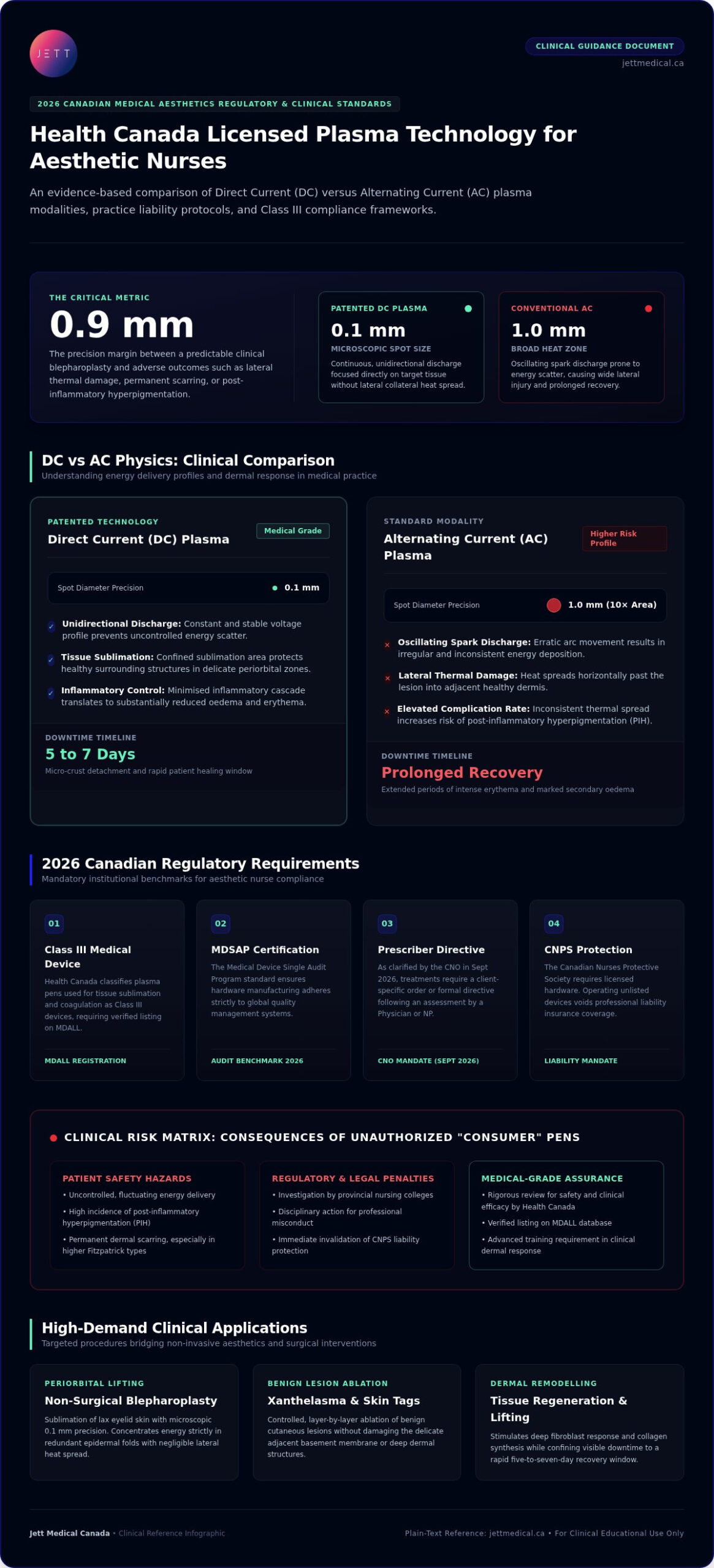
Did you know that the precision difference between a predictable non-surgical blepharoplasty and an adverse clinical outcome often comes down to just 0.9 millimetres? While conventional alternating current devices create a broad 1.0 mm heat-affected zone, patented Direct Current technology achieves a microscopic 0.1 mm spot size. Many Canadian aesthetic nurses feel a justified hesitation to adopt this modality, often stemming from confusion over Health Canada licensing and the valid fear of causing permanent scarring or hyperpigmentation. You aren’t alone in prioritizing patient safety and evidence-based results over market trends.
This guide will show you how to safely integrate a Health Canada licensed plasma pen for aesthetic nurses into your clinical practice to achieve superior results with minimal downtime. You’ll discover the science behind DC plasma, which reduces patient recovery to just five to seven days while maintaining the rigorous safety standards required for Class III medical devices. We will also outline the specific regulatory requirements for 2026, helping you distinguish authorized medical-grade technology from unauthorized consumer pens to ensure your practice remains compliant and your patients remain protected.
Key Takeaways
- Understand the critical regulatory distinctions between unauthorized devices and a Health Canada licensed plasma pen for aesthetic nurses to ensure your practice remains compliant with 2026 standards.
- Learn how patented Direct Current (DC) technology provides a microscopic 0.1 mm spot size, which minimizes thermal spread and reduces patient healing time to five to seven days.
- Identify the clinical protocols for high-demand procedures such as non-surgical blepharoplasty and the precise ablation of benign lesions like xanthelasma and skin tags.
- Discover why advanced clinical training in dermal response is essential for preventing complications and delivering consistent, high-quality results in a professional medical setting.
- Realize the potential for practice growth by offering sophisticated, non-invasive treatments that bridge the gap between traditional aesthetics and surgical interventions.
Navigating the 2026 Regulatory Landscape for Plasma Pens in Canada
Health Canada classifies professional plasma devices used for tissue sublimation and coagulation as Class III medical devices. This regulatory framework is essential. It distinguishes high-precision medical technology from unauthorized “fibroblast” pens often marketed to the spa industry. For a plasma pen for aesthetic nurses to be legally operated within a Canadian clinic, it must appear on the Medical Device Active Licence Listing (MDALL). This listing confirms that the hardware has undergone rigorous review for safety and clinical efficacy. It’s a critical distinction that protects both the practitioner and the patient from the risks associated with unregulated equipment.
The Consequences of Using Unauthorized Devices
Using unlicensed hardware carries severe professional risks. The Canadian Nurses Protective Society (CNPS) mandates that practitioners use only Health Canada authorized devices to maintain professional liability coverage. Operating an unlisted device can lead to disciplinary action from provincial colleges for professional misconduct. Beyond legal risks, patient safety remains the primary concern. Unauthorized pens often deliver inconsistent, fluctuating energy. This instability increases the likelihood of post-inflammatory hyperpigmentation (PIH) and permanent scarring, especially on patients with higher Fitzpatrick skin types. To protect your practice and patient outcomes, always verify a Health Canada licensed plasma device before procurement.
The 2026 Standard for Canadian Medical Aesthetic Clinics
Modern standards require more than just a basic licence number. The Medical Device Single Audit Program (MDSAP) has become a non-negotiable benchmark for professional equipment in 2026. This certification confirms that the manufacturer adheres to the highest global quality management standards, ensuring every unit performs with clinical precision. The integration of plasma medicine in dermatology has transformed how we approach tissue regeneration and non-surgical lifting. It allows for a level of control that was previously unavailable in non-invasive treatments.
As of September 2026, nursing regulators like the CNO have clarified that these procedures require a client-specific order or a formal medical directive from a licensed prescriber. This ensures a physician or Nurse Practitioner has evaluated the patient before the plasma pen for aesthetic nurses is utilized. Regulatory compliance isn’t just a hurdle; it’s the foundation of patient trust. It allows clinics to scale safely while delivering the predictable, high-ROI outcomes that patients expect from medical-grade technology. By adhering to these strict standards, nurses position themselves as leaders in a sophisticated and rapidly evolving medical field.
Understanding the Clinical Advantage of Direct Current (DC) Plasma
Direct current (DC) plasma represents a significant leap in precision compared to the alternating current (AC) systems found in many non-medical settings. In a clinical environment, the ability to control energy delivery is paramount. AC devices operate through an oscillating spark discharge that creates an erratic heat-affected zone. This often results in a spot size of 1.0 mm, which is too broad for delicate periorbital work. In contrast, patented DC technology produces a continuous, unidirectional discharge. This allows a plasma pen for aesthetic nurses to achieve a microscopic spot size of 0.1 mm, concentrating energy exactly where it’s required without affecting surrounding healthy tissue.
DC vs AC Plasma: Why It Matters for Patient Healing
The physics of the plasma arc determines the predictability of the treatment. AC plasma pens are prone to energy “scatter,” which leads to uneven tissue sublimation and increased lateral thermal damage. This collateral damage is the primary cause of prolonged oedema and erythema. Because DC plasma provides a stable and constant voltage, it minimizes the inflammatory response. Clinical data suggests that patients treated with DC technology typically see micro-crust detachment within five to seven days, whereas AC devices often require ten to fourteen days for similar re-epithelialization. This efficiency is why many practitioners are moving away from unauthorized equipment, as noted in the Health Canada safety advisory on plasma pens.
DC plasma is a medical-grade energy source that eliminates the “scatter” effect of AC devices by maintaining a unidirectional, continuous flow of ionized gas.
Precision Engineering in Professional Devices
Achieving a consistent depth of penetration is essential for safe skin tightening. The Jett Plasma Pen Medical utilizes patented technology to ensure that energy does not travel deeper than the superficial epidermis unless specifically intended. This precision prevents carbonization and excessive skin charring, which are common risks with lower-quality hardware. By avoiding deep ablative burns, nurses can deliver significant contraction of redundant skin folds while maintaining a high safety profile. This level of control makes the plasma pen for aesthetic nurses an indispensable tool for non-surgical blepharoplasty and perioral resurfacing. If you’re looking to elevate your clinical outcomes, you can explore the technical specifications of DC technology to see how it fits your practice.
Safety Standards and Professional Training for Aesthetic Nurses
The clinical efficacy of a plasma pen for aesthetic nurses depends as much on practitioner expertise as it does on the device’s technical specifications. While the hardware provides the energy, the nurse’s understanding of the dermal response determines the outcome. When plasma energy interacts with the skin, it causes immediate sublimation of the epidermis while simultaneously delivering a controlled thermal profile to the deeper dermis. This dual action triggers a wound-healing cascade that stimulates fibroblasts to produce new collagen and elastin. Without a deep understanding of this physiological process, a practitioner cannot accurately predict the tissue’s contraction or its eventual recovery path.
Patient screening is the first line of defence in maintaining safety. Nurses must evaluate candidates based on their Fitzpatrick skin type, medical history, and current skin condition. Contraindications such as active infections, pacemakers, or a history of keloid scarring are absolute barriers to treatment. Adhering to the Health Canada safety alert and licensing requirements is essential for ensuring that only authorized, medical-grade devices are used. This regulatory compliance protects the practice from the liability risks associated with unauthorized cosmetic tools that lack the precision required for medical applications.
Developing a Medical Standard of Care
Implementing a rigorous standard of care involves more than just procedural skill. It requires strict adherence to sterilization and infection control protocols to prevent post-procedural complications. Every treatment session should be supported by standardized clinical photography and detailed documentation. This creates a clear medical record of the patient’s progress and helps manage expectations during the consultation phase. By providing patients with a realistic roadmap of the healing process, nurses reduce post-treatment anxiety and ensure higher satisfaction rates. It’s about building a practice grounded in transparency and clinical evidence.
Sourcing Medical Grade Plasma Training in Canada
Professional certification must go beyond a simple one-day overview of device buttons. A comprehensive program should cover advanced techniques for specialized areas, such as the periorbital and perioral regions. When selecting a curriculum, prioritize those offered by reputable medical aesthetic device distributors in Canada that provide ongoing clinical support. This partnership ensures that you’ve access to peer-to-peer learning and advanced workshops as technology evolves. Ongoing mentorship is a vital component of professional growth, allowing you to refine your skills and implement high-ROI treatments with confidence. Expert-led training bridges the gap between basic operation and the mastery required to deliver superior clinical results.
High-Demand Clinical Applications for Aesthetic Nurses
Medical plasma technology expands the clinical scope for practitioners beyond traditional injectables and laser therapies. By utilizing a high-precision plasma pen for aesthetic nurses, clinicians can address complex anatomical areas that were previously reserved for surgical intervention. The versatility of ionized gas allows for both ablative and non-ablative protocols, providing solutions for a diverse range of dermatological and ophthalmic conditions. This adaptability ensures that a single platform can treat multiple patient concerns with clinical rigour.
Non-Surgical Eyelid Lifting (Blepharoplasty)
Non-surgical blepharoplasty remains the most sought-after application for medical plasma. The mechanism involves tissue sublimation, where the superficial epidermis is converted directly from a solid to a gas. This process results in immediate contraction of redundant skin folds. It’s a significant advancement because there’s no need for incisions or general anaesthesia. Precision is paramount in the periorbital region. The controlled energy discharge ensures that the thermal effect remains localized, protecting the delicate ocular structures. While surgical blepharoplasty involves significant downtime and risks such as ectropion, plasma therapy offers a predictable alternative with manageable recovery and no risk of over-correction.
Specialized Dermatological Treatments
Clinicians often utilize a professional fibroblast device to treat benign skin lesions that are resistant to other modalities. This includes the precise removal of xanthelasma, cherry angiomas, and seborrheic keratoses. Because the technology allows for layer-by-layer ablation, the risk of scarring is significantly reduced compared to traditional cautery. The same principles apply to advanced resurfacing for perioral lines, often called smoker’s lines, where the plasma arc stimulates deep dermal remodelling to smooth stubborn dynamic wrinkles. Practitioners also report success in treating:
- Skin laxity in the neck and décolletage areas;
- Hypertrophic surgical scars and stretch marks;
- Active acne through the sterilization properties of cold atmospheric plasma.
The technology is increasingly used in periorbital medicine to treat ocular surface disorders. High-precision DC plasma can effectively manage blepharitis and Meibomian Gland Dysfunction (MGD) by clearing obstructed glands and reducing localized inflammation. This convergence of aesthetic and medical care allows nurses to provide comprehensive treatment plans for their patients. It’s a sophisticated way to elevate the standard of care in any medical aesthetic setting. To learn more about implementing these advanced protocols, you can view our clinical application guides for medical professionals.
Elevating Your Practice with Jett Medical Plasma Technology
Integrating a medical-grade plasma pen for aesthetic nurses into a clinical setting represents a strategic investment in both patient outcomes and practice revenue. While the clinical results build patient trust, the business structure ensures long-term sustainability. Positioning your clinic as a leader in non-invasive medical technology requires hardware that is backed by rigorous data and international certifications. By selecting devices with CE and MDSAP approval, you demonstrate a commitment to global quality standards that exceeds the baseline requirements of the Canadian market. This commitment to excellence is a powerful tool for patient retention and professional reputation.
Integration and Business Growth
The financial viability of new technology is a primary concern for clinic owners. Calculating plasma pen ROI for medical clinics involves more than just the treatment fee. It includes the ability to offer specialized procedures like non-surgical blepharoplasty that have high patient demand and low consumable costs. Marketing these services effectively hinges on emphasizing your professional nursing expertise and the use of Health Canada licensed equipment. This transparency differentiates your practice from competitors using unauthorized tools. Building a partnership with a trusted Canadian distributor provides the technical support and clinical updates necessary to maintain this competitive edge as the industry evolves.
The Jett Medical Advantage
The Jett Medical portfolio offers specialized solutions tailored to different clinical needs. The Jett Plasma Lift Medical and Jett Plasma Medical II models provide the precision of patented DC technology for both ablative and non-ablative treatments. These systems allow for eight intensity levels, giving nurses the flexibility to treat everything from delicate periorbital skin to stubborn benign lesions. For clinics looking to expand into the intersection of aesthetics and ophthalmology, the Edge O Tech system provides specialized applicators designed for ocular surface disorders. This technological breadth allows a practice to diversify its service menu while maintaining a unified standard of care.
Evaluating hardware is the final step in the integration process. Requesting a clinical demonstration allows you to experience the ergonomic design and intuitive interface of the Jett systems firsthand. It also provides an opportunity to review the MDSAP certification documents and verify the current MDALL listing. This due diligence ensures that your investment is protected and that your clinical practice remains anchored in safety. Aesthetic nurses must prioritize Health Canada licensed DC technology to ensure patient safety and clinical excellence while delivering the superior results their patients expect.
Advancing the Standard of Medical Aesthetic Care
The transition into medical plasma therapy represents a significant milestone for Canadian clinicians. By prioritizing Health Canada licensed hardware and MDSAP certified manufacturing, you ensure that your practice operates within the highest regulatory and safety parameters. Patented DC technology provides the precision required to deliver superior results in delicate areas while maintaining a predictable healing window for your patients. Adopting a high-performance plasma pen for aesthetic nurses allows you to bridge the gap between traditional aesthetics and surgical interventions with confidence.
With the right clinical training and a commitment to evidence-based technology, you can achieve surgical-grade outcomes through non-invasive protocols. This evolution in your service menu doesn’t just enhance patient satisfaction; it secures your position as a pioneer in specialized periorbital and dermatological care. The integration of sophisticated energy devices is a logical step for those dedicated to the intersection of technology and human health. Request a clinical consultation for Jett Medical plasma technology to evaluate our systems and explore the future of your practice. We look forward to supporting your commitment to clinical excellence and patient safety.
Frequently Asked Questions
Is a plasma pen treatment legal for aesthetic nurses to perform in Canada?
Yes, Registered Nurses and Registered Practical Nurses can perform these treatments provided they use Health Canada licensed devices and adhere to provincial regulatory standards. Nurses must operate under a client-specific order or a formal medical directive from a licensed prescriber who has evaluated the patient. Using unauthorized “fibroblast” pens is illegal and risks disciplinary action from provincial colleges, as these tools don’t meet the Medical Devices Regulations.
What is the difference between a professional plasma pen and a consumer-grade device?
Professional devices are Class III medical instruments authorized by Health Canada for tissue sublimation and coagulation. Consumer-grade pens lack MDALL registration and often utilize low-voltage circuitry that fails to generate true physical plasma. These unauthorized tools provide inconsistent energy delivery, which significantly increases the risk of permanent scarring and hyperpigmentation. Professional hardware like the Jett Plasma Pen Medical undergoes rigorous testing to ensure clinical precision and patient safety.
How does Direct Current (DC) plasma technology differ from Alternating Current (AC)?
DC technology provides a continuous, unidirectional discharge that maintains a constant voltage. This allows for a microscopic 0.1 mm spot size, whereas AC systems produce an oscillating spark with a much wider 1.0 mm heat-affected zone. The stability of DC energy reduces lateral thermal damage to surrounding healthy tissue. This technical advantage results in more predictable clinical outcomes and a faster re-epithelialization process for the patient during recovery.
What are the main risks associated with unlicensed plasma pens?
Operating unlicensed hardware exposes practitioners to professional misconduct charges and the potential loss of liability insurance coverage. From a clinical perspective, these devices often cause excessive carbonization and deep ablative burns due to erratic energy output. Patients may suffer from chronic erythema, infection, or post-inflammatory hyperpigmentation. Using a licensed plasma pen for aesthetic nurses ensures the device meets stringent safety standards for energy stability and biocompatibility.
How long is the downtime for a medical-grade plasma treatment?
Typical recovery involves a healing window of five to seven days for the detachment of micro-crusts. Patients generally experience localized oedema and redness for the first 24 to 48 hours following the procedure. Because medical-grade DC technology minimizes collateral thermal spread, the inflammatory response is significantly lower than that of older AC systems. This efficiency allows patients to return to their daily routines sooner while achieving superior skin contraction.
Can a plasma pen be used for non-surgical blepharoplasty in Canada?
Yes, non-surgical blepharoplasty is a primary indication for Health Canada licensed plasma devices. The procedure utilizes tissue sublimation to contract the skin of the upper or lower eyelids without surgical incisions or general anaesthesia. It’s essential that nurses perform this treatment using high-precision hardware to protect delicate periorbital structures. This modality offers a viable alternative for patients seeking eyelid rejuvenation who don’t require or desire traditional surgical intervention.
What certifications should I look for when buying a plasma device for my clinic?
You must verify that the device holds an active Medical Device Licence and is listed on the Health Canada MDALL database. International standards such as the Medical Device Single Audit Program (MDSAP) and CE medical certification are also non-negotiable indicators of quality. These credentials confirm that the manufacturer adheres to strict quality management systems and that the device has been validated through comprehensive clinical data and safety testing.
Is specific training required for nurses to use the Jett Plasma Pen Medical?
Comprehensive clinical training is mandatory for the safe operation of professional plasma technology. Nurses must complete a curriculum that covers advanced anatomy, physiological tissue responses, and specific procedural protocols. Jett Medical Canada provides specialized support and certification to ensure that practitioners can confidently implement treatments like non-surgical blepharoplasty. Ongoing education is vital for maintaining high clinical standards and ensuring optimal patient safety across all dermatological and ophthalmic applications.