
Investing in an unverified plasma pen might seem like a cost-effective entry into aesthetics, but it often exposes a Canadian practice to significant regulatory risk and inconsistent clinical outcomes. You’ve likely noticed the market is saturated with consumer-grade devices that blur the line between professional medical tools and hazardous novelties. Finding a legitimate medical plasma device for sale requires more than a simple price comparison. It demands a rigorous assessment of Health Canada licence status and the technical superiority of patented direct current (DC) technology.
This 2026 guide provides the clinical clarity you need to distinguish between high-precision instruments and the alternating current (AC) pens that often fail to meet professional standards. We’ll explore the essential regulatory frameworks, the benefits of MDSAP-certified hardware, and how specialized applications like dry-eye therapy can significantly enhance your clinic’s revenue potential. By the end of this article, you’ll understand how to select a device that ensures patient safety and delivers the predictable, sophisticated results your patients expect.
Key Takeaways
- Understand why a Health Canada licence and MDSAP compliance are mandatory for the legal operation of medical-grade plasma technology in Canada.
- Differentiate between consumer-grade tools and a professional medical plasma device for sale by evaluating the precision of patented Direct Current (DC) technology.
- Explore multi-disciplinary clinical applications, ranging from ophthalmic dry-eye therapy to dermatological scar revision and non-surgical blepharoplasty.
- Realize the clinical benefits of a stable 0.1mm plasma arc for achieving predictable tissue sublimation with minimal thermal damage to surrounding areas.
- Identify the appropriate Jett Plasma Medical model for your specialty and the specific training protocols required to maintain high standards of patient care.
Evaluating the Clinical Utility of Medical Plasma Devices
Plasma represents the fourth state of matter, created through the ionization of atmospheric gas. In the emerging field of plasma medicine, this energy is harnessed for controlled tissue sublimation. This process allows clinicians to convert solid tissue directly into gas without the heat conduction associated with traditional electrosurgery. By focusing energy at the tip of a specialized probe, practitioners achieve precise micro-trauma that spares the surrounding healthy dermis.
The Evolution of Plasma in Modern Medicine
Historically, plasma technology was restricted to high-energy surgical cautery. It’s since evolved into a non-ablative, precision-focused modality used in diverse clinical settings. The shift toward multi-disciplinary devices has allowed specialists to treat delicate areas, such as the eyelids, where traditional lasers might pose risks. For Canadian practitioners, 2026 marks a pivotal turning point. Regulatory maturation and a clearer distinction between professional hardware and aesthetic novelties have stabilized the market, making it the ideal time to integrate these tools into a professional setting.
Distinguishing Medical Grade from Aesthetic Grade
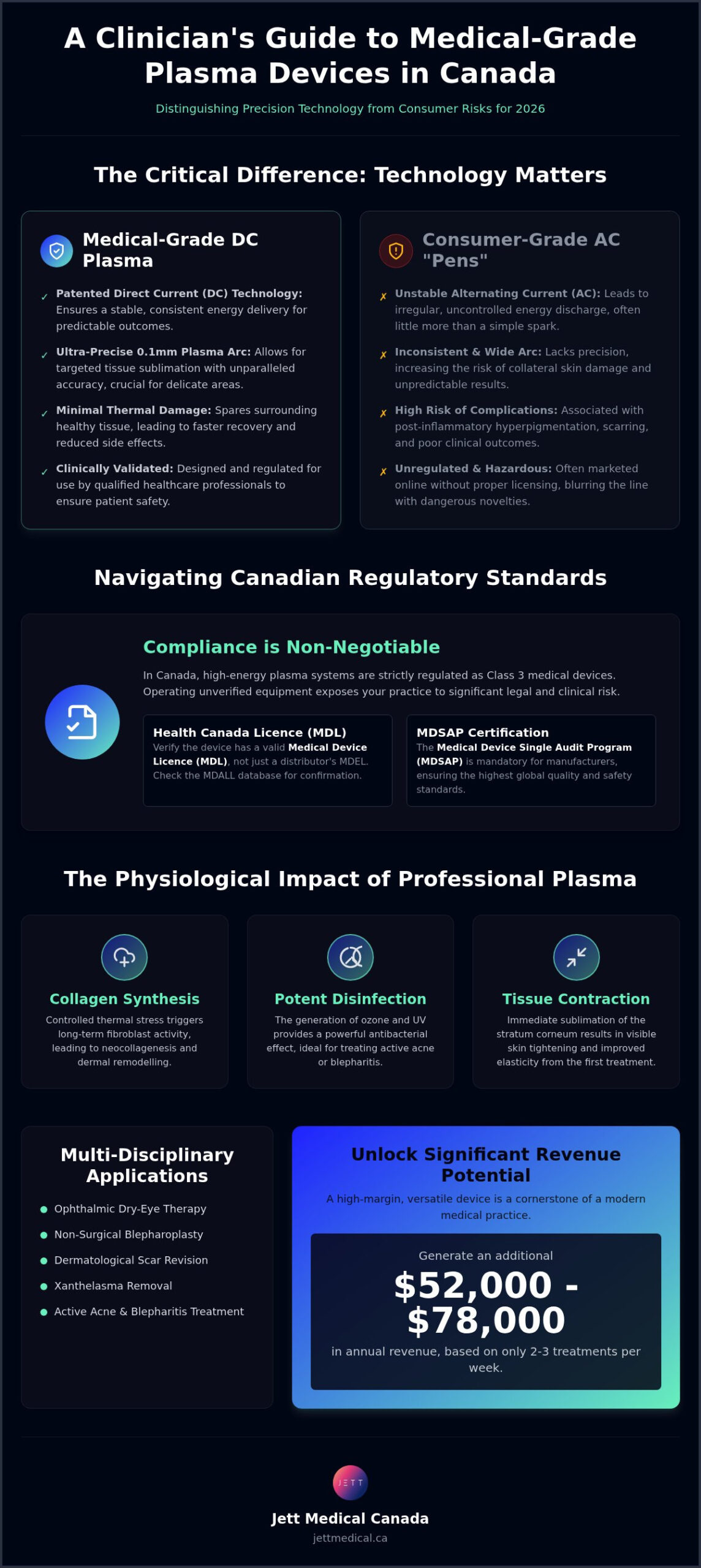
When searching for a medical plasma device for sale, you’ll find a clear technical divide between professional instruments and consumer-grade pens. Medical-grade units prioritize voltage stability and discharge control to ensure the plasma arc remains consistent throughout the procedure. Consumer “plasma pens” often rely on unstable alternating current (AC) discharge. This instability leads to irregular energy delivery, which increases the risk of post-inflammatory hyperpigmentation and unpredictable scarring. High-precision devices maintain a steady 0.1mm arc, allowing for the exactness required in ophthalmic and dermatological applications.
The physiological impact of professional plasma therapy extends beyond simple surface tightening. It involves three primary mechanisms:
- Collagen Synthesis: Controlled thermal stress in the papillary dermis triggers long-term fibroblast activity and neocollagenesis.
- Disinfection: The generation of ozone and ultraviolet components during the discharge provides a potent antibacterial effect, useful for treating active acne or blepharitis.
- Tissue Contraction: Immediate sublimation of the stratum corneum leads to visible skin tightening and improved elasticity.
Choosing a medical plasma device for sale is a strategic decision that affects your clinic’s return on investment. Canadian clinics that integrate specialized plasma therapies often see a rapid expansion in their service offerings. Research indicates that a clinic performing just two to three treatments per week can generate between $52,000 and $78,000 in additional annual revenue. This high margin, combined with the versatility of treating conditions from xanthelasma to dry-eye disease, makes plasma a cornerstone of the modern Canadian medical practice. Understanding how to optimize plasma pen ROI for medical clinics through strategic multi-specialty integration is essential for maximizing this revenue potential.
Navigating Canadian Regulatory Standards: Health Canada and MDSAP Compliance
Compliance in the Canadian medical landscape isn’t optional; it’s the foundation of clinical safety and legal practice. Health Canada strictly regulates the sale and use of plasma technology, classifying high-energy systems as Class 3 medical devices. A pivotal 2022 regulatory update clarified that these instruments are restricted to use by qualified healthcare professionals only. When evaluating a medical plasma device for sale, you must verify that the specific model holds a valid Medical Device Licence (MDL). This is distinct from a Medical Device Establishment Licence (MDEL), which only permits a company to distribute products but doesn’t validate the safety of the device itself. You can confirm a product’s status by searching the Medical Devices Active Licence Listing (MDALL) database, ensuring your chosen technology meets the rigorous criteria for Health Canada requirements for medical plasma pens.
The Significance of MDSAP for Canadian Clinics
The Medical Device Single Audit Program (MDSAP) represents the highest standard of quality management in the global supply chain. For a manufacturer to secure a Class II, III, or IV licence in Canada, they must provide proof of MDSAP certification. This program ensures that every stage of production, from initial design to final assembly, undergoes rigorous third-party auditing. Because medical aesthetic device distribution in Canada requires such specialized oversight, clinicians should view MDSAP compliance as a non-negotiable benchmark for reliability. It guarantees that the hardware you bring into your practice has been vetted for electrical safety, energy stability, and clinical efficacy.
Liability and Professional Standards
Operating unlicensed equipment carries severe implications for your professional standing. Most malpractice insurance providers explicitly exclude coverage for incidents involving non-compliant hardware. If a patient experiences an adverse event from an uncertified device, the clinician faces full personal liability and potential disciplinary action from their provincial regulatory body. Beyond the legal risks, patient safety remains the core driver of these standards. High-precision devices, like those found in the Jett Plasma series, are engineered to prevent the uncontrolled thermal spread often seen in cheap, unlicensed “fibroblast” pens. To protect your practice, use this verification checklist before procurement:
- Search the MDALL database using the specific device name and manufacturer.
- Confirm the presence of a unique Medical Device Licence (MDL) number.
- Verify that the distributor holds a valid MDEL to operate within Canada.
- Request documentation confirming the manufacturer’s current MDSAP certification status.
Maintaining these standards ensures your clinic remains at the forefront of the evolving aesthetic landscape while prioritizing patient outcomes. If you’re unsure about a specific unit’s standing, consult with a verified distribution partner to review current Health Canada registration data.
Direct Current vs. Alternating Current: Choosing Precision Technology
The technical foundation of a plasma system determines its clinical safety profile. Most entry-level devices utilize Alternating Current (AC), where the electrical flow reverses direction periodically. This oscillation creates an unstable discharge that often “scatters” across the skin surface, leading to uneven thermal damage and unpredictable depths of sublimation. In contrast, Direct Current (DC) provides a unidirectional flow, resulting in a significantly more stable and focused plasma arc. When searching for a professional-grade medical plasma device for sale, understanding this distinction is the key to achieving surgical-level precision without the complications associated with erratic energy delivery.
Jett Medical’s patented DC technology maintains a consistent 0.1mm arc diameter. This level of control is virtually impossible to achieve with AC units, which typically produce a wider, less predictable discharge that can fluctuate based on the distance from the skin. By stabilizing the ionization process, DC systems ensure that the energy delivered to the tissue is exact and repeatable across every treatment session.
The Precision of Direct Current (DC) Plasma
The stability of a DC discharge eliminates the lateral heat spread that characterizes lower-quality systems. This is particularly vital in the periorbital region, where the skin is exceptionally thin and the margin for error is minimal. Direct Current plasma is the essential technology for high-precision ophthalmic and dermatological procedures. By concentrating the energy on a microscopic point, clinicians can perform non-surgical blepharoplasty or treat xanthelasma with confidence that the surrounding tissue remains unaffected. This precision allows for a “spray” technique or a “spot” technique that remains uniform regardless of the procedural speed.
Clinical Outcomes and Patient Experience
The transition from AC to DC technology has a profound impact on the post-procedural recovery phase. Because DC plasma causes less collateral thermal injury, patients experience significantly reduced downtime. Traditional AC pens often result in prolonged inflammation and a higher incidence of post-inflammatory hyperpigmentation (PIH), especially in patients with higher Fitzpatrick skin types. This makes the choice between dc plasma vs ac plasma the most critical technical decision for buyers.
A DC-based system allows for faster re-epithelialization and a more comfortable healing process. Clinicians report that post-treatment crusting is finer and more uniform, typically resolving within five to seven days. This predictability is a primary reason why Jett Medical’s DC technology is considered the benchmark for precision in the Canadian market. When you invest in a medical plasma device for sale, prioritizing DC technology ensures that your practice delivers the high-standard results that modern patients demand while minimizing the risk of adverse reactions.
Specialized Applications in Ophthalmology, Dermatology, and Beyond
The clinical utility of plasma technology has expanded far beyond superficial skin tightening. While many clinicians start their search for a medical plasma device for sale to address aesthetic concerns, the most significant advancements are occurring in specialized medical fields. Modern platforms now offer a multi-disciplinary approach, allowing a single investment to serve ophthalmology, dermatology, and gynecology departments with equal efficacy. This versatility ensures that a practice can maximize its technological footprint across diverse patient populations.
Ophthalmology: Treating Dry Eye and Conjunctivochalasis
One of the most profound breakthroughs is the application of ophthalmic plasma technology for dry eye. This treatment targets Meibomian Gland Dysfunction (MGD) by using controlled plasma discharge to clear obstructed glands and reduce periorbital inflammation. The Edge O Tech is specifically engineered for these delicate pathologies, providing a non-invasive alternative to surgical interventions for conditions like conjunctivochalasis. By utilizing the 0.1mm precision arc discussed earlier, surgeons can perform eyelid tightening and lesion removal without the thermal risks associated with traditional lasers. This level of control is essential when working within millimetres of the ocular surface.
Dermatology and Aesthetics: Beyond the Wrinkle
In a high-volume dermatological practice, the role of a medical grade plasma pen Canada clinicians trust is defined by its versatility. Beyond non-surgical blepharoplasty, these devices excel at removing benign lesions such as moles, skin tags, and fibromas. The stable DC discharge ensures that the depth of sublimation is consistent, which is critical for managing xanthelasma and revising hypertrophic scars. This precision minimizes the risk of scarring and pigmentary changes, allowing for superior skin texture improvement and acne scar management. Practitioners can achieve predictable results on complex areas like the neck and décolletage where skin laxity is traditionally difficult to treat without surgery.
The utility of this technology extends even further into specialized women’s health. The Jett Plasma For Her II utilizes the same patented DC technology to address pelvic floor health and rejuvenation. This specialized application provides a non-surgical solution for stress urinary incontinence and tissue laxity, effectively broadening the clinical scope of a modern practice. When you evaluate a medical plasma device for sale, consider the long-term value of a system that transitions seamlessly between these diverse medical specialties. To explore the full range of multi-disciplinary models, view our licensed medical plasma inventory.
Procuring Jett Plasma Technology: Models and Implementation Support
The transition from clinical evaluation to procurement marks the beginning of a long-term partnership with a trusted distributor. When you identify a medical plasma device for sale that meets Health Canada standards, the focus shifts toward choosing a specific configuration that aligns with your practice volume and specialty. Jett Medical Canada doesn’t merely provide hardware; we deliver a comprehensive clinical ecosystem designed to ensure safety and profitability from the first treatment. Selecting the right model requires a balance of technical capability and ergonomic fit for your specific facility.
Selecting the Right Model for Your Practice
Clinicians must evaluate whether their practice requires a multi-functional system or a highly specialized unit. The Jett Plasma Lift Medical is the most versatile option, offering eight intensity levels to handle everything from gentle rejuvenation to deep tissue sublimation. In contrast, the Edge EOM-P EVO and Edge O Tech are engineered specifically for the ophthalmic suite, featuring ergonomic probes that facilitate precise work around the eyelid and ocular surface. Choosing a professional plasma lift device based on your primary patient demographics ensures that you maximize the utility of the technology. Consider the portability of the Jett Plasma Medical II if you operate across multiple clinic locations, as its compact design doesn’t compromise the stability of the patented DC arc.
Training and Onboarding for Success
Acquiring a medical plasma device for sale is only effective if your clinical staff is proficient in its operation. Jett Medical provides certified training programs tailored for Canadian doctors and nurses, focusing on the physiological interactions of DC plasma and specific procedural techniques. This onboarding process includes the development of standardized clinical protocols, ensuring that every patient receives a consistent level of care. We also provide marketing assistance to help you integrate these new services into your existing menu, allowing you to realize the plasma pen ROI for medical clinics discussed in our 2026 trend analysis through diversified revenue streams and optimized operational efficiency.
Post-purchase support extends to routine maintenance and ongoing clinical consultation. Our Canadian network ensures that technical assistance is readily available, minimizing potential downtime for your practice. Reliability is built into the hardware, but the security of local support provides peace of mind for clinic owners. If you’re ready to advance your clinical capabilities, the final step involves a hands-on demonstration to experience the precision of DC technology firsthand. Requesting a formal quotation or a clinical demo allows you to see how the Jett Plasma series can be tailored to your specific facility requirements.
Advancing Your Practice with Certified Plasma Innovation
Selecting a medical plasma device for sale in 2026 is a decision that balances regulatory adherence with technical superiority. The distinction between professional hardware and consumer-grade tools lies in the stability of patented Direct Current (DC) technology and the rigor of Health Canada licensing. By prioritizing MDSAP-certified devices, Canadian clinicians ensure both patient safety and long-term practice stability.
Whether your focus is on breakthrough dry-eye therapy or advanced dermatological sublimation, the Jett Plasma series provides the 0.1mm precision required for predictable results. Comprehensive Canadian clinical training further empowers your staff to deliver high-standard care across multiple medical specialties. We invite you to view our full range of Health Canada licensed plasma devices and discover how this specialized technology can elevate your clinical standards. The future of non-invasive medical intervention is grounded in the intersection of safety and precision. We look forward to supporting your clinic’s evolution toward better patient outcomes.
Frequently Asked Questions
Is the Jett Plasma device Health Canada licensed?
Yes, Jett Plasma devices are Health Canada licensed and MDSAP approved. This certification is mandatory for the legal sale and use of professional technology within the Canadian medical market. Clinicians can verify these specific licences through the Medical Devices Active Licence Listing (MDALL) database. Holding these certifications ensures that the hardware meets the rigorous safety and quality management standards required for stable, professional clinical operation across the country.
What is the difference between medical plasma and consumer plasma pens?
Medical-grade devices utilize stabilized Direct Current (DC) technology to create a consistent 0.1mm plasma arc. In contrast, consumer-grade pens often rely on unstable Alternating Current (AC), which causes erratic energy scattering and increased thermal damage. Professional units are restricted to healthcare professionals and must hold a Health Canada Medical Device Licence. Consumer tools lack these safety certifications and often result in unpredictable scarring or post-inflammatory hyperpigmentation.
Can nurses perform plasma treatments in Canada?
Nurses can perform plasma treatments in Canada, provided they operate within their provincial scope of practice and under appropriate medical supervision. Health Canada regulations specify that authorized plasma devices are for healthcare professionals only. Most provincial colleges require specialized training and certification before a nurse can perform these non-surgical procedures. It’s essential to consult your provincial regulatory body to ensure compliance with local delegated act requirements and professional standards.
What clinical conditions can be treated with a medical plasma device?
A professional medical plasma device for sale can treat a wide range of dermatological, ophthalmic, and gynecological conditions. These include non-surgical blepharoplasty, xanthelasma removal, and benign lesion excision. In ophthalmology, specialized units like the Edge O Tech treat Meibomian Gland Dysfunction (MGD) and dry-eye disease. Additionally, gynecological models address pelvic floor health and tissue laxity, demonstrating the multi-disciplinary versatility of modern direct current plasma systems in a clinical setting.
How much downtime should patients expect after a DC plasma procedure?
Patients typically experience significantly less downtime after a DC plasma procedure compared to traditional AC-based treatments. Because the direct current arc is highly focused, it minimizes collateral thermal injury to the surrounding dermis. Most patients notice fine crusting that resolves within five to seven days. While some mild swelling may occur in sensitive areas like the eyelids, the controlled nature of the sublimation allows for a predictable and rapid re-epithelialization process.
Does Jett Medical Canada provide training for new clinic owners?
Jett Medical Canada provides comprehensive, certified training programs for all new clinic owners and their medical staff. This onboarding covers the fundamental physics of plasma medicine, specific procedural protocols, and hands-on clinical technique. Training ensures that practitioners can achieve consistent results while prioritizing patient safety. Beyond technical instruction, we offer ongoing clinical support and marketing assistance to help your practice successfully integrate and grow these specialized treatment offerings for your patient base.
What are the electrical requirements for installing a medical plasma station?
Professional medical plasma stations are designed for seamless integration into standard clinical environments. Most units, including the Jett Plasma Lift Medical, operate on standard 100-240V power supplies. When you procure a medical plasma device for sale, you’ll find these systems don’t require specialized high-voltage wiring. It’s recommended to use a dedicated, surge-protected outlet to maintain the voltage stability required for the precision DC arc and to protect the sensitive internal electronics.
Why is Direct Current (DC) preferred over Alternating Current (AC)?
Direct Current (DC) is preferred because it generates a unidirectional flow that produces a stable, constant plasma arc. This stability allows for a microscopic 0.1mm point of contact, ensuring precise tissue sublimation with minimal lateral heat spread. Alternating Current (AC) oscillations cause the plasma to jump and scatter, which increases the risk of irregular scarring and prolonged healing times. DC technology provides the exact depth control necessary for treating delicate periorbital areas safely.