
Statistics indicate that over 50% of adults aged 30 and older present with cherry angiomas, representing the most common benign cutaneous vascular proliferation encountered in clinical dermatology. As a practitioner, you likely recognize the frustration of managing these lesions when traditional cryotherapy produces inconsistent depth or when the high capital cost of vascular lasers proves prohibitive for your practice. Concerns regarding pigmentary changes and scarring often complicate the decision to treat delicate areas. This guide details the professional protocol for using a Health Canada licensed plasma pen for cherry angioma removal, focusing on patented Direct Current (DC) technology that offers 0.1mm precision. You’ll discover how to safely vapourize these vascular spots while ensuring localized hemostasis and minimal patient downtime. We’ll examine the technical advantages of DC over AC plasma, provide a step-by-step clinical workflow, and outline the regulatory requirements for maintaining a compliant aesthetic practice in Canada.
Key Takeaways
- Understand the anatomical rationale for using patented Direct Current (DC) technology to achieve 0.1mm precision during vascular treatments.
- Compare the clinical efficacy and capital costs of plasma therapy against traditional modalities like cryotherapy and high-cost vascular lasers.
- Master the professional protocol for using a plasma pen for cherry angioma vapourization to ensure immediate hemostasis and predictable healing.
- Identify the regulatory requirements for operating Class III medical devices in Canada to maintain strict compliance and insurance standards.
- Discover how to access specialized training and clinical certification to successfully integrate advanced plasma technology into your medical practice.
Understanding Cherry Angiomas and the Role of Plasma Technology
cherry angiomas, also known as Campbell de Morgan spots, are common benign vascular lesions. They consist of proliferating capillaries that present as small, bright red or purple papules on the skin surface. While medically harmless, these lesions often cause significant aesthetic distress for patients. Some individuals experience irritation or spontaneous bleeding when the spots are located in areas prone to friction. Clinical practitioners frequently encounter patients seeking a reliable solution for these vascular proliferations. Utilizing a plasma pen for cherry angioma removal offers a non-surgical, non-ablative alternative to more invasive excision or less precise modalities. A professional dermatological diagnosis is mandatory before any intervention. This ensures the lesion isn’t an amelanotic melanoma or another atypical proliferation requiring biopsy rather than vapourization.
What is Plasma Pen Fulguration?
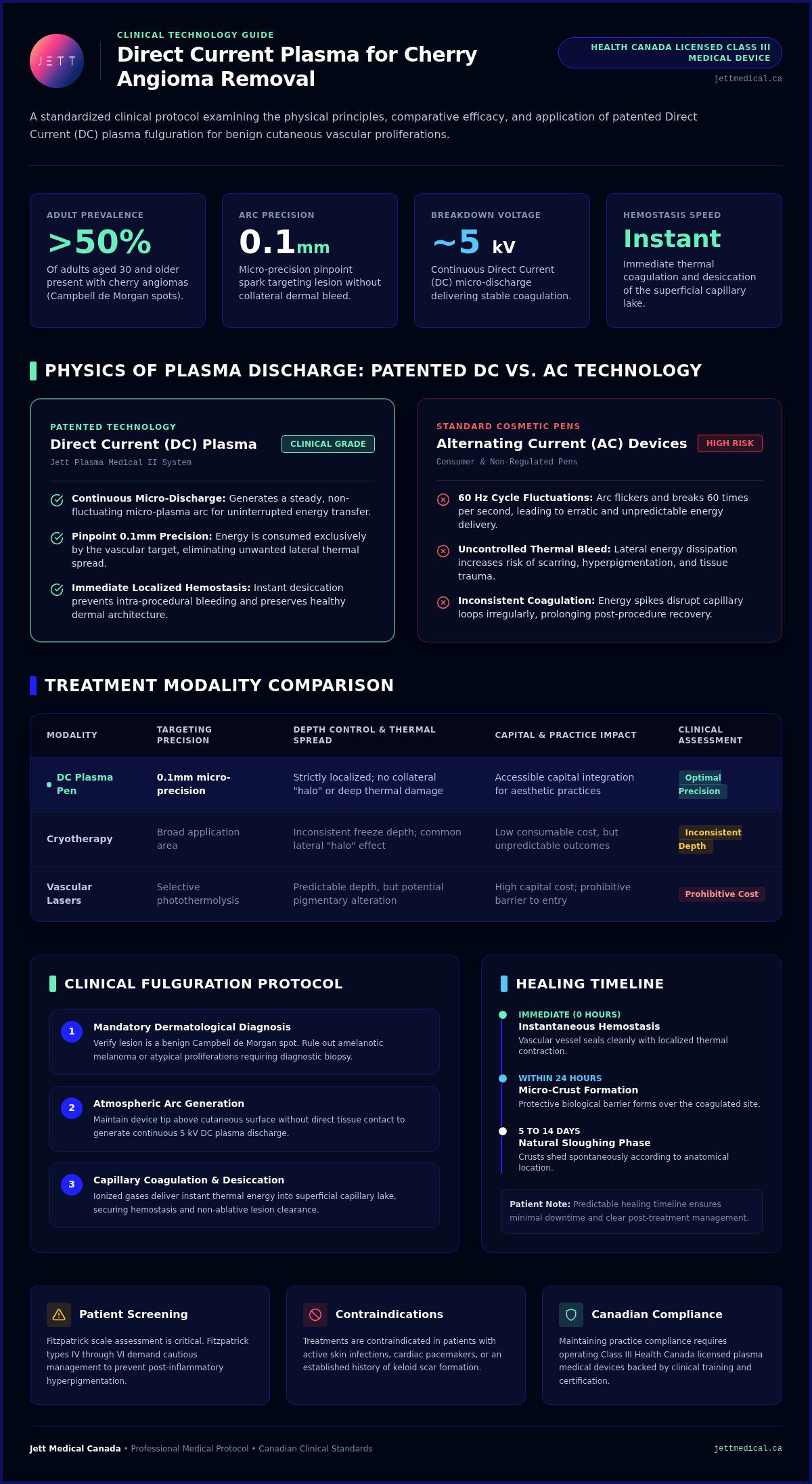
The process of fulguration involves generating a micro-plasma arc between the device tip and the cutaneous surface. This discharge ionizes atmospheric gases to create thermal energy that targets the superficial capillary lake. As the energy contacts the tissue, it causes immediate coagulation and desiccation of the vessel. This mechanism provides instantaneous hemostasis, which is a critical advantage for vascular lesions. High-quality medical devices, such as the Jett Plasma Medical II, differ significantly from consumer-grade pens. Professional systems utilize controlled Direct Current (DC) to maintain a stable 0.1mm spark, whereas unauthorized AC devices often produce erratic thermal spread and higher risks of scarring.
Patient Selection for Vascular Treatments
Successful outcomes depend on rigorous patient screening. The Fitzpatrick scale remains the primary tool for assessing risk. While DC plasma is precise, patients with Fitzpatrick types IV through VI require cautious management to prevent post-inflammatory hyperpigmentation. Contraindications include active skin infections, pacemakers, or a history of keloid scarring. Practitioners must manage expectations regarding the post-treatment “crust.” These micro-crusts form within 24 hours and typically slough off within 5 to 14 days, depending on the body location. Using a professional plasma pen for cherry angioma clearance ensures that this healing phase is predictable and manageable for the patient.
The Science of Direct Current (DC) Plasma for Vascular Precision
The efficacy of a plasma pen for cherry angioma treatment relies heavily on the electrical current’s stability and predictability. Jett Medical devices utilize a patented Direct Current (DC) system that distinguishes them from the common Alternating Current (AC) pens found in the cosmetic market. While AC devices produce a flickering, erratic arc that fluctuates 60 times per second, DC technology generates a continuous and stable micro-discharge. This steady flow allows for a breakdown voltage of approximately 5 kV DC, creating a pinpoint spark that remains consistent throughout the procedure. This technical distinction is vital when treating benign cutaneous vascular proliferations, as it prevents the uncontrolled energy spikes that lead to excessive tissue trauma.
Why Precision Matters for Cherry Angiomas
Vascular lesions like cherry angiomas are often small, requiring a treatment diameter that matches their scale. Jett Medical technology achieves a precision of 0.1mm, enabling practitioners to target the lesion with microscopic accuracy. Lower-quality devices often “bleed” thermal energy into the adjacent dermis, which increases the risk of post-inflammatory hyperpigmentation or scarring. DC plasma delivers instantaneous thermal coagulation to capillary loops, ensuring immediate hemostasis while preserving the surrounding dermal architecture. This focus ensures that the energy is consumed by the vascular target rather than dissipating into healthy skin cells.
Thermal Spread and Healing Outcomes
Controlling the zone of inflammation is the primary factor in accelerating patient recovery. By restricting the thermal impact to the specific lesion, DC plasma minimizes the lateral thermal spread that often complicates healing. This localized energy delivery prevents the “halo” effect frequently associated with cryotherapy, where the depth of freeze is difficult to monitor. Practitioners can review the full technical comparison in our clinical guide on Direct Current vs AC Plasma: Clinical Precision. Reducing collateral damage ensures that the resulting micro-crust is small and the underlying skin remains healthy. For clinicians seeking to refine their vascular treatments, integrating advanced DC plasma systems offers a reliable method for achieving superior aesthetic results with high patient safety standards.
Comparing Plasma Therapy to Cryotherapy and Vascular Lasers
Practitioners often weigh the merits of established modalities when selecting a method for clearing vascular lesions. Cryotherapy remains a common choice due to its low initial equipment cost, yet it lacks the precision required for aesthetic refinement. Conversely, vascular lasers such as Pulsed Dye Lasers (PDL) offer high efficacy but demand significant capital investment and rigorous safety protocols. Utilizing a plasma pen for cherry angioma removal serves as a sophisticated middle ground. It provides the technological precision of high-end energy devices without the prohibitive overhead or maintenance associated with laser platforms. This balance makes it an ideal addition to modern aesthetic clinics seeking to expand their treatment menu while maintaining high margins. A comprehensive clinical overview of cherry angiomas highlights that while these lesions are benign, their vascular architecture requires targeted destruction to prevent recurrence.
Precision and Depth Control
Cryotherapy involves liquid nitrogen, which often results in an unpredictable depth of freeze. This lack of control increases the risk of persistent hypopigmentation because melanocytes are destroyed at temperatures below -5°C. Plasma therapy offers superior visual feedback. The clinician sees the immediate blanching and subsequent darkening of the lesion in real time. This allows for precise depth control that liquid nitrogen can’t replicate. Because the thermal energy is confined to the 0.1mm spark area, the surrounding tissue remains intact. This significantly reduces the likelihood of the “halo” scarring often seen with cryosurgery.
Clinic ROI and Versatility
The financial viability of a clinic depends on device versatility. While a vascular laser is often limited to specific chromophores, the Jett Plasma Pen Medical functions as a multi-modality tool. One device addresses cherry angiomas, skin laxity, and benign epidermal pigment. The capital cost differential is stark. A Health Canada licensed DC plasma system requires an investment of approximately $12,000 to $25,000 CAD. This is roughly one-fifth the cost of a dedicated vascular laser, which can range from $85,000 to over $160,000 CAD. The absence of expensive consumables or specialized gas refills further lowers the cost per treatment. This efficiency allows practices to offer competitive pricing to patients while achieving a faster return on investment. It’s a strategic choice for practitioners who value both clinical outcomes and operational sustainability. Clinicians looking to further maximize device utility may also explore how a professional plasma pen for stretch marks can address dermal remodelling needs within the same platform, broadening the scope of treatable conditions without additional capital expenditure. Practices seeking to extend their benign lesion portfolio beyond vascular spots can also review the clinical considerations for a professional plasma pen for benign lesions such as moles, where the same DC precision principles apply to pigmented tissue sublimation.
Clinical Protocol: How to Treat Cherry Angiomas with Plasma
Establishing a standardized clinical protocol is essential for achieving the 90% to 98% clearance rate typical of advanced Direct Current technology. The procedure begins with a thorough cleansing of the treatment area using a non-flammable antiseptic. Avoid alcohol-based solutions immediately prior to arcing to eliminate ignition risks. While many patients tolerate the micro-plasma discharge without intervention, applying a topical anaesthetic for 20 to 30 minutes can enhance comfort during multi-lesion sessions. For the Jett Plasma Medical II, practitioners typically select intensity levels 6 through 8 to achieve effective micro-fulguration. These higher settings provide the necessary energy to collapse the superficial capillary lake while the 0.1mm spot size prevents unnecessary damage to the surrounding epidermis.
Step-by-Step Vapourization Technique
Precision is absolute. The practitioner must maintain a consistent operative distance of 1.0 to 2.0 mm between the applicator tip and the lesion. This non-contact “hover” allows the plasma arc to jump to the target, delivering localized thermal energy. Use a spot-by-spot technique for smaller angiomas or a light scanning motion for larger vascular plaques. You’ll observe an immediate shrinkage and blanching of the tissue as the vessels coagulate. This is often followed by a dusky purpuric darkening, which signifies successful vascular thrombosis. Stop the treatment once the lesion has flattened and the colour has shifted. Entering the deep dermis is unnecessary and increases the risk of atrophic scarring. The goal is superficial desiccation, not deep ablation.
Aftercare and Patient Education
Post-procedure management determines the final aesthetic outcome. A carbonized micro-crust forms instantly and acts as a biological dressing. Patients must keep this area dry for the first 24 hours and avoid mechanical scrubbing or picking. Premature removal of the crust can lead to infection or permanent scarring. The crust typically sloughs off spontaneously within 5 to 7 days on the face, though trunk lesions may take up to 14 days. Once the crust falls off, the underlying skin will appear pink and delicate. Mandatory application of broad-spectrum SPF 50+ mineral sunscreen is required for at least 90 days to prevent post-inflammatory hyperpigmentation. This is especially critical for patients with darker Fitzpatrick skin types who are more prone to pigmentary shifts. For practitioners ready to implement these protocols, you can view our full range of Health Canada licensed devices to ensure your clinic meets national safety standards.
Implementing Jett Medical Technology in Your Canadian Practice
Adopting a plasma pen for cherry angioma removal requires more than technical proficiency; it necessitates a commitment to regulatory excellence. In Canada, the aesthetic landscape is strictly governed by Health Canada’s Medical Devices Regulations. For clinic owners, the integration of Jett Medical technology provides a clear pathway to offer high-demand vascular treatments while adhering to these rigorous standards. By incorporating these procedures into your existing aesthetic consultation process, you can address common patient concerns regarding Campbell de Morgan spots during routine skin assessments. This proactive approach enhances patient satisfaction and reinforces your practice’s position as a provider of comprehensive, sophisticated dermatological care.
Health Canada Licensing and Safety
Operating a Class III medical device system in Canada requires explicit authorization. Purchasing from a dedicated national distributor ensures that your equipment holds a valid Medical Device Licence (MDL) and meets the standards of the Medical Device Single Audit Program (MDSAP). Practitioners should consult the Health Canada Licensed Plasma Devices reference guide to understand the specific requirements for their hardware. Utilizing “grey market” or consumer-grade devices poses significant risks, including potential device seizures by regulatory bodies and the total voiding of professional liability insurance. Compliance isn’t merely a legal obligation; it’s a foundational component of patient safety and professional reputation in the Canadian medical community.
Training and Certification for Nurses and Doctors
Mastering the 0.1mm precision of DC technology requires specialized training that goes beyond basic operation manuals. Jett Medical Canada provides comprehensive training modules designed specifically for physicians and nursing professionals. These sessions cover vascular anatomy, energy settings, and hands-on vapourization techniques to ensure clinical confidence. Mastery of the non-contact hover technique is essential for achieving the hemostatic endpoints discussed in previous sections without causing collateral tissue damage. If you’re ready to advance your clinical capabilities, contact Jett Medical Canada today to book a demonstration and explore our certification pathways.
The transition to advanced DC plasma represents a significant upgrade from traditional modalities like cryotherapy. The Jett Plasma Medical II offers a technologically superior solution for benign vascular lesions by providing the stability needed for predictable coagulation. Its minimal lateral thermal spread ensures rapid healing and high patient compliance. By choosing a licensed, supported, and scientifically grounded platform, your practice can deliver exceptional aesthetic results with the highest levels of safety and precision currently available in the Canadian market.
Elevating Vascular Care Standards in Your Practice
The integration of advanced plasma technology marks a significant shift toward higher precision and improved patient outcomes in vascular dermatology. By utilizing patented Direct Current (DC) technology, practitioners can achieve 0.1mm accuracy; this ensures that thermal energy remains localized to the lesion while providing immediate hemostasis. This methodical approach effectively replaces the unpredictable depth of cryotherapy and the high overhead associated with vascular lasers. Choosing a Health Canada licensed plasma pen for cherry angioma removal ensures that your clinic remains compliant with national safety standards while delivering predictable aesthetic results. Jett Medical Canada provides essential support through MDSAP-certified hardware and specialized training modules designed for medical professionals. This combination of scientific rigor and regulatory security allows you to expand your service offerings with complete confidence in the technology’s performance. Beyond vascular treatments, the same DC platform used for cherry angioma clearance has demonstrated clinical efficacy as a professional plasma pen for stretch marks, enabling practices to address striae revision within a single, compliant device investment. Clinicians who also treat pigmented benign lesions will find detailed procedural guidance in the clinical FAQ on using a professional plasma pen for benign lesions including moles, which addresses dermoscopic screening, post-inflammatory hyperpigmentation risk, and Health Canada compliance within the same DC technology framework. If you’re ready to modernize your approach to benign vascular lesions, Request a Professional Consultation and Device Demo to see how our patented DC technology can transform your clinical outcomes. Embracing these innovations will position your practice at the forefront of modern aesthetic care.
Frequently Asked Questions
Is the plasma pen treatment for cherry angioma permanent?
Removal is generally permanent for the specific lesion treated. The micro-plasma arc causes immediate coagulation and destruction of the vascular proliferation. While the treated spot will not return, patients may develop new cherry angiomas over time due to genetic factors or aging. Practitioners should clarify that the procedure addresses existing lesions rather than preventing future vascular developments. This distinction helps manage long-term patient expectations regarding their skin health.
How many sessions are typically required to remove a cherry angioma?
Most primary cherry angiomas under 3 mm in diameter require only a single session for complete clearance. The 90% to 98% clearance rate achieved with DC technology means secondary treatments are rarely necessary for isolated spots. Larger or more complex vascular plaques might require a follow-up assessment to ensure total vessel collapse. This efficiency makes the plasma pen for cherry angioma removal a highly productive modality for busy aesthetic clinics.
Can aesthetic nurses perform cherry angioma removal in Canada?
Registered Nurses and Licensed Practical Nurses can perform these treatments under appropriate medical oversight in Canada. Provincial nursing colleges require that Class III energy-based devices be operated under a medical directive or physician delegation. Practitioners must possess hardware-specific training and certification to operate these systems safely. Jett Medical Canada provides the necessary clinical education to ensure nurses meet these regulatory requirements while maintaining the highest standards of care.
What does the recovery process look like after plasma treatment?
The recovery process involves the formation of a carbonized micro-crust immediately following treatment. These crusts act as a biological dressing and typically slough off spontaneously within 5 to 10 days on the face and up to 14 days on the trunk. Patients must keep the area dry and avoid mechanical exfoliation or picking. Once the crust falls off, the underlying skin appears pink and requires strict sun protection with SPF 50+.
Are there any risks of scarring when treating vascular spots with plasma?
The risk of scarring is exceptionally low when using patented Direct Current technology. Unlike Alternating Current devices that produce erratic thermal spread, DC plasma offers 0.1mm precision that limits damage to the superficial epidermis. Scarring typically only occurs if the patient prematurely removes the protective crust or if the practitioner enters the deep reticular dermis unnecessarily. Following the established clinical protocol and ensuring proper aftercare are essential for achieving scar-free results.
How does the Jett Plasma Pen Medical differ from cheap alternatives found online?
The Jett Plasma Pen Medical utilizes patented Direct Current (DC) technology, whereas inexpensive alternatives typically use Alternating Current (AC). DC plasma provides a stable, continuous arc that prevents the lateral thermal necrosis associated with erratic AC sparks. Jett devices are also Health Canada licensed and MDSAP certified, ensuring they meet rigorous safety standards. Cheap online pens lack these regulatory approvals and pose significant risks for professional liability and patient safety.
Is topical anaesthesia necessary for this procedure?
Topical anaesthesia is not strictly mandatory but is highly recommended for patient comfort. While the micro-plasma discharge is brief, the sensation can be sharp during the coagulation of vascular structures. Applying a high-quality topical anaesthetic for 20 to 30 minutes before the procedure ensures a more positive patient experience. This is particularly useful when treating multiple lesions or sensitive areas where patient movement must be minimized to maintain precision.
Can plasma treat cherry angiomas on the face and body?
Plasma technology is effective for treating cherry angiomas on both the face and the body. The 0.1mm precision allows for safe application in delicate facial areas where other modalities might be less controlled. On the body, the device efficiently handles larger clusters of angiomas often found on the trunk or extremities. Practitioners should adjust aftercare instructions based on the location, as trunk lesions generally require a slightly longer desquamation period than facial treatments.