
Why do traditional fractional lasers often fail to deliver the predictable dermal contraction required for mature striae alba? Many Canadian clinicians share the frustration of inconsistent results and the mounting regulatory anxiety associated with unverified aesthetic hardware. It’s difficult to balance patient demands for body contouring with the necessity of safety and minimal downtime. When you’re selecting a professional plasma pen for stretch marks, the decision requires more than a cursory look at surface-level results. It demands a rigorous understanding of the underlying physics and the federal compliance frameworks that protect your professional standing.
This article explores the clinical science of patented Direct Current (DC) technology and the specific Health Canada regulatory requirements governing its use in a medical environment. You’ll discover how high-precision micro-arcs achieve superior tissue remodelling while ensuring your practice remains fully compliant with current Class III medical device standards. We’ll examine the transition from erratic Alternating Current (AC) units to stable DC systems, providing you with the evidence-based insights needed to elevate your clinical outcomes and patient satisfaction in the evolving Canadian aesthetic market.
Key Takeaways
- Understand why patented Direct Current (DC) technology provides a 100-fold reduction in lateral thermal scatter compared to traditional alternating current devices for safer dermal remodelling.
- Navigate the mandatory Health Canada Class III regulatory landscape and MDSAP standards required to legally operate a professional plasma pen for stretch marks in a clinical environment.
- Master the differentiation between non-ablative scanning and ablative micro-dotting to address the specific histopathology of both early-stage striae rubra and mature striae alba.
- Implement rigorous safety protocols for diverse patient populations by utilizing precise energy control to minimize the risk of post-inflammatory hyperpigmentation across various Fitzpatrick skin types.
- Evaluate how integrating medical-grade systems like the Jett Plasma Pen Medical can enhance clinic revenue through predictable, high-satisfaction results in specialized body contouring.
Understanding Striae Distensae and the Plasma Solution
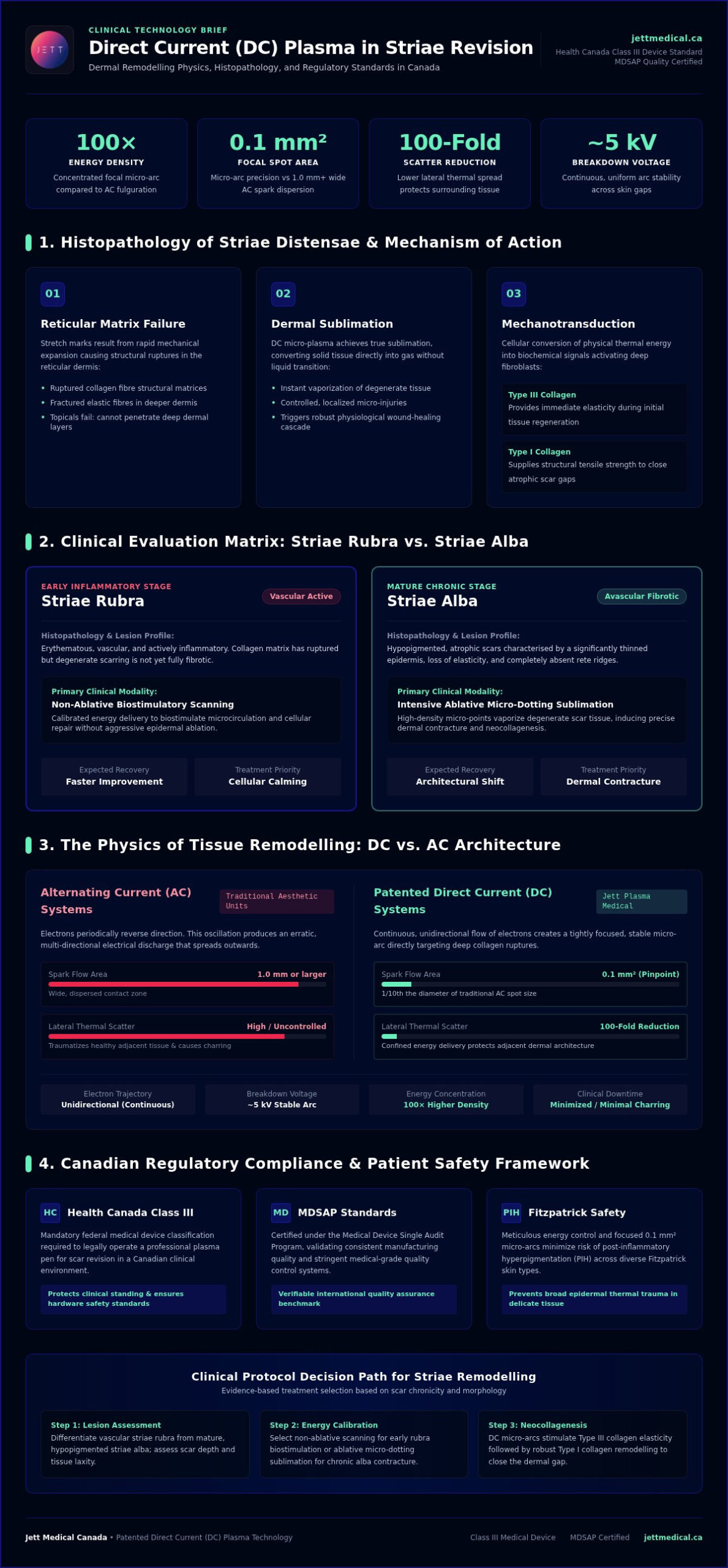
Clinically referred to as striae distensae, stretch marks represent a complex form of dermal scarring. These lesions occur when the skin undergoes rapid expansion, leading to structural failures in the reticular dermis. Specifically, the mechanical stress causes ruptures in the collagen matrix and fractures within the elastin fibres. While many patients initially seek relief through topical oils or creams, these solutions fail to address the underlying physiological challenge. Topicals cannot penetrate deep enough to reach the dermal layer where the structural damage resides.
Effective revision requires a technology capable of reaching these deep collagen ruptures. A professional plasma pen for stretch marks utilizes the principle of sublimation, converting solid tissue directly into gas. This process creates a controlled, localized micro-injury that triggers a robust wound-healing response. By deploying a professional fibroblast device canada clinics can move beyond surface-level hydration and begin true tissue architectural remodelling.
The Science of Fibroblast Activation in Scar Tissue
The efficacy of plasma technology rests on mechanotransduction. This is the biological process where cells convert mechanical or thermal energy into chemical signals. When the plasma arc interacts with the skin, it stimulates fibroblasts to synthesize new Type I and Type III collagen. Type III collagen provides initial elasticity, while Type I offers the structural tensile strength required to close the atrophic gap within the scar. Precision is paramount here. Because the skin within a stretch mark is significantly thinner and more fragile than the surrounding healthy tissue, the energy delivery must be meticulously controlled to avoid over-treatment.
Striae Rubra vs. Striae Alba: Clinical Considerations
Clinicians must distinguish between the two primary stages of stretch mark evolution to determine the appropriate treatment intensity. Striae rubra represent the early, erythematous stage. These marks are vascular and inflammatory, making them highly responsive to non-ablative, biostimulatory scanning. In contrast, striae alba are mature, hypopigmented scars characterized by a thinned epidermis and absent rete ridges. These chronic lesions require more intensive sublimation to vaporize degenerate tissue and induce dermal contracture. Predicting patient outcomes depends on a thorough assessment of tissue laxity, scar depth, and the age of the lesion. Younger, vascular marks typically show faster improvement, but mature scars can still achieve significant architectural refinement with the right clinical approach.
Direct Current (DC) vs. AC Plasma: The Physics of Tissue Remodelling
The mechanical efficacy of a professional plasma pen for stretch marks is dictated by the physics of its electrical discharge. Most consumer-grade or lower-tier aesthetic devices utilize Alternating Current (AC), where the flow of electrons reverses direction periodically. This results in an erratic, multi-directional spark that disperses energy across a wide surface area, typically reaching a spot size of 1.0 mm or larger. In contrast, Direct Current (DC) technology provides a continuous, unidirectional flow of electrons. This stability allows for a focused micro-arc with a spark flow area of just 0.1 mm², representing a 100-fold increase in energy density compared to traditional AC fulguration.
This concentrated focal point is essential for reducing lateral thermal damage. When treating atrophic scars, the goal is to trigger neocollagenesis within the lesion without traumatizing the adjacent healthy tissue. DC plasma minimizes patient downtime by delivering high-density energy to a localized target, preventing the widespread epidermal charring typical of less precise systems. Clinicians seeking to apply these same precision principles across broader facial indications will find that the standardized energy protocols outlined in advanced plasma skin resurfacing provide a valuable framework for reproducible tissue contraction.
Precision and Control in Dermal Sublimation
The Jett Plasma Pen Medical exemplifies this technological shift by maintaining a stable arc regardless of minor fluctuations in distance from the skin. It operates at a high breakdown voltage of approximately 5 kV, which allows the clinician to maintain a precise 2 mm air gap between the tip and the conductive skin. While traditional ablative lasers often require significant healing periods due to their broad thermal footprints, the 0.1 mm² precision of DC plasma allows for a faster healing curve. Clinicians can treat narrow, deep striae with surgical accuracy, ensuring that the energy penetrates the reticular dermis where it’s most needed for structural repair.
Thermal Spread and Safety for Diverse Skin Types
Safety remains the primary concern for Canadian practitioners, especially when considering the risk of post-inflammatory hyperpigmentation (PIH). AC devices often create a wide “halo” of heat that triggers inflammatory responses in surrounding melanocytes. DC technology maintains a ‘cold’ peripheral zone, effectively isolating the thermal effect to the treatment site. This is why understanding the distinction between dc plasma vs ac plasma is the most vital technical consideration for modern practices. Adhering to Health Canada regulatory advisories on plasma pens ensures that clinics utilize hardware designed for medical safety rather than mere aesthetic novelty. For those looking to upgrade their service offerings, reviewing medical-grade DC systems is the first step toward achieving predictable clinical results.
Regulatory Standards for Professional Plasma Pens in Canada
Operating a medical practice in Canada requires strict adherence to the Medical Devices Regulations. Health Canada classifies high-energy plasma systems as Class III Medical Devices. This means they must undergo rigorous assessment before receiving a Medical Device Licence (MDL). For a clinician, using a Health Canada licensed plasma device isn’t just a matter of best practice; it’s a legal mandate. When selecting a professional plasma pen for stretch marks, practitioners must ensure the manufacturer holds an active MDL. Devices that lack this authorization are considered illegal for professional use in Canada, posing significant risks to both the practitioner’s standing and patient safety.
Health Canada Licensing and MDSAP Compliance
Clinicians must verify that their hardware carries a valid certification label and cross-reference it with the Medical Devices Active Licence Listing (MDALL). A critical component of this verification is the Medical Device Single Audit Program (MDSAP). This program allows a single regulatory audit of a medical device manufacturer to satisfy the requirements of multiple jurisdictions, including Canada. MDSAP compliance ensures that every professional plasma pen for stretch marks is manufactured under consistent, high-quality standards that prioritize patient safety and device reliability. Sourcing equipment through a verified medical aesthetic device distribution canada partner guarantees the hardware meets these specific federal requirements.
Liability and Professional Insurance Requirements
Professional liability insurance providers in Canada typically exclude coverage for procedures performed with unauthorized medical devices. If a complication occurs while using a consumer-grade or non-licensed pen, the practitioner may face total forfeiture of their professional indemnity. Maintaining high documentation standards is essential for clinics offering advanced fibroblast treatments. This includes recording the device’s MDL number and ensuring all treatments are administered by regulated healthcare professionals, such as physicians or registered nurses, as per Health Canada’s May 2022 directives. By prioritizing licensed technology, you protect your practice from the severe legal and financial fallout associated with unapproved aesthetic hardware.
Clinical Protocols: Maximizing Results for Stretch Mark Revision
Standardizing clinical protocols is essential for achieving predictable tissue contraction in stretch mark revision. Before initiating treatment with a professional plasma pen for stretch marks, a comprehensive assessment of the patient’s Fitzpatrick skin type is mandatory. Patients with Fitzpatrick Types IV through VI require pre-treatment with topical tyrosinase inhibitors for two to four weeks to mitigate the risk of post-inflammatory hyperpigmentation. Contraindications such as active infections, keloidal tendencies, or recent use of photosensitizing medications must be ruled out during the initial consultation to ensure patient safety.
Clinicians must adapt their application method based on the lesion’s maturity. The ‘Scanning’ technique uses lower intensities to facilitate dermal bio-infusion and is ideal for early-stage striae rubra. For chronic striae alba, the ‘Spot’ or micro-dotting technique is required. This involves creating precise, ablative points directly within the atrophic striation to vaporize degenerate tissue. Managing patient expectations is a critical component of professional care. Because the physiological neocollagenesis cycle peaks between 8 and 12 weeks, a series of two to three sessions, scheduled six to twelve weeks apart, is typically necessary for deep striae revision. Practitioners who also perform facial rejuvenation procedures will find that the reproducible grid patterns and calibrated energy delivery described in the advanced plasma skin resurfacing clinical protocol and technology guide complement these body-focused techniques effectively.
Step-by-Step Procedure for Striae Alba
Treating mature striae alba requires a methodical approach to ensure deep dermal penetration. After applying topical anaesthesia and performing thorough skin disinfection, clinicians utilize the Jett Plasma Lift Medical at higher intensity settings, typically between levels 6 and 8, for intensive tissue contraction. The goal is to place micro-dots along the borders and within the centre of the scar using a precise 2 mm air gap to induce immediate shrinkage. Once the pass is complete, the area should be cooled and a protective, breathable barrier applied to support the initial five to seven days of micro-crust shedding.
Optimizing the Healing Cascade
The biological response to plasma sublimation follows a strict physiological timeline. By week 4, initial epidermal repair is complete. Histological neocollagenesis and the synthesis of Type I and Type III collagen peak between weeks 8 and 12, which is when the most significant architectural improvements become visible. Lifestyle factors, particularly strict adherence to broad-spectrum SPF 50+ photoprotection for a minimum of 12 weeks, are non-negotiable for preventing pigmentary changes. Integrating plasma with LED therapy or non-ablative scanning can further accelerate the resolution of erythema and support overall fibroblast efficiency. To explore advanced training on these clinical protocols, contact our technical support team.
Integrating Jett Plasma Medical Technology into Your Practice
The Jett Plasma Pen Medical represents a sophisticated addition to any modern aesthetic or medical practice. Its utility extends far beyond striae revision, serving as a versatile instrument for both dermatology and ophthalmology. By integrating a professional plasma pen for stretch marks, clinics can significantly expand their body contouring revenue without the high consumable costs associated with many laser systems. The return on investment is driven by the device’s ability to provide predictable, high-satisfaction results for localized atrophic lesions, a service category that is often underserved by traditional modalities.
Success with this technology depends on more than just the hardware. It requires a commitment to clinical excellence and ongoing professional development. Working with a dedicated national Canadian distributor ensures that practitioners have access to the technical support and maintenance required to keep their systems operating at peak performance. This local presence provides peace of mind regarding regulatory compliance and device longevity, which are critical for maintaining a high standard of professional care.
Training and Certification for Canadian Clinicians
Staff competency is the cornerstone of patient safety and clinical efficacy. Authorized Jett Medical training programs provide aesthetic nurses and physicians with the specific skills needed to master DC plasma physics. These programs offer clinical mentorship and technical support for managing complex cases, ensuring that every procedure is performed within the appropriate medical directive. Beyond stretch marks, practitioners can access advanced protocols for treating various vascular and benign skin lesions, such as using the plasma pen for cherry angioma or employing a professional plasma pen for benign lesions like mole removal. This breadth of application allows for a more robust clinical offering and improved patient outcomes across multiple indications.
The Jett Medical Advantage: Direct Current Precision
The Jett Plasma Medical II stands out in the Canadian market due to its patented Direct Current technology. This system provides the precision required for full-body applications, where skin thickness and tissue response vary significantly. The device’s Red Dot Award-winning design reflects the ergonomic needs of busy practitioners, allowing for comfortable, steady application during extended treatment sessions. By choosing a system that prioritizes stability and global certification, clinics anchor their practice in scientific rigor and reliability. If you are ready to elevate your clinical standards, inquire about Jett Medical plasma technology for your clinic to secure a demonstration of these industry-leading systems.
Advancing Clinical Standards in Dermal Remodelling
Effective striae revision requires a transition from unpredictable alternating current devices to the precision of patented direct current technology. By adopting a professional plasma pen for stretch marks that prioritizes localized energy delivery, your practice can achieve superior dermal contraction while minimizing the risks of lateral thermal damage. This shift not only improves patient satisfaction but also anchors your clinic in evidence-based medical science. Success in the Canadian market depends on this intersection of technological innovation and rigorous clinical protocols.
Protecting your professional reputation involves utilizing hardware that is both Health Canada Licensed and MDSAP Approved. Jett Medical Canada supports your growth through comprehensive national Canadian training and support, ensuring your team maintains the highest levels of procedural competency. If you’re ready to integrate these advanced capabilities into your body contouring services, we invite you to Request a Professional Consultation and Device Demonstration. We look forward to helping you establish a new benchmark for safety and efficacy in your practice.
Frequently Asked Questions
Is the plasma pen effective for old, white stretch marks (striae alba)?
Yes, medical-grade plasma technology is highly effective for mature striae alba. While early-stage vascular marks respond well to biostimulation, chronic white scars require the precise ablative micro-dotting provided by a professional plasma pen for stretch marks. This process vaporizes atrophic tissue and triggers the synthesis of new Type I and Type III collagen. By inducing dermal contracture within the cicatrix, the treatment significantly improves the texture and architectural alignment of the skin matrix.
What is the typical downtime for a professional stretch mark treatment?
Most patients experience a primary healing phase of five to seven days. During this period, small micro-crusts form at the sublimation sites and eventually shed naturally. While the surface appears restored within a week, the internal physiological remodelling continues for several months. Clinicians should advise patients that the most significant structural improvements typically become visible between 8 and 12 weeks post-procedure as the neocollagenesis cycle reaches its peak maturity.
Are there specific risks for treating stretch marks on darker skin tones?
Patients with Fitzpatrick Skin Types IV through VI carry an elevated risk of post-inflammatory hyperpigmentation (PIH). To mitigate this, clinicians must utilize Direct Current (DC) systems which offer a focused 0.1 mm² focal point to minimize lateral thermal damage. Pre-treating the skin with topical tyrosinase inhibitors for a minimum of two weeks is a standard safety protocol. These precautions ensure that the thermal effect remains isolated to the target tissue without triggering defensive melanocyte activity.
How many sessions are generally required for visible striae reduction?
Achieving optimal results typically requires a series of two to three sessions. These treatments are strictly scheduled six to twelve weeks apart to accommodate the natural biological timeline of collagen synthesis. While some patients observe visible tightening after a single procedure, deep or mature striae require cumulative stimulation to close the atrophic gap. A multi-session approach ensures that the tissue remodelling is both thorough and durable, providing long-term structural refinement for the patient.
Can a plasma pen be used on stretch marks during or immediately after pregnancy?
Plasma treatments are contraindicated during pregnancy and breastfeeding. It’s essential to wait until the patient has completed breastfeeding and their hormonal levels have stabilized before initiating striae revision. Hormonal fluctuations can significantly impact the skin’s healing response and pigmentary stability. Once the patient is no longer nursing, a professional plasma pen for stretch marks can be safely utilized to address postpartum skin laxity and dermal tearing within a regulated clinical setting.
What is the difference between a medical-grade plasma pen and a consumer device?
Medical-grade devices utilize patented Direct Current (DC) technology and hold valid Health Canada Medical Device Licences. In contrast, consumer-grade units often employ erratic Alternating Current (AC) which causes unpredictable lateral burns and significant scarring. Professional systems are manufactured under the Medical Device Single Audit Program (MDSAP) to ensure consistent quality standards. Using unauthorized consumer devices in a professional clinic is illegal in Canada and carries severe legal and professional liability risks for the practitioner.
Is the Jett Plasma Pen licensed by Health Canada for use in professional clinics?
Yes, the Jett Plasma Lift Medical is fully licensed by Health Canada for professional use. It holds Medical Device Licence No. 108642 and is classified as a Class III Medical Device. This certification confirms that the system has met rigorous federal standards for safety, effectiveness, and manufacturing quality. Canadian clinic owners can verify this status through the Medical Devices Active Licence Listing (MDALL) to ensure their hardware is compliant with current national regulations.
What kind of training is required for a nurse to perform plasma striae revision?
Nurses must be regulated healthcare professionals working within their provincial scope of practice to perform plasma procedures. Beyond their foundational medical training, they must complete specialized certification through an authorized distributor such as Jett Medical Canada. This training covers advanced DC plasma physics, skin typing, and emergency complication management. Proper certification ensures that the practitioner can safely operate the device and deliver predictable clinical outcomes while maintaining the practice’s professional insurance requirements.